.png)
'Dr Doom' Nouriel Roubini Warns World Is on a 'Slow-Motion Train Wreck' - Markets Insider
Believe it if you want to...WHO IS FREED KAPLAN?
Profile picture for Fred Kaplan
Fred Kaplan
My @Slate piece on Zelensky's DC visit: the power of charm and heroism; are the Patriot missiles a game-changer? (not unless we send a lot more); and where the war goes now. bit.ly/3YJrlZL
Twitter · 2 hours ago
Does turbulence in Russia, China, and Iran foretell revolution or serious reform? It's complicated. Read my @Slate column here: bit.ly/3jlBmMD
Twitter · 4 hours ago
My takedown of Kissinger's delusionally nostalgic "peace plan" for Ukraine. bit.ly/3hCkXTp
Twitter · 6 days ago

The Power of Volodymyr Zelensky’s Charm Offensive
The next Congress can’t slash support for Ukraine now.
BY FRED KAPLAN
DEC 22, 202210:45 AM
'...Earlier in the day, in a two-hour meeting in the White House, President Biden took up that request, noting that the spending bill—which Congress just passed—provides Ukraine with $45 billion in various forms of aid. Biden also announced that he was adding $1.8 billion in military assistance—on top of the $23 billion worth of arms that the U.S. has given Ukraine since the invasion.
The prominent item in the list of new weapons was a battery of Patriot air-defense missiles, which are far more effective than the weapons previously supplied for shooting down cruise missiles, short-range ballistic missiles, and high-flying airplanes—with which Russia has lately been attacking Ukrainian cities and power stations, leaving many cities without electricity, heat, or running water.
Except for the one line in his speech (“Is it enough? Honestly, not really”), which he spoke in a slightly self-deprecating tone, perhaps knowing that anger or pressure would backfire, Zelensky didn’t complain about any shortfalls in U.S. aid. But clearly he knew—and Biden did as well—that even the massive outflow of American weapons has left the Ukrainians less than fully capable.
The supply of Patriot air-defense weapons, after much hesitation, is not as bountiful as it may seem. Biden said at the press conference that he is sending a single Patriot battery—equipped with four missiles—so that Ukrainian units can be trained in how to use them. A knowledgeable source told me Wednesday night that the training would take place at a U.S. base in Germany where Patriots are already deployed and that, even with an accelerated program, the training would take “several weeks.” After that, Biden and his aides will decide—they haven’t just yet—how many Patriots the U.S. will supply. They are also prodding NATO allies to pay for some of the missiles, which cost $1 million each.
A Ukrainian journalist asked Biden at the end of the news conference whether he could just send all the weapons he was thinking of sending in one massive shipment now. Biden replied, looking at Zelensky, “His answer is Yes.” Zelensky chuckled and said, “I agree.” Biden then listed several of the weapons he has sent Ukraine, noted that he has spent “hundreds of hours” talking with NATO allies about supplying four kinds of arms (artillery, air defense, armor and ammunition), and then made his point: Western aid to Ukraine is an alliance effort. The allies have to agree on what types of weapons to send.
Some weapons—notably American ATACMs missiles, which have the range to strike targets deep inside Russia—seem to some allies like a provocation. (Ukrainians have struck two air bases inside Russia with their own weapons; some Western officials believe doing so with NATO weapons might provoke Putin into attacking NATO countries, though others doubt that theory.) The allies, Biden said, understand the nature of the conflict and the nature of Putin, ”but they’re not looking to go to war with Russia” themselves, “they don’t want to start World War III”—a sentiment that Biden himself has uttered several times.
NATO is as united as it has been in decades, but there still are some divisions. Similarly, the American Congress and public are more supportive of Ukraine than anyone might have imagined after nearly a year of war—but there are still differences in degree of support too, especially between Democrats and Republicans.
In his speech, Zelensky said, “Next year will be a turning point.” Maybe. But unless Putin is ousted or crumbles, the war is likely to go on for a while longer."
Update 12/21/2022: After publishing this story, Meta got back to us with a statement saying “this [the account suspensions] was done in error. the accounts have now been restored.” The account holder confirmed with Gizmodo that Meta had reinstated the accounts. One of those accounts was reactivated after nearly a month-long suspension and multiple appeals from the account holder.

✓ Demand Progress Action, the advocacy group responsible for the suspended deep fake account, responded to Meta’s change with this statement.
“How sad that Meta is joining Twitter in censoring its political adversaries,” Demand Progress Communications Director Maria Langholz said. “Meta has zero credibility in claiming that it accidentally took down content urging Big Tech reform right at the moment Congress was considering its fate.”
Original Story:
Meta appears to have suspended an Instagram parody account attempting to post this Zuckerberg deep fake just weeks after Zuckerberg himself expounded on the importance of making that same type of content available on his platforms. The deep fake, which shows a digitally altered Zuckerberg gloating over Congress’ self-inflicted struggles to pass tech-focused antitrust reform, was suspended the very same day Congress all but killed those reforms by not including the measures in a more than 4,000 page omnibus bill.
Zuckerberg was directly asked about the account during the New York Times DealBook summit by commentator Andrew Ross Sorkin following reporting on the deep fake from Gizmodo and other outlets. During the exchange Zuckerberg appears to have said Meta kept the video before going on to argue in favor of similar videos like it.
“It was clear that it was a deepfake,” Zuckerberg said. “It was sort of like a parody. Allowing people to do humor and allowing people to show technology is important.” The CEO said Meta’s policies against manipulated media would kick in “if it was really trying to trick people.”
Despite those comments, Gizmodo spoke with the “fake zuck” account holder who said the account was suspended with no explanation or email other than an alert saying it or its content did not follow Meta’s community guidelines. The account creator says they recently tried to re-upload the video, this time under a new account called “deepfakezuck.” That account was also suspended around a day later, just like the original one. The account creator said they chose to re-upload the video on December 19 to direct attention toward Congress inability to pass antitrust reforms that, if successful, could have implicated Meta’s bottom line.
“At the same time their operatives in Congress killed strong antitrust reforms, Meta went back on its word that it wouldn’t remove what is clearly parody (and therefore within the bounds of its manipulated media policy) and—again—removed the #FakeZuck campaign from its Instagram platform,” Demand Progress Communications Director Maria Langholz told Gizmodo.
Meta’s policies for enforcing deep fakes say it will remove media if it has been synthesized, “in ways that aren’t apparent to an average person and would likely mislead someone into thinking that a subject of the video said words that they did not actually say.” The Zuckerberg video clearly does not meet those criteria, however, Meta does say it will also remove content if it is a product of AI that “merges, replaces or superimposes content onto a video, making it appear to be authentic.”
Meta did not respond to Gizmodo’s request for comment on why the accounts were removed.
Other platforms like Twitter and YouTube meanwhile continue to host the video, and the “fake zuck” accounts without issue. And while much of the attention over inconsistently applied content policies on the internet in recent weeks has, deservedly so, focused on the evolving hellscape that is Twitter, Langholz said the zuck deepfake confusion points to a wider, more personal problem.
“Maybe Elon Musk isn’t the only thin-skinned, capricious social media CEO,” Langholz said.
.jpg)
"...Drone diplomacy is on the rise because it meets a growing demand. International leaders are increasingly convinced that their defense and foreign policy ambitions hinge on possessing remote-controlled weapons. Drones have changed the character of modern conflict by allowing states to project power while minimizing risk to friendly personnel. By keeping crews far from the frontlines, drones allow governments to undertake risky attack or intelligence-gathering missions that they might not otherwise launch. Russia, for instance, frequently uses drones instead of manned attack aircraft to strike well-defended Ukrainian targets. At the same time, drones offer air support and a bird’s-eye view to ground forces, which often tips the scale during battles. Moreover, drones are commonly cheaper and easier to operate and maintain than the missiles or inhabited aircraft they supplant, making it simpler for states to integrate drones into military operations.
.png)
.jpg)
Drone use in recent conflicts has proved effective advertising. Footage from Ukraine and Nagorno-Karabakh—a disputed territory fought over by Armenia and Azerbaijan—has showcased drones striking targets cheaply, prodding other militaries to add remotely piloted aircraft to their arsenals. Some countries have built domestic drone programs, but others have turned to international suppliers.
.jpg) Traditional arms exporters such as the United
States initially dominated drone production with systems including the
MQ-9 Reaper. But export restrictions such as the Missile Technology
Control Regime (MTCR), a multilateral agreement the United States is
party to, severely limited the sale of U.S.-built drones, even to
Washington’s closest allies. Firms from countries that are not MTCR
signatories, such as China and Israel, eagerly stepped in to fill the
void and could engage in largely unregulated trade.
Traditional arms exporters such as the United
States initially dominated drone production with systems including the
MQ-9 Reaper. But export restrictions such as the Missile Technology
Control Regime (MTCR), a multilateral agreement the United States is
party to, severely limited the sale of U.S.-built drones, even to
Washington’s closest allies. Firms from countries that are not MTCR
signatories, such as China and Israel, eagerly stepped in to fill the
void and could engage in largely unregulated trade. At the same time, other states that traditionally were not aircraft exporters ramped up drone production programs. Iran sold drones to other countries and made them available to its Hezbollah and Houthi proxies. Similarly, Turkey’s drone program—developed in part to reduce dependence on foreign arms suppliers—quickly made a name for itself with the Bayraktar TB2. Turkey first deployed the TB2 against Kurdish forces in Iraq and Syria. Soon, it was on the shopping lists of nearly two dozen countries across Africa, Central Asia, Europe, and the Middle East.
.jpg)
"Iranian-built drones now routinely puncture the skies over Kyiv. Elsewhere in Ukraine, Turkish- and American-manufactured drones help Ukrainian forces target Russian troops. These operations demonstrate the growing role of remote-controlled weapons in battle. The conflict also showcases how drone exports have increasingly become an instrument of diplomacy.
With drone use on the rise, states have capitalized on drone exports to increase their global clout. To be sure, this is part of an established trend: governments have long leveraged arms exports as a diplomatic tool. Beyond filling state coffers and defraying research and development costs, arms sales help states advance foreign policy agendas. Selling or donating weapons to like-minded partners can be used to extract concessions, exert influence, counter rivals, and strengthen military ties. A new era of arms trade is emerging, in which new exporters such as Iran and Turkey are displacing traditional weapons suppliers and are using drone exports to extend influence beyond their borders. These exports threaten Washington’s influence and the security of its partners. To keep ahead, U.S. policymakers should help allies build drone programs while developing approaches to counter the threat of rival drones.
... READ MORE
.jpg)
.png)
.jpg)
.jpg)
.jpg)
Midwinter festivals have long been celebrated on the winter solstice each year by current and ancient cultures.
.jpg)
✓ In fact, many elements of the Christmas holiday were influenced by the Roman pagan midwinter festival Saturnalia, which celebrated the god of agriculture and time and fell near the winter solstice each year.
.jpg)
.jpg)
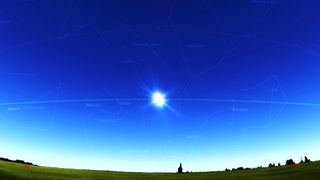
Winter is coming. Today, in fact!
.jpg)
Each December, the winter solstice marks the official start of astronomical winter in the Northern Hemisphere and the shortest day of the year. This year, the winter solstice occurs today, which means that from here on out, each day will be longer than the last for the next six months.
.jpg)
The winter solstice occurs on Wednesday (Dec. 21) at 4:48 p.m. EST (2148 GMT), according to Farmer's Almanac (opens in new tab). For those of us in the Northern Hemisphere, the days will gradually begin to get longer and the nights shorter going forward into winter. The sun will begin rising earlier and setting later, and will appear lower in the sky at local noon. In fact, if you can make it outside around noon local time today, take a look at your shadow; it should be the longest noontime shadow of the year due to the low angle of the sun.
Related: When is the Winter Solstice and what happens?
Seasons on Earth occur not because of our distance from the sun, but because of the planet's tilt. In fact, Earth's perihelion, or closest distance to the sun, comes in the middle of the Northern Hemisphere's winter. In 2023, it will fall on Jan. 4, according to In-The-Sky.org (opens in new tab).
The winter and summer solstices occur because Earth is tilted 23.5 degrees on its axis, and the moment of each solstice occurs when the axis is tilted in the direction of the sun. During the winter solstice, South Pole is tilted towards the sun, and during the summer solstice in June, the North Pole is tilted towards the sun.
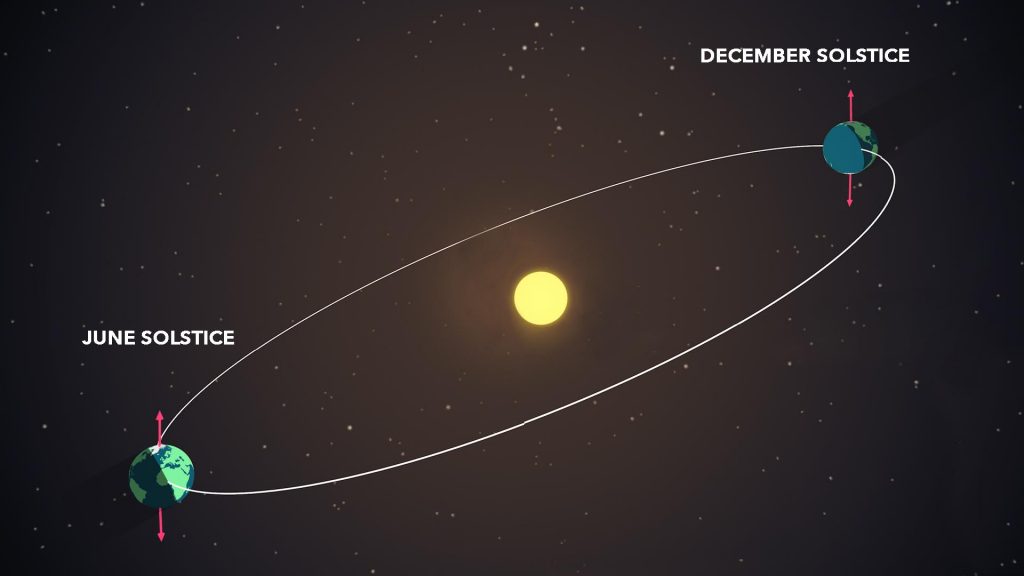
During the vernal and autumnal equinoxes, the Earth's axis is perpendicular to the sun, not tilted towards it. (This tilt is why we experience seasons, and why the seasons are flipped in the Northern and Southern Hemispheres.)
.jpg)
During the winter solstice, the sun reaches the southernmost point in the sky from the perspective of Earth — at noon, the sun will appear directly overhead of the Tropic of Capricorn, at 23.5 degrees south.
.png)
Midwinter festivals have long been celebrated on the winter solstice each year by current and ancient cultures. In fact, many elements of the Christmas holiday were influenced by the Roman pagan midwinter festival Saturnalia, which celebrated the god of agriculture and time and fell near the winter solstice each year.
According to History.com(opens in new tab), the winter solstice fell on Dec. 25 on the Julian calendar, which was used by the Ancient Romans; today we use the Gregorian calendar, which has the winter solstice fall on either Dec. 21 or Dec. 22.
Follow us on Twitter @Spacedotcom (opens in new tab) or on Facebook (opens in new tab).
Join our Space Forums to keep talking space on the latest missions, night sky and more! And if you have a news tip, correction or comment, let us know at: community@space.com.
RELATED CONTENT
A hard day's night
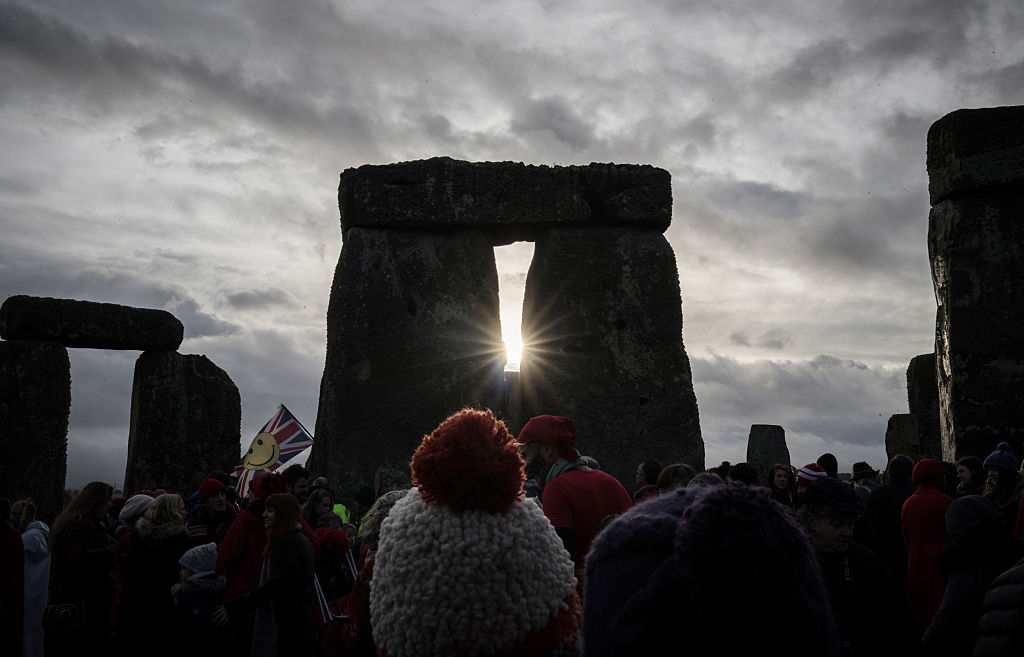
Dec. 21 is the 2022 winter solstice, marking the day with the least amount of daylight of the year for the northern hemisphere and the most amount of daylight for the southern hemisphere. The exact time of the solstice is 4:48 pm ET, which is the time of sunset in the northern hemisphere. The solstice occurs when the sun is directly above the Tropic of Capricorn, its most southern point of the year, CNN explains. The further north you live, the less daylight you will have.
"The Earth experiences winter and summer solstices because the planet's orbit around the sun occurs at a tilt of approximately 23.5 degrees. In turn, the winter solstice occurs when the South Pole is tilted towards the sun, giving the southern hemisphere more daylight and the northern hemisphere less, Space.com explains. The opposite is true for the summer solstice.
.jpg)
Many cultures also believe the solstice to be spiritually significant with many holidays and celebrations occurring around the time, writes the Los Angeles Times. According to Ed Krupp, director of the Griffith Observatory in Los Angeles. "It gives people a signal about the cosmic order that surrounds them and seems to govern their lives, and also gives them an opportunity to anticipate what is coming next."
.jpg)
Jan 27, 2026 #amanpourpbs From ICE's violent crackdown in Minneapolis to President ...


