Friday, February 10, 2023

North Korea blows a hole in decades of denuclearization and homeland security policies

Remnants of unresolved World War 2 rivalries are creating a dangerous realignment for increasing confrontations in a more militarized Super Powers in a multi-polar world armed with arsenals of weapons of mass destruction and high-tech firepower on-the-ground, air-borne, and near-Earth orbit.


www.politico.com

North Korea displays enough ICBMs to overwhelm U.S. defense system against them

5 - 7 minutes

This satellite image shows a closer view of missile launchers at a parade on Kim Il Sung Square in Pyongyang, North Korea Wednesday, Feb. 8, 2023. | Satellite image ©2023 Maxar Technologies via AP 


North Korea has just revealed a large enough number of missiles to conceivably overwhelm the United States’ defense against them, blowing a hole in decades of denuclearization and homeland security policies.

Images from state-run media show North Korea’s military rolling 10 to 12 Hwasong-17 intercontinental ballistic missiles down the streets of Pyongyang during a Wednesday night parade. The U.S. only has 44 ground-based interceptors to launch from Alaska and California to destroy an oncoming ICBM in flight. Assuming North Korea’s weapons can fit four warheads atop them, it’s possible Pyongyang can fire more warheads at the U.S. than America has interceptors.

U.S. officials and experts have long felt it was only a matter of time before North Korea built its way out of the missile-defense problem.

The Hwasong-17 has the theoretical range to make it all the way to the United States from North Korea. But Pyongyang has yet to demonstrate the warhead’s survivability upon reentry or that it could hit a desired target from so far away.

Regardless, the message from North Korea and its leader Kim Jong Un is clear: Despite repeated efforts, the U.S. can’t stop us. It’s a defiant display that both underscores the nation’s stunning military advancement and Western failures to get the ruling Kim family to part with its weapons.

“It punches a hole in 20-plus years of U.S. homeland missile defense policy predicated on defending against a ‘limited’ missile threat from North Korea. That threat is no longer limited and the United States cannot count on missile defense to confer anything close to invulnerability to North Korean retaliation in a conflict,” said Ankit Panda, a senior fellow at the Carnegie Endowment for International Peace and author of “Kim Jong Un and the Bomb.”

Critics of the ground-based midcourse defense system, or GMD, say it wouldn’t take so many North Korean missiles to get past it. It might only take one. . .

It’s unclear how the Biden administration will respond — a request for comment from the National Security Council wasn’t immediately returned. But the implication for policy is clear: Administration after administration has failed to stop North Korea’s march to this moment, and now Pyongyang is literally parading in front of the world.

“North Korea, whether we like it or not, is a third nuclear deterrence relationship for the United States that will need to be dealt with, much like we’d plan to deal with Russia and China,” said Carnegie’s Panda." READ MORE 


21 hours ago · North Korean leader Kim Jong Un and his daughter attended a huge, propaganda-filled military parade on Feb. 8 in Pyongyang, as seen in state TV footage.
21 hours ago · North Korean leader Kim Jong Un presided over a military parade Wednesday evening that showcased the country's largest-ever display of long-range missiles, ...
21 hours ago · North Korea held a military parade at Kim Il Sung Square in Pyongyang, the capital, on Wednesday, according to the North's state media Korean Central News ...
22 hours ago · Reporting on the military parade marking the 75th anniversary of the Korean People's Army, North Korea's Korean Central News Agency praised the ICBM display as ...


X


Thursday, February 09, 2023

NOURIEL ROUBINI: The demise of the dollar and the rise of a "bipolar" economic world.


www.ft.com

A bipolar currency regime will replace the dollar’s exorbitant privilege 


Nouriel Roubini
1 - 2 minutes

The writer is professor emeritus at the Stern School of Business, NYU and chief economist at Atlas Capital Team

"The US dollar has been the predominant global reserve currency since the design of the Bretton Woods system after the second world war. Even the move from fixed exchange rates in the early 1970s did not challenge the greenback’s “exorbitant privilege”.

But given the increased weaponisation of the dollar for national security purposes, and the growing geopolitical rivalry between the west and revisionist powers such as China, Russia, Iran and North Korea, some argue that de-dollarisation will accelerate. This process is also driven by the emergence of central bank digital currencies that could lead to an alternative multipolar currency and international payment regime.

Sceptics argue that the global share of the US dollar as unit of account, means of payment and store of value hasn’t fallen much, despite all the chatter about a terminal decline. They also point out that you can’t replace something with nothing — as former US Treasury secretary Lawrence Summers put it: “Europe is a museum, Japan is a nursing home and China is a jail.”

More nuanced arguments point out that there are economies of scale and network that lead to a relative monopoly in reserve currency status, and that the Chinese renminbi cannot become a real reserve currency unless capital controls are phased out and the exchange rate made more flexible.

Moreover, a reserve currency country needs to accept — as the US long has — permanent current account deficits in order to issue enough of the liabilities held by non-residents as a counterpart. Finally, such sceptics argue that all attempts to create a multipolar reserve currency regime — even an IMF Special Drawing Right basket that includes the renminbi — have so far failed to replace the dollar.

These points may once have had some validity, but in a world that will be increasingly divided into two geopolitical spheres of influence — namely those surrounding the US and China — it is likely that a bipolar, rather than a multipolar, currency regime will eventually replace the unipolar one.

Complete exchange rate flexibility and international capital mobility is not necessary in order for a country to achieve reserve currency status. After all, in the era of the gold-exchange standard the dollar was dominant in spite of fixed exchange rates and widespread capital controls.

And while China may have capital controls, the US has its own version that may reduce the appeal of dollar assets among foes and relative friends. These include financial sanctions against its rivals, restrictions to inward investment in many national security-sensitive sectors and firms, and even secondary sanctions against friends who violate the primary ones.

In December, China and Saudi Arabia conducted their first transaction in renminbi. And it is not farfetched to think that Beijing could offer the Saudis and other Gulf Co-operation Council petrostates the ability to trade oil in RMB and to hold a greater share of their reserves in the Chinese currency.

It is likely that the GCC countries, as well as many other emerging market economies, may soon start accepting such Chinese offers given that they do a great deal more trade with China than the US. Also, there is a clear so-called Triffin dilemma in a currency regime in which the reserve country runs permanent current account deficits that will eventually undermine its reserve status as the growth in its international liabilities becomes unsustainable.

Critics question whether the currency of a country running a persistent current account surplus can ever achieve global reserve status. But China may in any case be moving towards a growth model less dependent on trade surpluses.

It is also an anachronism that the US, whose share of global gross domestic product has halved to 20 per cent since the second world war, still accounts for at least two-thirds of all so-called vehicle currency transactions. The current system makes emerging market economies financially and economically vulnerable to changes in US monetary policy driven by domestic factors such as inflation.

Finally, new technologies including CBDCs, payment systems such as WeChat Pay and Alipay, swap lines between China and other countries, and alternatives to Swift, will hasten the advent of a bipolar global monetary and financial system. For all these reasons, the relative decline of the US dollar as the main reserve currency is likely to occur over the next decade. The intensifying geopolitical contest between Washington and Beijing will inevitably be felt in a bipolar global reserve currency regime as well." 


4 days ago · Professor Nouriel Roubini op-ed: "A Bipolar Currency Regime Will Replace the Dollar's Exorbitant Privilege."
 
Top stories

The Mike & John Show. . .a packed house so they say


2 days ago · Mesa Mayor John Giles speaks during his State of the City address on Feb. 7, 2023, at the Mesa Convention Center. Mark Henle/The Republic. Mesa ...
Missing: annual | Must include:annual
2 days ago · Mesa Mayor John Giles gave his annual State of the City speech Tuesday. He touted the city's economic growth and expanded ASU partnership.
John Giles is Mayor of Mesa, AZ the 36th largest city in the United States. mesaaz.gov/mayor. ... Mayor John Giles' upcoming 2023 State of the City Address.
Mesa Mayor John Giles gave his annual State of the City speech Tuesday. He touted the city's economic growth and expanded ASU partnership.
Feb 22, 2022 · Mesa Mayor John Giles energized an audience of about 800 people with an ... a packed house for his eighth annual State of the City address.


Kinetic Swing Loop


Ukraine's use of Starlink internet for drones was "never never meant to be weaponized," ...


Starlink's terms of service state that the service is "not designed or intended for use with or in offensive or defensive weaponry or other comparable end-uses."

Musk has previously tweeted about Starlink being used for "peaceful use only" and being banned for use in long-range drone strikes.


www.businessinsider.com

SpaceX never intended Starlink internet to be 'weaponized' in Ukraine, says COO

Kate Duffy
3 - 4 minutes

  • SpaceX's COO said the company didn't intend Starlink to be "weaponized" amid the war, per reports.
  • Gwynne Shotwell claimed the Ukrainian military had used Starlink internet in "unintentional" ways.
  • Ukraine has used Starlink for drones to help destroy Russian tanks, The Times reported last year. 


Elon Musk's SpaceX never intended its Starlink satellite internet to be "weaponized" in the Ukraine war, COO Gwynne Shotwell said, per media reports.

She told a Federal Aviation Administration conference in Washington DC on Wednesday that SpaceX was aware Ukraine's military was using Starlink for communications in its conflict with Russia.


However, Shotwell claimed Ukraine had used Starlink "in ways that were unintentional and not part of any agreement," according to a report by Space News.

"We were really pleased to be able to provide Ukraine connectivity and help them in their fight for freedom," the SpaceX COO said, according to Space News. "It was never intended to be weaponized, but the Ukrainians have leveraged it in ways that were unintentional and not part of any agreement."

Shotwell said SpaceX had taken steps to limit the Ukrainian military's use of Starlink in offensive operations, per Space News and other reports.

After the conference address, Shotwell spoke to the media about reports of the Ukrainian military using Starlink on drones, per Space News and other outlets.

The Times of London reported in March 2022 that an elite Ukrainian drone unit was using Starlink to help destroy Russian weaponry such as tanks and trucks at night.

SpaceX and Ukraine's defence ministry didn't immediately respond to Insider's request for comment made outside of normal US working hours.


Starlink's terms of service state that the service is "not designed or intended for use with or in offensive or defensive weaponry or other comparable end-uses."

Musk has previously tweeted about Starlink being used for "peaceful use only" and being banned for use in long-range drone strikes.

Since Russia invaded Ukraine in February 2022, SpaceX has provided thousands of Starlink dishes to Ukrainians and has helped Ukrainian troops stay online. One soldier told a British reporter that the satellite service had "changed the war in Ukraine's favor."

5 hours ago · Elon Musk's SpaceX never intended its Starlink satellite internet to be "weaponized" in the Ukraine war, COO Gwynne Shotwell said, per media reports.
breakingdefense.com

SpaceX didn’t intend that Starlink be ‘weaponized’ by Ukraine: Shotwell

Theresa Hitchens
3 - 4 minutes

Starlink Resumes Service In Ukraine

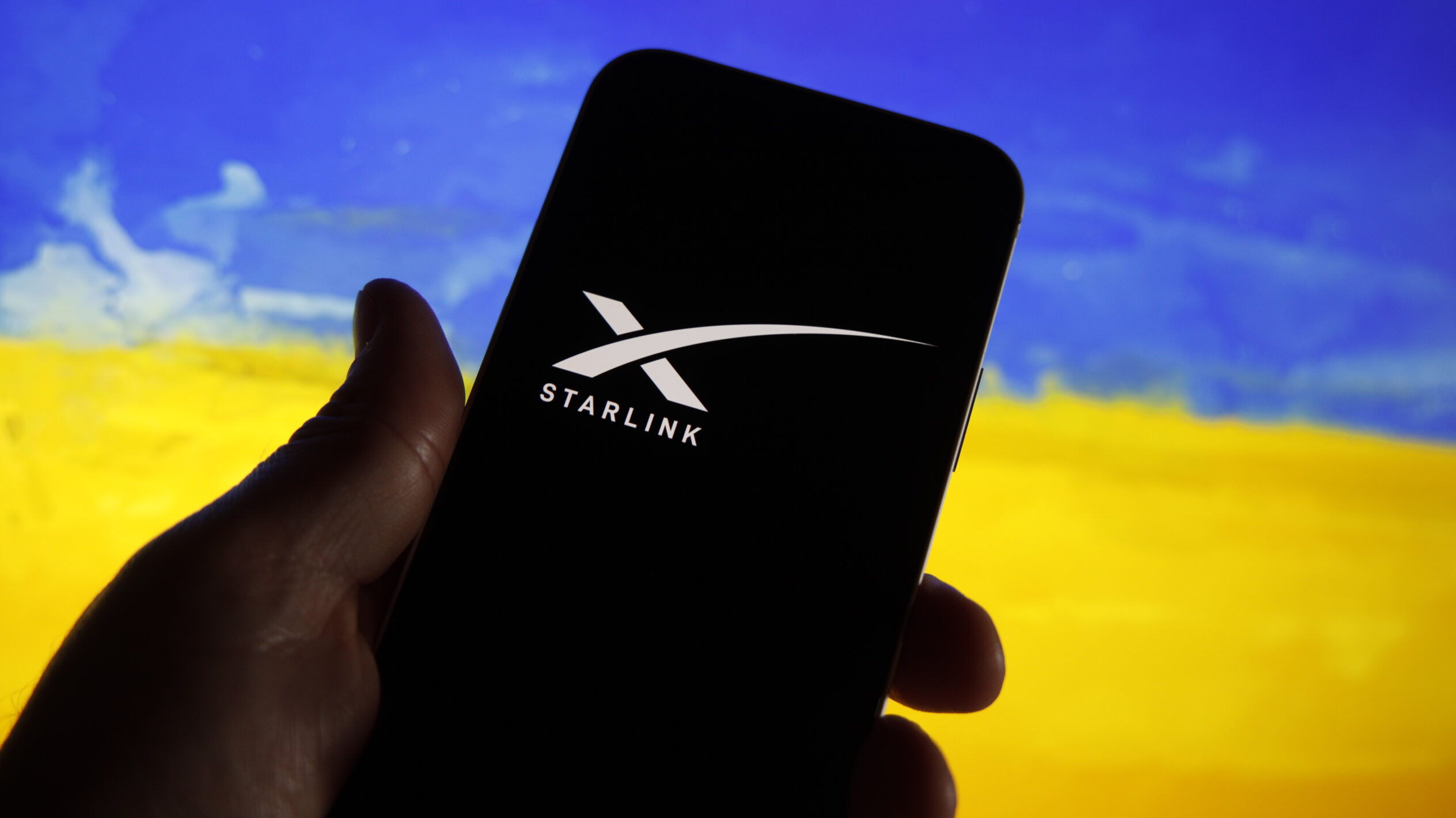
The Starlink logo is seen on a mobile device with a Ukrainian flag in the background in this illustration photo in Warsaw, Poland on 21 September, 2022. (STR/NurPhoto via Getty Images)

WASHINGTON — The Ukraine military’s use of SpaceX’s Starlink internet communications service as a weapon system in its war with Russia was something the company neither foresaw or agreed to, SpaceX President Gwynne Shotwell said today.

“We were really pleased to be able to provide Ukraine connectivity, and help them in their … fight for freedom. It was never intended to be weaponized, however,” she told the 25th Annual FAA Commercial Space Transportation Conference here today.

“The Ukrainians have leveraged it in ways that were unintentional and not part of any agreement. So you know, we have to work on that [with] Starlink. You offer a commercial product by connectivity to people which is helpful in conflict, but you also want to be careful of how they use it,” she added. “On the other hand, they’re trying to fight for their country, so I understand it. The thing is, it’s not what was intended.”

Shotwell didn’t elaborate on what exact use the Ukrainian military made of Starlink to “weaponize” the satellite constellation and its communications terminals. It is clear, however, that the government in Kiev has been using the satellite network for not only strategic, but also tactical communications with embattled troops on the ground — for instance, for coordinating strikes on the invading Russian forces.

RELATED: A Musk monopoly? For now, Ukraine has few options outside Starlink for battlefield satcoms

Moscow further has charged that Starlink is directly enhancing the ability of Ukrainian forces to target weapons on Russian forces.

Konstantin Vorontosov, the head of Russia’s delegation to the UN Open Ended Working Group on Reducing Space threats that recently concluded in Geneva, told the group on Jan. 31 that Starlink satellites are being used “not just for communications, but also for guiding drones and also amending the trajectory of artillery shells.”

It also is possible that the communication network has played a role in Ukrainian efforts to fight back against Russian efforts at cyber intrusion, as it is at least technically possible that Russian hacking attempts into Ukrainian communications are being hacked back along the same route by Ukrainian malware.

Starlink has proven a challenge for Russian jamming and hacking attempts — due in part simply to the enormous numbers of satellites making up the constellation. As of mid-January, SpaceX has some 3,120 operational satellites on orbit.

“It’s just the ubiquity,” Shotwell said. “If you got six satellites in view or more, it’s really hard to point a weapon at it, whether it’s a kinetic or whether it’s anything.”

5 minutes ago


spacenews.com

Shotwell: Ukraine “weaponized” Starlink in war against Russia

Jeff Foust
4 - 5 minutes

Ukrainian soldier setting up Starlink terminal
A Ukrainian soldier setting up a Starlink terminal. SpaceX's president says that Ukraine used Starlink services provided by the company for offensive military activities, something the company did not intent to support. Credit: Ukraine Military Center

WASHINGTON — SpaceX’s president said that Ukraine used Starlink services provided to the country for offensive purposes in its war against Russia, an application the company didn’t intend to support when it enabled service in the country.

Speaking at the Federal Aviation Administration Commercial Space Transportation Conference here Feb. 8, Gwynne Shotwell described Ukraine’s use of the Starlink broadband satellite communication system for weapons systems like drones as an “unintentional” effect of donating services and terminals to the country after Russia’s invasion nearly a year ago.

“We were really pleased to be able to provide Ukraine connectivity and help them in their fight for freedom,” she said. “It was never intended to be weaponized, but the Ukrainians have leveraged it in ways that were unintentional and not part of any agreement.”

She didn’t elaborate in the conference talk on how Ukraine had weaponized Starlink. In a later conversation with reporters, though, she referred to reports that the Ukrainian military was using Starlink to control drones used in attacks on Russian forces.

SpaceX was providing Ukraine with Starlink services, she said, for humanitarian applications. Even some generic military communications were also acceptable. “We know the military is using them for comms and that’s OK. But our intent was never to have them use it for offensive purposes.”

A general commercial agreement, like one any Starlink user signs, limits its use for offensive purposes, she said, but acknowledged SpaceX had not given the issue of how it might be used much thought when it started providing Starlink to Ukraine shortly after the invasion. “We didn’t think about it. I didn’t think about it,” she said. “But we learned pretty quickly.”

Shotwell said SpaceX has since taken steps to limit Starlink’s use in supporting offensive military operations. “There are things that we can do to limit their ability to do that,” she said, declining to elaborate. “There are things that we can do and have done.”

Last fall, SpaceX Chief Executive Elon Musk raised the possibility of ending the company’s donations of Starlink services to Ukraine, citing the financial burden on the company, unless the Defense Department stepped in to cover those costs. Musk then backtracked, saying the company would continue offering the service “even though Starlink is still losing money and other companies are getting billions.”

Shotwell told reporters she led efforts to get Pentagon funding for Starlink services in Ukraine. “I was the one that asked the Pentagon to fund this. It was not an Elon thing,” she said. “We stopped interacting with the Pentagon on the existing capability.”

While Musk said in October that Starlink was losing money, Shotwell offered a more upbeat assessment. “This year Starlink will make money,” she said, noting that the company’s Falcon launch vehicle and Dragon spacecraft, and other unspecified work, already makes money.

“We actually had a cashflow positive quarter last year, excluding launch. This year, they’re paying for their own launches, and they will still make money,” she said.

She said cash flow from operations pays for development, supplemented as needed by outside investment. Tackling both Starlink and the Starship launch vehicle at the same time, she argued, drives that need for outside investment.

“If we had done Starlink and then Starship, or Starship and then Starlink, we probably could have funded them through customer contracts and revenue from Falcon and Dragon. But you do both of them at the same time it’s a lot of money every year.”

Jeff Foust writes about space policy, commercial space, and related topics for SpaceNews. He earned a Ph.D. in planetary sciences from the Massachusetts Institute of Technology and a bachelor’s degree...

Zelensky Calls for a European Army as He Slams EU Leaders’ Response

      Jan 23, 2026 During the EU Summit yesterday, the EU leaders ...