The price tag is a real eye-popper -- we're told she spent $85,000/night to stay here, and booked it for 6 nights ahead of the game ... so, about $510K more or less.
Definitely a rental fit for a king or, in this case, a queen. Nothing less for Ri.
The price tag is a real eye-popper -- we're told she spent $85,000/night to stay here, and booked it for 6 nights ahead of the game ... so, about $510K more or less.
Definitely a rental fit for a king or, in this case, a queen. Nothing less for Ri.
"Russia has accused the United States-led military alliance of “direct and growing” involvement in the conflict by providing the Ukrainian government with tens of billions of dollars worth of military assistance, including battle tanks, over the past year. . .Russian President Vladimir Putin has frequently referred to NATO’s eastward enlargement as a reason for the conflict in Ukraine.
.jpg)
. . .In his comments to reporters ahead of a NATO defence ministers’ meeting, Stoltenberg said the issue of supplying combat aircraft was on the table but stressed that such a development would not make member countries part of the war.
Since the start of the war on February 24, NATO member countries have sent both conventional weapons as well as more advanced equipment and weaponry to Ukraine.
These include:
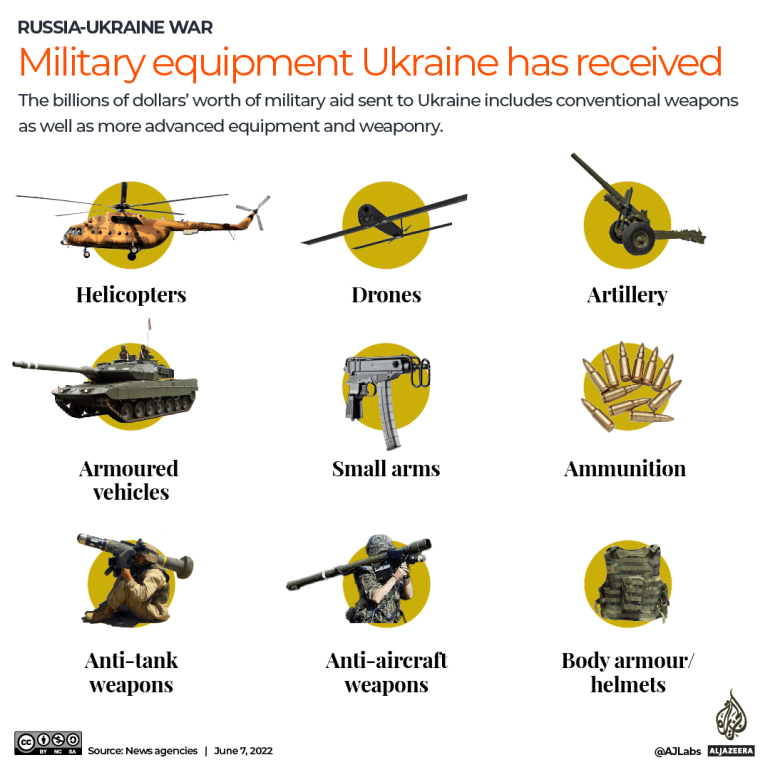
In January, the US, UK and Germany each pledged to send modern main battle tanks to Ukraine. The UK said it would deliver 14 of its Challenger 2 tanks, Germany agreed to send 88 Leopard tanks, and the US said it would send dozens of its M1 Abrams to bolster the country’s war effort.
Analysts say the latest-generation main battle tanks are vital for Ukraine in order to punch holes in Russian defensive lines and retake territory that Russian forces seized in the opening weeks of the invasion.
Southern Ukraine is flat and ideal tank territory. Russia has been building rows of trenches and fortified bunkers to stop a Ukrainian advance in the area.
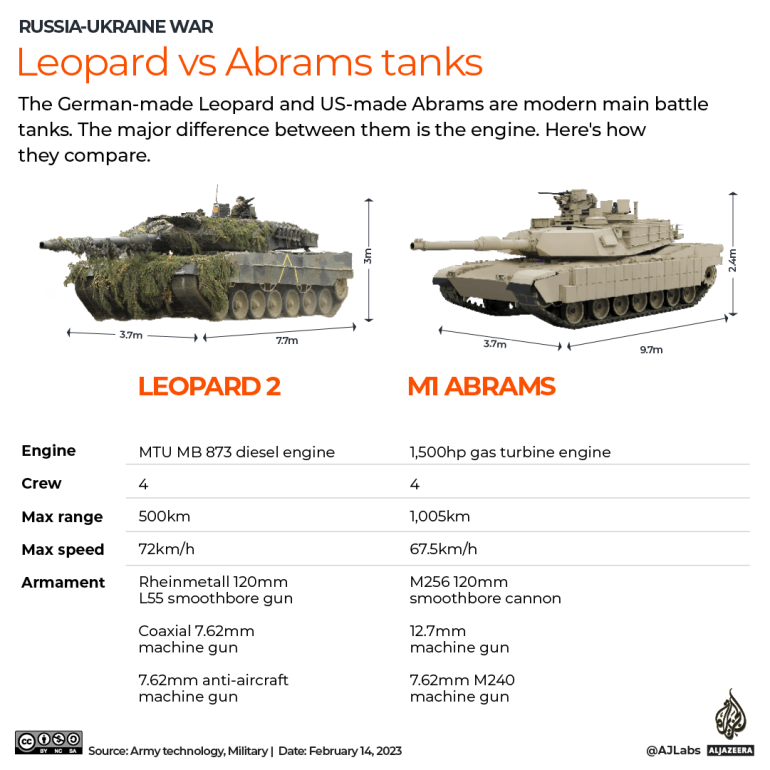
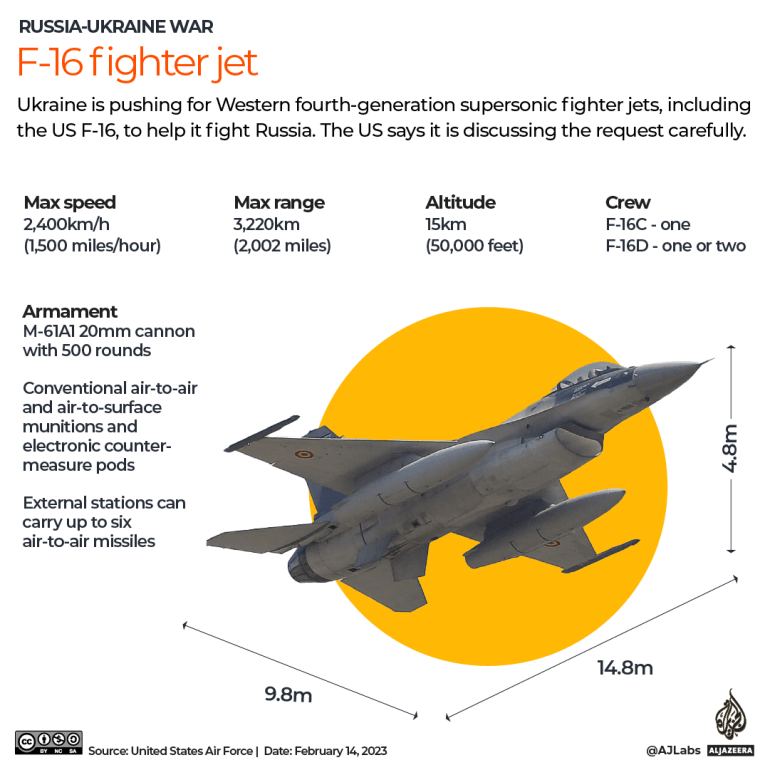
In addition to tanks, Ukraine has also been pushing for Western fourth-generation supersonic fighter jets, including the US-made F-16.
Ukraine’s air force has a fleet of ageing Soviet-era aircraft that came off the assembly line before it even declared independence more than 31 years ago. The jets are used for intercept missions and to attack Russian positions.
The UK, US and France have not ruled out sending fighter jets to Ukraine, though Germany has.
German Chancellor Olaf Scholz said there was no chance of fighter jets being sent to Ukraine. Scholz said Western allies would keep supporting Ukraine, but he also highlighted the danger of further inflaming the conflict.
NATO and its allies have also trained tens of thousands of Ukrainian troops, including special forces.
Ukraine has long expressed interest in joining NATO. In 2019, it adopted a constitutional amendment to pursue membership of the alliance.
While Ukraine is not expected to join NATO any time soon, in December Stoltenberg said that “Russia does not have a veto” on countries joining and that the alliance “stand[s] by that, too, on membership for Ukraine”.
READ MORE
"Just days before the first anniversary of Russia’s invasion of Ukraine, there are growing signs that a major new Russian offensive has already begun.
“We see how they [Russia] are sending more troops, more weapons, more capabilities,” NATO chief Jens Stoltenberg said on Monday.
Russia has accused the United States-led military alliance of “direct and growing” involvement in the conflict by providing the Ukrainian government with tens of billions of dollars worth of military assistance, including battle tanks, over the past year.
In his comments to reporters ahead of a NATO defence ministers’ meeting, Stoltenberg said the issue of supplying combat aircraft was on the table but stressed that such a development would not make member countries part of the war.
NATO, the acronym for the North Atlantic Treaty Organization, is the world’s largest military alliance.
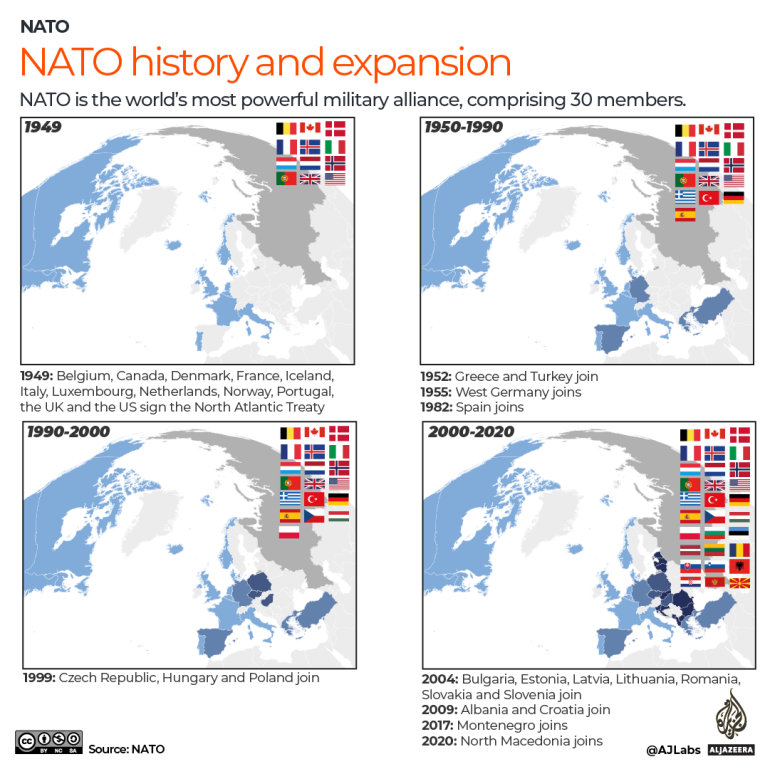
It was founded in 1949 by 12 member states – Belgium, Canada, Denmark, France, Iceland, Italy, Luxembourg, the Netherlands, Norway, Portugal, the United Kingdom and the US – with the aim of curbing Soviet expansion and encouraging political integration in Europe.
Between 1950 and 1999, seven more countries – Greece, Turkey, West Germany, Spain, the Czech Republic, Hungary and Poland – joined the alliance.
The expansion continued in 2004 when seven Eastern European states – Bulgaria, Estonia, Latvia, Lithuania, Romania, Slovakia and Slovenia, joined the military bloc. Of those, all but Slovenia were part of the Warsaw Pact – a defence treaty created in 1955 between the Soviet Union and seven satellite states.
Today, NATO comprises 30 nations. Only six members of the 27-country European Union (EU) are not NATO members: Austria, Cyprus, Finland, Ireland, Malta and Sweden.
Russian President Vladimir Putin has frequently referred to NATO’s eastward enlargement as a reason for the conflict in Ukraine.
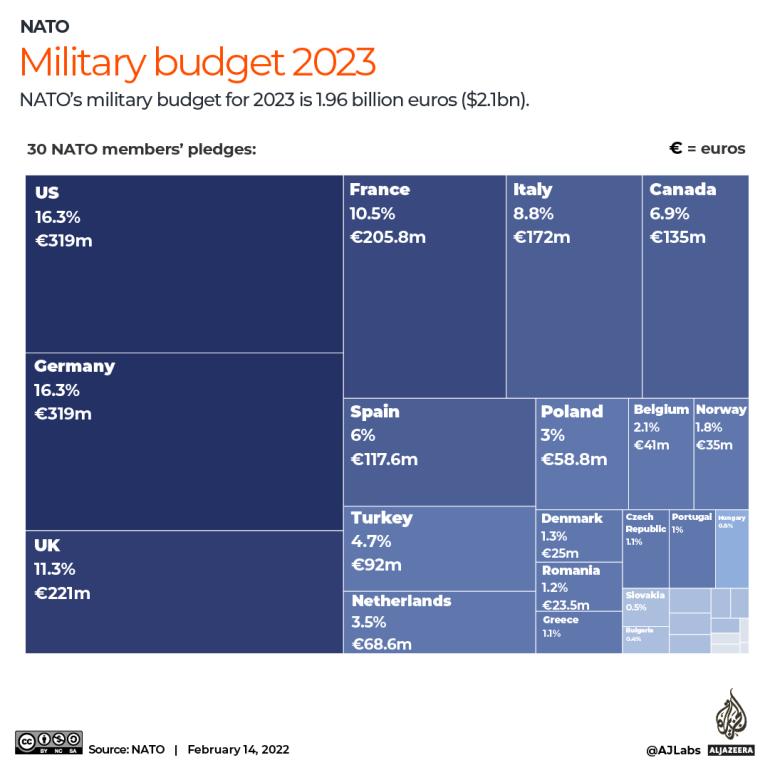
Every year, NATO sets its military and civil budgets, with all member countries pledging to contribute to the budget based on a cost-sharing formula derived from the gross national income of each country.
NATO members have committed a minimum of two percent of their gross domestic product (GDP) to defence spending to continue to ensure the alliance’s military readiness, but most countries have over the years been missing the target.
For 2023, the military budget was set at 1.96 billion euros ($2.10bn), represienting a 25.8 percent increase compared with last year.
The US and Germany have pledged to equally contribute the highest percentage to the military budget, together totalling more than 30 percent of the alliance’s funds.
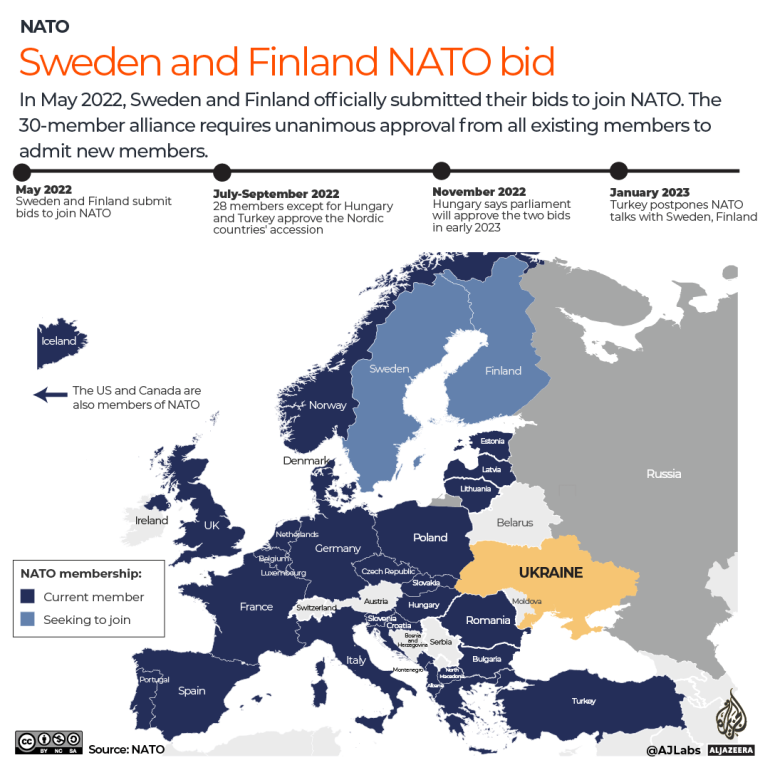
On May 16, 2022, Sweden officially applied to join NATO. Two days later, Finland followed suit.
On July 5, NATO ambassadors signed the accession protocols to allow Sweden and Finland to join the alliance.
Between July and September, 28 NATO members except for Hungary and Turkey approved Sweden and Finland’s accession. NATO requires unanimous approval from all of its existing members to admit new members.
Turkey has demanded that the Nordic countries stop supporting Kurdish armed groups, such as the Kurdistan Workers’ Party (PKK), and lift their bans on the sales of some arms to Turkey.
In January, Turkey’s President Recep Tayyip Erdogan indicated that Ankara may agree to Finland joining NATO, but not Sweden, in the face of rising tensions with Stockholm.
Hungarian Prime Minister Viktor Orban, who has close relations with Putin, has promised that his parliament would approve the two bids next month.
Finland shares a 1,300km (810-mile) border with Russia. While Sweden does not have a la
nd border with Russia, it does share a maritime border with the country in the Baltic Sea.
Russia has firmly opposed Finland and Sweden’s accession to NATO, seeing it as further encroachment of the transatlantic alliance towards Russia’s borders.
According to the latest data from the Kiel Institute for the World Economy, a German think tank, NATO members committed at least 75.2 billion euros ($80.5bn) in financial, humanitarian and military aid between January 24 and November 20, 2022.
$$$ ✓ At 47.8 billion euros ($51.2bn) in commitments, the US is Ukraine’s biggest contributor, with at least 22.9 billion euros ($24.5bn) going towards military pledges, 15.05 billion euros ($16.1bn) in financial aid and 9.9 billion euros ($10.6bn) in humanitarian assistance.
Military assistance includes weapons, equipment and financial aid for the Ukrainian military. Humanitarian relief covers medical, food and other items for civilians, while financial assistance comes in the form of grants, loans and guarantees.
$$ ✓ The UK is the second-highest NATO member contributor with 7.1 billion euros ($7.6bn) pledged to Ukraine, while Germany is third at 5.4 billion euros ($5.8bn).
$ ✓ Non-members Sweden and Finland have committed at least 810 million euros ($867m) and 310 million euros ($332m), respectively.
Since November 20, the US and other countries have pledged additional military packages to Ukraine. The chart below provides a detailed breakdown of how much each NATO member country has committed to Ukraine"
.png)
.png)
.jpg)
RELATED
"Large-scale Russian missile strikes on Friday brought the operations of Ukraine’s key defense enterprises to a halt and prevented Kiev from redeploying reserves and foreign hardware to the battlefield, Russia’s Defense Ministry has claimed.
The attack involved high-precision, long-range air, sea, and land-based weapons as well as drones, the ministry’s spokesman, Lieutenant General Igor Konashenkov, told reporters during his daily briefing on Saturday.
It targeted critically important energy facilities, providing power to Ukraine’s defense enterprises and the country’s transport system, he said.
“The goals of the massive strike were achieved. All of the intended facilities were hit,” Konashenkov said.
✓ As a result of the bombardment, “the operations of energy-intensive enterprises of the [Ukrainian] military-industrial complex were stopped. The redeployment of foreign weapons, ammunition, and reserves by rail to the areas on the front lines was also blocked,” the spokesman noted.

Air-raid warnings had been activated all across Ukraine since early Friday. Reports of explosions came from the capital Kiev, along with the regions of Kharkov, Odessa, Dnepr, Nikolaev, Lviv, Ivano-Frankovsk, and other locations.
Ukraine’s Air Force said that at least 71 cruise missiles were fired by Russian long-range bombers and navy vessels from the Black Sea. Most of those missiles were shot down by air defenses, it claimed.
Ukraine’s energy operator, Ukrenergo, has confirmed that several of its high-voltage sites nationwide were hit. The company said it had to implement emergency shutdowns to preempt possible damage to the power grid from overload.
The country’s railway operator, Ukrzaliznytsia, also said the power cuts had delayed a number of trains and led to some electric locomotives being replaced with backup diesel engines.
Moscow has stepped up the pressure on Ukraine since October last year, when it accused Kiev of using “terrorist tactics” and of targeting Russian infrastructure, including the strategic Crimean Bridge. Since then, a number of large-scale missile strikes have been carried out against Ukrainian military installations and energy facilities, leading to rolling blackouts across the country."
READ MORE
Satellites will facilitate the sharing of intelligence data between commercial and national systems
NATO will launch a new “virtual network” comprising national and commercial satellites, Secretary-General Jens Stoltenberg revealed in a press conference on Monday ahead of a meeting of NATO defense ministers.
“This will improve our intelligence and surveillance. And support NATO missions and operations,” he said, adding that it would allow for “better navigation, communication, and early warning of missile launches.”
The move comes several months after the Russian Foreign Ministry warned that Western commercial satellites being used in the Ukraine conflict are valid military targets.

Stoltenberg acknowledged that the new network – as well as the much-needed replenishment of member nations’ weapons stores after a year of fighting in Ukraine – would require increased military spending from those nations. The day’s meeting would thus include discussions of how to “maintain and step up defense spending across the alliance,” he said.
In addition to “stand[ing] with Ukraine for as long as it takes,” he hinted at an expansion of NATO’s efforts in Eastern Europe, explaining that “ministers will also address how to step up our practical support for Bosnia and Herzegovina, Georgia and Moldova,” whom he called “valued partners which face Russian threats.”
While none of the three named countries are NATO members, the bloc has encouraged them to cozy up to it as the conflict in Ukraine drags on. Moldova received EU candidate status in June, Bosnia in December, and Georgia applied for EU membership in March, though none have officially applied for NATO membership.
Russia has adamantly opposed NATO expansion, viewing the military alliance’s efforts to encroach on its borders and place missiles on its western flank as a direct threat. Moscow has sought a promise from Kiev that it will never join the bloc, though such a pledge has not been forthcoming.

The West is attempting to use the Ukraine conflict to portray Russia as a “rogue state”
in the eyes of the world, Foreign Minister Sergey Lavrov said on
Wednesday. He stressed that the strategy has not been successful.
“The US and its satellite states are waging an all-encompassing hybrid war that they have long been preparing for, and are using Ukrainian radical nationalists as a battering ram against us,” Lavrov outlined in a speech to the lower house of the Russian parliament, the State Duma.
They are not even trying to hide the goal of this war: it is not only to defeat our country on the battlefield and destroy our economy, but also to surround us with a ‘sanitary cordon’ and turn us into a type of a rogue state.
The statement came the same day that European Commission President Ursula von der Leyen unveiled proposals for a new sanctions package against Russia, including additional export bans and measures to prevent the bypassing of restrictions.
Lavrov said that the West’s efforts to isolate Russia have failed because Moscow continues to develop relations with partners in other areas of the globe. He added that nations that have refused to back the “unprecedented” sanctions make up the majority of the world’s population.
The countries of the Asia-Pacific, the Middle East, Africa, and South America “don’t want to live in accordance with the West-centric order,” the Russian minister stated. “So it makes perfect sense why three-quarters of the world’s countries have not joined the anti-Russian sanctions and have a reasonable view regarding the situation in Ukraine.”
China and India are among the major economies that have refused to impose restrictions on Moscow. Denis Alipov, Russia’s ambassador to New Delhi, said on Tuesday that sanctions “had an opposite effect” and facilitated more trade and closer cooperation between Russia and India.
Beijing, meanwhile, has accused the US of fueling the Ukraine conflict and trying to weaponize the world economy for its own benefit.



© Autonomous Nonprofit Organization “TV-Novosti”, 2005–2023. All rights reserved.
"Stockholm has indicated it is willing to abandon its goal of synchronizing accession with Finland
Sweden may be forced to abandon its plan to join NATO alongside Finland and instead become part of the military bloc at a later date, Prime Minister Ulf Kristersson has admitted. The Swedish premier claimed that such a path would not constitute a failure.
Speaking at a press conference on Tuesday, Kristersson described the potential entry of his country to NATO separately from Finland as an “unfortunate” scenario, resulting mainly from “Türkiye making Turkish decisions.” However, this route into the alliance “would not be a failure,” he added.
Kristersson’s remarks came shortly after NATO Secretary General Jens Stoltenberg insisted that the “main question is not whether Finland and Sweden are ratified together,” but “that they are both ratified as full members as soon as possible.”
Sweden and Finland tendered their official NATO applications in mid-May of 2022, citing Russia’s offensive against Ukraine. Until recently, the bloc had spoken in favor of both Nordic nations being admitted simultaneously.

Twenty-eight of the 30 NATO member states gave the green light to
immediate enlargement. However, Hungary and Türkiye refused to grant
their approval, stalling the process indefinitely as the unanimous
consent of all nations in the alliance is required. . ." Read more
.jpg)
.jpg)
.jpg)
 Polish president to meet Macron, Scholz and Sunak in "diplomatic offensive" ahead of Biden visit
 "Poland’s president, Andrzej Duda, has launched what he describes as a “diplomatic offensive”, during which he will meet European and NATO leaders in an effort to drum up support for Ukraine ahead of Joe Biden’s visit to Poland later this month to mark the first anniversary of Russia’s invasion.
After a conversation tomorrow with the presidents of neighbouring Slovakia and Lithuania – Zuzana Čaputová and Gitanas Nausėda – Duda will meet with NATO Secretary General Jens Stoltenberg, followed by British Prime Minister Rishi Sunak and King Charles, he announced his a speech this afternoon.
✓ He will then hold talks at the Munich Security Conference with German Chancellor Olaf Scholz and French President Emmanuel Macron, as well as the president-elect of the Czech Republic, Petr Pavel, and Norwegian Prime Minister Jonas Gahr Støre.
.jpg)
.jpg)
✓ That will be followed by Biden’s visit to Poland from 20 to 22 February, during which Warsaw will also host a summit of the so-called Bucharest Nine, comprised of Bulgaria, Czech Republic, Estonia, Hungary, Latvia, Lithuania, Poland, Romania and Slovakia. The US president will also attend the event.
The aim of these “very active two weeks” will be to not only “strengthen Poland’s security” but also to “adopt new provisions that will allow us to support Ukraine in an even better and more efficient way in defending its territory, in repelling the Russian attack, jointly within the framework of allied agreements”, said Duda.
This will involve “above all strengthening the security of NATO’s eastern flank” by “persuading our allies to send larger military forces here, which will be stationed in our part of Europe”. Such forces would act as a “deterrent against the further expansion of Russian imperialism”.
These efforts are being coordinated in particular with Slovakia – which currently holds the presidency of the Bucharest Nine – and Lithuania, which will be hosting NATO’s annual summit in July, added the Polish president.
.jpg)
.jpg)
READ MORE
The Polish government is seeking Russia’s removal from the G20, with Poland taking its place. One minister claims the idea has been “very well received” by the United States, but experts warn that achieving unanimity among G20 members to remove Russia would be very difficult to achieve.
The G20 was founded in 1999 as a forum for most of the world’s largest economies. However, Poland’s GDP last year (over $655 billion according to IMF estimates) was significantly larger than those of South Africa ($415 billion) and Argentina ($455 billion), which have the smallest economies among G20 countries.
During a visit to Washington last week, Poland’s development minister, Piotr Nowak, told US Trade Representative Katherine Tai that there should be “no place for Russia in the G20” after it “violated the rules of international cooperation by attacking Ukraine”.
By contrast, “Poland deserves a place in the G20 as the second fastest developing country in the world in the last 30 years”, said Nowak.
Eventual membership of the group has been a longstanding aim for the government, with then foreign minister Jacek Czaputowicz saying in 2019 that it was a “long-term goal”.
2/2 Na miejsce w #G20 z całą odpowiedzialnością zasługuje Polska, jako drugi najszybciej rozwijający się kraj na świecie w ciągu ostatnich 30 lat – minister @PiotrNowak_PL podczas rozmowy z @AmbassadorTai.
— Ministerstwo Rozwoju i Technologii (@MRiTGOVPL) March 14, 2022
Speaking yesterday, Nowak said that “our proposal to remove Russia from the G20 group and replace it with Poland was met with great understanding by representatives of the American administration”.
“Gina Raimondo, the US secretary of commerce, declared that she would pass it on to President Joe Biden, and the idea was very well received,” added the development minister, quoted by the 300Gospodarka news service.
A US Department of Commerce spokesperson said that Raimondo had held a “good meeting” and “welcomed hearing Poland’s views on a number of topics, including the operation of the G20, but did not express a position on behalf of the US Government with respect to the Polish G20 proposal”, reports Reuters.
Nowak argued that Poland’s admission to the group would be a mark of success for Western institutions, showing how they had effectively supported Poland’s post-communist transition over the last three decades.
“Entering the G20 would show that, with such support, a [post-]communist country is able to become one of the fastest developing countries in the world within 30 years,” he said. According to World Bank data, Poland recorded the second largest GDP growth in 1990-2019 among the world’s top 40 economies.
As per the "Lived Change Index", the Chinese people have witnessed amazing prosperity. Very interesting metric. pic.twitter.com/CLlShmjdRw
— Gaurav Dalmia (@gdalmiathinks) June 20, 2021

✓ Nowak admits, however, that removing Russia from the G20 would be difficult, given that such a decision would require unanimity from all members. China and India are seen as those most likely to oppose such a proposal.
“However, the idea is liked so much in the US that the US would be ready to leave the G20 and work towards establishing a new organisation,” claimed the Polish minister. “Such suggestions were made in backstage conversations.”
In an article for Foreign Policy magazine published last week, Josh Lipsky, director of the Atlantic Council’s GeoEconomics Center, argued that, even though removing Russia from the G20 would be difficult, the US should push to expand the club by inviting Poland, Thailand and Nigeria to join.
Kicking Russia out of the G20 is good if we can do it. If we can't, @joshualipsky has another way to dilute Russian power there: add Poland, Thailand, and Nigeria to the G-20. @mmagierowski @ACGeoEcon https://t.co/7GeyQERuW3
— Daniel Fried (@AmbDanFried) March 17, 2022
Last week, Poland’s current foreign minister, Zbigniew Rau, confirmed that “talks on replacing Russia with Poland in the G20 are underway”, but added that it was still “too early to talk about the results”, reported Polsat News.
There are reports that Biden is intending to discuss Russia’s position in the G20 during a visit to Brussels this week. “We believe that it cannot be business as usual for Russia in international institutions and in the international community,” said his national security adviser, Jake Sullivan, yesterday.
A European Union source told Reuters that “It has been made very clear to Indonesia [which currently holds the G20’s rotating chair] that Russia’s presence at forthcoming ministerial meetings would be highly problematic for European countries”.
Main image credite: Herman Van Rompuy/Flickr (under CC BY-NC-ND 2.0)

Daniel Tilles is editor-in-chief of Notes from Poland. He has written on Polish affairs for a wide range of publications, including Foreign Policy, POLITICO Europe, EUobserver and Dziennik Gazeta Prawna.
Aleks Szczerbiak
While currently it would struggle to obtain a majority, several factors are working in its favour.

The European Commission says that Poland’s constitutional court has “violated EU law”.
On the last Thursday before Lent, Poles eat over 100 million doughnuts – an average of more than 2.5 per person.
X
US National Weather Service Phoenix Arizona t͏ o͏ r͏ o͏ S͏ d͏ n͏ p͏ e͏ s͏ 5͏ 3͏ 8͏ c͏ u͏ 5͏ a͏ 6͏ 1͏ t͏ f͏ 2͏ c͏ 6͏ m͏ g͏ 4͏ u͏ i͏ 1͏ 5͏...