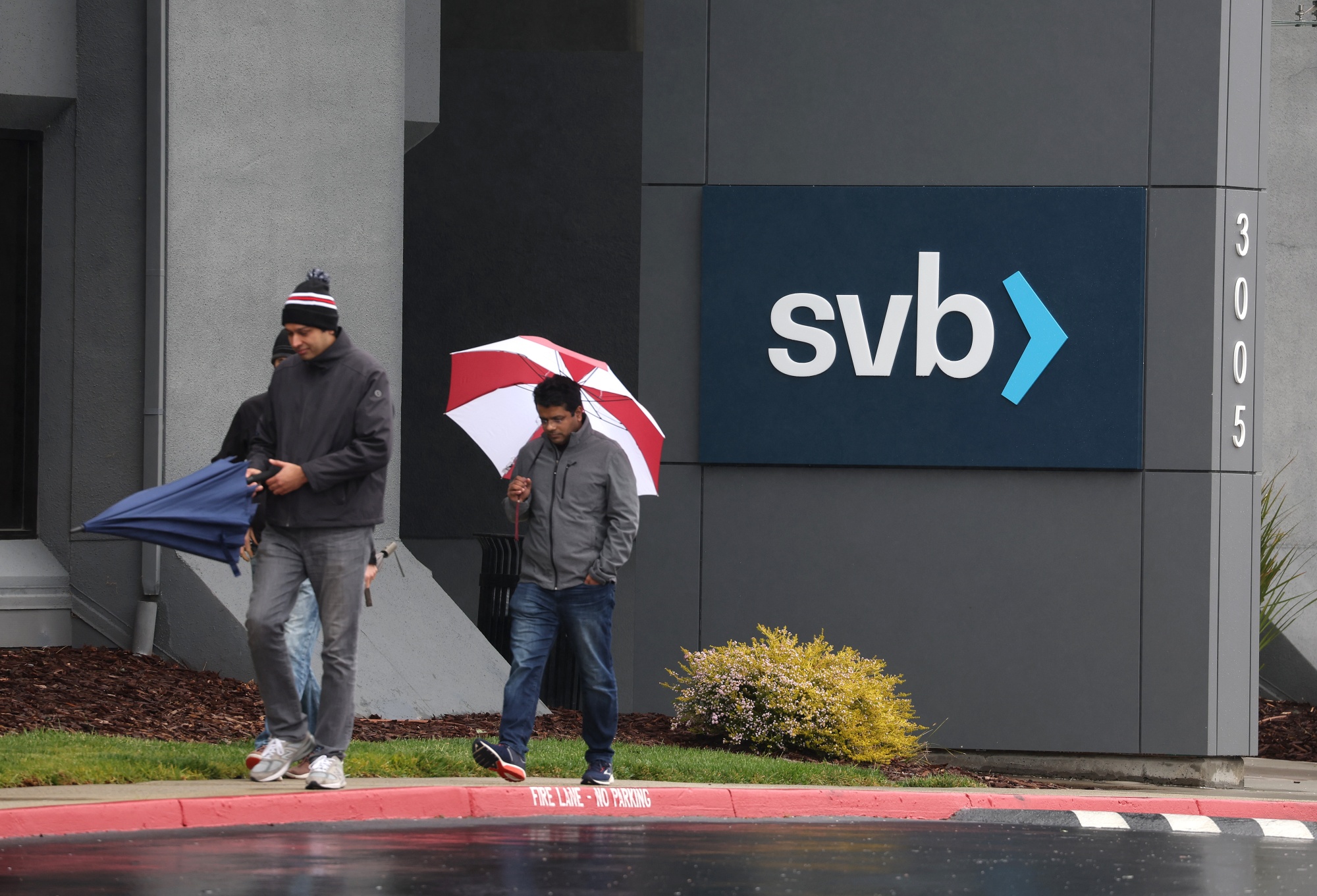
Sunday, March 12, 2023

HOW TO???...orchestrate a deal to rescue Silicon Valley Bank depositors before branches open tomorrow.


www.axios.com

How Silicon Valley Bank could precipitate a banking crisis

Dan Primack,Felix Salmon
4 minutes

Illustration of dominos falling forward, with the last domino showing an exclamation point

Illustration: Annelise Capossela/Axios

President Biden is in danger of a catastrophic banking crisis, unless the U.S. government can orchestrate a deal to rescue Silicon Valley Bank depositors before branches open tomorrow.

Why it matters: Bank runs kill banks, no matter how good or bad their risk management. (For a quick primer, see the famous financial-crisis documentary Mary Poppins.)

How it works: Banks don't keep deposits in a vault — they lend them out to businesses and individuals. So if depositors ask for all their money back at once, as they did at SVB, the bank is likely to fail.

  • Corporate America just got a stark reminder that none of their deposits are insured above $250,000 by the Federal Deposit Insurance Corporation (FDIC).
  • If SVB's depositors aren't made whole by Monday morning, hundreds of billions of dollars of corporate deposits are likely to flow out of regional banks. Most would flow into a handful of so-called systemically important banks — if they're too big to fail, they won't fail. Some might go into other ultra-safe havens like Treasury bills.

State of play: Every non-enormous bank in America is left to worry about whether it's going to be able to hold onto its corporate customers.

  • Investors are worried, too. Shares of First Republic fell 34% last week, Signature Bank fell 38%, and PacWest was down 55%.

In the short term: The Biden administration must find a well-capitalized buyer for SVB's commercial business, if not also its private bank, securities and U.K. units.

  • That would allow customers to access their money, including for meeting this week's payroll, and provide the sort of calm that discourages bank runs elsewhere.
  • If it's unable to find a buyer, the government will come under pressure to back the uninsured deposits. That would be politically unpalatable, particularly for Silicon Valley Bank, but it's preferable to the alternative.

Where it stands: The FDIC is clearly the main entity in charge. Its leadership is acutely aware that the best way to avoid bank runs is to signal that everybody with money at SVB ended up having full access to all their funds.

  • Treasury and the White House also have a role to play, by removing any regulatory obstacles to SVB being immediately acquired by the likes of a large bank such as JPMorgan or Goldman Sachs.

In the long term: During the great financial crisis, the Federal Reserve guaranteed corporate transaction accounts under something called the Transaction Account Guarantee Program (TAG). That, however, expired at the end of 2012.

  • Had TAG or something similar been in place last week, SVB might still be alive today, and thousands of companies wouldn't now be worrying about their financial solvency.

Between the lines: One of the reasons for the $250,000 cap on guaranteed deposits is that insuring more deposits is generally more expensive, both for participating banks and for the FDIC.

  • But it doesn't always work that way. A lower cap can mean higher insurance costs, if it causes more bank runs. In that sense, extending deposit insurance to include corporate transaction accounts could actually save the government money.

The bottom line: Look around the world, and nearly all countries are dominated by three or four banks. The U.S., with its thousands of banks, is an outlier. The FDIC's job is to shore up confidence in every last one of those banks. Right now that job is harder, and more urgent, than ever.

SVB: The largest failure of a U.S. financial institution since the height of the financial crisis.


Why didn’t anyone step in to save Silicon Valley Bank? 


Headline:

www.heraldbulletin.com


Yellen: No federal bailout for collapsed Silicon Valley Bank

CHRIS MEGERIAN - Associated Press
5 - 6 minutes

WILMINGTON, Del. (AP) — Treasury Secretary Janet Yellen said Sunday that the federal government would not bail out Silicon Valley Bank, but is working to help depositors who are concerned about their money.

The Federal Deposit Insurance Corporation insures deposits up to $250,000, but many of the companies and wealthy people who used the bank — known for its relationships with technology startups and venture capital — had more than that amount in their account. There are fears that some workers across the country won't receive their paychecks.

Yellen, in an interview with CBS' “Face the Nation,” provided few details on the government's next steps. But she emphasized that the situation was much different from the financial crisis almost 15 years ago, which led to bank bailouts to protect the industry.

“We’re not going to do that again," she said. "But we are concerned about depositors, and we’re focused on trying to meet their needs.”

With Wall Street rattled, Yellen tried to reassure Americans that there will be no domino effect after the collapse of Silicon Valley Bank.

“The American banking system is really safe and well capitalized," she said. "It’s resilient.”

Silicon Valley Bank is the nation’s 16th-largest bank. It was the second biggest bank failure in U.S. history after the collapse of Washington Mutual in 2008. The bank served mostly technology workers and venture capital-backed companies, including some of the industry’s best-known brands.

Silicon Valley Bank began its slide into insolvency when its customers, largely technology companies that needed cash as they struggled to get financing, started withdrawing their deposits. The bank had to sell bonds at a loss to cover the withdrawals, leading to the largest failure of a U.S. financial institution since the height of the financial crisis.

Yellen described rising interest rates, which have been increased by the Federal Reserve to combat inflation, as the core problem for Silicon Valley Bank. Many of its assets, such as bonds or mortgage-backed securities, lost market value as rates climbed.

“The problems with the tech sector aren’t at the heart of the problems at this bank,” she said.

Yellen said she expected regulators to consider “a wide range of available options,” including the acquisition of Silicon Valley Bank by another institution. So far, however, no buyer has stepped forward.

Tom Quaadman, executive vice president of the U.S. Chamber of Commerce’s Center for Capital Markets Competitiveness, said in a statement that “we urge the administration to facilitate a quick acquisition, guaranteeing all bank depositors have access to their cash.”

Regulators seized the bank's assets on Friday. Deposits that are insured by the federal government are supposed to be available by Monday morning.

“I’ve been working all weekend with our banking regulators to design appropriate policies to address this situation," Yellen said. "I can’t really provide further details at this time.”

House Speaker Kevin McCarthy, R-Calif., told Fox News Channel's “Sunday Morning Futures” that he hoped the administration would announce the next steps as soon as Sunday.

“They do have the tools to handle the current situation, they do know the seriousness of this and they are working to try to come forward with some announcement before the markets open,” he said.

McCarthy also expressed hope that Silicon Valley Bank would be purchased.

“I think that would be the best outcome to move forward and cool the markets and let people understand that we can move forward in the right manner,” he said.

Sen. Mark Warner, D-Va., said in an interview with ABC News' “This Week” that he was concerned that the bank's collapse could prompt nervous people to transfer money from other regional banks to larger institutions.

“We don’t want further consolidation,” he said.

Warner suggested there would be a “moral hazard” in reimbursing depositors in excess of the $250,000 limit and said an acquisition would be the best next step.

“I’m more optimistic this morning than I was yesterday afternoon at this time," he said. "But, again, we will see how this plays out during the rest of the day.”

He added: "What we’ve got to focus on right now is how do we make sure there’s not contagion.”

President Joe Biden and Gov. Gavin Newsom, D-Calif., spoke about “efforts to address the situation” on Saturday, although the White House did not provide additional details on next steps.

Newsom said the goal was to “stabilize the situation as quickly as possible, to protect jobs, people’s livelihoods, and the entire innovation ecosystem that has served as a tent pole for our economy.”


Associated Press reporter Hope Yen contributed to this report from Washington.


 RELATED

ww.businesstoday.in

Short sellers make $500 million on Silicon Valley Bank's collapse: Report

Business Today Desk
2 - 3 minutes

"SVB Financial Group’s record plunge on Thursday minted short sellers roughly half a billion dollars in paper profits, according to a report.

However, they now a face a challenge: how to close their positions.

On Thursday, the stock of SVB plunged by about 60 per cent as concerns mounted over the bank's operation, netting traders who bet against the stock a one-day mark-to-market profit of roughly $513 million, a Bloomberg report said.

The stock fell another 63 per cent in premarket trading Friday before being halted, with the Federal Deposit Insurance Corp. ultimately announcing that it had seized the bank.

As per the report, SIVB’s closure gives short sellers a windfall profit, but now they have to go through the sometimes-difficult process of liquidating their positions and realising their mark-to-market profits, said S3 Partners head of predictive analytics Ihor Dusaniwsky.

“With stock borrow financing costs accruing daily, even on weekends, even though trading is halted there is a continuous reduction of profits until short sellers close out their positions and return their borrowed shares.”

On Wednesday, the SVB Financial Group announced that it was raising $2.25 billion in a share sale. It said in an investor prospectus it needed the proceeds to plug a $1.8 billion hole caused by the sale of a $21 billion loss-making bond portfolio consisting mostly of US Treasuries.

The portfolio was yielding it an average 1.79 per cent return, much lower than the current 10-year Treasury yield of around 3.9 per cent, according to Reuters.

Following this, the 16th largest bank in the US failed following a run on deposits after its parent company's share price crashed a record 60 per cent on Thursday.

The Silicon Valley Bank episode marks the second-biggest US commercial bank failure since Washington Mutual, which collapsed at the peak of the 2008 financial crisis."

Also Read: 'Missed US and did hit job on India': Hindenburg gets trolled for labeling Adani a 'scam' as SVB collapses

Also Read: If SVB can go bust, any crypto exchange can, warns Nouriel Roubini who predicted Great Financial Crisis

fortune.com

For nearly 2 months, a short seller was warning on Twitter that Silicon Valley Bank was about to blow up. ‘It was sitting there in plain sight.’


Isabelle Lee, Bloomberg
4 - 6 minutes

The problems that triggered SVB Financial Group Inc.’s death spiral were hiding in plain sight in the firm’s earnings reports.

That’s according to short seller William C. Martin, who warned his Twitter followers about the balance-sheet issues for almost two months before the parent of Silicon Valley Bank blew up in the blink of an eye this week. 

The tweets started on Jan. 18, the day before SVB reported earnings, when Martin’s account posted a prescient thread that began: “Investors have rightfully been fixated on $SIVB’s large exposure to the stressed venture world, with the stock down a lot. However, dig just a little deeper, and you will find a much bigger set of problems at $SIVB.”

Silicon Valley Bank $SIVB reports earnings tomorrow

Investors have rightfully been fixated on $SIVB's large exposure to the stressed venture world, with the stock down a lot.

However, dig just a little deeper, and you will find a much bigger set of problems at $SIVB… 1/10

— Raging Capital Ventures (@RagingVentures) January 18, 2023

The posts by Martin, the former manager of a now-closed hedge fund that peaked with about $1 billion in assets, went on to detail how SVB had ratcheted up its portfolio of securities by 700% near the “generational top in the bond market.” 

When the bank experienced an increase in withdrawals from depositors this year, deep losses on sales of some securities created a hole in the balance sheet that triggered its spectacular failure in just two days this week, as a run on the bank erupted among its clientele of mostly young tech companies. 

Martin said he initially started analyzing SVB out of suspicion that he’d find weakness in its book of loans to Silicon Valley startups. Instead, he realized how vulnerable the firm’s fixed-income investments had left it following a year of deep losses in the bond market. 

“They had bought all these mortgages at the top of the market and were sitting on a massive unrealized loss,” he said in an interview. “And it was sitting there in plain sight. There were a number of other banks and insurance companies with similar issues, but I haven’t seen anyone anywhere near the scale of Silicon Valley Bank.”

Losses on the asset side of the bank’s balance sheet were more alarming in light of signs of trouble on the liabilities side: Its deposits were at risk of disappearing amid a cold snap in the once red-hot world of startups. Many of SVB’s customers were now burning cash rather than raising fresh funds thanks to the largess of the VC industry.   

“When you layer on the fact that their primary depositors were venture- backed companies, so they were seeing outflows on deposits, it seemed from a short perspective, a pretty good setup,” Martin said. 

Martin, who managed a Princeton, New Jersey, hedge fund called Raging Capital for 15 years before closing it and starting a family office, said he began shorting the stock in January. He said it was his largest short position for his family office Raging Capital Ventures, but he declined to say how much money he made on the trade: “It’s a nice win, but I prefer not to talk about specifics,” he said.

With the short position in place, he took to Twitter to make his case — including one post in which he described the bank’s “‘Hold to Maturity’ accounting trap,” referring to a bookkeeping maneuver that allows banks to avoid mark-to-market losses on bonds it doesn’t plan to sell.

$SIVB's HTM securities had mark-to-market losses as of Q3 of $15.9 b…compared to just $11.5 b of tangible common equity!!

Luckily, regulators do not force $SIVB to mark HTM securities to market. But the bank would be functionally underwater if it were liquidated today. 5/10 pic.twitter.com/WoM5789o4X

— Raging Capital Ventures (@RagingVentures) January 18, 2023

The tweets have garnered a lot of attention now that a top 20 US bank with more than $200 billion in assets is under receivership with the Federal Deposit Insurance Corp.

Yet not everyone heeded Martin’s warnings in time. 

“Two of my very good friends have meaningful dollars locked up there despite my advice,” he told Bloomberg. “So it’s a shame. I never thought it was going to play out this quickly and even to the extent that it did.”

Fortune‘s CFO Daily newsletter is the must-read analysis every finance professional needs to get ahead. Sign up today

fortune.com

The 5 most pressing questions answered about Silicon Valley Bank’s collapse

Luisa Beltran
9 - 12 minutes

Measured by sheer speed and violence, the stunning crash of Silicon Valley Bank has left even those who’ve lived through decades of ups and downs in the market floored. On Wednesday, SVB was a 40-year old Valley institution, quietly banking (by some estimates) half of the Valley’s startups. By Friday, it was done, shut down by California regulators. Now startups, VCs and analysts are piecing together how the bank run happened, why no one could stop it, and who is at risk next.

How did the Silicon Valley Bank run happen?

SVB Financial, parent company of embattled Silicon Valley Bank, shocked many when it announced plans March 8 to strengthen its financial position. SVB said it sold nearly all of a $21 billion securities portfolio at a loss of nearly $2 billion. SVB also said it was seeking to raise $2.25 billion, by offering $1.75 billion in a share sale. General Atlantic, a private equity firm, also agreed to buy $500 million in stock. Goldman Sachs served as underwriter on both transactions.  The $2.25 billion stock sale ended up getting pulled, SVB said in a March 10 statement. Goldman and General Atlantic declined comment.

The attempted stock sales spooked the venture community, with several funds withdrawing their money from SVB. For example, Peter Thiel’s Founders Fund, Union Square Ventures and Coatue Management told their companies to pull their money from SVB to avoid getting caught up in a potential bank failure, CNBC reported.  Investors and depositors ended up withdrawing $42 billion in deposits from the SVB, which caused the bank to end March 9 with a negative cash balance of about $958 million, according to a March 10 filing from the Commissioner of Financial Protection and Innovation. SVB stock plunged 60%, closing Thursday at $106.04. Founders Fund and Union Square did not return messages for comment. Coatue declined to comment. SVB did not return messages for comment. 

On Friday, SVB was rumored to be seeking out a buyer. However, large banks were not expected to be interested in SVB due to its loan portfolio, which is heavily skewed toward VC. Venture or private equity funds made up about 56% of its global banking portfolio in 2022, per the company’s 2022 annual report, Fortune reported. 

The California Department of Financial Protection and Innovation then shut SVB down on Friday, appointing the Federal Deposit Insurance Corp as receiver. The FDIC created the Deposit Insurance National Bank of Santa Clara, a temporary bank. As receiver, the FDIC will dispose of the SVB assets, according to a statement. The Nasdaq, which treats an FDIC receivership as the functional equivalent to a bankruptcy, halted SVB’s stock on Friday. 

SVB had $209 billion in assets as of Dec. 31, according to the FDIC. This means SVB is the biggest bank failure since 2008 when Washington Mutual collapsed with $307 billion in assets. JPMorgan ended up buying WaMu for $1.9 billion. SVB was still looking for a savior by Friday afternoon. A deal could involve selling the company’s assets piecemeal or as a whole, Bloomberg reported. The goal is to complete a deal by Monday, the story said.

Why didn’t anyone step in to save Silicon Valley Bank?

Late Thursday and into Friday morning, there were rumblings that a white knight might step in to acquire SVB—making it a Merrill Lynch rather than a Lehman moment. At best, it looks like SVB could become another Washington Mutual. Several banks were expected to be interested in SVB. “SVB has a great balance sheet. Just a sh***y situation with a run,” one venture capital executive said. The best buyer is JPMorgan, one of the world’s biggest banks that has been buying up fintechs, according to three banking and VC executives. Other potential bidders included Citi and Wells Fargo, the people said. But a buyer as of Friday had yet to materialize. “Big banks will not touch [SVB]. Too much bad debt exposure to the VC world,” one of the bankers told Fortune

It’s 2023. Don’t regulators have any way to stop bank runs?

While you might assume there’s an A.I. bot that can stop modern bank runs, some are arguing the opposite is true: Digital portals for withdrawals and social media to fuel the panic may have made things worse. During most previous bank runs depositors at least had to show up in person (or later call) to ask for their money back, somewhat stretching out the process.  

And yes, there are lots of lots of laws governing banks along with 50 state agencies and several federal agencies. Then there’s the FDIC, which was created in 1933 to insure deposits in U.S. banks and thrifts (up to $250,000 per account holder) in the event of bank failures. But the main way regulators try to prevent bank runs is before they happen. And plenty of questions will also be asked about the Dodd-Frank Wall Street Reform and Consumer Protection Act, a law that was passed after the 2008 financial crisis to prevent the excessive risk-taking that led to blowups like Lehman Brothers and Washington Mutual. Dodd-Frank was enacted to guard against an SVB-type blowup. But fault for this might lie with small banks themselves, who after Dodd-Frank went into effect, complained that the stricter regulations were excessively costly for them, according to a report from the Federal Reserve Bank of Philadelphia. In 2018, President Donald Trump signed a bill that raised the threshold for when companies qualify as a “systemically important financial institution” or SIFI, meaning the bank would be subject to annual stress testing and other regulatory requirements, to $250 billion in assets from $50 billion in assets. Greg Becker, SVB’s CEO, in 2015 urged the government to increase the threshold, arguing it would otherwise lead to higher costs for customers and “stifle our ability to provide credit to our clients,” Bloomberg reported. SVB had about $212 billion in total assets as of December 2022, up from $56.9 billion at the end of 2018, meaning it was exempt from the stricter regulations. 

Then there’s the Basel Accords, an international regulatory framework, that was developed to make sure banks hold enough cash reserves to meet their financial obligations and survive in financial and economic distress, according to the Corporate Financial Institute. In September 2022, the Federal Reserve reaffirmed its commitment to Basel III standards, which required banks to hold considerably higher capitalization levels and wider liquidity buffers, a PwC report said. European banks were required to implement Basel III but only the largest U.S. banks were subject to full Basel NSFR requirements, the Financial Times said. SVB didn’t have to adhere to Basel III. The bank said in its most recent 10K filing: “Because we are a Category IV organization with less than $250 billion in average total consolidated assets, less than $50 billion in average weighted short-term wholesale funding and less than $75 billion in cross-jurisdictional activity, we currently are not subject to the Federal Reserve’s LCR or NSFR requirements, either on a full or reduced basis.”

Academic journals are rife with articles about how the system can better protect against bank runs. But generally the political conversation seems to toggle between ‘we need more regulation’ and ‘regulation is too costly and strangles competitiveness.’ 


What can Silicon Valley bank depositors get back?

Nearly all, or 89% of SVB’s liabilities are deposits,  according to the Wall Street Journal. This is higher than some bigger banks, like Bank of America, where 69% of its liabilities are deposits. The lack of IPOs means SVB clients weren’t getting new funds from public offerings or fundraisings, the Wall Street Journal said. Total deposits dropped nearly 9% to $173.1 billion at the end of 2022, according to the SVB annual report

The FDIC said Friday that all insured depositors will have full access to their insured deposits no later than the morning of Monday, March 13. However, most of SVB’s deposits are uninsured. (According to SVB’s 2022 annual report, the bank reported $173.1 billion in total deposits as of Dec. 31. About $151.5 billion, or 88% of total deposits, was uninsured.) FDIC said it would pay uninsured depositors an advance dividend within the next week. They will also receive a receivership certificate for the remaining amount of their uninsured funds. Uninsured depositors may also get future dividend payments as the FDIC sells off SVB assets, the statement said. 

Who else is at risk?

Just like during the Financial Crisis in 2008, there’s a sense that there will be plenty more shoes to drop as the contagion from SVB spreads.

SVB’s collapse impacted other banks Friday, while many larger institutions, whose deposits are more diversified, remained unscathed. Shares of First Republic Bank, a bank and wealth company with $212.6 billion in total bank assets as of Dec. 31, fell nearly 15% Friday, while Western Alliance Bancorp, a regional bank holding company with more than $65 billion in assets, plunged 21%. Both banks attempted to calm investors Friday, saying their liquidity and deposits remained strong. In contrast, shares of JPMorgan rose more than 3% to close at $133.65, while Bank of America shed 27 cents to $30.27 and Wells Fargo added 23 cents to end at $41.36 Friday. 

One consequence of the SVB implosion is its impact on startups that have their assets, or deposits, with the bank, according to Dan Dolev, a senior analyst in fintech equity research at Mizuho Securities USA. “We don’t know what the exposure is of some of the startups,” Dolev said. Etsy, Roku, and Roblox are just a few of the companies that have already warned of exposure to SVB.

But as we’ll see in the coming days and weeks, they certainly won’t be the last. 

Fortune‘s CFO Daily newsletter is the must-read analysis every finance professional needs to get ahead. Sign up today


Friday, March 10, 2023

Quick Take: Concentration Risk is A Killer for Commercial Real Estate

It's a 1-Minute Read >

www.bloomberg.com

SVB and Silvergate Tumult Has Echoes in Texas Bank Crisis

Paul J. Davies
1 minute

Concentration risk is a killer.

Concentration risk is a killer.

Photographer: Justin Sullivan/Getty Images

"When small banks grow fast driven by a booming local industry and then the bubble bursts, you can be sure it’ll cause some mayhem. Just ask Texas. The collapse of Silvergate Capital Corp. this week and now the takeover of Silicon Valley Bank by the government aren’t a repeat of the Texas banking crisis of the 1980s, but they sure do rhyme.

There’s a ton of differences between what’s going on in California and what was happening Texas four decades ago, but concentration risk is the big harmony. And if these problems are going to spread like a virus to other regional banks, commercial real estate is likely to be a significant  transmission vector."

TUNE IN: PBS Frontline March 14


 “We lived in a bubble, in a dream, and this dream and bubble is bursting,” economist and author Nouriel Roubini says in the film. The film draws on two years of reporting and interviews with prominent financial players, leading economic thinkers, current and former top-level Fed insiders, members of Congress and the Biden administration, and people impacted by the country’s economic policies.

19 hours ago · From the award-winning team behind The Facebook Dilemma and Amazon Empire, the two-hour documentary Age of Easy Money investigates how the Fed's experiment ...
 
 
www.kpbs.org

FRONTLINE: Age of Easy Money

Jennifer Robinson
5 - 6 minutes

Published March 9, 2023 at 4:05 PM PST

Premieres Tuesday, March 14, 2023 at 9 p.m. on KPBS TV / PBS App

"As the threat of recession looms around the world and inflation remains high, this March, FRONTLINE will premiere "Age of Easy Money" — a two-hour special from the award-winning documentary team behind "Amazon Empire: The Rise and Reign of Jeff Bezos" and "The Facebook Dilemma." Producers James Jacoby and Anya Bourg chart the American economy’s tumultuous course since the Great Recession, the current uncertainty and fragility, and the role of the Federal Reserve.

The two-hour special investigates the Fed’s epic economic experiment to revive the economy with what has been called an “easy money” policy, and the far-reaching and unintended consequences - including a widening gap between Main Street and Wall Street. With the Fed now pulling back on its “easy money” policy, the country and the world may be entering a new economic era.

FRONTLINE "Age of Easy Money" - Preview

“We lived in a bubble, in a dream, and this dream and bubble is bursting,” economist and author Nouriel Roubini says in the film. The film draws on two years of reporting and interviews with prominent financial players, leading economic thinkers, current and former top-level Fed insiders, members of Congress and the Biden administration, and people impacted by the country’s economic policies.

It reveals what led to the Fed’s recent decisions to hike interest rates at a historic pace, and shows the ongoing effects — economic anxiety, fears of recession, concerns about public and private debt, and uncertainty about what comes after the age of easy money.

“One of the things about the age of easy money that is so diabolical, is that we're all in it, right? We're all part of this Faustian bargain of pretending that there's something wonderful happening in the real economy, when really it's just Wall Street going up. But we all kind of want the market to go up, because we're in it, with our pension funds, and with our 401Ks,” says Rana Faroohar, author and associate editor at the Financial Times. “We are 100% entering an entirely new economic era.”

With inflation still high and economic uncertainty ongoing, "Age of Easy Money" is a comprehensive and timely examination of how we reached this precarious moment and the role of the institution at the heart of America’s economy.


Watch On Your Schedule:

This film will be available to watch in full at pbs.org/frontline and in the PBS App starting March 14, 2023, at 7/6c. It will premiere on PBS stations, and on FRONTLINE’s YouTube channel at 9/8c. 


VIDEO 


FRONTLINE: Age of Easy Money from watch.wpbstv.org
Posted: 14 hours ago 

RELATED CONTENT on this blog  


30 December 2022

Roubini: Renowned economist Nouriel Roubini was nicknamed “Dr. Doom,” until his prediction of the 2008 housing crisis and Great Recession came true


The world is walking into a long and ugly recession: Roubini. Will India be an exception?

m.youtube.com › watch
Video for Roubini
Duration: 40:42
Posted: 22 hours ago
www.thestreet.com 
2 days ago · Economist Nouriel Roubini has warned the Federal Reserve will have to trigger a recession. The US central bank has hiked interest rates from near zero to 4.5% ...


'Dr. Doom' Nouriel Roubini Has a Gloomy View for 2023

Dan Weil
3 - 4 minutes

'Nouriel Roubini, chief economist at Atlas Capital, made his name calling the financial crisis of 2007-09, earning the moniker of Dr. Doom.

He finds a lot to be gloomy about now too. He sees a global economic and financial crisis on the horizon, sparked by a debt bubble and accompanied by stagflation.

Here are some of the most colorful quotes from his writings and comments this year.

Project Syndicate, December 2

“Center-right governments have persistently cut taxes without also cutting spending, while center-left governments have spent generously on social programs that aren’t fully funded with sufficient higher taxes.”

✓ “There will be a hard landing – a deep, protracted recession – on top of a severe financial crisis. As asset bubbles burst, debt-servicing ratios spike, and inflation-adjusted incomes fall across households, corporations, and governments, the economic crisis and the financial crash will feed on each other.”

✓ “Once the inflation genie gets out of the bottle – which is what will happen when central banks abandon the fight [i.e. interest-rate increases] in the face of the looming economic and financial crash – nominal and real borrowing costs will surge. The mother of all stagflationary debt crises can be postponed, not avoided.”


Twitter, November 19.  https://twitter.com/Nouriel/status/1593841338981974016

“Crypto[currencies] = Concealed, Corrupt, Criminals, Crooks, Con Men, Carnival-barkers, Cult, Crappy, @cz_binance = melting down pyramid scheme = collapsing Ponzi scheme = Mother Of All Bank Runs = collapsing House of Cards = Suckers’ Shitcoins Shitshow.”


Project Syndicate, November 15

“Central banks are in both a stagflation trap and a debt trap. Amid negative aggregate supply shocks that reduce growth and increase inflation, they are damned if they do and damned if they don’t. If they increase interest rates enough to bring inflation down to 2%, they will cause a severe economic hard landing. And if they don’t – attempting instead to protect growth and jobs – they will be left increasingly far behind the curve, leading to a de-anchoring of inflation expectations and a wage-price spiral.”

Project Syndicate, October 3

“Most forward-looking indicators of economic activity in advanced economies point to a sharp slowdown that will grow even worse with monetary-policy tightening. A hard landing by year’s end should be regarded as the baseline scenario.”

“There are early signs that the Great Moderation has given way to the Great Stagflation, which will be characterized by instability and a confluence of slow-motion negative supply shocks.”

“U.S. and global equities have not yet fully priced in even a mild and short hard landing. Equities will fall by about 30% in a mild recession, and by 40% or more in the severe stagflationary debt crisis that I have predicted for the global economy.… The crisis is here.”

Project Syndicate, June 29

“Today, we face supply shocks in a context of much higher debt levels, implying that we are heading for a combination of 1970s-style stagflation and 2008-style debt crises – that is, a stagflationary debt crisis.”

“Though the current global situation confronts us with many questions, there is no real riddle to solve. Things will get much worse before they get better.”" 

READ MORE 

Video for Roubini

FBI finally admits to buying location data on Americans, horrifying experts


arstechnica.com

FBI finally admits to buying location data on Americans, horrifying experts

by Ashley Belanger - Mar 9, 2023 5:41 pm UTC
6 - 7 minutes

Policy / Civilization & Discontents

FBI director denied that the agency currently purchases location data.

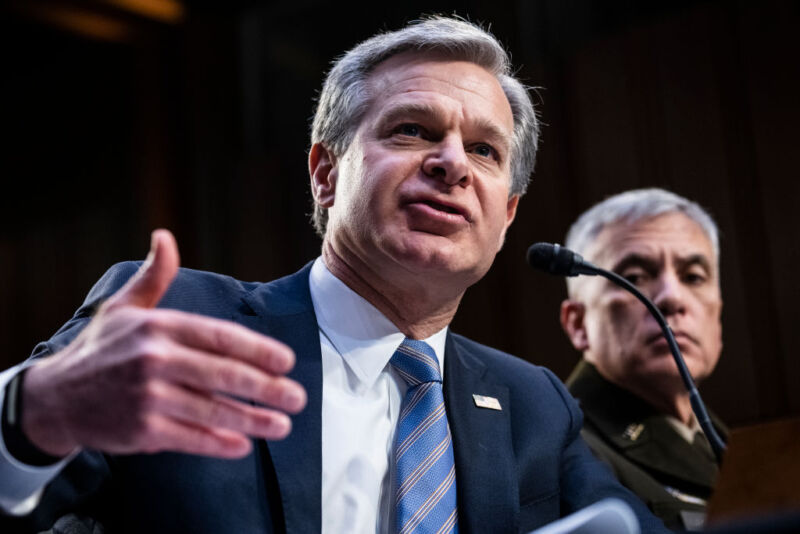
FBI Director Christopher Wray, left, and National Security Agency Director Gen. Paul Nakasone, testify during the Senate Select Intelligence Committee hearing on worldwide threats on Wednesday, March 8, 2023.

At a Senate Intelligence Committee hearing yesterday, FBI Director Christopher Wray confirmed for the first time that the agency has in the past purchased the location data of US citizens without obtaining a warrant, Wired reported.

This revelation, which has alarmed privacy advocates, came after Sen. Ron Wyden (D–Ore.) asked Wray directly, “Does the FBI purchase US phone-geolocation information?” Wray’s response tiptoed around the question but provided a rare insight into how the FBI has used location data to surveil Americans without any court oversight.

“To my knowledge, we do not currently purchase commercial database information that includes location data derived from Internet advertising,” Wray said. “I understand that we previously—as in the past—purchased some such information for a specific national security pilot project. But that’s not been active for some time.”

Americans are protected against unreasonable searches under the Fourth Amendment, and the Supreme Court has said that government agencies accessing location data without a warrant can be considered in violation of Fourth Amendment rights. But privacy advocates like the Electronic Frontier Foundation (EFF) have continually found evidence that federal agencies, including the FBI, have relied on a legal loophole to continue purchasing location data that agencies otherwise may not legally be able to access.

During the hearing, Wray said the FBI does not currently purchase location data and has “no plans to change that” right now. Instead, the FBI has a “court-authorized process” for seizing data, which may or may not be easier than obtaining a warrant. Wray didn’t specify how that process works.

The FBI and EFF did not immediately respond to Ars’ request for comment. [Update: Electronic Frontier Foundation Senior Staff Attorney Adam Schwartz told Ars, "US government agencies must not be allowed to do an end run around the Fourth Amendment by buying private information from data brokers who collect information about the precise movements of hundreds of millions of people without their knowledge or meaningful consent. This extremely sensitive information can reveal where we live and work, who we associate with, and where we worship, protest, and seek medical care." Demand Progress policy attorney Sean Vitka told Ars that there is "no sense of the scale" of how widely location data is used by government agencies, noting that "people like Senator Wyden have been asking the intelligence agencies to be transparent, and they have absolutely failed."] 


Feds purchasing location data remains a privacy concern

Wray’s comments come after years of scrutiny of federal agencies’ covert location data gathering. Last year, the EFF reported that within the past few years, “data brokers and federal military, intelligence, and law enforcement agencies have formed a vast, secretive partnership to surveil the movements of millions of people.”

The data that Wray pointed to—commercial databases including data gathered for online advertising—is only a small subset of the location data out there. Mobile devices can be used to track location data, and the EFF found that popular weather, coupon, and navigation apps also gathered location data that has been used by federal agencies to monitor US citizens. In 2020, The Wall Street Journal reported that the Department of Homeland Security had purchased location data on millions of Americans from data brokers like Venntel. More recently, the EFF revealed that Venntel appeared to be the same location data source of increasingly secretive warrantless local police efforts.

No federal law meaningfully guarantees online privacy in the US. To address privacy concerns, Congress has sought to pass new laws for decades, but no bill has made it through both chambers, and no bill has been designed to eradicate the risk of authorities purchasing data. Even the American Data Privacy and Protection Act, which lawmakers from both parties seemed to consider a significant step forward, doesn’t prevent law enforcement agencies from collecting data, Wired noted.

Rather than focus exclusively on restricting law enforcement agencies' sketchy data purchases, some privacy experts told Wired they’re pushing for enforcement of the Fair Credit Report Act to include a requirement that data brokers gain consent for selling consumer data. That would at least ensure citizens are aware of when sensitive data may be shared with police.

Vitka told Wired that if the FBI ever decides to purchase location data in the future, it should be more “forthcoming” with details so that Americans know when the FBI considers that an appropriate measure.

Suggesting that Congress should ban the FBI and other federal agencies from ever purchasing location data, Vitka said that Wray’s statements to the committee are “horrifying” enough to warrant investigating the agency’s past purchase of sensitive US data.

“The public needs to know who gave the go-ahead for this purchase, why, and what other agencies have done or are trying to do the same,” Vitka told Wired.

Ashley Belanger / Ashley Belanger is the senior tech policy reporter at Ars Technica, writing news and feature stories on tech policy and innovation. She is based in Chicago.

Zelensky Calls for a European Army as He Slams EU Leaders’ Response

      Jan 23, 2026 During the EU Summit yesterday, the EU leaders ...