Timeline: The Shocking Collapse of Silicon Valley Bank
"Just days ago, Silicon Valley Bank (SVB) was still viewed as a
highly-respected player in the tech space, counting thousands of U.S.
venture capital-backed startups as its customers.
But fast forward to the end of last week, and SVB was shuttered by regulators after a panic-induced bank run.
So, how exactly did this happen? We dig in below.
Road to a Bank Run
SVB and its customers generally thrived during the low interest rate
era, but as rates rose, SVB found itself more exposed to risk than a
typical bank. Even so, at the end of 2022, the bank’s balance sheet
showed no cause for alarm.
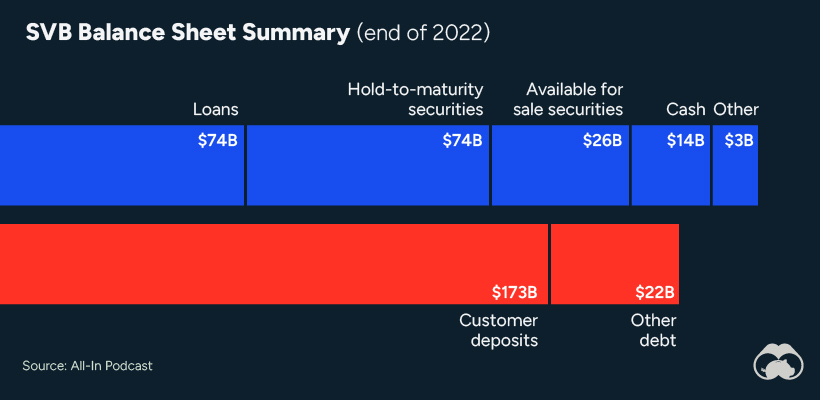
As well, the bank was viewed positively in a number of places. Most Wall Street analyst ratings were overwhelmingly positive on the bank’s stock, and Forbes had just added the bank to its Financial All-Stars list.
Outward signs of trouble emerged on Wednesday, March 8th, when SVB surprised investors with news that the bank needed to raise more than $2 billion to shore up its balance sheet.
The reaction from prominent venture capitalists was not positive,
with Coatue Management, Union Square Ventures, and Peter Thiel’s
Founders Fund moving to limit exposure to the 40-year-old bank. The
influence of these firms is believed to have added fuel to the fire, and
a bank run ensued.
Also influencing decision making was the fact that SVB had the
highest percentage of uninsured domestic deposits of all big banks.
These totaled nearly $152 billion, or about 97% of all deposits.
 The Federal Deposit Insurance Corporation (FDIC) insures up to $250,000 per account, per bank, for depositors.
By the end of the day, customers had tried to withdraw $42 billion in deposits.
What Triggered the SVB Collapse?
While the collapse of SVB took place over the course of 44 hours, its roots trace back to the early pandemic years.
In 2021, U.S. venture capital-backed companies raised a record $330 billion—double the amount seen in 2020. At the time, interest rates were at rock-bottom levels to help buoy the economy.
Matt Levine sums up
the situation well: “When interest rates are low everywhere, a dollar
in 20 years is about as good as a dollar today, so a startup whose
business model is “we will lose money for a decade building artificial
intelligence, and then rake in lots of money in the far future” sounds
pretty good. When interest rates are higher, a dollar today is better
than a dollar tomorrow, so investors want cash flows. When interest
rates were low for a long time, and suddenly become high, all the money
that was rushing to your customers is suddenly cut off.”
| Year | U.S. Venture Capital Activity | Annual % Change |
| 2021 | $330B | 98% |
| 2020 | $167B | 15% |
| 2019 | $145B | 1% |
| 2018 | $144B | 64% |
| 2017 | $88B | 6% |
| 2016 | $83B | -3% |
Source: Pitchbook
Why is this important? During this time, SVB received billions of
dollars from these venture-backed clients. In one year alone, their
deposits increased 100%. They took these funds and invested them in
longer-term bonds. As a result, this created a dangerous trap as the
company expected rates would remain low.
During this time, SVB invested in bonds at the top of the market. As interest rates rose higher and bond prices declined, SVB started taking major losses on their long-term bond holdings.
Losses Fueling a Liquidity Crunch
When SVB reported its fourth quarter results in early 2023, Moody’s Investor Service, a credit rating agency took notice. In early March, it said that SVB was at high risk for a downgrade due to its significant unrealized losses.
In response, SVB looked to sell $2 billion of its investments at a
loss to help boost liquidity for its struggling balance sheet. Soon,
more hedge funds and venture investors realized SVB could be on thin
ice. Depositors withdrew funds in droves, spurring a liquidity squeeze
and prompting California regulators and the FDIC to step in and shut
down the bank.
What Happens Now?
While much of SVB’s activity was focused on the tech sector, the
bank’s shocking collapse has rattled a financial sector that is already
on edge.
The four biggest U.S. banks
lost a combined $52 billion the day before the SVB collapse. On Friday,
other banking stocks saw double-digit drops, including Signature Bank
(-23%), First Republic (-15%), and Silvergate Capital (-11%).
| Name | Stock Price Change, March 10 2023 | Unrealized Losses / Tangible Equity |
| SVB Financial | -60%* | -99% |
| First Republic Bank | -15% | -29% |
| Zions Bancorp | -2% | -47% |
| Comerica | -5% | -47% |
| U.S. Bancorp | -4% | -55% |
| Fifth Third Bancorp | -4% | -38% |
| Bank of America | -1% | -54% |
| Wells Fargo | 1% | -33% |
| JPMorgan | -1% | -21% |
Source: Morningstar Direct. *Represents March 9 data, trading halted on March 10.
When the dust settles, it’s hard to predict the ripple effects that
will emerge from this dramatic event. For investors, the Secretary of
the Treasury Janet Yellen announced confidence in the banking system
remaining resilient, noting that regulators have the proper tools in
response to the issue.
But others have seen trouble brewing as far back as 2020 (or earlier)
when commercial banking assets were skyrocketing and banks were buying
bonds when rates were low."
The whole sector is in crisis, and the banks and investors that support these assets are going to have to figure out what to do.-Christopher Whalen, The Institutional Risk Analyst
.jpg)
.png)


.png)