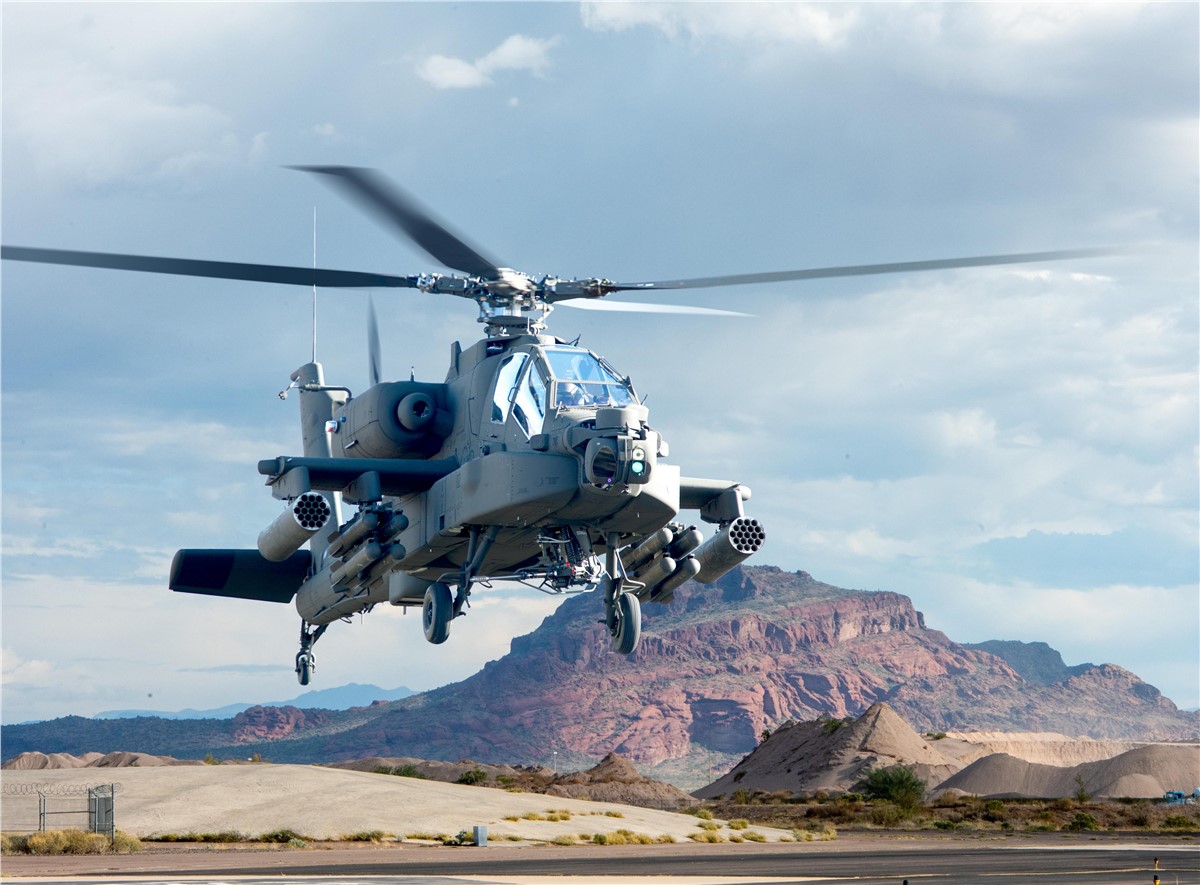
Boeing to Produce 184 Apaches for US Army, International Customers
The
AH-64E, built at the Boeing site in Mesa, Ariz., is the most advanced
multirole combat helicopter in the world. There are more than 1,275
Apaches currently in operation around the world.
Every quarter we provide our readers with the Aerospace & Defense Market Sentiment.
You can help us by answering a few questions. It will take less then 2 minutes of your time.
Boeing to Produce 184 Apaches for US Army, International Customers
Boeing will build E-model AH-64s for the U.S. Army and international operators
Australia is the 18th nation to select Apaches as their attack aircraft
Boeing [NYSE: BA] will build 184 AH-64E Apaches for the
U.S. Army and international customers, including the first Apaches for
Australia. This $1.9 billion award brings the total current funded value
of the contract to $2.1 billion, and has the potential to increase to
more than $3.8 billion with future obligations.
“We are enhancing the U.S. Army’s attack fleet, while supporting
additional partner nations and welcoming our newest Apache customer, the
Australian Army,” said Christina Upah, vice president of Attack
Helicopter Programs and senior Boeing Mesa site executive. “This
contract highlights the need for Apaches worldwide.”
The U.S. Army will receive 115 remanufactured Apaches, with an
additional 15 Apaches to be procured as options, ensuring significant
savings to taxpayers. The additional 54 aircraft will be delivered to
partner nations as part of Foreign Military Sales.
Global Military Helicopter - Market and Technology Forecast to 2027
Market forecasts by Region, by
Platform, and by Component. Country analysis, Market Overview,
Opportunity Analysis, and Leading Companies
Published: August 2019 - Pages: 222 pages
This award comes on the heels of the U.S. Army’s Apache fleet
surpassing five million flight hours, a milestone proving the AH-64 is
the most capable, reliable and versatile attack helicopter.
"This multi-year contract is critical for the warfighter and the
entire Apache team," said Col. John (Jay) Maher, U.S. Army Apache
project manager. "It demonstrates the Army's commitment to continue
putting unmatched capability into the hands of our nation’s finest,
while providing stability and predictability for the outstanding
citizens and companies that pour their talent into producing the best
attack helicopter in the world."
Boeing Global Services will continue to deliver optimal readiness for
the warfighter including training devices, spare provisions, support
and test equipment kits, depot support, field engineering and technical
manuals. Major advantages in the technical publication area allow for a
streamlined process approach to re-use data which reduces operational
and sustainment costs.
Under the first multi-year contract, signed in 2017, Boeing delivered
244 remanufactured Apaches to the Army and 24 new-build aircraft to an
international customer. The AH-64E, built at the Boeing site in Mesa,
Ariz., is the most advanced multirole combat helicopter in the world.
There are more than 1,275 Apaches currently in operation around the
world.
"Twenty
years ago, the United States invaded Iraq. It spent a decade breaking
the country and then trying to put it back together again. It spent
another decade trying to forget. “We have met our responsibility,” U.S.
President Barack Obama told the nation in 2010 while declaring a
short-lived end to the U.S. combat mission in Iraq. “Now, it is time to
turn the page.”
For Obama, moving on meant taking the fight to al
Qaeda and the Taliban in Afghanistan through a surge of U.S. troops.
Obama’s critics, for their part, soon found another reason to tell
Americans to “get over Iraq”: the debacle was, in their view, making the
president and the public too reticent to use military force, this time
to sort out Syria’s civil war, which erupted in 2011. Obama refrained
from striking Damascus, but he ended up deploying troops to Iraq and
Syriain 2014 to fight the Islamic State (also known as
ISIS), which emerged out of the maelstrom of the United States’
original invasion.
By 2021, it was President Joe Biden’s turn to urge
the country to move on from post-9/11 debacles. “I stand here today,
for the first time in 20 years, with the United States not at war,” he
declared in September. Biden had just withdrawn U.S. forces from
Afghanistan. The United States nevertheless continued to conduct
counterterrorism operations in multiple countries, including Iraq, where
2,500 ground troops remained. “We’ve turned the page,” Biden said.
Stay informed.
In-depth analysis delivered weekly.
Have we? Over two decades, Americans have
stubbornly refused to move on from Iraq. That is partly because the U.S.
military is still fighting there and many other places besides. More
profoundly, the country cannot “turn the page” without reading and
comprehending it—without truly reckoning with the causes of the war. It
may be painful to revisit what drove American leaders, on a bipartisan
basis, to want to invade a country that had not attacked the United
States and had no plans to do so, facts widely appreciated at the time.
Yet without looking back, the country will not move forward with
confidence and unity.
To be sure, Washington has absorbed several
hard-earned lessons from the conflict. American policymakers,
politicians, and experts now generally reject wars to change regimes or
rebuild nations. In weighing the use of force, they have rediscovered
the virtue of prudence. And they now appreciate that democracy is rarely
imposed at gunpoint and takes hard work to establish and preserve, even
in deep-rooted democracies such as the United States.
These are necessary lessons, but they do not
suffice. They reduce the Iraq war to a policy error, which could be
corrected while the United States goes on pursuing the hegemonic world
role it assigned itself when the Cold War ended. In fact, thedecision
to invade Iraq stemmed from the pursuit of global primacy. Primacy
directs the United States to fund a massive military and scatter it
across the globe for an essentially preventive purpose: to dissuade
other countries from rising and challenging American dominance.
Promising to keep costs low, primacy assumes that U.S. hegemony will not
engender resistance—and strikes hardto snuff out any
that appears. It sees global dominance almost as an end in itself,
disregarding the abundant strategic alternatives that wide oceans,
friendly neighbors, and nuclear deterrents afford the United States.
The invasion of Iraq emerged from this logic. After the 9/11
attacks, the architects of the invasion sought to shore up U.S.
military preeminence in the Middle East and beyond. By acting boldly, by
targeting a galling adversary not involved in 9/11, the United States
would demonstrate the futility of resisting American power.
As “shock and awe” gave way to chaos, insurgency,
destruction, and death, the war should have discredited the primacist
project that spawned it. Instead, the quest for primacy endures. U.S.
power is meeting mounting resistance across the globe, and Washington
wishes to counter almost all of it, everywhere, still conflating U.S.
power projection with American interests, still trying to overmatch
rivals and avoid curbing U.S. ambitions. The results were damaging
enough during the United States’ unipolar moment. Against major powers
armed with nuclear weapons, they may be much worse.
BULLY ON THE BLOCK
The ideological foundations for the Iraq war took
shape well before American tanks rolled into Baghdad in 2003. Just over a
decade earlier, three of the men who would become the most influential
officials in the George W. Bush administration—Dick Cheney, Colin
Powell, and Paul Wolfowitz—were working in the Pentagon to devise a new concept
to guide U.S. strategy in the post–Cold War world. Even though the
Soviet Union had collapsed, they wanted the United States to keep
projecting superior military power across the globe. In 1992, Powell,
then chairman of the Joint Chiefs of Staff, put the objective plainly.
The United States must possess “sufficient power” to “deter any
challenger from ever dreaming of challenging us on the world stage,” he
told Congress. “I want to be the bully on the block.”
So did Cheney, serving at the time as President
George H. W. Bush’s secretary of defense. He assigned his deputy,
Wolfowitz, to supervise the drafting of the Defense Planning Guidance,
a comprehensive framework for U.S. security policy written in 1992. In
46 pages, Wolfowitz and his colleagues explained how to sustain U.S.
global dominance in the absence of formidable rivals. The key, they
reasoned, was to think and act preventively. Lacking challengers to
balance against, the United States should keep new ones from emerging.
It must work to dissuade “potential competitors from even aspiring to a
larger regional or global role.” To this end, the United States would
maintain a massive military, sized to dwarf all others and capable of
fighting two large wars at once. It would retain alliances and garrison
troops in every region of the world that Washington considered to be
strategically significant. It would, in short, replace balances of power
with an American preponderance of power.
In this vision of American hegemony, the United
States would be benevolent. It would internalize the core interests of
allies and act to benefit much of the world. In formulating its own
foreign policy, the Pentagon planners recommended, the United States
should “account sufficiently for the interests of the advanced
industrial nations to discourage them from challenging our leadership or
seeking to overturn the established political and economic order.” U.S.
primacy would thereby suppress the security role of U.S. allies as well
as adversaries. Every nation, save one, would have nothing to gain and
much to lose by building military power of its own. In this way, the
United States could stay on top for good, delivering global security at
reasonable cost.
Bush addressing soldiers and their families in Fort Hood, Texas, January 2003
Jeff Mitchell / Reuters
There were two principal problems with this theory,
and they surfaced as soon as Wolfowitz’s draft leaked to reporters that
March. The first flaw was that the United States’ bid for hegemony
might induce others to push back. Rather than submit to perpetual peace
on Washington’s terms, other countries could develop capabilities to
counter U.S. might. With Russia
reeling after the Soviet Union’s collapse and China still poor, the
United States would not face determined opposition for years to come.
But the more the sole superpower expanded its defense commitments and
military reach, the more it might encounter and even stimulate
resistance. In time, the United States could find itself overstretched
and risking wars detached from U.S. interests, except for those
interests circularly created by seeking globe-spanning dominance in the
first place. Cheney’s Pentagon wanted American primacy to make
resistance futile. What if resistance made American primacy futile
instead?
It was also unclear whether the American people
would be willing to bear the costs of global dominance, especially if
those costs were to rise. The Pentagon’s document sparked an immediate
backlash. Conservative commentator Pat Buchanan, amid his insurgent
presidential campaign, denounced the plan as a “formula for endless
American intervention.” The bald ambition for primacy likewise repelled
leading Democrats, who favored a peace dividend for Americans and
collective security for the world. Biden, a U.S. senator at the time,
scoffed: “The Pentagon vision reverts to an old notion of the United
States as the world’s policeman—a notion that, not incidentally, will
preserve a large defense budget.” The Cold War consensus in favor of
containing Soviet communism had been forged in response to an existing
great-power threat. To police the post–Cold War world, which featured
sundry challenges but no major enemy, was a new and untested proposition
that more than a few Americans thought dubious.
The rest of the 1990s constituted the heyday of
American unipolarity, yet signs of international opposition and domestic
apathy abounded. China and Russia worked to resolve their bilateral
disputes and began to assemble what became the Shanghai Cooperation
Organization. Together, they touted “the multipolarization of the
world.” In a 1997 letter
to the UN Security Council, Beijing and Moscow declared, “No country
should seek hegemony, engage in power politics, or monopolize
international affairs.” Even some American allies voiced similar
concerns. Two years later, French Foreign Minister Hubert Vedrine dubbed
the United States a “hyperpower” and called for “real multilateralism
against unilateralism, for balanced multipolarism against unipolarism.”
Most nettlesome at the time were the so-called
rogue states of Iran, Libya, North Korea, and especially Iraq. After
expelling Iraqi forces from Kuwait in 1991, the U.S. military did not
try to depose Iraqi dictator Saddam Hussein, but U.S. officials hoped
Saddam would fall and encouraged popular uprisings by the country’s
Shiite majority in the south and its Kurdish minority in the north. When
Saddam held on by suppressing these uprisings and killing thousands of
Iraqis, the United States did not walk away. For the rest of the decade,
it contained Iraq through no-fly zones, routine bombings, weapons
inspections, and economic sanctions. For this purpose, among others, the
United States indefinitely stationed tens of thousands of troops in the
Persian Gulf, including in Saudi Arabia, for the first time in history.
The Iraq War was not just a policy error.
President Bill Clinton embraced his predecessor’s
goal of hegemony in the Middle East and pursued the “dual containment”
of Iran and Iraq. Yet this was not enough to satisfy right-wing
primacists. In 1997, intellectuals William Kristol and Robert Kagan
formed the Project for the New American Century, a think tank devoted to
a foreign policy of “military strength and moral clarity.” For them,Saddam’s
Iraq represented unfinished business. The dictator was “almost certain”
to acquire deliverable weapons of mass destruction—WMD—and use them to
challenge U.S. forces and partners in the region, according to the
group’s 1998 open letter,
signed by Donald Rumsfeld, Wolfowitz, and a handful of other soon-to-be
officials in the George W. Bush administration. The United States, they
argued, must seek regime change in Iraq—a goal enshrined as U.S. policy
by the Iraq Liberation Act later that year. The resolution passed the
House overwhelmingly, 360 to 38, and the Senate unanimously. The rise of
this “regime change consensus,”
as historian Joseph Stieb writes, did not make a full-scale invasion a
serious possibility before 9/11. But it delegitimized the alternative
policy of leaving Saddam in power while keeping him contained.
Washington had set its desired end: ousting Saddam.
The means were another matter. After winning the
Gulf War and helping to reunify Germany within NATO, President George H.
W. Bush had been booted from office in 1992. The voters preferred a
Vietnam War draft evader promising to “focus like a laser beam on the
economy.” Clinton, for his part, had taken pains to minimize U.S.
casualties even as he used military force frequently and enlarged
American alliances. The death of 18 U.S. Rangers in Mogadishu in 1993
caused him to withdraw from Somalia completely and brought the term
“mission creep” into the American lexicon. Clinton’s most daring
intervention, intended to stop ethnic cleansing in Kosovo, relied on
airpower alone. NATO planes flew high enough to remove any risk to pilots, even though doing so made targeting less accurate.
Madeleine Albright, Clinton’s secretary of state,
is remembered for proclaiming the United States to be “the indispensable
nation.” Often forgotten is that she did so at a televised town hall in
1998 in Columbus, Ohio, during which her defenses of American policy in
Iraq were met with hostile questions and occasionally drowned out by
hecklers. The first post–Cold War decade showed that such opposition
would not swell into a determined political force as long as the United
States could exercise global hegemony on the cheap. If the costs went
up, however, who could say? How could an “indifferent America,” as
Kristol and Kagan lamented in these pages, be made to “embrace the possibility of national greatness, and restore a sense of the heroic”?
Even inside the Beltway, the depth of support for a
muscular U.S. foreign policy was questionable. As the Clinton
administration came to a close, Wolfowitz justifiably bragged
that the ideas in his Defense Planning Guidance, much maligned on its
introduction years earlier, had become conventional wisdom in both
political parties. Writing in The National Interest in 2000, he
nevertheless admitted: “In reality today’s consensus is facile and
complacent.” As Wolfowitz bemoaned, the country displayed a “lack of
concern about the possibility of another major war, let alone agreement
about how to prevent one.” Most of Washington was now singing from the
same hymn book, but in Wolfowitz’s eyes, there were alarmingly few true
believers.
DEMONSTRATING DOMINANCE
That started to change on September 11, 2001. The
9/11 attacks supplied a sense of existential threat that gave purpose to
American power after a decadelong search. But the attacks could have
been interpreted very differently: as a horrific case of blowback and a
portent of resistance to U.S. hegemony. In the days and weeks following
9/11, more than a few Americans entertained this possibility as they
tried to understand why 19 terrorists would give their lives to kill
people halfway across the globe. The writer Susan Sontag suggested
the attacks were “undertaken as a consequence of specific American
alliances and actions.” Osama bin Laden, after all, had declared war on
the United States years before, citing three main grievances: the U.S.
troop presence in Saudi Arabia, American coercion of Iraq, and U.S.
support for Israel. In TheNew York Times, journalist Mark Danner pointed out:
“The American troops and warships in the Gulf, the unpopularity of our
presence there, the fragility of the regimes we support—these facts are
not secrets but among Americans they are not widely known.”
After 9/11, those facts might have become more
widely known, especially if the United States had stayed focused on the
specific enemy that attacked it: al Qaeda.
Americans might have concluded that the way to make themselves safe
from terrorists in the Middle East was ultimately to stop occupying the
region and killing people there. They might have asked, once the United
States retaliated for 9/11, whether the quest for global dominance was
diminishing their own security.
For President George W. Bush and his foreign policy
principals, it was crucial that the country come to a different
conclusion: the problem was not too much American power but too little.
The attackers, they assured Americans, were motivated by pure evil and
not at all by anything the United States might have done. “Americans are
asking, why do they hate us?” Bush said in an address to the nation
nine days after 9/11. His answer: “They hate our freedoms.”
Just as important, “they” were not only the
jihadists of al Qaeda. To focus solely on the group that had attacked
New York and Washington would miss the larger stakes, namely the
struggle to sustain U.S. global hegemony against all manner of
opposition. As Wolfowitz, now deputy secretary of defense, told Congress
on October 4, 2001, “Osama bin Laden, Saddam Hussein, Kim Jong Il and
other such tyrants all want to see America out of critical regions of
the world.” The 9/11 attacks were just an instance of resistance, which
had to be confronted as a whole. “That is why our challenge today is
greater than winning the war against terrorism,” Wolfowitz continued.
“Today’s terrorist threat is a precursor of even greater threats to
come.”. .
Viewed in this light, the 9/11 attacks presented
the Bush administration with an opportunity. By mounting a spectacular
response, the United States could nip gathering international resistance
in the bud. It could dissuade a wide variety of potential adversaries
from “even aspiring” to a larger role, as the 1992 Defense Planning
Guidance had urged. This time, moreover, the nation’s leaders could
galvanize public support. At last, the American people would positively
embrace, not just passively accept, the once abstract primacist mission.
For such purposes, not even a “global war on
terror” would suffice. The United States must “go massive,” Rumsfeld
told an aide four hours after the Twin Towers fell. According to the
aide’s notes of the conversation, Rumsfeld said, “Sweep it all up.
Things related and not.” That meant hitting “S.H. @ same time—Not only
UBL” (referring to Saddam and bin Laden). U.S. intelligence promptly
identified al Qaeda as the perpetrator of the hijackings, yet Rumsfeld,
along with Wolfowitz and other officials, began advocating an attack on
Iraq. The idea struck the National Security Council’s counterterrorism
coordinator, Richard Clarke, as nonsensical. “Having been attacked by al
Qaeda, for us now to go bombing Iraq in response would be like our
invading Mexico after the Japanese attacked us at Pearl Harbor,” Clarke later recalled saying
on September 12. As the country embarked on an uncertain war in
Afghanistan against a shadowy enemy that might well strike again, it was
remarkable for senior officials to contemplate invading Iraq, too, let
alone to devote 130,000 soldiers to the task within 18 months.
The Bush administration advanced several rationales
for attacking Iraq, but at the center were allegations (some but not
all of which were backed by U.S. intelligence) that Saddam was
stockpiling chemical and biological weapons and seeking to develop
nuclear weapons. The United States might not have invaded if officials
had known that Saddam’s weapons program was a mirage, a bluff intended
to bolster the dictator’s power and ward off enemies such as Iran. It is
nonetheless difficult to know how much explanatory weight to give to
the fear that Saddam might one day pass WMD to terrorists, who could
then employ them on the U.S. homeland—a nightmare scenario conjured by
many advocates of the war. The prospect was always entirely speculative,
although policymakers did not want to suffer another “failure of
imagination” after failing to anticipate how commercial airliners could
be hijacked and turned into missiles.
But whereas Saddam might never use WMD against the
United States proper, it was more certain that his presumed weapons
would pose an obstacle to American designs in the Middle East. “A
likelier problem was that they would affect our willingness to defend
U.S. interests,” Douglas Feith, who served as undersecretary of defense
during the run-up to the war, subsequently wrote.
Revealingly, Feith dismissed as “beside the point” the possibility that
Saddam had no intention of attacking the United States. “Saddam might
even prefer to leave us alone,” he acknowledged. “The issue was whether
Iraq’s WMD capabilities would compel us to leave him alone—free to
attack Americans and our friends and interests.” That is, a well-armed
Saddam would impede U.S. hegemony in the Middle East. Taking him out
would make American dominance more secure, whether or not it was the
best way to protect the United States itself.
Sometimes the Iraq war seems to have vanished from collective memory altogether.
Retrospective accounts, including a recent book by historian Melvyn Leffler,
fixate too narrowly on the issue of WMD, a far from sufficient cause of
the invasion. Even if Bush administration officials had not
misrepresented some of the intelligence concerning Iraq’s programs, the
desire to disarm Saddam would not account for key aspects of the march
to war. Fear of Saddam’s arsenal is an inadequate explanation for why
the Bush administration moved so rapidly after 9/11 to attack Iraq,
which was not thought to be on the cusp of acquiring a major new type of
weapon. Nor can it account for why the Bush administration pulled UN
weapons inspectors out of Iraq in March 2003, by which time the UN team
had conducted more than 550 inspections without notice, believed it was
making progress, and wanted to continue. If disarming Saddam had been
the paramount motivation, the Bush administration could have allowed the
inspections to continue and potentially avoided war. To the contrary,
some advocates of an invasion, such as Cheney, had never wanted to give
weapons inspections a chance.
The rush to war is better explained by a desire to
shore up U.S. primacy soon after the United States was beset by a
devastating attack. “The demonstration effect”
was how Cheney’s deputy national security adviser at the time, Aaron
Friedberg, later characterized the thinking. The administration aimed
“not just to be a tough guy but to reestablish deterrence,” he told the
journalist Barton Gellman. “We have been hit very hard, and we needed to
make clear the costs to those who might have been supporting or
harboring those who were contemplating the acts.” It was imperative to
do something big, to restore a general sense of fear without which U.S.
global hegemony could provoke endless antagonism. “If the war does not
significantly change the world’s political map, the U.S. will not
achieve its aim,” Rumsfeld wrote Bush
on September 30. The United States should seek, among other things,
“new regimes in Afghanistan and another key State (or two).”
From this standpoint, it scarcely mattered whether Iraq was connected
to the 9/11 attacks, what the precise status of its weapons program
was, or whether the U.S. government could align on a plan to govern Iraq
before dismantling its regime. What mattered was the
“order of magnitude of the necessary change,” in Rumsfeld’s phrasing.
What mattered, as political scientist Ahsan Butt argues,
was that the United States would destroy an adversary and send a
message: don’t underestimate our power or our willingness to use it.
The war’s architects doubtless believed they were
protecting U.S. national security. Yet what they were directly
attempting to achieve was something distinct: fortifying the United
States’ preeminent power position through a preventive war. Although
they assumed that such preeminence was necessary for American security,
the very argument for the Iraq war should have suggested otherwise.
Ousting Saddam required the United States to pay upfront costs in lives
and treasure in return for highly speculative benefits. (If the costs
appeared minimal at the outset, that was only because the war’s
cheerleaders discounted the possibility that U.S. forces would be
treated as invaders and occupiers. “We will, in fact, be greeted as
liberators,” Cheney promised in March 2003.) The potential benefits of
removing Saddam would accrue to Israel, Saudi Arabia, and other U.S.
security partners in the region. The United States would benefit only
insofar as maintaining U.S. hegemony in the Middle East was worthwhile.
But could the United States better obtain security for itself by
reducing its involvement in the region? The question went unexamined as
the pursuit of primacy ironically deflected from its deadly costs by
generating new and deadlier missions.
DOMESTIC BLOWBACK
Over the next decade, Americans would hear no
shortage of reasons for why the war in Iraq went wrong: the Bush
administration failed to plan for postwar reconstruction. It let the
Iraqi state collapse into civil war. Democracy is rarely imposed at the
point of a gun. Nation building does not work.
Those insights are all true and meaningful. They
are also inadequate. A parade of small lessons allowed larger ones to go
unlearned—and allowed the war’s supporters to avoid scrutiny of their
main misconceptions. A year into the war, Kristol and Kagan conceded
that Bush had “not always made the right decisions on how to proceed”
in reconstructing Iraq while urging U.S. forces to remain “as long as
needed.” In an influential 2005 book on the war, the writer George
Packer blasted the Bush team for “criminal negligence.” The problem with
the invasion, in his view, lay less in its conception than in its
execution. “The Iraq war was always winnable; it still is,” he concluded. “For this very reason, the recklessness of its authors is all the harder to forgive.”
Small wonder that the targets of Packer’s critique
adopted a similar stance, the better to redeem the decision for war and
salvage the ongoing campaign to fight insurgents and terrorists and
establish a viable Iraqi state. In 2006, Bush and Secretary of State
Condoleezza Rice admitted to errors in “tactics”—“thousands of them, I’m sure,” Rice added unhelpfully. They nonetheless cast the invasion as strategically sound.
By then, the American public was turning against
the war and Washington’s excuses. Over the next decade, voters delivered
three electoral surprises that revealed the depth of their discontent.
Invading Iraq was supposed to demonstrate American power and
Washington’s will to shape the world, unconstrained by internal doubt or
external norms. When political elites proceeded to treat the war as a
tactical mistake, born of incorrect intelligence or insufficient
planning, they did not eliminate the sense of existential purpose with
which they initially invested the invasion. Instead, they tried to paper
over the war’s deeper meaning, only to be hit by blowback at home, as
well as abroad.
An Iraqi man suspected of having explosives being detained near Baquba, Iraq, October 2005
Jorge Silva / Reuters
The first surprise came in the congressional
election of 2006. Bush’s White House expected to wield the war to the
Republican Party’s advantage, accusing Democrats of “retreat and
defeatism,” in Cheney’s words. By Election Day, it was the GOP that had
retreated from the debate. Led by Nancy Pelosi, who decried the invasion
as a “grotesque mistake,” Democrats won the House of Representatives
after 12 years of Republican rule. A majority of voters viewed the Iraq
war as the single most important issue of the election and expected
Democrats to reduce or terminate U.S. military involvement in the
country.
Bush, however, ordered a “surge” of troops into
Iraq as a last-ditch effort to stabilize the country. The next election,
in 2008, produced an even bigger surprise: the victory of Obama, young,
Black, and liberal, over the more senior senators Hillary Clinton and
John McCain. Both Clinton and McCain had voted to authorize the Iraq
war. Obama stood out for opposing it in October 2002 as “dumb” and
“rash.” His stance on Iraq constituted perhaps his chief advantage in
the primary campaign. “I don’t want to just end the war,” he declared.
“I want to end the mindset that got us into war in the first place.”
Obama seemed to offer a clean break not only from the Bush
administration but also from a “foreign policy elite that largely
boarded the bandwagon for war,” as he put it on the campaign trail.
The clean break turned out to be a false one.
In office, Obama treated the “mindset” behind the war mostly as a
psychological deficiency. Whereas Bush had acted impulsively, Obama
would think carefully. He would calculate consequences before opening
fire. Obama withdrew U.S. forces from Iraq in 2011, but he kept the war
in Afghanistan going and ended up sending troops back to Iraq in 2014.
Meanwhile, he maintained the security partnerships he inherited and
enlarged and routinized a program of terrorist killing by drones and
special forces. Obama found himself bogged down in the Middle East,
perhaps against his better judgment, for much the same reason that his
predecessor had launched the war in Iraq: the United States sought to
remain the dominant power in the region and, as Obama repeated, the
“indispensable nation” globally.
In the next presidential election, Washington presumed that George W. Bush’s younger brotherJeb
would be the Republican frontrunner. The former Florida governor became
a political casualty of his brother’s war. At first, asked if he would
have invaded Iraq even “knowing what we know now,” he said yes. Then he
attempted to skirt follow-up questions. Finally, he decided he would not
have invaded after all. It fell to Donald Trump to capitalize on the
public’s untended outrage. The demagogue delivered the third shock to
the political establishment when, in 2016, he blasted the war as
possibly the “worst decision” in American history. Trump was lying when
he claimed to have opposed the invasion all along, but at least he
recognized in hindsight that the war was a disaster. It was proof enough
for some voters to trust him as commander in chief and ignore the
chorus of elites that deemed him unfit to lead.
UNFINISHED BUSINESS
Today, political leaders once again seek to turn
the page. Perhaps the appearance of forbidding adversaries will allow
them to succeed where prior efforts failed. In the face of China’s rise
and Russia’s aggression, the United States has acquired renewed purpose
for its global power. Never mind that balancing behavior by major powers
was exactly what U.S. global primacy was supposed to avert: now that
its theory of the case has come up short, Washington wants to look
forward, not backward. Sometimes the Iraq war seems to have vanished
from collective memory altogether. Biden recently referred to Russia’s
war against Ukraine as the only large-scale invasion the world has
witnessed in eight decades. “The idea that over 100,000 forces would
invade another country—since World War II, nothing like that has
happened,” Biden proclaimed in February. He spoke these words within a
month of the 20th anniversary of the U.S. invasion of Iraq, a war that
then Senator Biden voted to authorize.
Attempting to forget is the only way to guarantee
failing to learn. If the United States applies to peer competitors the
same will to dominate that brought it into Iraq, a far weaker country,
the consequences will be severe.
The “next Iraq” could well take the
form of a great-power war.
Few Americans would seek such a conflict, but neither did many advocate
for a direct invasion of Iraq before 9/11 or anticipate the scale and
duration of Operation Iraqi Freedom before it commenced. The pathologies
of primacy made war appear necessary and worth the price, and those
pathologies continue to put the United States on a collision course with
other countries. First, Washington conflates U.S. interests with its
far-flung military positions and alliance commitments, almost excluding
in advance the possibility that offloading some responsibilities could
increase American security and enhance American strategy. Second,
Washington systematically discounts how its power threatens others, who
then act accordingly. Together, these errors force U.S. foreign policy
to fight the tendency of power to balance power, just when an
overstretched United States needs to harness that tendency.
Since February 2022, the United States has rightly
helped Ukraine defend itself against Russia’s brutal invasion. Yet it
has evaded serious consideration of U.S. policy mistakes that set the
stage for this conflict and potentially more to come. By enlarging NATO
through an open-ended, open-door process, the United States extended its
dominance of European security affairs while hoping that Russia would
not turn hostile. That hope was naive from the start. The creation of a
dividing line within Europe, creeping ever closer to Moscow, rendered
especially vulnerable whichever countries NATO would not admit.
The “next Iraq” could well take the form of a great-power war.
NATO expansion therefore came at the expense of
Ukraine—and the United States. By entrenching its dominance of European
defense, the United States gave its allies ample reason to outsource
their security to Washington. As a result, it now falls principally on
the United States to orchestrate international aid for Ukraine and to
put its soldiers and cities on the line if Russia were to attack NATO
countries in the future. The only escape from this self-imposed trap is
to break with the logic of primacy and gradually but decisively turn
leadership of European defense over to the Europeans, who can mobilize
ample resources to deter Russia and defend their territory.
As it runs greater risks in Europe, Washington is
also barreling toward confrontation with Beijing. An emerging bipartisan
consensus seeks to get ever tougher on the world’s number two power.
Yet what the United States wants its relationship with China to consist
of in the coming decades remains ill defined and superficially
considered. A hostile direction, without a desired destination,
makes for unwise policy. Although passions are less intense and the
public less engaged, the environment in Washington increasingly
resembles the lead-up to March 2003, when politicians and officials,
eager to take on an adversary, neglected to assess the potential
trajectories of a post-Saddam Iraq and underestimated the agency of
others in determining the outcome.
If the United States and China are serious about
avoiding a cold war, or a world-rending shooting war, both sides will
have to work to establish terms of coexistence. Yet those terms are
getting more elusive by the day. Amid the torrent of objections to
Chinese practices, it often seems that the United States opposes China’s
rise altogether. After the Trump administration identified China as a
threat, Biden has taken potentially fateful measures, eroding the “one
China” policy that has allowed Washington and Beijing to agree to
disagree over Taiwan and imposing broad restrictions on China’s access
to technology, including advanced semiconductors. How China will react
is not yet known, but its capability to harm the United States is
substantial. In defending its preeminent power position—which ought to
be a means to an end—the United States is assuming enormous risks
without appreciating how intensified rivalry could make Americans poorer
and less safe.
Better options are available: the United States should
disentangle itself from the Middle East, shift defense burdens to
European allies, and seek competitive coexistence with China. If it
sometimes sounds as though policymakers are doing just that, the facts
say otherwise. For all the talk of strategic discipline, about as many
U.S. troops are stationed in the Middle East today, around 50,000, as
there were at the end of the Obama administration. Washington is still
in thrall to primacy and caught in a doom loop, lurching from
self-inflicted problems to even bigger self-inflicted problems, holding
up the latter while covering up the former. In this sense, the Iraq war
remains unfinished business for the United States."






.jpg)
.jpg)
.jpg)

.jpg)


.jpg)