Mohamed A. El-Erian ... is Chief Economic Advisor at Allianz, the corporate parent of PIMCO where he formerly served as chief executive and co-chief investment ...
It also comes equipped with multilingual dialogue features to accommodate languages from all over the world.
How does it work?
Users can create an AI Chatbot Clone, which can personally interact with others 24/7 via a question-and-answer format.
They can also upload information about themselves, their careers, or businesses directly into their chatbot profile.
However, users are always urged to be careful about what sort of information they share online.
People can then ask questions and their AI chatbot clone will respond in a conversational way.
"Your social media can now talk with people, not at them," InWith AI CEO and Founder Michael Hayes said.
"Our launch gives everyone famous or infamous, big or small, their
own AI chatbot where all their friends, fans or strangers can interact
with them at any time," Hayes added.
"We now live in a world of chatbots and AI interactions and these
instruments are great relationship-building and engagement tools. All of
which is garnering unprecedented interest."
"A RUSSIAN fighter jet has intercepted a pair of US nuclear bombers as Vladimir Putin ordered his own planes into the sky.
Footage taken from the Su-35 shows it flying beside one of two
massive B-52s while Russian Tu-95 Bear nuclear bombers were seen taking
off in a show of force from the Russian tyrant.
10
The moment a Russian Su-35 intercepted the US B-52 bombers
10
Russian TU-95 bombers also took to the skiesCredit: East2West
10
Footage of one of the B-52s taken from the Russian fighter jet
10
The Russians intercepted the US bombers over the Baltic Sea
10
The US planes were first escorted by Polish fighter jets
10
The encounter between the US and Russian planes was the first between the sides since the drone clash.
Before the B-52s were intercepted by Vladimir Putin's planes, a photo shows them being escorted by Polish F-16 jets over the Baltic Sea.
✓ It comes after Russian fighter jets dumped fuel on a US Reaper drone before crashing into it above the Black Sea.
In the latest incident, Russia’s defence ministry said its radar
detected two targets which were identified as US Air Force B-52H
bombers, the state-owned TASS news agency reported.
The ministry said a Su-35 fighter jet took to the air in order to prevent a border violation.
After that “the foreign military aircraft moved away from the Russian
Federation state border, the Russian fighter returned to its base
airfield".
The Su-35's flight was strictly in line with international rules of
the use of airspace during Monday's incident, added the ministry.
"No violation of the state border of the Russian Federation was permitted," it said.
At the same time, Putin ordered up two of his own Tu-95MS - the
world’s only propeller-powered strategic bombers - with Su-30SM and
Su-35S warplanes providing fighter support in eastern Russia.
The move saw Putin flexing his nuclear muscles as it was announced
that Japanese Prime Minister Fumio Kishida is making a surprise trip
today to Ukraine.
"Two Tu-95MS strategic missile-carrying bombers of long-range
aviation performed a scheduled flight in the airspace over the neutral
waters of the Sea of Japan,” said the Russian defence ministry.
“The flight lasted over seven hours.”
The United States has a number of military bases on Japan, including ones just across the Sea of Japan from Russia.
The Russians didn't reveal where the Su-35s flew from but some are
known to be based in Kaliningrad, a Russian enclave on the Baltic.
Flight tracking website Flightradar24 shows the one plane taking off
from a base in Spain, flying over Sweden and then into international
airspace, where it was intercepted.
The plane continued to Estonian airspace before flying back over the Baltic Sea.
The site explained that one plane showed up as it had its location
transponder turned on, while the other most likely had it off in order
to avoid setting off collision alerts.
During last week’s clash a Russian Su-27 jet struck the propeller of the MQ-9 Reaper drone - forcing it to crash into the sea.
The drone was taken down while flying near Russian-occupied Crimea and the Ukraine frontline on Tuesday.
What is the B-52 bomber?
The B-52 Stratofortress is a US Air Force's heavy bomber which has been in use since the mid-1950s.
One of the reasons why the plane - which has a 150ft wingspan - is still in use is its staggering flying range of 9,000 miles.
And then there's the awe inspiring payload capability.
In fact its enormous size means they can carry more than 30 tonnes of bombs.
The hulking bomber can also be fitted with large numbers of nuclear-able cruise missiles and precision air-to-surface rockets.
B-52s were synonymous with the bombing of North Vietnam and Cambodia in the 1960s and 1970s during the Cold War.
Its destructive capability was also demonstrated in the Iraq and
Afghanistan wars where they were used to demolish caves and underground
facilities.
The majority of the 76-strong fleet are based at Barksdale in Louisiana and Minot in North Dakota.
The planes also fly missions from bases outside the US, including the UK and Spain.
Prior to the collision, which happened at 7am local time, two Su-27s
had "dumped fuel on and flew in front of the MQ-9" in a "reckless" and
"unprofessional" manner, the US military said.
Footage of the moment has now been released by the US European Command.
It shows one of the Russian fighter jets zooming towards the drone before flying above it - dumping fuel on it.
Horrified US military personnel in Germany watched a live feed from
the drone as the Russian jets repeatedly flew around it, dumping fuel to
damage cameras and sensors.
Senior US officials have been worried for months that some sort of
incident over the Black Sea could lead to miscommunication and
confrontation.
The Russians said the drone manoeuvred sharply and crashed into water
after its fighter jets were scrambled to intercept it near Crimea.
Moscow denied its warplanes came into contact with the drone and
insisted they didn't fire their weapons to shoot down the drone, which
would have been an act of war.
The area has seen intense NATO military activity and is close to the frontlines of the Ukraine war.
The Russians reportedly said they won the race to retrieve the drone from the 3,000ft under the Black Sea.
I cover foreign news
for The Sun Online. I started on local and regional papers. In the past
I’ve work as a reporter for Metro newspaper, Evening Standard, the
Sunday Telegraph and the Daily Mail Online. I’ve also been a Political
Correspondent for the Press Association. I work on breaking news and
exclusives and cover everything from China, the war in Ukraine and Russia.
Now the Legislature is studying a "state dementia plan,"
with an alarming rise in Alzheimer's disease. “We call it the silver
tsunami,” state Rep. Jennifer Longdon, D-Phoenix, said Wednesday at a
news conference at the state Capitol, according to Arizona Public Media.
“The number of folks who are projected to experience Alzheimer’s in the
coming years is going to be significant.”
"One
of the many lies the boosters tell is that Arizona is a youthful state.
Yet according to the U.S. Census Bureau, 18.3% of the state's residents
are 65 years or older. That compares with 16.8% nationally and — among
peer Western states, 15% for Colorado, 16% for Washington, yet
surprisingly 18% for Oregon (home of Portland, "where young people go to
retire").
Either way you slice the baloney, Arizona is a state with a sizable
cohort of older people. It's not surprising. Since 1960, when Del Webb
built his pioneering Sun City development west of the Santa Fe Railway
tracks and Grand Avenue northwest of Phoenix, Arizona has marketed
itself to retirees.
One of our long-lost commenters — I believe it was Concern Troll —
made the point that a huge piece of the state economy is dependent on
retirees, including their Social Security and pension checks, and the
vast system of hospitals, medical workers, and caregivers who serve
them.
According to the Social Security Administration, more than $69
million was dispersed in Arizona in 2021, the latest data available. The
average monthly check is modest: 574.76. And not all this goes to
seniors. Still...
✓ It's only one window into the advantages and disadvantages of being a retirement destination.
Advantages include a built-in economic engine with local spending,
supporting large numbers of medical establishments, and the incentive to
build more retirement "communities." But disadvantages loom large..."
Factoids: Tucson’s mayor, Regina Romero, launched Tucson Million Trees in 2020, an initiative to plant 1m
drought-tolerant shade trees to help mitigate the impact of climate change.
The work in Dunbar Spring, along with Lancaster’s books and website,
have inspired people worldwide to take up water harvesting to irrigate
native food-bearing street trees. “In almost every neighborhood in
Tucson, you can now find at least one property doing this,” he said.
The work of Dunbar Spring neighborhood foresters has also informed Tucson’s climate action plan, including legalizing citywide rainwater harvesting and planting arid-adapted trees.
‘A living pantry’: how an urban food forest in Arizona became a model for climate action
Samuel Gilbert
Tue 21 Mar 2023 06.00 EDT
8 - 10 minutes
"Near downtown Tucson, Arizona,
is Dunbar Spring, a neighborhood unlike any other in the city. The
unpaved sidewalks are lined with native, food-bearing trees and shrubs
fed by rainwater diverted from city streets. One single block has over
100 plant species, including native goji berries, desert ironwood with
edamame-like seeds and chuparosa bushes with cucumber-flavored flowers.
This
urban food forest – which began almost 30 years ago – provides food for
residents and roughage for livestock, and the tree canopy also provides
relief to residents in the third-fastest
warming city in the nation. It has made Dunbar Spring a model for other
areas grappling with increased heat, drought and food insecurity caused
by the climate crisis.
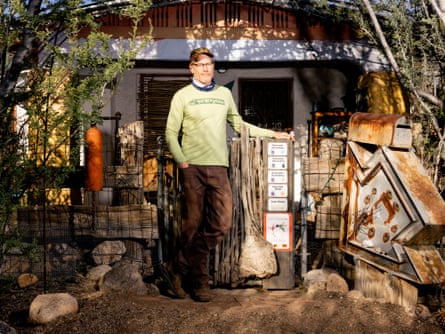
“We’re creating a living pantry,” said Brad Lancaster, a resident and co-founder of the Dunbar/Spring Neighborhood Foresters organization, which planted the urban food forest.
Brad Lancaster, a resident and co-founder of the Dunbar/Spring Neighborhood Foresters. Photograph: Cassidy Araiza/The Guardian
Dunbar
Spring’s urban food forest began on an early morning in September 1996,
when residents gathered for the first-ever community-wide tree-planting
event. Like many lower-income areas in Tucson, Dunbar Spring was
unusually hot, lacking the street tree cover to provide shade during the
city’s brutal summers. Temperatures today are 4.5F warmer than in the 1970s.
>The
plan, headed up by Lancaster, was to plant multi-use drought-tolerant
shade trees in streetside basins that could capture rainwater and create
“a more livable community”, he said.
> Almost 30 years later,
neighborhood foresters have planted more than 1,700 trees and thousands
more understory plants, transforming Dunbar Spring into an urban food forest fed by rainwater. . .
✓ The work in Dunbar Spring, along with Lancaster’s books and website,
have inspired people worldwide to take up water harvesting to irrigate
native food-bearing street trees. “In almost every neighborhood in
Tucson, you can now find at least one property doing this,” he said.
Left:
A tree-lined street and shrubs in the Dunbar Spring neighborhood.
Right: The executive director of Tucson Clean and Beautiful, Katie
Gannon, planting trees in the Roberts/Naylor neighborhood on a recent
Saturday. Photograph: Cassidy Araiza/The Guardian
The work of Dunbar Spring neighborhood foresters has also informed Tucson’s climate action plan,
including legalizing citywide rainwater harvesting and planting
arid-adapted trees. Fatima Luna, the city of Tucson’s climate and
sustainability adviser, said Dunbar Spring demonstrates how storm water
harvesting can be implemented at the neighborhood scale “using low-tech,
low-cost technologies that direct runoff into vegetated basins where it
infiltrates the soil and supports native vegetation”. . .
On a cloudy Saturday in January,
Katie Gannon, arborist and program manager for Tucson Million Trees,
gathered with program staff and volunteers in the A Mountain
neighborhood for a tree-planting event. The goal that day was to plant
97 desert-adapted shade trees, including pomegranate and fig trees,
outside three dozen homes – which would provide food and cooling shade
to residents. . .
On rainy days, Dunbar Spring looks
completely different. First Avenue, which runs through the entire
neighborhood, transforms into a rushing stream, filling streetside
basins, planted roundabouts and other earthworks with water. These water
management practices, Lancaster said, are rooted in Indigenous
rainwater harvesting techniques, in particular Ak-Chin runoff farming, practiced in the Sonoran desert for millennia.
✓ For
Lancaster, city streets hold vast, untapped potential. One mile of road
in Tucson drains over a million gallons of storm water runoff a year,
enough to support 400 native food-bearing trees, said Lancaster.
✓ These practices will become increasingly important as the US south-west continues in its historic megadrought, and many cities, including Tucson, rely on imported water from the declining Colorado river.
“The majority of the water that irrigates landscapes in Arizona is not
indigenous water,” said Lancaster, as he walked east toward the now-dry
Santa Cruz River, depleted for decades through overuse.
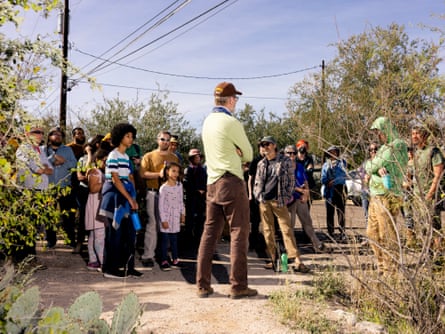
Brad Lancaster gives a tour of the Dunbar Spring neighborhood. Photograph: Cassidy Araiza/The Guardian
These time-tested water harvesting techniques, coupled with climate-smart desert food production,
will be crucial in building food security in the warming south-west,
especially as agriculture consumes 74% of Arizona’s fresh water.
“Part of the tragedy is we have not valued the Indigenous knowledge of this place,” said Lancaster.
For
Lancaster, surviving and thriving in an increasingly hot and dry world
will require dramatic and necessary changes to how we live. “We need to
adapt ourselves and our practices in a way that doesn’t just serve us
but the living systems that allow us to be here,” he said."
.png)
.jpg)


 @@tariqtahir