April 27, 2023 at 2:09 pm With triple digit temperatures coming soon, the City of Mesa and Mesa Animal Control are reminding residents to protect their pets as the thermometer rises in Arizona. The heat can affect pets in many ways, from causing dehydration to burning their...
April 27, 2023 at 10:18 am Mesa Arts Center is excited to announce the 2023–2024 Performing Live season. Highlights include Yo-Yo Ma, Matteo Bocelli, Audra McDonald, Tori Amos, Dave Koz, Mandy Patinkin and more. “This season is about creating new memories and reigniting...
HISTORY...How hot was it? Before this landmark was the Hotel/Mineral Baths it became famous
for, The Buckhorn was a place to stop in the desolate desert to fill up
on gas, buy trinkets and view an array of still wildlife.
The Buckhorn Baths Motel at 5900 East Main Street at the corner of North
Recker Road in Mesa, Arizona was a small mineral hot springs resort
which offered a bathhouse as well as both cottages and motel rooms for
overnight stays.
Who is the new owner of Buckhorn Baths?
New owner Ajay Verma, who formerly
lived in Mesa, purchased the historic property near Main Street and
Recker Road for $3.8 million. Tim Boyle, a Mesa architect and Planning
and Zoning Board member, represents Verma.
Bathing in history
After completion of Diving Lady, preservation interest switches to Buckhorn Baths
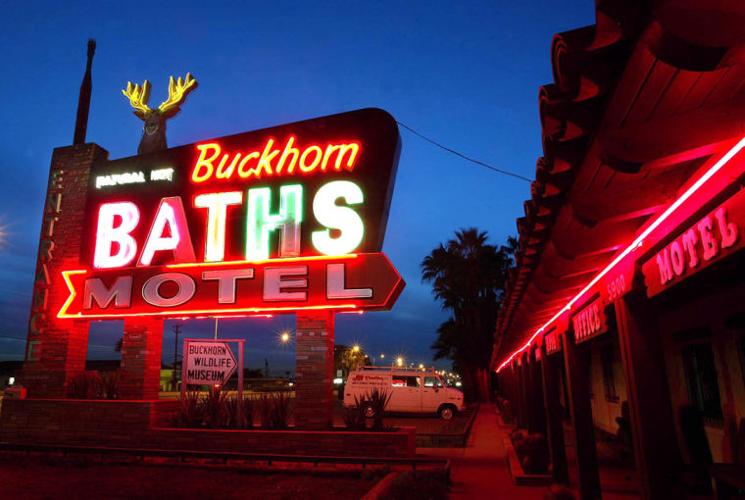
The City of Mesa is in talks to purchase and possibly restore the historic Buckhorn Baths Motel after voters approved a $70 million bond last fall that includes money for renovating some of the city’s landmarks. Pictured in 2007. [Tribune file photo]
Tribune file photo
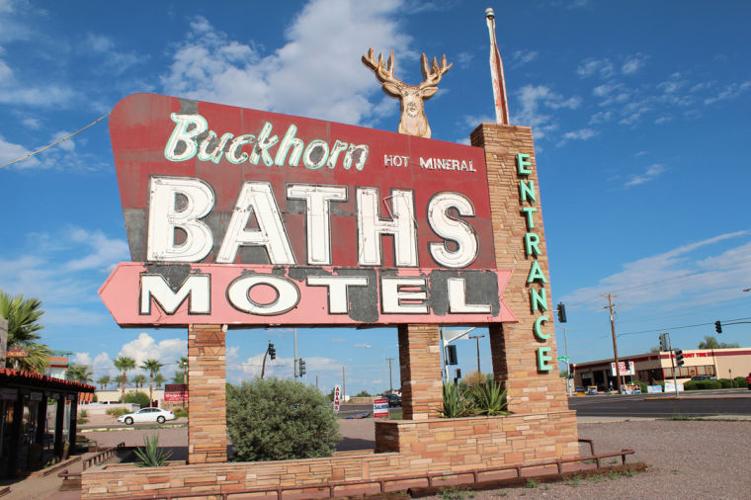
The Buckhorn Baths Motel sign as it looked in August 2012 on the corner of Main Street and Recker Road in Mesa, Arizona. [Cronkite News file photo]
Cronkite News file photo
FacebookTwitterEmaiPrint
SNearly a month after the Diving Lady was again restored to her perch high above Main Street, the focus of the Mesa Preservation Foundation has shifted to restoring and reopening the also-historic Buckhorn Baths
“The Buckhorn will be a herculean effort,” said Vic Linoff, the president of the Mesa Preservation Foundation and the board chair of the Mesa Historical Museum. “It makes the diving lady look like a piece of cake.”
Last fall, Mesa voters approved a $70 million bond which grants money, in part, for the city to use in procuring the Buckhorn property.
“The city is in ongoing negotiations with the property owners,” said Marc Heirshberg, parks, recreation and commercial facilities director for the City of Mesa. . ."
Buckhorn Baths Motel & Museum (Arizona Photo Spot)
SHARE THIS PAGE
Buckhorn Baths Motel & Museum - Photo by Tom Driggers
Hot-tub league: How a Mesa spa brought spring training to Arizona
Buckhorn Baths Motel, on the corner of Main Street and Recker Road in Mesa, played a role in bringing spring training to Arizona. But the hotel and spa has fallen into disrepair. (Photo courtesy of Charlie Vascellaro)
Posted
Jeffrey Hinkle | Cronkite News
MESA – Nestled on the corner of Main Street and Recker Road in Mesa is a structure that looks like any old, dilapidated building that has fallen into disrepair.
But this tiny roadside building, known as the Buckhorn Baths Motel, is one of the reasons why the Cactus League is what it is today, and was one of the founding pieces of spring training in Arizona.
Ted and Alice Sliger bought a plot of land in 1936 on what today is East Main Street in Mesa. It was their home, it was a gift shop and a place for Ted to show off his huge taxidermy collection.
After three years of having to haul fresh water between downtown Mesa and their property, the couple decided to dig a well and see if they could find water.
What came next changed their lives.
They found water — but it was about 120 degrees and full of minerals. The water wasn’t drinkable but had lots of healing benefits. Not long after the water was found, the motel was built and a spa along with it.
Word got around to New York Giants owner Horace Stoneham. After he made his way out to the Buckhorn for a stay he decided to move his team to Mesa for spring training to play Cleveland, which had moved to Arizona to escape the radical Jim Crow laws of the South.
Stoneham started bringing his top players to Mesa about a week early to stay at the Buckhorn and receive treatment, and soon the entire team had moved into the little roadside motel.
✓ It was the start of a long and storied history between the Buckhorn Baths Motel and the Giants, who stayed there for a 25-year span that included the team’s move from New York to San Francisco.
“They were like a family,” said Mesa Historical Museum Executive Director Susan Ricci.
Eventually, word got out around the league, and more teams started to use the Buckhorn as their hotel. The Chicago Cubs, who moved to Mesa from Catalina Island off the coast of California, used the Buckhorn for their first couple of years in Arizona.
Now with three teams in Arizona, and the Baltimore Orioles eventual move to Yuma, the Cactus League was born.
The baths closed its doors in 1999, and the hotel shut down in 2007. Ever since then, the hotel has been in a sort of limbo.
“There’s a term we use in preservation called demolition by neglect. That’s kind of where it is,” said Mesa Historical Museum President Vic Linoff.
Plans for an apartment complex have stalled, Linoff reports, and any plans to develop any part of the land have reached a standstill. So at the moment, the fate of the Buckhorn is up in the air.
But if walls could talk, the Buckhorn would have a speech like no other from the things the old hotel has seen. And, Linoff says, rumor has it that the pipes in the hotel still hold that mineral water Ted found when he was trying to find drinking water.
And it might work, too. Alice Sliger, who lived on the property until six months before she died in 2010, lived to be 103 years old."
Dec 23, 2021 · A piece of Mesa and Cactus League history is set for a significant facelift.The Buckhorn Baths were sold earlier this year, and the new ...
Jan 16, 2023 · The Buckhorn Baths was an early adopter of neon in Mesa, and the property includes a stylish mid-century neon sign that “stops traffic” on Main ...
NOTE: Deer spend months dumping loads of nutrients and siphoned minerals from their skeleton into building antlers. Then when mating season is over, they toss them off like yesterday’s empty acorn shells...
A
giant rack on a mature deer has fascinated hunters and enthusiasts
since the dawn of time. Early native people once painted and chipped
their forked figures onto stone walls, and today we photograph and mount
them as trophies on our living room walls. There’s just something about
a buck’s gnarly set of antlers that doesn’t get old. And how those
antlers grow and eventually shed—then repeat the process year after
year—is a big part of the mystique...Antlers are not
made from keratin, ivory, hair, or wood, as some people question. Deer
antlers are made of actual bone consisting mainly of calcium and
phosphorous. They grow from pedicles, or bases, on the front skull of
male deer. Antlers are also deciduous,
meaning they’re cast off and grow back yearly. But what actually
happens to antlers seasonally and during their three stages of
development?
And what about minerals? Do minerals really help antler growth? Calcium and phosphorus are scientifically known to be important, and other minerals play a critical role as well. The National Deer Association noted a University of Georgia study found 11 different minerals in whitetail antlers. The top four included calcium (19 percent), phosphorus (10 percent), magnesium (1 percent), and sodium (0.5 percent).
MPF involvement: directed effort to save Buckhorn Baths and raised awareness of its potential development within the city.
The Buckhorn Baths Motel was famous for its mineral-rich waters
and welcomed a vast array of guests from baseball players and movie
stars, to high level businessmen and politicians. Mesa Preservation
Foundation hoped to preserve the history and personality of this unique
piece of land. This project's preservation efforts have stopped due to
matters outside of MPF's realm. However, its history is worth
remembering.
History of the Buckhorn Baths Buckhorn
Baths were the vision of Ted and Alice Sliger who developed their land
on East Main Street, then U.S. Highways 60-70 and 80-89, between about
1935 and 1947. The Buckhorn is about 4.2 miles East of the Diving Lady Sign on same "Main Street."
After
establishing their residence on the Buckhorn property on the northwest
corner of Main Street and Recker Road, the Sliger's built a store and
gas station to accommodate the growing auto tourism. They sold Indian
curios in the store and Alice cooked homemade meals for weary travelers.
In 1938,
Ted began displaying his taxidermy collection of Arizona wildlife at The Buckhorn the
addition. Before this landmark was the Hotel/Mineral Baths it became
famous for, The Buckhorn was a place to stop in the desolate desert to
fill up on gas, buy trinkets and view an array of still wildlife.
Finding the Springs In
1939, Ted got tired of traveling to bring water to their place so he
decided to drill the land for water. He struck an unknown hot
spring reservoir that produced 127 degree water (average jacuzzi heats
to 104 degrees)!
Baths to Baseball In
1947, the New York Giants (now the San Francisco Giants) baseball team
came to town. The presence of the Buckhorn Baths led them to make the
Valley their spring training home and the Cactus League was born. For
the next 25 years, the Buckhorn Baths were the Giants' home away from
home and baseball greats like Ty Cobb, Willie Mays, Gaylord Perry, Leo
Durocher, Mel Ott and Juan Marichal became part of the Sliger family.
The
architectural and historical significance of the Buckhorn Baths makes
the site highly noteworthy and it was listed on the National Register of
Historic Places in 2005..." READ MORE
The Buckhorn Baths Motel was famous for its mineral-rich
waters and welcomed a vast array of guests from baseball players and
movie stars, to high level businessmen and politicians. Mesa
Preservation Foundation hoped to preserve the history and personality of
this unique piece of land. This project's preservation efforts have
stopped due to matters outside of MPF's realm. However, its history is
worth remembering.
History of the Buckhorn Baths Buckhorn
Baths were the vision of Ted and Alice Sliger who developed their land
on East Main Street, then U.S. Highways 60-70 and 80-89, between about
1935 and 1947. The Buckhorn is about 4.2 miles East of the Diving Lady Sign on same "Main Street."
After
establishing their residence on the Buckhorn property on the northwest
corner of Main Street and Recker Road, the Sliger's built a store and
gas station to accommodate the growing auto tourism. They sold Indian
curios in the store and Alice cooked homemade meals for weary travelers.
In 1938,
Ted began displaying his taxidermy collection of Arizona wildlife at The Buckhorn the
addition. Before this landmark was the Hotel/Mineral Baths it became
famous for, The Buckhorn was a place to stop in the desolate desert to
fill up on gas, buy trinkets and view an array of still wildlife.
Finding the Springs In
1939, Ted got tired of traveling to bring water to their place so he
decided to drill the land for water. He struck an unknown hot
spring reservoir that produced 127 degree water (average jacuzzi heats
to 104 degrees)!
Baths to Baseball In
1947, the New York Giants (now the San Francisco Giants) baseball team
came to town. The presence of the Buckhorn Baths led them to make the
Valley their spring training home and the Cactus League was born. For
the next 25 years, the Buckhorn Baths were the Giants' home away from
home and baseball greats like Ty Cobb, Willie Mays, Gaylord Perry, Leo
Durocher, Mel Ott and Juan Marichal became part of the Sliger family.
The
architectural and historical significance of the Buckhorn Baths makes
the site highly noteworthy and it was listed on the National Register of
Historic Places in 2005. With the passing of Alice Sliger on November
9, 2010 at the age of 103, the future of the Buckhorn Baths is
imperiled. The Mesa Preservation Foundation worked with all interested
parties to ensure the Sliger legacy is maintained through preservation
of the most significant structures and adaptive reuse of the remainder
of the site, possibly including baseball fields.






.jpg)
.jpg)
.jpg)