Pushback Against Powell’s Prognosis Comes Almost Immediately
Within hours of the Federal Reserve’s latest policy decision, traders and commentators alike had started to challenge Chair Jerome Powell’s …
Bloomberg - Paul Dobson • 9h
Read more on bloomberg.com
The bond market waved off the prospect that Powell might have one more hike up his sleeve, instead adding to bets the US central bank's next ...
Bloomberg.com · Paul Dobson · 9 hours ago
Pushback against Powell’s prognosis comes almost immediately
Within hours of the Federal Reserve’s latest policy decision, traders and commentators alike had started to challenge Chair Jerome Powell’s assessment of the economy.
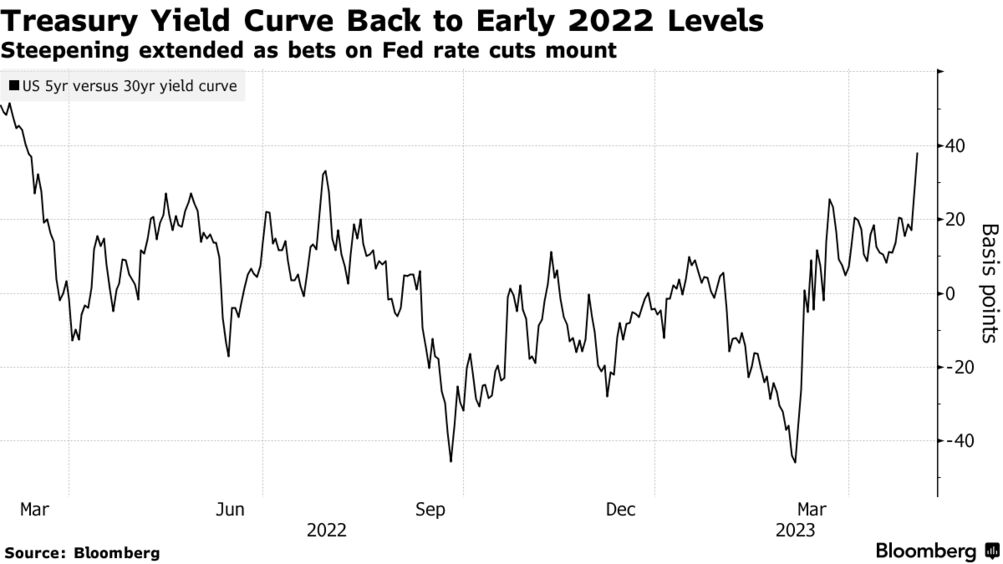
The bond market waved off the prospect that Powell might have one more hike up his sleeve, instead adding to bets the US central bank’s next move will be to cut its benchmark interest rate. A slide in crude oil prices indicated mounting concern over a recession that the Fed chair said could be avoided. And financial stocks tumbled anew even after Powell had seen a line being drawn under US bank turmoil.
DoubleLine Capital’s Jeffrey Gundlach told CNBC there’s an increased likelihood of a recession and the Fed likely won’t lift interest rates again following its latest increase. Meanwhile, over at the Milken Institute Global Conference, talk among the panelists suggested a consensus view that a contraction is inevitable.
WTI crude sank 4.3 percent Wednesday, reflecting concerns about weakening economic growth in major economies. It tumbled as much as 7.2 percent in a chaotic market open Thursday before recovering.
“Our view is for a technical recession, when is the question mark,” said Lindsay Rosner, multi-sector portfolio manager at PGIM Fixed Income. “If Powell just laid out the framework they are operating under is one of modest growth, not recession, it would suggest they need to change their course if they see a recession. That is why we believe they will have to cut.”
To be fair to Powell, he did hint Wednesday’s interest-rate increase, which took the benchmark rate above 5 percent, could be the last one in a cycle that’s lifted borrowing costs from near-zero levels last year. While the Fed chief said there was strong support for raising rates by 25 basis points this week, he suggested officials may pause their tightening campaign in June.
Powell also acknowledged that the pace of bank lending has slowed. And US economic data, while pointing to a slowdown in the labor market, don’t yet signal a recession is on hand.
Rapid response
But news moves fast and traders are wont to anticipate rather than wait to see how things pan out.
Treasuries surged Wednesday as investors reinforced bets that Fed rates will be lower by the end of this year, despite Powell’s insistence that the central bank’s inflation outlook doesn’t support easier policy. By the end of the day even swap contracts for June were pointing to the effective fed funds rate being lower.
Meantime, a Bloomberg News report that PacWest Bancorp was considering its strategic options redoubled concern that turmoil among smaller US banks would claim more victims and tighten credit conditions.
Four US banks have collapsed since early March, including First Republic Bank, which federal regulators seized this week. Powell called the resolution of First Republic an “important step toward drawing a line” under bank turmoil.
Yet the PacWest report triggered a fresh selloff in financial stocks in after-market trading.
“The market will be looking for signs that credit tightening is starting to impact activity and labor market data,” said Vassili Serebriakov, FX and macro strategist at UBS Securities in New York. “Since the Fed hinted at a pause today, any weakness in the data would reinforce the view that the tightening cycle is over.”
Powell said Wednesday it’s possible the US could experience what he hopes would be a mild recession, but “the case of avoiding a recession is in my view more likely than that of having a recession.” Wage increases have been moving down, and job openings have declined but have not been accompanied by rising unemployment, he said.
But at the Milken conference attendees expressed concerns. Guggenheim Capital Chairman Alan Schwartz told Bloomberg Television he’s worried about the effects of credit tightening and how far banks will have to pull back. Jenny Johnson, chief executive officer at Franklin Templeton, also pointed to the stress in the banking system caused by the pace of Fed hikes and the possibility of further retrenchment as a result.
Gundlach, DoubleLine Capital’s co-founder, cited the cumulative rate increases by the Fed since March 2022 and credit contraction for reasons he’s “turning more bearish at this point in time.” The Fed likely won’t lift interest rates again following its latest increase, he said. “Recessionary odds are pretty darn high right now.”
With assistance from Matthew Boesler, Rob Verdonck, Michael Mackenzie, Brandon Sapienza, Stacey Shick and Matthew Burgess / Bloomberg
 • Action Line with ...
Toronto Star video on King Street in Toronto:
• Action Line with ...
Toronto Star video on King Street in Toronto: