Thursday, May 04, 2023

Tomgram: Hartung and Freeman, The Twenty-First Century of (Profitable) War

 A watchdog group, the Stockholm International Peace Research Institute (SIPRI)  just released its yearly report on global military spending. 

World military expenditure reaches new record high as European spending surges

Inflation, tax, cash flow and another financial concept. focused on decreasing value of money in post-covid. background of graph of rising inflation rates 2023 2022 years
Photo: Shutterstock


(Stockholm, 24 April 2023) Total global military expenditure increased by 3.7 per cent in real terms in 2022, to reach a new high of $2240 billion. Military expenditure in Europe saw its steepest year-on-year increase in at least 30 years. The three largest spenders in 2022—the United States, China and Russia—accounted for 56 per cent of the world total, according to new data on global military spending published today by the Stockholm International Peace Research Institute (SIPRI).

Read this press release in Catalan (PDF), French (PDF), Spanish (PDF) or Swedish (PDF).

Invasion of Ukraine and tensions in East Asia drive increased spending

World military spending grew for the eighth consecutive year in 2022 to an all-time high of $2240 billion. By far the sharpest rise in spending (+13 per cent) was seen in Europe and was largely accounted for by Russian and Ukrainian spending. However, military aid to Ukraine and concerns about a heightened threat from Russia strongly influenced many other states’ spending decisions, as did tensions in East Asia.


Hartung and Freeman, The Twenty-First Century of (Profitable) War

May 4, 2023

Honestly, it should take your breath away. We are on a planet prepping for further war in a staggering fashion. A watchdog group, the Stockholm International Peace Research Institute (SIPRI), just released its yearly report on global military spending. Given the war in Ukraine, you undoubtedly won't be surprised to learn that, in 2022, such spending in Western and Central Europe surpassed levels set as the Cold War ended in the last century. Still, it wasn't just Europe or Russia where military budgets leaped. They were rising rapidly in Asia as well (with significant jumps in Japan and India, as well as for the world's second-largest military spender, China). And that doesn't even include spiking military budgets in Saudi Arabia and elsewhere on this embattled planet. In fact, last year, 12 of the 15 largest military spenders topped their 2021 outlays.

None of that is good news. Still, it goes without saying that one country overshadowed all the rest -- and you know just which one I mean. At $877 billion last year (not including the funds "invested" in its intelligence agencies and what's still known as "the Department of Homeland Security"), the U.S. military budget once again left the others in the dust. Keep in mind that, according to SIPRI, Pentagon spending, heading for a trillion dollars in the near future, represented a staggering 39% of all (yes, all!) global military spending last year. That's more than the next 11 largest military budgets combined. (And that is up from nine not so long ago.) Keep in mind as well that, despite such funding, we're talking about a military, as I pointed out recently, which hasn't won a war of significance since 1945.

With that in mind, let Pentagon experts and TomDispatch regulars William Hartung and Ben Freeman explain how we've reached such a perilous point from the time in 1961 when a former five-star general, then president, warned his fellow citizens of the dangers of endlessly overfunding the -- a term he invented -- military-industrial complex. Now, let Hartung and Freeman explore how, more than six decades later, that very complex reigns supreme. Tom

Unwarranted Influence, Twenty-First-Century-Style

Not Your Grandfather’s Military-Industrial Complex

By William D. Hartung and Ben Freeman

The military-industrial complex (MIC) that President Dwight D. Eisenhower warned Americans about more than 60 years ago is still alive and well. In fact, it's consuming many more tax dollars and feeding far larger weapons producers than when Ike raised the alarm about the “unwarranted influence” it wielded in his 1961 farewell address to the nation. 

The statistics are stunning. This year’s proposed budget for the Pentagon and nuclear weapons work at the Department of Energy is $886 billion -- more than twice as much, adjusted for inflation, as at the time of Eisenhower’s speech. The Pentagon now consumes more than half the federal discretionary budget, leaving priorities like public health, environmental protection, job training, and education to compete for what remains. In 2020, Lockheed Martin received $75 billion in Pentagon contracts, more than the entire budget of the State Department and the Agency for International Development combined.

Click here to read more of this dispatch.


RECENT POSTS

2 days ago...
Liz Theoharis, Whose World Is This Anyway?

4 days ago...
Eduardo Galeano, Sacrilegious Women

1 week ago...
Alfred McCoy, Whose Continent Is This Anyway?

9 days ago...
Stan Cox, Spreading Hate and Bullets

RECENT HIGHLIGHTS

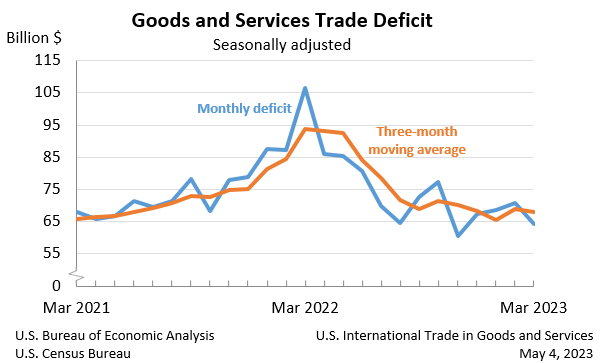
U.S. International Trade in Goods and Services, March 2023 EMBARGOED UNTIL RELEASE AT 8:30 a.m. EDT, Thursday, May 4, 2023


Borderlands' DoorDash delivery program > This service enables you to get an up to 25lb box of rescued produce, delivered right to your door, for a simple donation of $15

This DoorDash delivery service is meant for people who are unable to leave the house, or lack transportation to come out to an actual Borderlands' P.O.W.W.O.W. event. 

We know this program is not for everyone, but if you are interested in participating please double check your address to make sure you are within 10-miles of our participating locations.

Borderlands Produce Rescue

We hope you are having an amazing week! 

This email is to simply notify you, you may be eligible to participate in Borderlands' DoorDash delivery program. 

.

This Saturday, May 6th, Borderlands' DoorDash delivery is available at our Tucson, Green Valley, Phoenix, Buckeye, Thatcher and Chandler locations.

This service enables you to get an up to 25lb box of rescued produce, delivered right to your door, for a simple donation of $15. Your donation includes the DoorDash delivery fee of $4.50, and a .50¢ online processing fee. If you do decide to participate in this service, remember, we are limited by DoorDash to boxes that weigh no more than 25lbs, so your box will be up to 25lbs.

Click Here to Donate Towards a May 6th Borderlands' DoorDash Box


Regardless of how you take part in our programs, we are thankful for your ongoing support, and for doing your part to help curb food waste. With your donations, each season, we are able to rescue 20 - 30 million pounds of produce.

Sincerely,

Yolanda Soto
President / CEO
Borderlands Produce Rescue

Borderlands Produce Rescue is a 501C(3) charitable organization. Our mission is to ensure fresh produce is diverted from the landfill, helping to save our planet and supplementing meals nutritiously. Claim your AZ Charitable Tax Credit by making a $400, or $800 donation to support our mission.

Figures: FACTS USA These are the least efficient government programs


USAFacts - Our Nation, in Numbers

How does the GAO form its high risk list?  

The Government Accountability Office (GAO) is an independent agency that provides unbiased information to help run the government more efficiently and save taxpayers money. The GAO has produced a high risk list since 1990 to identify federal programs vulnerable to waste, fraud, abuse, and mismanagement. As of March, 38 programs were on the list.

Read this on the web instead
  • The GAO evaluates various factors to classify a program as high risk, such as risk to public health or safety, national security, and economic growth. The program must be in danger of losing at least $1 billion. 
     
  • The high risk list comprises programs rather than the departments that run those programs. For example, the unemployment insurance system lost over $60 billion in fraudulent payments during the pandemic, leading to its inclusion (rather than the Labor Department's) in 2022. 
     
  • The Defense Department's contract management program has been on the list since 1992. It spent more than $400 billion on contracts in 2020, accounting for over 60% of the department's budget.
  • Several programs on the high risk list — including IRS enforcement of tax laws, protecting the nation's cybersecurity, and administering Medicare — have been wasting government resources for decades without congressional action or other corrections. 
To see more, including the current high risk list, click here.
 

Tracking guns used in crimes

  • To help understand how guns end up used in crimes, the Bureau of Alcohol, Tobacco, Firearms, and Explosives tracks the time between a gun's last legal purchase and when it's used in a crime. The Bureau even has a name for it: time-to-crime (TTC). USAFacts has the data on how this timeline has shortened since 2018, the types of guns it tracks, the buyers involved, and more.
  • A short time-to-crime can indicate gun trafficking, as it suggests that the gun was likely purchased with criminal intent. The percentage of guns that were used in a crime one year or less after purchase increased from 19.7% in 2019 to 32.2% in 2021.
     
  • Twenty-eight percent of traced pistols had a TTC of one year or less — more than double the percentage for shotguns (13%) and revolvers (11%). Rifles had a time-to-crime of 20%.
  • By age group, buyers 18 to 24 had the highest share of guns recovered within a year: 37%. The ATF traced 22% of crime guns to minors (who cannot legally buy guns) within a year of their purchase.
     
  • Thirty-six percent of guns traced to female buyers were used in a crime within one year of purchase; the rate was 24% for male buyers.
  • The median TTC for traced crime guns varies widely by state. Hawaii had the longest period, 7.5 years. Virginia had the shortest: 1.6 years.

Read more about the length of time between a gun’s purchase and its use in a crime plus the buyers and possessors of guns.
 

Data behind the news

On Monday, JPMorgan Chase announced it would buy most of First Republic Bank after the latter bank failed. Here’s a refresher on the history of US bank failures.

The NFL draft was last week. And while the league does not stipulate that draftees must have attended college, virtually all of them have. USAFacts has this 2020 look at what football means for universities' bottom lines.

Take the newest weekly fact quiz here!

One last fact

The federal government collected $5.03 trillion in revenues in 2022 (adjusted for inflation), up $630 billion from the previous year. Americans contributed an average of $15,098 per person to federal revenues — nearly double what they paid 40 years ago.

According to a Congressional Budget Office report, federal revenues grew in 2022 due to increased individual income tax collection. Despite recent changes to the tax code, roughly 40%–50% of federal revenues come from income taxes.