Saturday, June 03, 2023

20th Asia Security Summit 2023 in Singapore June 2 - June 4: America's Strategic Ambiguity

The IISS Shangri-La Dialogue is Asia's premier defense summit. It’s a unique meeting where ministers debate the region’s most pressing security challenges, engage in important bilateral talks and come up with fresh approaches together. 
The 2023 event is taking place in Singapore on 2–4 June.
All events will take place at the Shangri-La Hotel, 22 Orange Grove Road, Singapore 258350, except for dinner on Saturday night, which will be held at the Istana.
All sessions will be on the record. 


U.S.-China divide looms as Asia security summit begins in Singapore

NPR | By Emily Feng

SINGAPORE – Tense U.S.-relations and an arms build-up in the Pacific region will be on show this weekend as defense chiefs, including from the U.S. and China, gather at the Shangri-La Dialogue, an international defense summit, in Singapore.
  • The Dialogue, which started Friday, has been overshadowed by China's refusal to let its defense minister meet formally with U.S. Secretary of Defense Lloyd Austin at the forum. 
  • Meanwhile, representatives from the U.S. and Taiwan signed a trade agreement on the eve of the security summit and over protests from China, which claims the island as part of Chinese territory. The pact was signed by workers of unofficial entities that maintain relations between the U.S. and the island democracy. 
  • The deepening U.S.-China military competition has drawn in surrounding countries, whose concerns will be front and center at the Shangri-La Dialogue. Australian Prime Minister Anthony Albanese delivers a keynote address at the opening dinner on Friday. Japan, a key U.S. ally which has been deeply concerned over China's increasing hostility toward the nearby island of Taiwan, has sent a large delegation. 
  • Southeast Asia is also maneuvering around how to position themselves around the great power rivalry between the U.S. and China. The South China Sea, where China has staked out contested territorial claims at odds with overlapping claims from Vietnam, the Philippines, and Malaysia, to name just a few, remains a hot button issue.
  • Taiwan and its dominance in semiconductor manufacturing – a critical tech sector at the heart of the U.S.-China rivalry – is also an issue of concern for Southeast Asia. Some U.S. firms and Taiwanese chip juggernaut TSMC have been looking to shift operations to the region, out of China.

The war in Ukraine, despite being a hemisphere away, will also be on the agenda. 

  • Most Southeast Asian countries have chosen to remain silent on Russia's invasion. 
  • Ukraine has sent its deputy defense chief, Volodymyr Havrylov, to Singapore to attend the summit, where he will speak on a panel with Andi Widjajanto, a politician from Indonesia, which has kept up friendly ties with Moscow.

Here's what else to look out for at the Shangri-La Dialogue this weekend.

The U.S. and China are headlining the event

Although Chinese defense minister Li Shangfu and Austin weren't expected to speak to each other, the two defense chiefs did briefly exchange words and shook hands before being seated at Friday's opening dinner — "but did not have a substantive exchange," Pentagon spokesperson Pat Ryder said in statement.

VIDEO INSERT; 


Asia security summit kicks off amid US-China tensions

Gurkha police officers patrol near the entrance of the Shangri-La Hotel, the venue for the 20th International Institute for Strategic Studies (IISS) S...

Gurkha police officers patrol near the entrance of the Shangri-La Hotel, the venue for the 20th International Institute for Strategic Studies (IISS) S... (AP photo)

SINGAPORE, June 2 (Reuters) - Asia's top security meeting opened on Friday, with intensifying competition between the United States and China expected to dominate a weekend of high-level speeches, backroom military dealings and delicate diplomacy. . .
  • The relationship between the U.S. and China is at its lowest point in decades, as the two superpowers remain deeply divided over everything from the sovereignty of Taiwan to cyber espionage and territorial disputes in the South China Sea.
  • Hopes that the summit in Singapore could be a chance to mend ties between Washington and Beijing were dealt a blow last week when Li declined an offer to meet with Austin.

Li, who was named China's new defence minister in March, was sanctioned by the U.S. in 2018 over weapons purchases from Russia. . ."


IISS Shangri-La Dialogue – Speaker Agenda

Explore the agenda for Asia’s premier defence summit, the IISS Shangri-La Dialogue 2023, which is taking place in Singapore on 2–4 June.


X

Top stories


FRIDAY 2 JUNE 2023

All dayBILATERAL MEETINGS 
16:45 – 18:15SIMULTANEOUS SPECIAL SESSIONS
 Session 1: SECURITY IMPLICATIONS OF CYBER AND
TECHNOLOGICAL COMPETITION
Dr Bastian GiegerichDirector of Defence and Military Analysis, IISS
Avril HainesDirector, National Intelligence, US  
Okano MasatakaDeputy National Security Advisor, Cabinet Secretariat, Japan  
Brigadier General Edward Chen, Defence Cyber Chief, Singapore Armed Forces
Žilvinas TomkusVice Minister of National Defence, Lithuania  
 Session 2: CHALLENGES OF ASIA-PACIFIC MILITARY
CAPABILITY DEVELOPMENT
Dr Euan GrahamShangri-La Dialogue Senior Fellow for Indo-Pacific Defence and Strategy, IISS-Asia
General Andres Centino, Chief of Staff, Armed Forces of the Philippines
General Angus CampbellChief of the Defence Force, Australia  
General Yoshida YoshihideChief of Staff, Joint Staff, Japan Self-Defense Forces
Admiral Linda FaganCommandant, US Coast Guard  
 Session 3: NUCLEAR DIMENSIONS OF REGIONAL
SECURITY
William AlberqueDirector of Strategy, Technology, and Arms Control, IISS-Europe 
General Sahir Shamshad MirzaChairman, Joint Chiefs of Staff Committee, Pakistan Armed Forces 
Andrew LittleMinister of Defence, New Zealand  
Kim GunnSpecial Representative, Korean Peninsula Peace and Security Affairs, Ministry of Foreign Affairs, Republic of Korea
Angus LapsleyAssistant Secretary General, Defence Policy and Planning, NATO  
19:00 – 20:00OPENING RECEPTION
 MINISTERIAL RECEPTION (BY INVITATION ONLY)
20:00 – 22:15

KEYNOTE ADDRESS AND OPENING DINNER
Opening Remarks
Dr John Chipman, Director-General and Chief Executive, IISS 
Keynote Address
Anthony AlbanesePrime Minister, Australia


SATURDAY 3 JUNE 2023

08:30 – 08:35

OPENING OF THE SUMMIT
Dr John Chipman, Director-General and Chief Executive, IISS

08:35 – 09:30

FIRST PLENARY SESSION
UNITED STATES’ LEADERSHIP IN THE INDO-PACIFIC
Lloyd J Austin III, Secretary of DefenseUS  

09:30 – 11:00

SECOND PLENARY SESSION
BUILDING A STABLE AND BALANCED ASIA-PACIFIC
Carlito Galvez JrSenior Undersecretary; Officer-in-ChargeDepartment of National Defense, Philippines  
Ben WallaceSecretary of State for DefenceUK  
Anita AnandMinister of National Defence, Canada

11:00 – 11:30Break
11:30 – 13:00THIRD PLENARY SESSION
RESOLVING REGIONAL TENSIONS
General (Retd) Prabowo SubiantoMinister of Defense, Indonesia  
Lee Jong-SupMinister of National Defense, Republic of Korea
Josep Borrell FontellesHigh Representative; Vice President, European Commission, EU 
13:00 – 14:45MINISTERIAL ROUNDTABLE (BY INVITATION ONLY)
Hosted by Dr Ng Eng Hen, Minister for Defence, Singapore

LUNCH FOR ALL OTHER DELEGATES
LUNCH FOR SPONSORS AND CORPORATE SUPPORTERS OF THE IISS
(BY INVITATION ONLY)
14:45 – 16:00FOURTH PLENARY SESSION
ASIA’S EVOLVING MARITIME SECURITY ORDER
Hamada YasukazuMinister of Defense, Japan  
Dr Pål JonsonMinister for Defence, Sweden    
Pio TikoduaduaMinister for Home Affairs and Immigration, Fiji  
16:00 – 17:00Break
17:00 – 18:30SIMULTANEOUS SPECIAL SESSIONS
 Session 4: BALANCING ASIA-PACIFIC MINILATERALISM
AND ASEAN CENTRALITY
Aaron ConnellySenior Fellow for Southeast Asian Politics and Foreign Policy, IISS-Asia
Dr Kao Kim HournSecretary-General of ASEAN  
Jan AdamsSecretary, Department of Foreign Affairs and Trade, Australia 
Loren LegardaSenate President Pro Tempore, Senate of the Philippines  
Pornpimol KanchanalakAdvisor to the Deputy Prime Minister and Minister of Foreign Affairs, Thailand 
Anne-Marie Trevelyan, Minister of State, Indo-Pacific, Foreign, Commonwealth and Development Office, UK
Sidharto SuryodipuroChair, ASEAN Senior Officials Meeting; Director General, ASEAN Cooperation, Ministry of Foreign Affairs, Indonesia
 Session 5: MANAGING EURO-ATLANTIC AND ASIA-PACIFIC SECURITY
Dr Lynn KuokShangri-La Dialogue Senior Fellow, IISS-Asia; Editor, Asia-Pacific Regional Security Assessment 
Oleksii Reznikov, Minister of Defence, Ukraine  
Cui TiankaiFormer Vice Minister, Ministry of Foreign Affairs, China
Andi WidjajantoGovernor, National Resilience Institute, Indonesia  
Kajsa OllongrenMinister of Defence, The Netherlands
 Session 6: DEFENCE COOPERATION IN THE INDIAN OCEAN REGION
Rahul Roy-ChaudhurySenior Fellow for South and Central Asian Defence, Strategy and Diplomacy, IISS 
Sayyid Badr bin Hamad bin Hamoud Al Busaidi, Foreign Minister, Oman
Vikram MisriDeputy National Security Advisor, India 
Admiral John Aquilino, Commander, US Indo-Pacific Command
Sagala RatnayakaChief of Staff to the President and National Security Advisor, President’s Office, Sri Lanka
Admiral Pierre VandierChief of Staff, French Navy
19:30 – 22:00THE ISTANA DINNER (BY INVITATION ONLY)
Hosted by Mdm Halimah Yacob, President, Singapore


SUNDAY 4 JUNE 2023

08:30 – 08:35OPENING OF DAY 2
Dr John Chipman, Director-General and Chief Executive, IISS
08:35 – 09:30

FIFTH PLENARY SESSION
CHINA’S NEW SECURITY INITIATIVES
General Li ShangfuState Councilor; Minister of National Defense, China

09:30 – 11:00

SIXTH PLENARY SESSION
NEW PARTNERSHIPS FOR ASIA-PACIFIC SECURITY
Dr José Ramos-HortaPresident, Timor-Leste
Kaja Kallas, Prime MinisterEstonia
Boris PistoriusMinister of Defence, Germany

11:00 – 11:30Break
11:30 – 13:00SEVENTH PLENARY SESSION
DEVELOPING MODELS FOR COOPERATIVE SECURITY
General Tea Banh, Deputy Prime Minister; Minister of National Defense, Cambodia
Richard MarlesDeputy Prime Minister; Minister for Defence, Australia  
Dr Ng Eng HenMinister for Defence, Singapore  
 ENVOI
Dr John Chipman, Director-General and Chief Executive, IISS
13:00 – 14:30MINISTERIAL ROUNDTABLE (BY INVITATION ONLY)
Hosted by Dr Ng Eng Hen, Minister for Defence, Singapore

CLOSING LUNCH FOR ALL OTHER DELEGATES


Australia's Prime Minister Anthony Albanese delivers the Keynote Address at the IISS Shangri-La Dialogue 2023

FIRST PLENARY SESSION: UNITED STATES LEADERSHIP IN THE INDO-PACIFIC

Welcome to the 20th IISS Shangri-La Dialogue


2023 SPEAKERS

  • Anthony Albanese

    Prime Minister, Australia

  • Lloyd J. Austin III

    Secretary of Defense, US

  • Carlito Galvez Jr

    Senior Undersecretary; Officer-in-Charge, Department of National Defense, Philippines

  • Ben Wallace

    Secretary of State for Defence, UK

  • Anita Anand

    Minister of National Defence, Canada

  • General (Retd) Prabowo Subianto

    Minister of Defense, Indonesia

  • Lee Jong-Sup

    Minister of National Defense, Republic of Korea

  • Josep Borrell Fontelles

    High Representative; Vice President, European Commission, EU

  • Hamada Yasukazu

    Minister of Defense, Japan

  • Pål Jonson

    Minister for Defence, Sweden

  • Pio Tikoduadua

    Minister for Home Affairs and Immigration, Fiji

  • General Li Shangfu

    State Councilor; Minister of National Defense, China

  • José Ramos-Horta,

    President, Timor-Leste

  • Kaja Kallas

    Prime Minister, Estonia

  • Boris Pistorius

    Minister of Defence, Germany

  • Tea Banh

    Minister for National Defense, Cambodia

  • Richard Marles

    Deputy Prime Minister; Minister for Defence, Australia

  • Dr Ng Eng Hen

    Minister for Defence, Singapore

X

Friday, June 02, 2023

Space Radiation Dose, Record Plume Event, Solar Watch | S0 News June.2.2023

Neuralink Begins Human Trials! 9,814 views Jun 2, 2023

Arizona limits construction around Phoenix as its water supply dwindles; Rose Law Group Founder and President Jordan Rose comments

What have we here -- Rose Law Group Founder and President Jordan Rose 
Here's a flashback to December 2019

Jordan Rose: In Real Estate We Trust > How-To-Turn Land Holdings Into Pay-Dirt

Here's Jordan Rose - a feature in one of today's posts that covers a lot of territory all about real estate development. In particular it's about one pending project in Southeast Mesa named Hawes Crossing.
If you're wondering what Jordan Rose does, she tells you herself in less-than-a-minute is a streaming video uploaded to YouTube last year . . . "she [and The Rose Law Group] gets governments to do of not to do something. . ."
Vague enough. . .QUESTION: What's that something?
And how does her law group get all the goodie$ delivered?
Here's just the most recent media report by Jim Walsh that tells you what that "something" is all about:
Millions of dollars ride on E. Mesa vote        
By Jim Walsh, Tribune Staff Writer
East Valley Tribune | 2019-12-15T01:00:00-07:00
"After months of public meetings, the massive Hawes Crossing development is heading toward a vote by the Mesa City Council in January, with only one member opposing it and millions of dollars riding on the decision. . . "

WHO IS JORDAN ROSE? Let her tell you herself >
She says personally she gets governments to do or not to do something
_________________________________________________________________________
"Rose Law Group pc is a full-service real estate and business law firm practicing in land use, zoning, renewable energy, government relations and lobbying, administrative law, family law, transactional real estate, employment law, water law, Native American relations, ADA compliance, infrastructure finance, special districts taxation, business formation/corporation transactions, business litigation, school law, cyber-defamation, cyber-privacy, drone law, cannabis law, hemp law, intellectual property, estate planning, asset protection, private litigation, class actions and DUI’s.

Our staff of attorneys, planners and construction project managers is unique in the state.
Our planning department focuses on helping clients process plans and applications through municipal, county and state regulatory agencies, and we have the skills to coordinate with your consultant team, conduct plan checks and catch errors, saving you time and money... "

Link to the website > https://www.roselawgroup.com/ 

She comments

Arizona limits construction around Phoenix as its water supply dwindles; Rose Law Group Founder and President Jordan Rose comments

Arizona limits construction around Phoenix as its water supply dwindles; 


By Christopher Flavelle, Jack Healy | New York Times

Arizona has determined that there is not enough groundwater for all of the future housing construction that has already been approved in the Phoenix area, and will stop developers from building some new subdivisions, a sign of looming trouble in the West and other places where overuse, drought and climate change are straining water supplies.

The decision by state officials marks the beginning of the end to the explosive development that has made the Phoenix metropolitan region the fastest growing in the country.

Maricopa County, which includes Phoenix and its suburbs, gets more than half its water supply from groundwater; most of the rest comes from rivers and aqueducts as well as recycled wastewater. In practical terms, groundwater is a finite resource; it can take thousands of years or longer to be replenished.


The announcement of a groundwater shortage — what the state calls “unmet demand” for water over the next hundred years — means Arizona would no longer give developers in areas of Maricopa County new permits to construct homes that rely on wells for water.

Phoenix and nearby large cities, which must obtain separate permission from state officials for their development plans every 10 to 15 years, would also be denied approval for any homes that rely on groundwater beyond what the state has already authorized.

The decision means cities and developers must look for alternative sources of water to support future development — for example, by trying to buy access to river water from farmers or Native American tribes, many of whom are facing their own shortages. That rush to buy water is likely to rattle the real estate market in Arizona, making homes more expensive and threatening the relatively low housing costs that had made the region a magnet for people from across the country.

READ ON:

“It’s important to remember this does not affect industrial development and there are still hundreds of thousands of lots in central Arizona that can be developed without any water challenges. We have enough supply for some time, until we solve this problem for good through technological advance.” 

– Jordan Rose, Rose Law Group founder and president 

RELATED 

Nov 12  
We just need to prioritize demand

Opinion: An alarming prediction about Pinal County facing a water shortage is a myth that’s based on outdated assumptions and incomplete data.
By Jordan Rose and Tom Galvin, opinion contributors | azcentral
Mark Twain once wrote of his difficulty with math by ascribing a quote about the flexible power of numbers to British Prime Minister Benjamin Disraeli, “There are three kinds of lies: lies, damned lies, and statistics.”
Farmers, developers, landowners, residents and elected officials in Pinal County are now empathetic with Twain because we are trying to dispel a growing notion that Pinal County is out of groundwater.”
The Arizona Department of Water Resources (ADWR) is working on revising a model based on outdated assumptions and incomplete data that have perpetuated the myth that Pinal County is facing a water shortage. In fact, Pinal County has plenty of water for today, tomorrow and 100 years from now.
Farmers and cities are good stewards
The agricultural and municipal sectors rely on substantial and robust aquifers and are responsible stewards of water for today’s needs and for future demand.
READ ON: 

________________________________________________________________________
FROM JULY 2019
Dairy farmers and State Land work together to plan vibrant mixed-use Mesa community,

Jordan Rose and dairyman Jim Boyle, Jr. talk to Phoenix Business Journal about Hawes Crossing project
Posted by   /  July 12, 2019
Homebuilder’s eye state land for growth
By Angela Gonzales | Phoenix Business Journal
No group may have a more intimate view of the struggle to develop homes and businesses using Arizona-owned land than dairy farmer Jim Boyle Jr. and his cows.
Boyle is among a group of dairy farmers in Mesa working to transform their property into a 1,200-acre master-planned community — a process that’s taking years to accomplish.
The path isn’t getting easier. Of the 1,200 acres the farmers plan for the development, about half are state land, said Jordan Rose, zoning attorney with Rose Law Group, who is working with Boyle and the other dairy farmers to get their property and the adjacent state land rezoned.
READ ON:

>> 

IMPORTANT***Virtual Meeting Announcement | Arizona Aquifer Water Quality Standards Rulemaking | Thurs., June 8, 2023***


Meeting Announcement

Dear Stakeholders,

The Arizona Department of Environmental Quality (ADEQ) is holding this virtual meeting to discuss the Aquifer Water Quality Standards (AWQS) setting process. ADEQ is required by state law to propose AWQS when a new drinking water maximum contaminant level (MCL) is determined by the federal Environmental Protection Agency. 

This meeting will present our draft approach for either adopting drinking water MCLs as AWQS or developing alternative AWQS. We are planning to open a rulemaking docket to this end, pursuant to state law. The following seven MCLs are planned to be the scope of the future rulemaking docket(s):

  • arsenic
  • bromate
  • chlorite
  • microbiological contaminants
  • haloacetic acids
  • total trihalomethanes
  • uranium

We welcome the community's participation and input. If you know others who may be interested in the AWQS rulemaking, please feel free to forward this information.

Sincerely,

Randall Matas
Deputy Director, Water Quality Division


MEETING DETAILS
Thursday, June 8, 2023
8 a.m. – 10 a.m.
Online or by phone

Click to Join the Google Meet at Meeting Date/Time >

Join by phone: (‪US‬) 1-336-949-8110‬
PIN: 992 403 828#‬

View Event Web Page >

Subscribe to the Water Quality Division Rulemaking Email List >


How much money has the US given Ukraine since Russia’s invasion? Answer: Approximately $115 billion in emergency funding to support Ukraine since February 24, 2022


Here’s another way to think of it: the federal government spent $6.48 trillion last fiscal year, meaning the money spent on Ukraine today would be equivalent to approximately 2% of the US budget.

Nearly $40 billion of that aid has already gone to humanitarian relief and military security assistance.  Some aid falls under a lend-lease program President Joe Biden signed in May 2022, meaning Ukraine will have to pay back a certain amount to the US after the war, plus interest.

Currently, Congress is debating the feasibility of long-term support for Ukraine. With immeasurable suffering felt within Ukraine (the United States has accused Russia of war crimes) and millions of refugees heading to neighboring countries, the world wonders how much longer this war will last and what role the US is expected to continue playing.

How is the money for Ukraine distributed? 

Nearly 95% of the discretionary spending for Ukraine goes to the Department of Defense and the State Department, which manages the US Agency for International Development (USAID). The remaining funds are dispersed among government and non-government agencies that provide humanitarian aid to Ukraine and Ukrainian refugees.

While tracking every dollar of appropriated funds is difficult, a large portion goes toward security and economic concerns for the US and European allies.[1]

Several billion is for domestic national security concerns, such as replenishing US military equipment and munition stocks.

Other domestic funds go to programs addressing cybercrime threats, promoting energy independence, and even seizing property belonging to Russian oligarchs.

Roughly $20 billion is for European Command Operations, which involves deploying military personnel throughout Eastern European countries, subsequent intelligence support operations, and additional assistance to friendly foreign nations.

The largest portion of the aid package goes to the Ukrainian people, covering military assistance, refugee resettlement, macroeconomic support, and more.

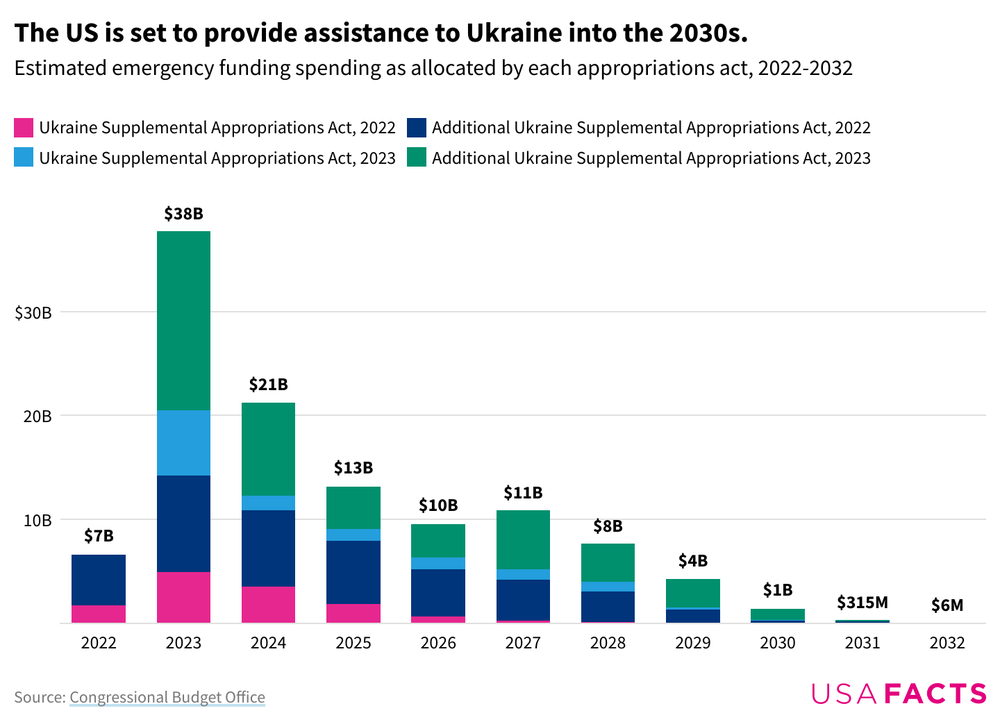
The money from these bills can take years to distribute. According to Congressional Budget Office reports, the US expects to provide emergency funding for Ukraine and neighboring countries until 2032.

Aid-to-Ukraine-by-year-column-graph

This means that, while the US has set aside roughly $115 billion for aid, most of the money hasn’t been spent yet. Departments that received emergency funding have discretion over how much money will be dealt out over time.

How much humanitarian aid has the US given Ukraine?

According to USAID, the US granted Ukraine nearly $10 billion in development and humanitarian support during the first year of the war.

Additional funding from USAID has also gone towards paying salaries for civil servants such as educators, healthcare workers, and first responders.

The nation initially budgeted for less than $5 billion in humanitarian aid for 2022, but discretionary spending varies based on immediate needs creating by the conflict. This is also the case with military security assistance.

How much military aid has the US given Ukraine? 

The US has sent more than $30 billion in military assistance to the Ukrainian government since February 24, 2022, primarily through presidential drawdowns and the Ukraine Security Assistance Initiative (USAI).

Presidential drawdowns are orders directing the Defense Department to immediately deliver defensive equipment and services to foreign countries in crises. President Joe Biden has signed 31 drawdowns for Ukraine as of the war's one-year anniversary.

The USAI is a Defense Department-led program focused on increasing Ukraine’s defenses against Russian aggression through military training, equipment, and intelligence support.[2]

Military assistance comes in the form of equipment and weaponry. The Defense Department regularly updates a comprehensive list of supplies sent to Ukraine.

Where did foreign aid for Ukraine come from?

The nation has allocated $114.9 billion in aid over the last year, contained in four separate bills.

In 2022[3], the US appropriated nearly $55 billion in foreign aid towards supporting Ukraine during Russia’s war.

These funds were from the Ukraine Supplemental Appropriations Act, 2022 and the Additional Ukraine Supplemental Appropriations Act, 2022 which provide $13.6 and $41.6 billion in emergency funding, respectively.

President Biden signed the Ukraine Supplemental Appropriations Act, 2023, last September and the Additional Ukraine Supplemental Appropriations Act, 2023 last December, providing an additional $12.3 and $47.4 billion in emergency funding, respectively.

Additionally, President Biden signed the Ukraine Democracy Defense Lend-Lease Act in May 2022, authorizing the US military to provide Ukraine and other Eastern European countries with equipment.

>

Zelensky Calls for a European Army as He Slams EU Leaders’ Response

      Jan 23, 2026 During the EU Summit yesterday, the EU leaders ...