2 AUG 2023 | PUBLICATION
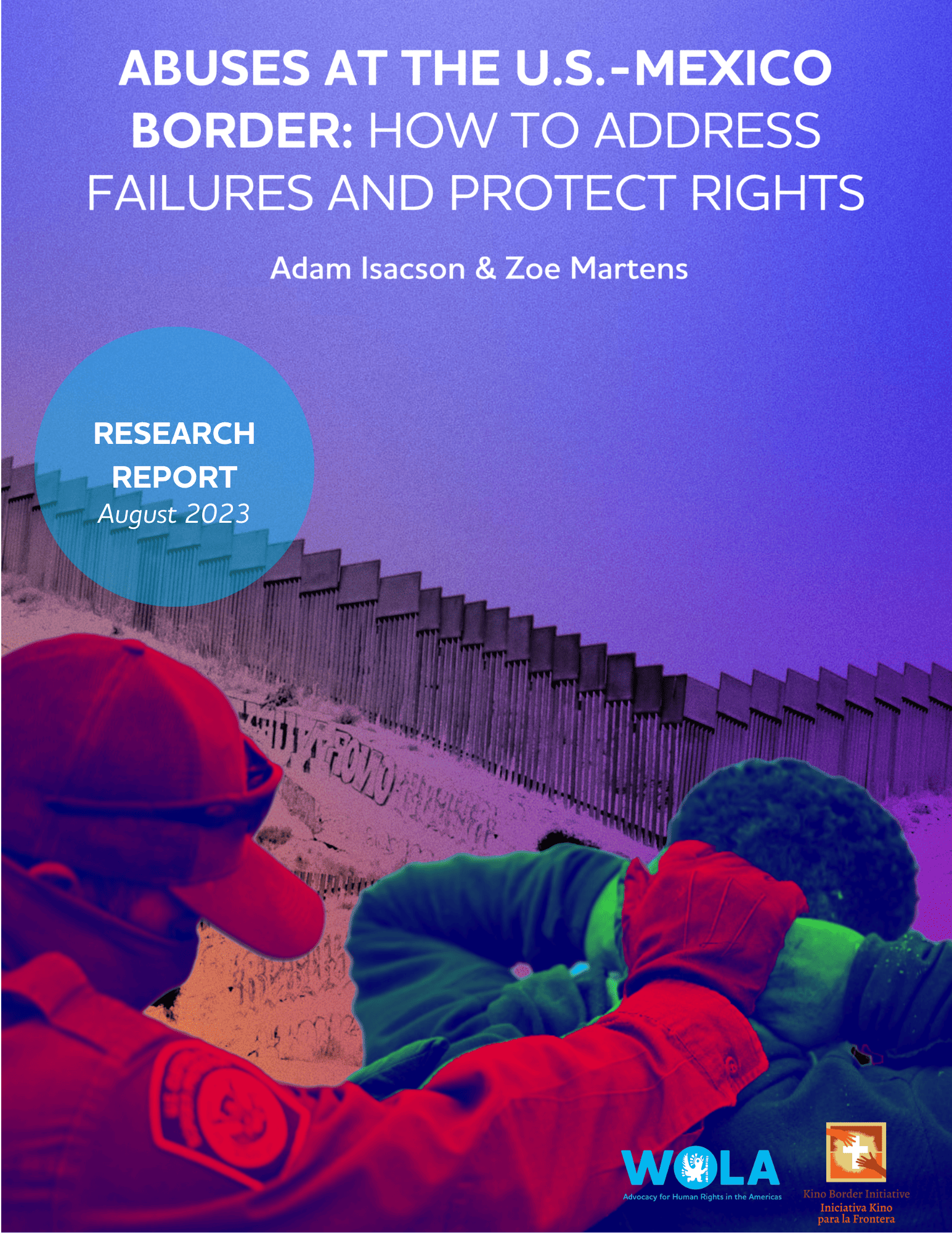
Abuses at the U.S.- Mexico Border: How To Address Failures and Protect Rights
“Border Patrol has the right to apprehend someone, but in the proper way, not wrongfully. Many people are afraid of the Border Patrol. Thanks be to God—He gave me the strength to endure and overcome what they [Border Patrol] did to me… People do not have to put up with Border Patrol’s abuses. Because it’s difficult, and my case is one example. An example for many people who maybe also have been run over, like me… It is an example that I share with fellow migrants, so that they don’t become demoralized. If the Border Patrol hits you, demand your rights, because we all have rights.”
— “Marco Antonio,” who filed a complaint after Border Patrol hit him and ran over his leg on a four-wheeler
Contents
Executive Summary
A U.S.-Mexico border that is well governed and that also treats migrants and asylum seekers humanely can go hand in hand and should not be seen as an unattainable aspiration. For this to happen, U.S. government personnel who abuse human rights or violate professional standards, must be held to account within a reasonable amount of time and victims must receive justice.
Right now, at the U.S.-Mexico border, this rarely happens.
- Customs and Border Protection (CBP), the federal government’s largest civilian law enforcement agency, has a persistent problem of human rights abuse without accountability. Many, if not most, CBP officers, and agents in CBP’s Border Patrol agency are professionals who seek to follow best practices. However, the frequency and severity of abuse allegations indicate that a substantial number of officers and agents don’t meet that standard. Further, the record suggests that existing investigations are flawed and incomplete, while disciplinary procedures are not credible enough to change their behavior.
- This report gives numerous examples of alleged abuse, as well as insubordinate or politicized behavior since 2020. Some of the cases are severe, involving misuse of force or even loss of life. Many other examples of cruelty and victimization take place on a daily basis, such as unprovoked violence during arrests, abusive language, denial of food or medical attention, family separations, non-return of documents and valuables, dangerous deportations, racial profiling, and falsifying migration paperwork. The Washington Office on Latin America (WOLA) keeps a regularly updated database documenting these abuses.
- The investigations of many of these allegations would not take place without the work of outside actors like human rights defenders, journalists, whistleblowers and the victims themselves. Investigations can begin in two ways. Some—often, the most serious cases—start at U.S. government investigators’ own initiative, especially if the site of the abuse is a crime scene. Many others require outside actors to take the first step. Without their initiative, most such cases would never be investigated at all—and, as this report shows, many still don’t get investigated.
- For a victim or advocate seeking to make a complaint and achieve redress, the accountability process is bewildering, opaque, and slow-moving. Right now, outside efforts to gain accountability for abuse must go through a convoluted system that has been cobbled together in the 20 years since the Department of Homeland Security’s (DHS) founding. Four agencies with overlapping responsibilities handle complaints and pass cases between each other. All suffer from personnel and other capacity shortfalls, and some have insufficient power to make their recommendations stick.
- There are several frequent “failure points” where cases commonly lead nowhere, ” leaving victims without justice and harming the credibility of the DHS accountability process. In its accompaniment of migrant victims who come from CBP custody to its shelter in Nogales, Sonora, Mexico, the Kino Border Initiative (KBI) often sees complaints go nowhere. Cases get entered into a database without further action. They get closed because of ongoing litigation, even about general topics, or because “policy was not violated.” Cases get forwarded to other agencies, then nothing happens. Sometimes, there is no response at all. This report’s second section documents painful examples of abuses suffered and what this inability to get past “failure points” looks like, including to victims—some of whom are deported without ever speaking to an investigator.
- The status quo is unsustainable. Strengthening accountability will require action from many quarters. The way ahead involves improving the complaints process, investigations, discipline, congressional oversight, and cultural change. WOLA and KBI researchers drew on our experience, on many conversations with advocates and officials, and on extensive reading of existing literature to pull together more than 40 recommendations. Among them:
- The complaints process: it is urgent to improve personnel capacity to reduce caseloads, to ease intakes, to offer real-time feedback to complainants about the status of their cases, to inform about resulting recommendations, and to explain why investigations were terminated.
- Investigations: it is crucial to relieve complainants of the burden of knowing which of four agencies to complain to, to stop the DHS Inspector General (OIG) from freezing investigations by holding on to cases without acting, to improve agencies’ ability to handle complaints with multiple allegations, to build up staffing, to deploy and use more body-worn cameras, to ensure that victims are interviewed, and to make top-level management changes at the OIG.
- Discipline: it is vital to strengthen CBP’s use of force standard to “necessary and proportionate,” to make it more difficult to overrule investigators’ disciplinary recommendations in human rights cases, to get officials in the chain of command out of discipline decisions, and to empower the National Use of Force Review Board to issue quicker, tougher decisions.
- Congressional oversight: legislators and their staff need to carry out more hearings, issue more written inquiries, and add more reporting requirements about accountability, while passing legislation to clarify oversight agencies’ jurisdictions and increase their funding.
- Cultural change: key steps include getting the Border Patrol Union out of human rights and other misconduct cases involving members of the public, taking stronger measures on sexual harassment and bolstering the recruitment of women, protecting whistleblowers, closing the current loophole allowing racial profiling, and taking Border Patrol agents out of asylum processing.
This agenda of recommended reforms is ambitious, and many sectors have roles to play: DHS officials, legislators, NGOs, journalists, philanthropists, and—first and foremost—agents and officers themselves. But as the many examples of injustice documented here make clear, there is no choice: this is a matter of democratic rule of law, both at the border and beyond it.
This report was made possible, and tremendously improved, by editing, design, research, communications, and content contributions from Kathy Gille, Joanna Williams, Ana Lucía Verduzco, Zaida Márquez, Sergio Ortiz Borbolla, Milli Legrain, and Felipe Puerta Cuartas. We could not do this work without the generosity of our supporters; please become one of them.