Officials of the countries stressed that such assumptions are linked with support personnel who will provide training, help set up processes, and do other work without being involved in hostilities.

In their everyday lives, humans often weigh the value of different options and decide how to act based on this mental evaluation. This process, known as value-based decision-making, has been the topic of numerous studies rooted in psychology, neuroscience and economics.
Despite the fact that it is present in almost all vertebrate species, very little was known about the habenula until fairly recently. In the past several years, however, the habenula has received a significant amount of attention for its potential role in both cognition (e.g. reward processing) and disorders like depression. Still, the habenula remains a little-known structure whose functions are yet to be fully elucidated.

"Behavioral and economic theory dictate that we decide between options based on their values," wrote Ethan S. Bromberg-Martin, Yang-Yang Feng and their colleagues in their paper.
"However, humans and animals eagerly seek information about uncertain future rewards, even when this does not provide any objective value. This implies that decisions are made by endowing information with subjective value and integrating it with the value of extrinsic rewards, but the mechanism is unknown."
As part of their study, Bromberg-Martin, Feng and their collaborators released a series of tasks in Amazon's Mechanical Turk, which were completed by 824 human participants between 18 and 55 years of age. These participants received money for completing these tasks and the amount depended on how well they performed.


More information: A neural mechanism for conserved value computations integrating information and rewards. Nature Neuroscience(2024). DOI: 10.1038/s41593-023-01511-4.
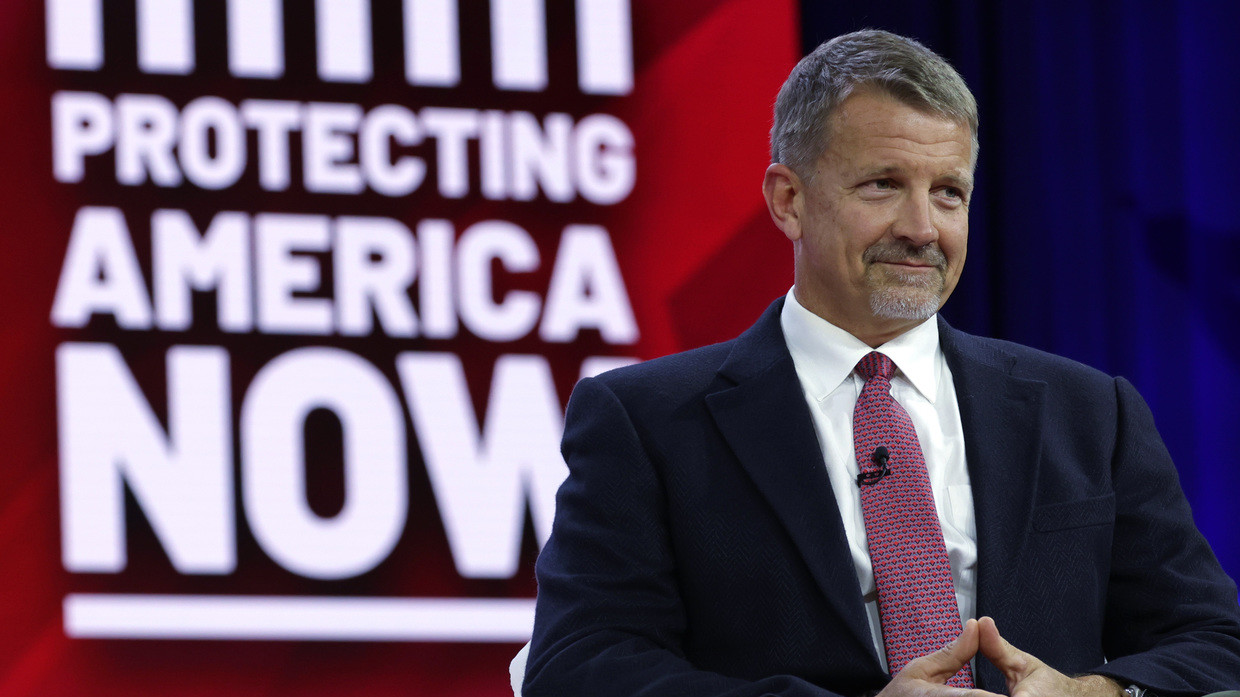
The West should pull the plug on the Ukraine conflict as soon as possible because it will not be able to outperform Russia’s defense industry, Erik Prince, founder of the American private military company Blackwater has said.
Speaking to the podcast PBD on Friday, Prince, who served as the CEO of the mercenary group until 2009 and now heads Frontier Resource Group, a private equity fund, expressed doubts about whether Kiev and its Western backers could prevail in the conflict with Russia, which has just entered its third year.
“We need to bring this war to a close because all Ukraine is doing right now is destroying itself demographically,” he said, adding that hostilities are “chewing up the next generation of Ukrainian manpower,” which will be almost impossible to replace.
“The Western defense base is pathetic and you’re not going to out-conventional war the Russian bear,” Prince argued.
According to the former US Navy SEAL, in this light, the “ugly peace” and a freeze in hostilities would be a better option both for Kiev and its Western supporters than “whatever their idea of an ideal war is,” adding “let them [Russia] keep Crimea, Donetsk, Lugansk. Whatever.”
The majority Russian-speaking Autonomous Republic of Crimea and city of Sevastopol voted overwhelmingly to become part of Russia in a 2014 referendum after a Western-backed coup in Kiev. Donetsk and Lugansk, regions which had declared independence from Ukraine, followed suit in September, 2022 after the start of the current conflict.
However, Prince did not mention Kherson and Zaporozhye regions, which also held successful referendums to join Russia in the fall of 2022.
“It’s not the American taxpayer’s obligation to spend another hundred billion in Ukraine when there’s been significant corruption and really nothing to show for it,” he added.
Meanwhile, Tesla and Space X CEO Elon Musk appeared to agree with Prince. Commenting on the Blackwater CEO’s quotes, which were cited by American investor David Sacks, he wrote on X (formerly Twitter): “Unfortunately, that is true.”
Russia maintains it is open to talks on Ukraine; however, Ukrainian President Vladimir Zelensky signed a decree banning talks with the current leadership in Moscow after the referendums in Kiev’s four former regions, which it immediately condemned as illegitimate.
At the same time, Kremlin spokesman Dmitry Peskov said last year that Moscow is opposed to a freeze in the Ukraine conflict, saying that it will not stop until its goals are accomplished and national interests protected by military or other means. Russia has repeatedly said that its main goals are to “denazify” and “demilitarize” Ukraine.


