The global economy appears to be in final approach for a “soft landing” in 2024, indicating that a global recession has been avoided despite the steepest rise in global interest rates since the 1980s. Yet policymakers “would be wise to keep their eye on the ball,” Gill writes.
World Bank raises estimate for Russian economic growth The country’s GDP is projected to expand 2.9% this year, according to the institution’s latest report
The World Bank has raised its growth forecast for the Russian economy based on revised figures published on Tuesday.
According to Global Economic Prospects 2024, Russia’s GDP will grow 2.9% this year and 1.4% in 2025. This is an upward revision from its previous projection of 2.2% and 1.1% growth, respectively. The World Bank added that the Russian economy outperformed expectations in 2023, with growth picking up to 3.6% last year, a sharp increase from its January prediction of 2.6% and October projection of 1.6%. “The upgrade largely reflects stronger-than-expected private demand, supported by subsidized mortgages, fiscal measures, and a tight labor market,” the institution wrote, noting that increased military expenditures have also boosted activity. It further stated that “while the carry-over from strong growth in late 2023 and the beginning of 2024 is expected to boost activity throughout 2024, the anticipated tightening of macroprudential measures and the scaling back of the provision of subsidized mortgages are set to temper private demand.” The report also pointed out that Russia’s trade ties with China have grown; more transactions are being conducted in the Chinese yuan amid Moscow’s ongoing ‘pivot’ to the East. According to Russian President Vladimir Putin, the country’s economic growth exceeds the global average. In an address to the St. Petersburg International Economic Forum (SPIEF) last week, Putin said that Russian GDP expanded by 3.6% last year, bouncing back from a 1.2% downturn amid Ukraine-related sanctions in 2022. This year, the economy has continued to expand, he stated, adding that the growth has largely been driven by non-resource sectors.
In April, the International Monetary Fund (IMF) said it expects the Russian economy to grow faster than all advanced economies in 2024.
According to its projections, the country’s GDP is forecast to expand by 3.2%, exceeding the expected growth rates for the US (2.7%), the UK (0.5%), Germany (0.2%), and France (0.7%).
Russian Finance Minister Anton Siluanov earlier said he expects GDP growth in 2024 to equal that of last year, while the Bank of Russia has put it at 2.5–3.5%.
“Growth rates remain too slow for progress. Without stronger international cooperation and a concerted push for policies that advance shared prosperity, the world could become stuck in the slow lane."
In its latestglobal economic outlook report, the Economist Intelligence Unit (EIU) "forecasts more fragmentation and regionalization in the world economy in 2024-28 as alliances tighten and competing blocs form."
The World Bank raised its forecast for global growth this year on strong US expansion, while warning that climate change, wars and high debt will hurt the poorer countries where most of the world’s population lives.
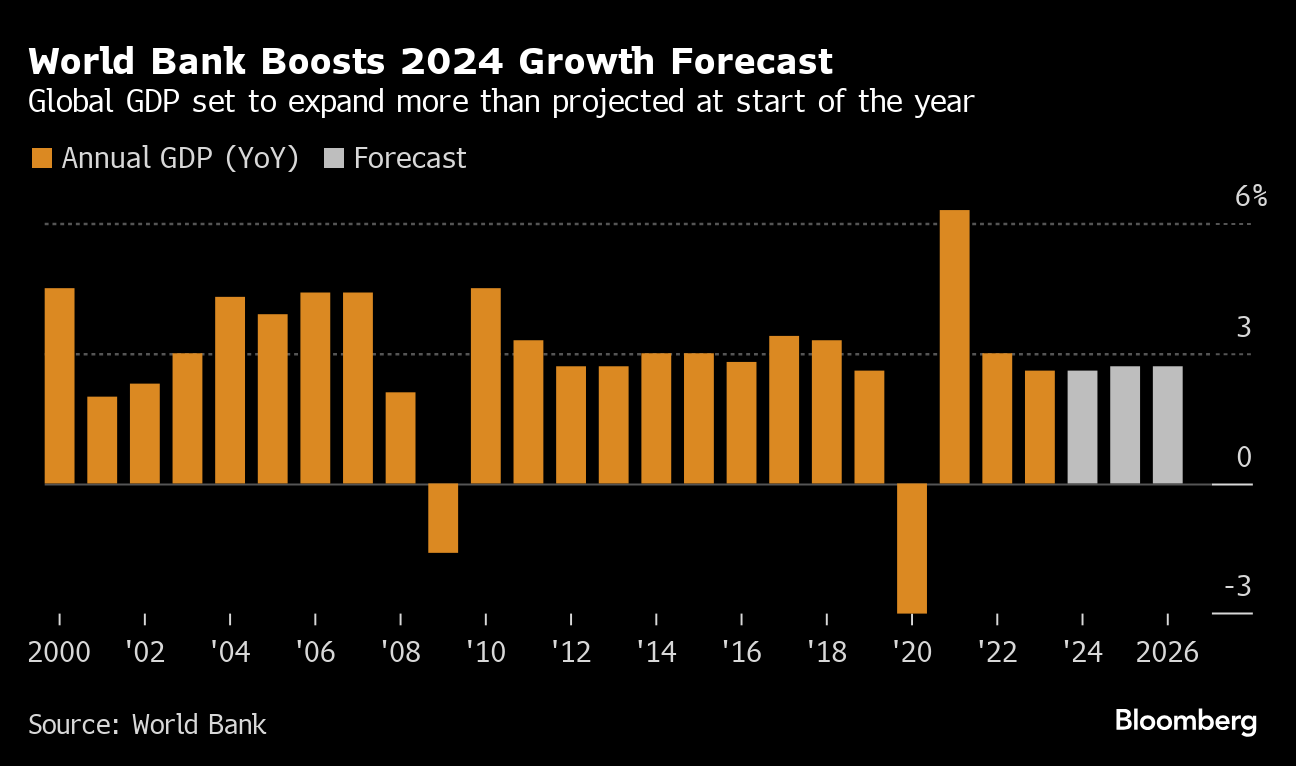
Despite an improvement in near-term prospects, the global outlook remains subdued by historical standards. In 2024-25, growth is set to underperform its 2010s average in nearly 60 percent of economies, comprising over 80 percent of the global population.
Downside risks predominate, including geopolitical tensions, trade fragmentation, higher-for-longer interest rates, and climate-related disasters.
Global cooperation is needed to safeguard trade, support green and digital transitions, deliver debt relief, and improve food security.
In EMDEs, public investment can boost productivity and catalyze private investment, promoting long-run growth.
Comprehensive fiscal reforms are essential to address ongoing fiscal challenges in small states, including those arising from heightened exposure to external shocks.
Growth Is Proving Surprisingly Resilient in the Face of High Interest Rates and Geopolitical Risks, Says EIU Report
This article was originally published on GT Perspectives.
In its latest global economic outlook report, the Economist Intelligence Unit (EIU) "forecasts more fragmentation and regionalization in the world economy in 2024-28 as alliances tighten and competing blocs form."
What is more,
"The return of industrial policy, including sanctions and the provision of new incentives, will push firms to adopt more inefficient supply chains, stoke trade tensions in strategic sectors and make it difficult to compete across the global marketplace.
These developments will drag on growth potential."
The EIU expects "global real GDP will expand by 2.8% a year on average over the next five years—below the 3% of the 2010s, which was hardly a stellar decade for the global economy."
The UK-based organization adds that "In the near term, however, the global economy is showing resilience in the face of international conflict and higher interest rates.
This mainly reflects the remarkable strength of the US economy, which is driven by strong household finances, a rising trend in manufacturing investment and a booming technology sector. Elsewhere, the picture is less dynamic but short of a downturn." Moreover, "Momentum in Europe will build gradually in 2024. Modest government stimulus in China is helping the economy to in the Middle East as the conflict in Gaza continues. Russia's invasion of Ukraine, now in its third year, shows no sign of resolution. Flash points in Asia, such as in relation to the South China Sea and Taiwan, will pose a persistent threat to the fragile stability that has developed in US-China relations. The diffusion of global power and uncertainty over the direction of US foreign policy underpins this rise in geopolitical risk."
Other key findings from the report include: 2.5% global real GDP growth in 2024 (compared with 2.4% previously), meaning growth will be unchanged rather than slowing from 2023.
Growth is proving surprisingly resilient in the face of high interest rates and geopolitical risks.
The change in global growth reflects
another upward revision for US growth in 2024 to 2.2% (from 2% previously),
upward revisions for several European economies that have pushed euro area growth to 1% (from 0.8%) and
an upward revision for Brazil to 2.1% (from 1.8%)
Reduction of expectations for future monetary policy loosening, removing one 25-basis-point cut from the loosening cycles of both the Federal Reserve (the US central bank) and the European Central Bank in 2024-25.
In contrast, the EIU now expects the Bank of England (the UK central bank) to cut quicker than previously forecast, lowering its rate to 3.5% by end-2025 (compared with 4.25% previously).
The US dollar effective exchange rate is now forecast to appreciate for a third consecutive year in 2024—the EIU previously expected a mild depreciation.
This reflects a stronger depreciation in the yen's value than previously forecast and the fact that the EIU is no longer forecasting euro appreciation.
On the topic of how climate change and AI may threaten global convergence prospects, the report says: The green transition and technological change will be among the major trends shaping global economic prospects over the next five years.
In both cases, they seem set to diminish convergence prospects for developing economies.
Poorer countries will be disproportionately affected by climate change and will struggle to secure financing to mitigate its impact.
Although we are skeptical about the scale of productivity gains from artificial intelligence (AI), those improvements that do emerge will accrue mainly to developed economies; this will create challenges for countries aiming to move up the manufacturing and services value chains.
We still expect some emerging markets to stand out, however, helped by being fairly insulated from geopolitical tensions and rising trade barriers.
India is forecast to expand the fastest of any major economy in 2024-28, and Mexico will benefit from nearshoring trends.

The bust of the Egyptian queen has been a tourist attraction in Berlin for more than 100 years. But from the beginning it's also been at the heart of a bitter row, with many believing it should be returned to Egypt.
Nefertiti means “the beautiful one has come”.
Nefertiti bust: Ambassador or hostage?
Ulrike Bornhak 06/08/2024June 8, 2024
The bust of the Egyptian queen has been a tourist attraction in Berlin for more than 100 years. But from the beginning it's also been at the heart of a bitter row, with many believing it should be returned to Egypt.
Learn about the history behind the Bust of Nefertiti by Thutmose, including its history, creation, rediscovery, and cultural relevance as an Egyptian antiquity. Understand why the ownership of the ...
What the “Nefertiti Hack” Tells Us About Digital Colonialism
A hacked 3D scan of the famous sculpture shows how traditional models of heritage ownership might change in museums.
Digital render of the Egyptian Museum of Berlin's 3D scan of the bust of Nefertiti acquired in 2019 by Cosmo Wenman (image used by expressed permission of Cosmo Wenman)
Support Independent Arts Journalism
As an independent publication, we rely on readers like you to fund our journalism and keep our reporting and criticism free and accessible to all. If you value our coverage and want to support more of it, consider becoming a member today.
In 1912, the famed painted limestone and stucco bust of Egyptian queen Nefertiti was excavated by German archaeologists using Egyptian labor. The newly revealed bust lived up to the queen’s name, which means “the Beautiful One Is Here”, as it was pulled from behind a door in the house of the master sculptor Thutmose at Tell el-Amarna, about 150 miles south of Cairo. The day of the discovery, lead archaeologist Ludwig Borchardt jotted down a prescient note:
Colours look freshly painted. Really wonderful work. No use describing it, you have to see it.
For millions of viewers since then, Borchardt’s recommendation has been taken to heart. Created around 1340 BCE and weighing 44 pounds, the captivating polychromatic bust was unveiled to the public at the Egyptian Museum in Berlin in 1923.
The story of the Nefertiti bust provides a window into the European domination of excavations in Egypt and other Mediterranean archaeological sites in the late 19th and early 20th century. French, German, and British excavators were often supercilious in their defense of looting cultural heritage from classical sites in the Eastern Mediterranean in order to be “protected” within European museums. They also developed cunning methods for carrying out their work. In the Nefertiti bust’s case, overwhelming evidence suggests its removal to Germany in 1913 was not legal then and remains both illicit and unethical today — a wrong yet to be rectified.
Much of the storied history of the bust is reconstructed by archaeologist Joyce Tyldesley in her book, Nefertiti’s Face: The Creation of an Icon. In it, she recounts the lengths gone to by European and then American archaeologists to hide objects from inspectors when, at the end of a dig, the finds from sites were to be divided between the Western countries granted licenses by the French to excavate and the native Egyptian authorities. When French archaeologist and Louvre emissary Auguste Mariette became the first Conservator of Egyptian Monuments in 1858, he opposed training native Egyptians as professional archaeologists. The “School of the Ancient Egyptian Language” opened in 1869, but Mariette feared native Egyptians learning to translate hieroglyphics and other ancient languages as a potential threat to European archaeologists. German Egyptologist Heinrich Karl Brugsch, the director of the short-lived school, remarked on Mariette’s paranoia over being replaced by Egyptian professionals:
No matter how much I tried to set his mind at ease, [Mariette] remained so suspicious that he gave the order to museum officials that no native be allowed to copy hieroglyphic inscriptions.
Whether in the Antebellum South or in 19th century Egypt, White control over the literacy of marginalized persons has always been a tactic for control. Egyptology did not begin to be decolonized and to encourage the training of native Egyptians within the Antiquities Service until the 1920s. French oversight within the Antiquities Service in Egypt did not end until 1952, after almost a century of colonial control. Mostafa Amer, its first Egyptian director, was appointed in 1953.
During the inspection of dig finds in the early 20th century, artifacts were often hidden from view, mislabeled on lists, or covered with mud in order to avoid being taken in the 50/50 division of cultural heritage between European licensees and the Egyptian state. The French inspectors at the Antiquities Service also had the right to commandeer finds at any time to be kept in Cairo. The tactic to get around these inspections was to play down anything you wanted to keep as unmemorable, forgettable, prosaic. And Nefertiti was and is anything but.
A black and white photo of the bust of Nefertiti from a postcard available from the Staatliches Museum, Berlin, Germany (1956) reveals how and why color photography would have been key in the inspection of the Amarna finds in 1912 (image by Brück & Sohn via Wikimaedia Commons).
As Tyldesley notes, the Nefertiti bust was placed inside an excavation box and then black and white photos outside of the closed container were presented to the French inspector Gustave Lefebvre. Lefebvre’s cursory exam of these photos (and perhaps some mud used to dirty up the bust if he had looked closer) meant that the exquisite polychromatic beauty of the bust went unrecognized. Borchardt later confided to the German art critic Julius Meier-Graefe, in regards to the Nefertiti bust, that “The gents in Cairo were just too slack to look in the box.” The Germans notified back at the Deutsche Orient-Gesellschaft (the German Oriental Society) wanted Nefertiti in order to draw visitors to Berlin, and by 1913, they had her in their possession.
For almost a decade after the bust’s tantalizing but brief unveiling in the courtyard of the Neues Museum in Berlin in 1913, she was kept out of public view for fear the Antiquities Service in Egypt would be riled about her export and perhaps terminate excavation licenses in retaliation. Nefertiti’s lure was immediate when finally put on display in the Neues Museum in 1923, although she was hidden away in a German salt mine during World War II. The museum would then be hit with Allied bombs in 1943 and 1945.
Nefertiti Bust on display (1963)at the Berlin-Dahlem Museum, West-Berlin, Germany during a visit by the Vice-President of Cyprus (image by Ludwig Wegmann via Wikimedia, originally provided by the German Federal Archive).
However, Borchardt was right about one thing: Egypt did eventually come for their queen. In 2009, following the museum’s grand reopening, Egypt’s Supreme Council of Antiquities (SCA), headed by archaeologist Zahi Hawass, requested the return of the bust. Thousands of Berliners had waited in line to see the Neues Museum reopen to the public but Egyptians had waited almost a century for her return. The re-display of the bust as the pièce de résistance of the space immediately stirred up old animosities.
The request was ultimately denied; however, another attempt was made in 2011. At that time, Hawass wrote to the Prussian Cultural Heritage Foundation, which oversees the Neues Museum along with the other Berlin State Museums, to again ask for the return of the bust. The Egyptian SCA was rebuffed again, this time witha paternal statement claiming that the bust would not be returned because in their mind, Nefertiti — and the roughly one million viewers who travel to the museum to see her yearly — stands as a material mediator between the two cultures. “She is and remains the ambassador of Egypt in Berlin,” they stated. Never mind that she is a captive ambassador.
Despite the fact that Nefertiti and many other works of African cultural heritage reside within the “white cube” of the museum, the developing digital space for a new version of the museum, known as the “black box,” carries both potential and risk. The idea of a universally accessible, digital museum could challenge traditional models. Conversely, it may allow algorithms and gatekeeping to replicate colonial policies. The future of the digital museum was recently explored in a two-day symposium at the Metropolitan Museum of Art organized by Saima Akhtar, Kristine Khouri, and Andrea Wallace. Panels interrogated the overtly utopian ideals that often frame the idea of a universal digital museum. As many in the symposium pointed to, as 3D modeling and online collection databases become more normalized, the colonial legacies and paternal policies which shaped acquisition can migrate from the physical to the digital realm.
Screenshot of comparative 3D models of the 2016 Nefertiti Hack versus the 2019 3D model released by the museum following FOIA filings (image by AD&D 4D via Sketchfab).
Although the artists originally stated that they had gone into the museum and guerrilla scanned the Nefertiti bust using a hidden Microsoft Xbox 360 Kinect Sensor, in reality they were likely involved in a double-blind hack. As Geismar concludes, it appears that an inside (wo)man with access to the museum’s 3D data released the scan to the artists. Subsequently, Al-Badri and Nelles released the files under a Creative Commons open license (CC0) for anyone to use. Geismar remarks that the hack drew “attention to museum hoarding [practices] not just of ancient collections but of their digital doubles.” The hack used the tools of “data collection and presentation to undo the regimes of authority and property over which the museum still asserts sovereignty.” Such museum interventions also underscore that the “digital repatriation” of objects by museums can never replace physical repatriation.
Where does the fight over Nefertiti’s bust stand today? In 2020, a campaign was launched anew to restore the Nefertiti bust to Egypt in time for the opening of the Grand Egyptian Museum (GEM) in Giza, likely in 2022. In a conversation with Hyperallergic, Monica Hanna, Dean of the College of Archaeology and Cultural Heritage at the Arab Academy for Science, Technology, and Maritime Transport in Giza, noted the necessity to return the bust in addition to thousands of other stolen, looted, and illegally exported pieces. To Hanna and many within Egypt, Europeans must begin to consider Egyptian cultural heritage within the context of the larger push among countries like France, Britain, and Germany to repatriate African heritage such as Nigeria’s Benin Bronzes. As Shirley Graham Du Bois famously stated, “Egypt is Africa.”
Side view of the Nefertiti Bust, limestone, stucco, and polychromy (ca. 1340 BCE), Neues Museum, Berlin, Germany (photo byJesús Gorriti via Wikimedia Commons).
Hanna is part of a team of academics from Cairo, the Pitt Rivers Museum, and other UK institutions, located in Accra, Cape Town, and Berlin who have come together to make a list of thousands of African objects that should be repatriated — with hopes to list each of them publicly within the next three years. Hanna, as well as researchers such as Felwine Sarr, caution that there remains a pernicious belief that African nations do not have the museums to house and protect their own heritage.
This condescending attitude generates a defense of pseudo-protection of cultural assets separated from indigenous cultures. In the wake of Germany’s landmark decision to return the looted Benin Bronzes, the work is not over; restitution is not complete. With or without the new GEM to house the Nefertiti bust, she deserves to be a part of the conversation over the return of African cultural heritage. “Agency and control of knowledge production is the goal,” Hanna states, “and Egyptians are not required either to build a museum or prove themselves to Europeans in order to get their stolen heritage back.”