Tuesday, July 02, 2024

Hungarian PM meets Ukraine’s Zelenskyy in surprise visit


Viktor Orbán arrives in Ukraine to meet Zelenskyy – POLITICO
Hungary's Orbán in Kyiv for talks with Zelenskyy in first visit since the  war began | NPR Illinois


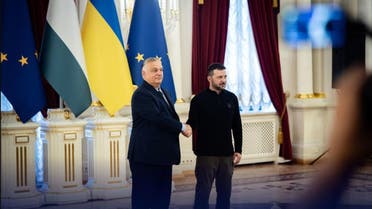
Hungarian Prime Minister Viktor Orban pays a surprise visit to Kyiv for talks with President Volodymyr Zelenskyy. (Facebook)

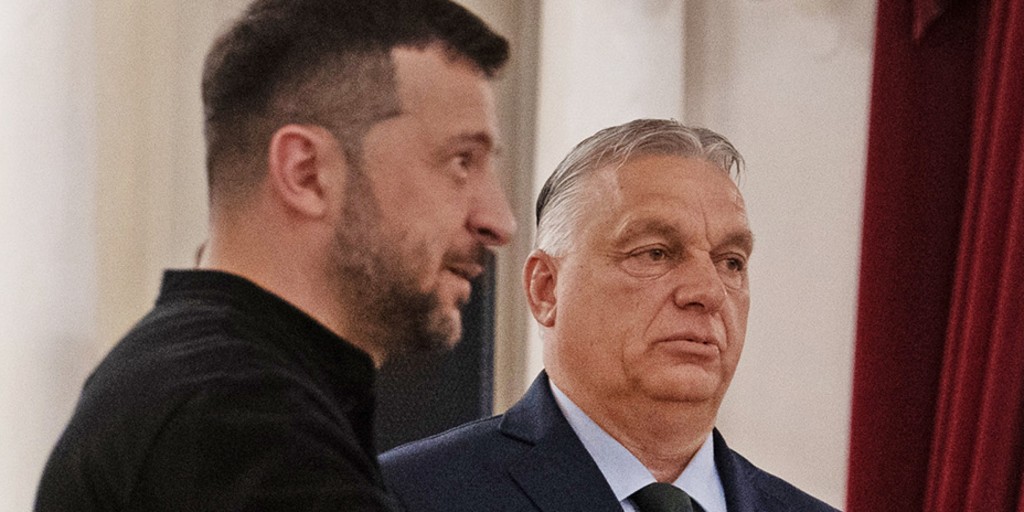
Hungarian Prime Minister Viktor Orban, an outspoken critic of Western military aid to Ukraine, paid a surprise visit to Kyiv on Tuesday for talks with President Volodymyr Zelenskyy.

Orban, who has the warmest relations of any European leader with Russian President Vladimir Putin, arrived a day after Hungary assumed the rotating six-month presidency of the EU Council. It is his first visit to Kyiv in more than a deca
de.
“The aim of the Hungarian presidency is to contribute to solving the challenges ahead of the European Union. That’s why my first trip was to Kyiv,” Orban wrote on Facebook under a photograph of him shaking hands with Zelenskyy.

  • Separately, his press chief Bertalan Havasi told Reuters in an email that the two leaders would discuss bilateral relations, saying “the most important topic of the talks is the chance to create peace”, but gave no details.

Zelenskyy and Orban were expected to deliver statements to reporters later on Tuesday.

Ties between the neighbors have come under heavy strain since Russia launched its full-scale invasion of Ukraine on Feb. 24, 2022, with Budapest often opposing European Union efforts to support Kyiv.
  • Under Orban, who upset Western partners by holding talks with Putin last October, Hungary has repeatedly accused Ukraine of curbing the rights of roughly 150,000 ethnic Hungarians living in the far west of Ukraine.
Kyiv has denied any such infringements but said it will do everything to address Budapest’s concerns, which center around the ethnic Hungarian minority’s language rights and native-language schooling.

Ukraine is keen to secure Hungary’s backing as it relies heavily on financial and military support from the 27-member EU, where unanimity is needed for many decisions

EU membership talks

Last week, the EU opened formal membership talks with Ukraine at its summit in Brussels, giving the country a morale-lifting boost, although a long and tough road still lies ahead before it can join the bloc.

Zelenskyy and Orban were filmed on the sidelines of that summit in what looked like an emotional exchange.

Last year, Orban told Putin that Hungary had never wanted to oppose Russia. In early 2024, it took the EU leaders weeks to break the Hungarian prime minister’s veto to extend 50 billion euros ($53.67 billion) in new aid to Ukraine.
  • Hungary used its complaints over language rights in Ukraine to block the decision until December when Orban left the room before an EU meeting on the issue, allowing the aid package to pass.
Kyiv passed a law in 2017 that required all schools to teach students over the age of 10 in the Ukrainian language. Hungary saw this as a breach of the ethnic Hungarian minority’s rights.
Some changes were made in December 2023 when the issue became critical for Kyiv’s EU accession talks. Budapest said the changes were an improvement but didn’t go far enough.

Coup attempt thwarted in Ukraine, security service says, as Hungary's Orbán arrives in Kyiv for talks

The Security Service of Ukraine said the group plotted to seize the country's Parliament.
Hungarian Prime Minister Viktor Orban in Ukraine
Ukrainian President Volodymyr Zelenskyy welcomes Hungarian Prime Minister Viktor Orban in Kyiv on Tuesday. Andrew Kravchenko / Bloomberg via Getty Images


President Volodymyr Zelenskyy’s security service said Monday, it foiled a coup that would have “played into Russia’s hands” as his Ukrainian forces battled their Russian counterparts in the east of the country.

News of the plot emerged ahead of the visit of one of Russian President Vladimir Putin’s only European allies, Hungarian Prime Minister Viktor Orbán, to Kyiv on Tuesday for talks with Zelenskyy.

The Security Service of Ukraine (SBU) said in a Telegram post on Monday that a group of people were preparing “a series of provocations” in capital Kyiv.

It added that the group was led by a co-founder of a public organization known for its “anti-Ukrainian actions” since 2015, although it did not name either the individual or the group.

After calling for a public gathering in central Kyiv on Sunday, the suspects were planning to announce the removal of the country’s military and political leadership from power, the SBU said. Then they plotted to seize the building of the Verkhovna Rada, Ukraine’s Parliament, the statement added.

The perpetrators “hoped to stir up the social and political situation within our country, which would work in Russia’s favor,” the security service said, although it did not explicitly say whether the Kremlin was behind the group or its plans.

Ukraine President Volodymyr Zelenskyy
Ukrainian President Volodymyr Zelenskyy says he has survived multiple Russian assassination attempts.Zhao Dingzhe / Xinhua News Agency via Getty Images
The SBU did not identify the suspects or say how many people were detained. But it said they are facing charges of calling for and trying to overthrow the constitutional order and seize power. If convicted, they could face up to 10 years in prison, the SBU said.
In a separate statement, Ukraine’s Office of the Prosecutor General said Monday that the head of the group sought out members of the military and private security guards to help them carry out the plan.

NBC News could not independently verify the details of the alleged coup, one of several purported attempts to topple the Ukrainian leadership since Putin launched his invasion in February 2022.

Ukrainian investigators said in May that they foiled a Russian plot to assassinate Zelenskyy and other top military and political figures. Two colonels in the State Guard of Ukraine, which protects top officials, were detained on suspicion of enacting the plan.

And ahead of the Russian invasion, Zelenskyy claimed to have intelligence and recordings of a coup plot involving Russians and a Ukrainian billionaire oligarch.

Orban and Zelenskyy in Ukraine
Hungarian Prime Minister Viktor Orbán at a meeting with Zelenskyy in Kyiv on Tuesday.Zoltan Fischer / AP

News of the latest plot emerged two days before Orbán, Hungary’s Prime Minister, arrived in Kyiv for talks with Zelenskyy.

Orbán, a self-described “illiberal” leader, is known to have a close personal relationship with Putin and while he and his government have condemned the invasion of Ukraine, they have refused to criticize the Russian leader.

He has also routinely blocked, delayed or watered down European Union efforts to extend assistance to Ukraine and to sanction Russia over the war.
He has also accused Ukraine of infringing on the rights of an ethnic Hungarian minority in the country’s western region of Zakarpattia for years, complicating relations between the two neighbors.
Orbán’s visit comes the day after Hungary took over the six-month rotating presidency of the European Union, a position that has little real power but can be used to set the tone of the 27 nation bloc’s agenda.
0 seconds of 3 minutes, 17 secondsVolume 90%
 
Referencing the presidency in a news conference after meeting with Zelenskyy, Orbán said he chose Kyiv for his first visit “because peace is an important question” and the war was impacting European security, according to the translation of his comments posted to the Ukrainian president's official Telegram account.
He also vowed to resolve “all previous disputes” with Ukraine, and “focus on the future.”
Zelenskyy's chief of staff, Andriy Yermak, also said that an "important conversation" about the future of Europe, security, international law and the Peace Formula, Zelenskyy’s 10-point plan for ending the war, had taken place.
Elsewhere, in eastern Ukraine, fierce battles between the country's forces and their Russian rivals continued. However, Moscow’s counteroffensive in the northeastern Kharkiv region appeared to stall as newly-committed U.S. military supplies have started to trickle in.

Moscow’s economic growth has defied Western sanctions

1 Jul, 2024 22:35

Russia becomes ‘high income’ country – World Bank

The World Bank’s annual national income rankings, released on Monday, showed that Russia has advanced from “upper middle” to “high” category on the strength of its economic growth.

The bank measures gross national income (GNI) based on a method dating back to 1989, and updates its classifications every July 1, based on the previous calendar year’s GNI per capita. The income is measured in the equivalent of US dollars. 

“Economic activity in Russia was influenced by a large increase in military related activity in 2023, while growth was also boosted by a rebound in trade (+6.8%), the financial sector (+8.7%), and construction (+6.6%),” said a post on the World Bank blog.

“These factors led to increases in both real (3.6%) and nominal (10.9%) GDP, and Russia’s Atlas GNI per capita grew by 11.2%,” the bank added.

This economic growth happened even after the US and its allies levied thousands of sanctions against Russia over the Ukraine conflict, openly stating that their goal was to destroy the Russian economy and provoke regime change in Moscow.

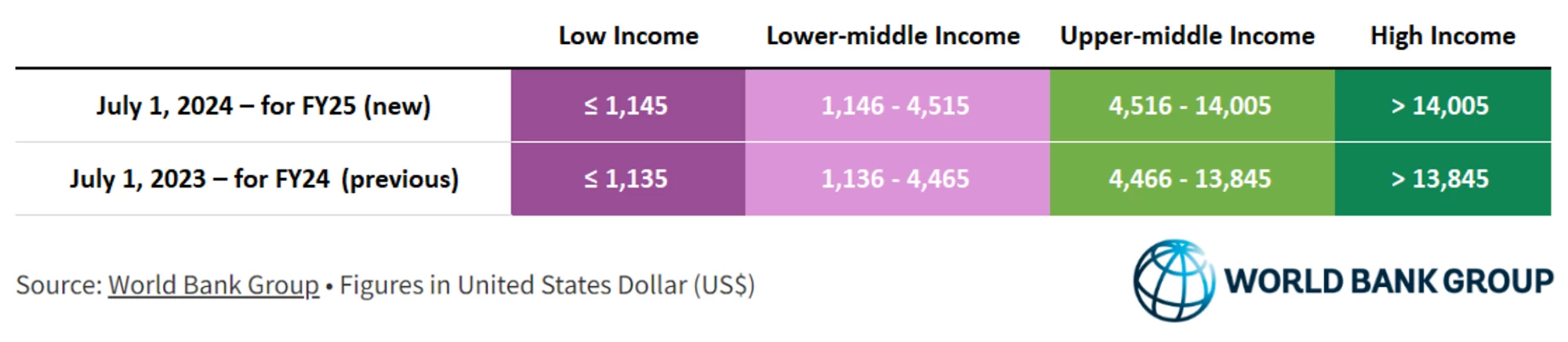
To be considered high-income, a country has to have a GNI of over $14,005, adjusted up from $13,845 for the previous fiscal year. The adjustment relies on a weighted average of GDP deflators of China, Japan, the UK, the US, and the Eurozone.

The income classification is supposed to reflect a country’s level of development, using the GNI as “broadly available indicator of economic capacity.”

World Bank figures also showed a trend towards development in South Asia and Latin America and the Caribbean, while the Middle East and North Africa were worse off in 2023 than in 1987. By contrast, Europe and Central Asia went from having 71% of high-income countries in 1987 to 69% in the past fiscal year.

LIVE: Fed Chair Powell, ECB's Lagarde and Brazil Gov Roberto Speak at Central Bank/ECB Policy Forum...No Flares, please

STUNNING VISUAL !!

Imagine if your local police could just arrest you, for any reason, and no judge or jury was allowed to determine if you'd actually committed a crime or not. Just off to jail you go.

That's what Chevron Deference was. It was not only blatantly unconstitutional, it caused immeasurable harm to everyone. Thankfully, it's now gone. We haven't even begun to feel the effects of this decision in the courts. It will be used, for years to come, to roll back federal agencies, and we'll all be better of for it. And that's why politicians and corporate media are freaking out about it.
Image

World Bank country classifications by income level for 2024-2025

 WORLDBANK.ORG

This page in:English
Français
Español
العربية
Русский
中文
日本語


World Bank country classifications by income level for 2024-2025

ERIC METREAU
KATHRYN ELIZABETH YOUNG
SHWETHA GRACE EAPENJULY 01, 2024

This page in:English
العربية
中文

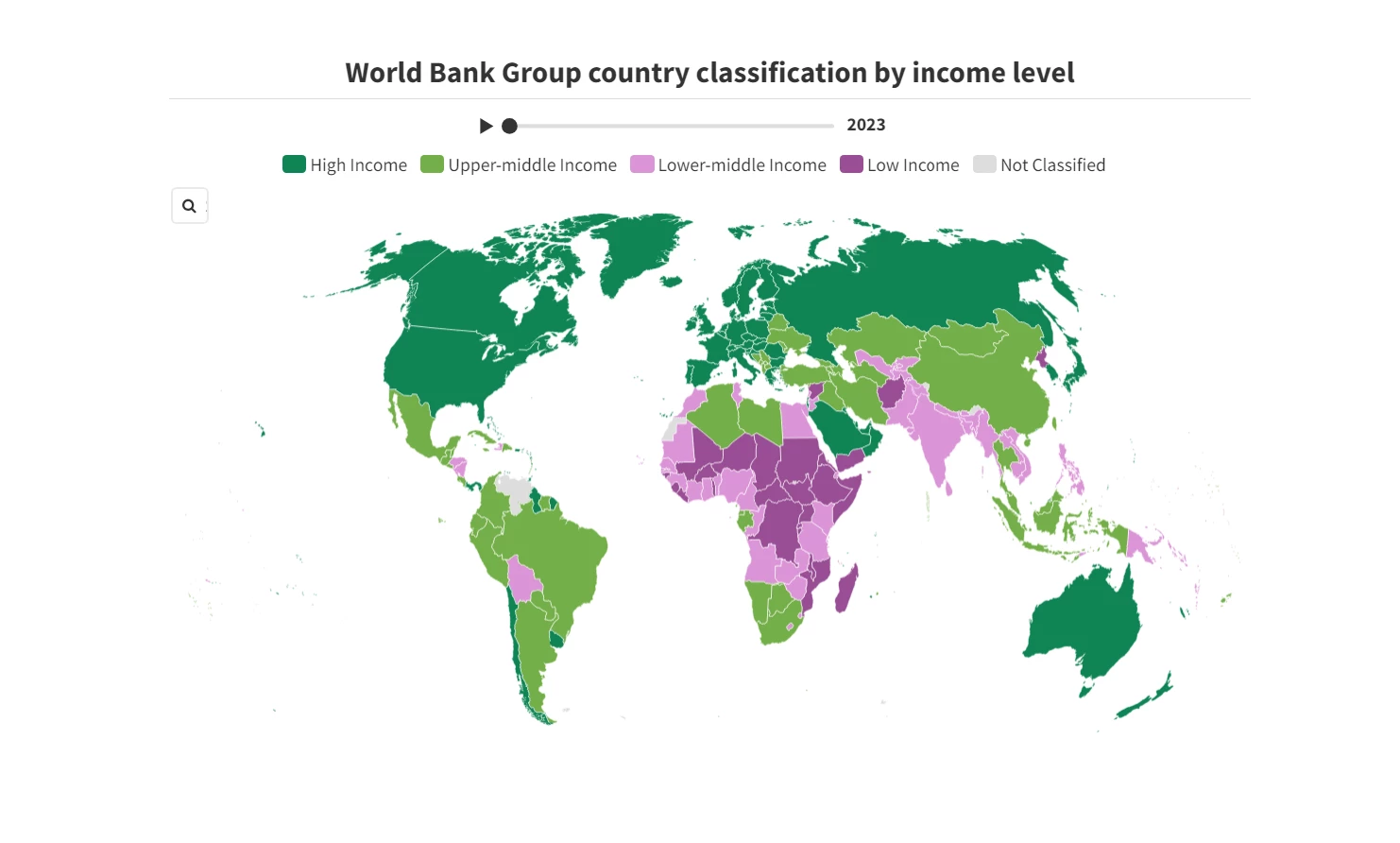
The World Bank Group assigns the world’s economies[1] to four income groups: low, lower-middle, upper-middle, and high. The classifications are updated each year on July 1, based on the GNI per capita of the previous calendar year. GNI measures are expressed in United States dollars[2] using conversion factors derived according to the Atlas method, which in its current form was introduced in 1989[3]. The World Bank’s income classification aims to reflect a country’s level of development, drawing on Atlas GNI per capita as a broadly available indicator of economic capacity.

The classification of countries into income categories has evolved significantly over the period since the late 1980s. 
  • In 1987, 30% of reporting countries were classified as low-income and 25% as high-income countries. 
  • Jumping to 2023, these overall ratios have shifted down to 12% in the low-income category and up to 40% in the high-income category. 

The scale and direction of these shifts, however, varies a great deal between world regions. Here are some regional highlights:

  • 100% of South Asian countries were classified as low-income countries in 1987, whereas this share has fallen to just 13% in 2023.

  • In the Middle East and North Africa there is a higher share of low-income countries in 2023 (10%) than in 1987, when no countries were classified to this category.

  • In Latin America and the Caribbean, the share of high-income countries has climbed from 9% in 1987 to 44% in 2023.

  • Europe and Central Asia has a slightly lower share of high-income countries in 2023 (69%) than it did in 1987 (71%).
     

These changing compositions are depicted visually in the diagram below, which shows country classifications by region and over time since 1987.
 

Classification changes

The updated country income classifications for FY25, based on the GNI per capita of 2023, are available here.

From a statistical perspective, classifications can change for two reasons:

  1. Changes to Atlas GNI per capita: In each country, factors such as economic growth, inflation, exchange rates, and population growth can all influence the level of Atlas GNI per capita. Revisions to improve methods and data can also have an impact. Updated data on Atlas GNI per capita for 2023 can be accessed here.

  2. Changes to classification thresholds: To keep income classification thresholds fixed in real terms, they are adjusted annually for inflation using the Special Drawing Rights (SDR) deflator, a weighted average of the GDP deflators of China, Japan, the United Kingdom, the United States, and the Euro Area. The new thresholds for Atlas GNI per capita (in US$) are as follows:
     
Image


The chart below shows the economies moving to new income categories this year:
 

This year, three countries—Bulgaria, Palau, and Russia—moved from the upper-middle-income to the high-income category:

  • Bulgaria has been steadily approaching the high-income threshold with modest growth throughout the post-pandemic recovery period, which continued in 2023 as real GDP grew 1.8%, supported by consumption demand.

  • Palau also continued its post-pandemic recovery as GDP returned to previous levels, growing by 0.4% in real terms. With inflation (as measured by the GDP deflator) at 8.1%, nominal GNI increased 10.0%.

  • Economic activity in Russia was influenced by a large increase in military related activity in 2023, while growth was also boosted by a rebound in trade (+6.8%), the financial sector (+8.7%), and construction (+6.6%). 
  • These factors led to increases in both real (3.6%) and nominal (10.9%) GDP, and Russia’s Atlas GNI per capita grew by 11.2%.
     

Algeria, Iran, Mongolia, and Ukraine all moved up from the lower-middle-income to the upper-middle-income category this year: 

  • While the Algerian economy grew 4.1% in 2023, the main reason for the upward reclassification was a comprehensive revision to national accounts statistics undertaken by the Algerian authorities (Office National des Statistiques) to align with current international standards. This realignment resulted in an upward revision to the level of GDP (on average 13.3% higher over the 2018-2022 period) due, for example, to the expansion of investment estimates to include research and development, improved methods for measuring production in public administration, and improved coverage of the non-observed economy.

  • Iran’s economy grew 5.0% in 2023, driven mainly by oil exports and supported by gains in services and manufacturing. GNI jumped 39.5% in nominal terms which, combined with the depreciation of the Iranian rial, resulted in a 17.6% increase of the Atlas GNI per capita.

  • Mongolia continued its recovery after the pandemic, with real GDP increasing 7.0% in 2023. Growth was driven by expansions in mining of 23.4%, along with higher export prices which boosted exports by 53.4%.

  • Ukraine’s upward change in classification resulted from a resumption of economic growth in 2023 (real GDP grew 5.3%, following a drop of 28.8% in 2022) along with a continued decline in population, which has fallen more than 15% since the invasion from Russia began. These factors were further amplified by price increases of domestically produced goods and services to result in a large increase in nominal Atlas GNI per capita of 18.5%. While Ukraine’s economy was significantly impaired by Russia’s invasion, real growth in 2023 was driven by construction activity (24.6%), reflecting a sizable increase in investment spending (52.9%) supporting Ukraine’s reconstruction effort in the wake of ongoing destruction.


West Bank and Gaza was the only country whose classification moved downward this year.
 The conflict in the Middle East began in October 2023, and while the impact on West Bank and Gaza was limited to the fourth quarter, its scale was nonetheless sufficient to lead to a 9.2% drop in nominal GDP (-5.5% in real terms). Since West Bank and Gaza’s economy was close to the threshold (it entered the upper-middle-income category only last year), these declines brought Atlas GNI per capita back down to the lower-middle-income category.


More information

Detailed information on how the World Bank Group classifies countries is available here. The country and lending groups page provides a complete list of economies classified by income, region, and World Bank lending status and includes links to prior years’ classifications. The classification tables include World Bank member countries, along with all other economies with populations greater than 30,000. These classifications reflect the best available GNI figures for 2023, which may be revised as countries publish improved final estimates.

Data for 
GNIGNI per capitaGDPGDP PPP, and Population for 2023 are now available on the World Bank's Open Data Catalog. Note that these are estimates and may be revised. For more information, please contact us at data@worldbank.org.


[1] 
The term country, used interchangeably with economy, does not imply political independence but refers to any territory for which authorities report separate social or economic statistics.
[2] In countries where dual or multiple exchange rates are in use, the exchange rate used to convert local currency units to US$ is an average of these exchange rates, provided necessary data are available.
[3] For data beginning in reference year 1987.

The authors are pleased to acknowledge the essential contributions of our colleagues, 
Charles Kouame, and Tamirat Yacob to the preparation of this piece.

Please note: The country classification described here aims to serve analytical purposes and changes have no direct impact on the eligibility for World Bank resources. In the classification used for World Bank operational purposes, a range of additional criteria are considered to determine country eligibility and the terms and conditions of Bank financing. For more information, please see the IBRD Financial Products web page.

Talton's Teaser: Just a Quick Clip ..."When the totally unqualified former news-reader for the local Fox affiliate comes within a few thousand votes of becoming governor, you know we're in trouble. . ."

 Monster

IMG_8271

Carl Muecke illustration.

"Rogue readers have been imploring me to write again. So I will put my shoulder to the wheel, even though much of this will be repetitive, whether dealing with what Soleri aptly called the Arizona Problem or our national existential crisis.
I hesitate to use the T word, because he and his cult feed on media attention. Whether voters are paying attention is another matter. Many Democrats are panicked by President Biden's debate performance this past week — even though he became much more impressive as the night continued. However, by that time too many viewers had tuned out.
When I was growing up, Arizona was a low-population state with only three congressmen. It didn't matter much in national elections. Now, with an unsustainable population of more than seven million people, Arizona has become a swing state with dangerous possibilities in November. When the totally unqualified former news-reader for the local Fox affiliate comes within a few thousand votes of becoming governor, you know we're in trouble. . .

READ MORE >

"Rogue Columnist" - 1 new article

  1. Monster