Wednesday, September 04, 2024

UA POV: Ukraine Braces for IMF Pressure to Devalue Currency, Cut Rates - Bloomberg


US Press: Ukraine Prepares for IMF Pressure and Devaluation of Its Currency


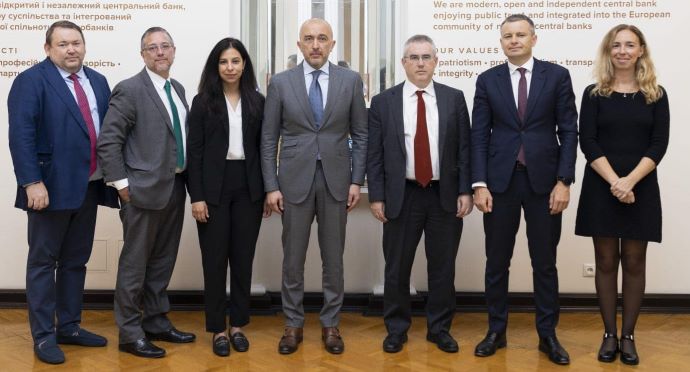
The IMF and Ukraine in the negotiations will focus on finding domestic resources – Lush
Wednesday, September 4, 2024, 6:35 PM - 
Photo: Feisbook page of the Magnificent
The IMF's mission for the fifth revision of the EFF Extended Funding Program and Ukraine's representatives in the Kyiv talks will focus on the ability to accumulate domestic resources to meet the needs of the state budget, which have increased due to the duration and intensity of the war. 
About it reported Chairman of the National Bank of Ukraine Andriy Pishny.
"The task is really not easy. We see that work in the domestic debt market will play a significant role in resolving it.
The issue of maintaining a sufficient level of international reserves and maintaining macro-financial stability will also be discussed, he wrote on his Facebook page.
  • The NBU chairman added that it would be important to find the optimal set of monetary and fiscal policy measures.

Vyshny also said that the financial instrument, secured by future income from immovable Russian assets, can provide Ukraine with additional financial resources in 2025.

The NBU team will also hold separate discussions with representatives of the Fund on 
  1. updating the macroeconomic forecast, 
  2. further monetary policy and 
  3. continuing to reform the financial sector. 
  • According to him, as part of the IMF delegation, in addition to the head of the mission in Ukraine Gavin Gray, his deputies Sana Nadim and Trevor Lessard, the permanent representative of the IMF in Ukraine Prishila Tofano and the Deputy Executive Director of the IMF Vladislav Rashkovan.
  • Lushny noted that the mission will work for a week.

Let's remind:

IMF mission started discussions with the Ukrainian authorities on the revision of the $ 1.1 billion expanded funding program.

Ukraine is being prepared to the pressure of the International Monetary Fund (IMF) on the devaluation of hryvnia and tax increases. 

The IMF delegation discussed with Krivonos the audit of NABU

Wednesday, September 4, 2024, 20:00 - 

The director of the National Anti-Corruption Bureau, Semyon Kryvonos, and a delegation from the International Monetary Fund discussed the forthcoming independent audit of NABU during the meeting.
About it reports press service of NABU.

Kryvonos and IMF representatives paid special attention to the need to conduct an independent audit of NABU's activities as soon as possible on the principles of transparency and openness.
The meeting also discussed the need to establish an expert institution at the bureau and introduce autonomous listening, which will affect the efficiency of NABU.
The parties also discussed Ukraine's accession to the OECD Convention to Combat Bribery.
  • Kryvonos noted that the bureau is making efforts to achieve the end result, in particular in the context of changes in the legislation on liability for corruption of legal entities.

UA POV: Ukraine Braces for IMF Pressure to Devalue Currency, Cut Rates - Bloomberg

  • Fund is meeting officials this week in Kyiv to review loan

  • Ukraine needs to raise funds to help narrow budget gap

Ukrainian officials are expecting the International Monetary Fund this week to push it to devalue its currency faster, cut interest rates and strengthen its tax-raising efforts to fill the country’s budget gap, according to people familiar with the situation.

IMF staff visiting Kyiv are expected to pressure the war-torn country to pursue those steps to continue receiving financial support, as they undertake a scheduled review of a $15.6 billion loan program, Ukrainian officials with the knowledge of the topic for preliminary discussions with the fund. They spoke before the meetings began on Wednesday and asked not to be identified as the talks are private.

The result of the review could unlock a $1.1 billion disbursement to Ukraine if the fund’s staff determines Ukraine is hitting program targets and has sufficient funds and policies lined up to meet its financing needs. The National Bank of Ukraine, however, is reluctant to let the hryvnia weaken further. The currency has already lost more than 10% since October, when it ended a fixed-exchange rate imposed in the wake of Russia’s full-scale invasion. The move would challenge the central bank’s ability to maintain price stability, the people said. A depreciation, as well as higher taxes, would also be politically damaging as the population is struggling with the fallout from a war with Russia.

The IMF, as well as Ukraine’s central bank and finance ministry, declined to comment. Ukraine has relied on international support for weapons and financing to sustain its efforts to repel Russian forces, which invaded the country in February 2022. A surprise push by Ukraine’s military into Russia’s Kursk region has done little to tilt the war toward a resolution, with Russia dug into Ukraine’s east and raining down a punishing barrage of missile strikes across the country.

Ukraine’s government finances have been supported by about $122 billion in international assistance from the US, the European Union and other allies, as well as the IMF. But the nation still faces a $15 billion budget gap next year, which has not yet been filled by financial commitments from donors, according to recent estimates from the Prime Minister Denys Shmyhal.

To help plug that hole, the IMF plans to urge Ukraine’s central bank to devalue the hryvnia at a faster pace and ease its monetary policy amid moderate inflation, according to the people. These steps are meant to balloon Ukraine’s budget revenues in the local currency and make borrowing cheaper for the finance ministry.

In discussions before this week’s meetings, the people added, IMF also criticized the government’s plan to raise several taxes as being too lenient and urged President Volodymr Zelenskiy’s government to consider increasing a broader range of duties. One possible proposal is to raise the value added tax from its current 20%, they said. On Tuesday, Ukraine’s parliament failed to pass legislation that would increase the so-called “military levy” on personal income and expand it to individuals doing business as well, reflecting the unpopularity of such steps among citizens enduring wartime mobilizations, government corruption concerns, regular blackouts due to airstrikes and higher power prices.

Separately, Ukraine is also slated to get further support from $50 billion in loans funded by profits from frozen Russian central bank assets. The Group of Seven, which is spearheading the effort, is aiming to get funds flowing by the end of the year, although the US and EU are still finalizing details.

40

Ukraine becomes the poorest country in Europe again

 Ukraine becomes the poorest country in Europe again

Ukraine becomes the poorest country in Europe again
Even assuming no fall in wages since the war started in February, the dollar value of the average income in Ukraine has crashed by a quarter due to the devaluation of the hryvnia and wages are now some $150 less than in Moldova, which was the poorest country in Europe. / bne IntelliNews
By bne IntelliNews August 3, 2022

Wages in Ukraine decreased to UAH14,577 per month in January from UAH17,453 in December of 2021, according to the National Bank of Ukraine's (NBU) most recent data available.

Wages in Ukraine have been rising faster than those in Russia in recent years, but quite apart from the problems that a war with Russia has caused business, the devaluation of the hryvnia in the last months has once again make Ukraine the poorest country in Europe, with wages $150 lower than those in Moldova, in dollar terms.

This is not the first time that Ukraine has won this dubious accolade. 
  • In 2018 the International Monetary Fund (IMF) briefly ranked Ukraine as the poorest country in its October World Economic Outlook, when it estimated per capita income at current prices in US dollar terms stood at $2,964.193, just behind that of Moldova with $3,226.717 and bottom of the list. 
  • However, after the 2019 Ukrainian election of President Volodymyr Zelenskiy incomes began to lift and Ukraine overtook Moldova and started to grow.
With at least a third of Ukraine’s business in limbo due to the ongoing military operations, average wages are likely to have fallen. However, Ukrstat has not released any fresh data on incomes since January.

In January the average wage in dollar terms was $521, up from $445 a year earlier. As bne IntelliNews reported, by 2021 Zelenskiy’s reforms had resulted in Ukraine rapidly closing the gap with Russia, where real incomes have been stagnating since 2014. In Russia the average wage in January was $727, only slightly up from $666 a year earlier.

Following the invasion of Ukraine at the end of February, the very sharp devaluation of the ruble hit Russian wages, which tumbled to $601 in March, but the rapid rebound of the ruble, thanks to the fast action by the Central Bank of Russia (CBR), has lifted Russian average incomes in dollar terms again to $943 as of May, the last data available.

Residents of eastern Europe are very conscious of the dollar value of their income, as most people with savings keep a significant proportion in foreign exchange to protect it from the persistent currency volatility. Devaluations also send the cost of widespread imports soaring.

Ukrainian have suffered from very similar problems, as the country Ukraine is running out of money and the central bank has been unable to hold up the value of the hryvnia. 

The situation has been made worse by the approximately 4mn refugees living in other European countries that have been withdrawing foreign exchange using bank cards to pay for their lives outside Ukraine, in effect fuelling capital flight.

Even if you assume that the nominal salaries have remained unchanged, the hryvnia has fallen from UAH28.4 on average in January to UAH37 as of the end of July after the NBU devalued the hryvnia by 25% on July 21.
That means January’s nominal salary dropped to $394 in dollar terms following the devaluation, assuming no hryvnia pay rises or decreases since the start of the year. (chart)
  • The pain from the fall in the dollar value of incomes has been doubly compounded, as even if salaries have not been cut the purchasing power of the hryvnia has been eroded by almost as much again caused by the devaluation thanks to run away inflation. 
  • Last month inflation rose to 21.5% year on year, leading the NBU to hike the prime interest rates to 25% on June 2 in an effort to curb prices rises – inflation at this level is the equivalent of a 20% pay cut even if the nominal value  of wages remains the same. (chart)

And the hryvnia has not stopped falling. According to latest reports from Kyiv, the cash rate has since dropped further in the last week to UAH41 to the dollar, which has further reduced the dollar value of wages to $355 per month, or almost $150 less than the average wage in Moldova.

Materials by topic

Strike on Ukrainian military school is one of the deadliest attacks sinc...


4 Sep, 2024 09:45

Russia provides details of strike on Ukrainian military training center

Foreign instructors were carrying out instruction in electronic warfare and the use of drones in Poltava, the MOD says
Russia provides details of strike on Ukrainian military training center


Moscow’s forces have carried out a high-precision strike on a Ukrainian training center in the city of Poltava, the Russian Defense Ministry confirmed on Wednesday. The facility was housing a number of foreign instructors who were training Kiev’s troops in communication, electronic warfare, and drone operation, according to Moscow.

The strike was initially reported by Ukrainian officials, who stated on Tuesday that two Russian Iskander ballistic missiles had hit the School of Military Communication and Information Technology, resulting in the nearly 300 casualties, including nearly 50 killed.
  • While the Russian Defense Ministry did not initially comment on the attack, it confirmed the strike in an update on Telegram on Wednesday. It said Russian forces had conducted “a high-precision strike on the 179th Joint Training Center of the Armed Forces of Ukraine in the city of Poltava” on September 3.
The ministry added that foreign instructors had been preparing specialists in communications and electronic warfare at the facility, as well as operators of unmanned aerial vehicles participating in strikes on civilian targets on the territory of the Russian Federation.
Previously, Kherson Region Governor Vladimir Saldo had also claimed in an interview with RIA Novosti that the training center had effectively served as a base for NATO instructors, and was being used to train newly mobilized Ukrainians who had recently been “caught on the streets.”

Ukrainian leader Vladimir Zelensky has used the attack on the center to demand more air-defense systems from his Western backers.

Meanwhile, the New York Times has claimed that the strike was a “demoralizing blow to Ukraine,” given how Kiev’s troops were already retreating from relentless Russian advances along the main front in Donbass.
