EU
leaders and Ukrainian President Volodymyr Zelenskyy were to meet to
discuss boosting European countries' defense spending. Meanwhile,
France's Emmanuel Macron showed openness to sharing Paris' nuclear
deterrent.
Ukraine, all of Europe, and America –
together, we can ensure decades of peace. And for this, we must stay
constructive – work together, complement each other's proposals, and
speed up diplomacy to end the war.
". . .Today, we
continued working with our European partners on a special diplomatic and
security framework that can bring peace closer.
In particular, this is
what we discussed in London recently and what we had spoken about with
many world leaders before that.
Ukraine, all of Europe, and America –
together, we can ensure decades of peace.
And for this, we must stay
constructive – work together, complement each other's proposals, and
speed up diplomacy to end the war.
I spoke today with the leaders of the Baltic states – Lithuania,
Latvia, Estonia.
A good conversation.
About the outcomes of the London
summit.
About opportunities and perspectives on all processes involving
the United States.
And about defense support that saves lives of our
people.
I am grateful to the Baltic states for standing so firmly with
Ukraine – thank you once again for your support, friends!
"I held a Staff meeting where we analyzed support packages and some contracts secured over this time.
There are good results on artillery contracts – Ukraine needs a solid foundation.
Next – drones, an unwavering priority.
Air defense – additional systems have now arrived in Ukraine from Lithuania. Thanks a lot, Mr. President.
The Prime Minister of Ukraine reported today on finances for this year – we are securing all necessary funding and will get through 2025 financially.
There were also some special issues concerning our national resilience on the Staff meeting agenda today – we are working on all possible scenarios to protect Ukraine.
The baseline scenario is to hold positions and create conditions for proper diplomacy, for the soonest possible end to this war with a decent peace.
We need peace – real, fair peace – not endless war."
This recorded conversation on YouTube, leaked a few days ago, goes back to 2014 between U.S. Ambassador to Ukraine Geoffrey Pyatt and senior U.S. Diplomat Victoria Nuland.
It’s a demonstration of America’s intense involvement in reshaping Middle Europe and restructuring Ukraine.
. .The conversation has not been denied so far
2 days ago · In
a phone call whose transcript was leaked in 2014, assistant secretary
of state Victoria Nuland and US ambassador to Ukraine Geoffrey Pyatt
discussed whom ...
2 days ago · ...
of State Victoria Nuland and the U.S. ambassador to Ukraine, Geoffrey
Pyatt, ... had Nuland positioning Yatsenyuk as the future leader of
Ukraine and, ...
11 hours ago · State
Department's Victoria Nuland spoke to the US Senate about anti-Russian
... who should run Ukraine with the US ambassador in Kiev Geoffrey
Pyatt.
11 hours ago · An
intercepted phone call between assistant secretary of state Victoria
Nuland and the US ambassador to Ukraine, Geoffrey Pyatt, which took
place in the ...
6 hours ago · ...
Douglas D. Jones, Emily Blanchard, Erik Woodhouse, Geoffrey R. Pyatt
... Uzra Zeya, Vedant Patel, Victoria Nuland, Wendy R. Sherman, Yael
Lempert.
3 days ago · Victoria
Nuland: US-Assistant Secretary of State for European and Eurasian
AffairsGeoffrey R. Pyatt: United States Ambassador to UkraineJeff
Feltman: head ...
US Proxy War: The constant battle to keep things out of the memory hole Nuland-Pyatt Video Restored to YouTube
Paul Knaggs
16 - 21 minutes
US proxy war
People
have the right to be informed and in no way does the information within
this article detract away from Ukraine’s right to defend itself from
Russian aggression, nor does it undermine the people’s right to
self-determination and protection from Ukraine’s military and government
who have been waging a civil war for over eight years in the breakaway
regions of Donetsk and Luhansk’s. A war zone the international community
has constantly and conveniently ignored.
However, again we find
the war of propaganda is constantly being waged. Censorship and the
takedown of information on the internet seem to be the norm. The ‘memory
hole’ is in full swing, it conveniently makes information that helps
people get a better perspective of the history behind the Ukrainian
conflict disappear.
A video of a leaked conversation between ‘Assistant Secretary of StateVictoria Nuland,’
a former U.S. ambassador to NATO and State Department spokeswoman,
talking to the U.S. ambassador to Ukraine, Geoffrey Pyatt, was removed
from YouTube, but now has been restored.
Although during her
three-decade-long career as a US Foreign Service officer Victoria
Nuland has done many things, mostly in the shadows, unfortunately for
her she was projected into the headlines, to become a household name
in US foreign policy.
In the video, the two discuss changing the
Ukrainian government weeks before the democratically-elected President
Viktor Yanukovych was violently driven from power.
The video,
posted on April 29, 2014, had 181,533 views before it was taken down on
Wednesday, and was among the most viewed versions of the conversation on
YouTube. Eight years’ worth of viewer comments on the video had also
been removed.
The bugged phone conversation in which the
pair disparages the EU over the Ukraine crisis was posted online. The
conversation between Assistant Secretary of State Victoria Nuland and
the US Ambassador to Ukraine, Geoffrey Pyatt, appeared on YouTube in 2014.
It
came after Nuland arrived in Ukraine for talks in early February 2014,
two weeks later a coup took place. It was also widely viewed on a
Russian-language Web site, where it appeared online along with a photo
montage of Nuland, Pyatt, and opposition figures. The Russian caption
reads, “Puppets of the Maidan,” the colloquial name for Kiev’s
Independence Square.
The background and implications of the 2014
far-right coup in Kiev, which overthrew the pro-Russian President Viktor
Yanukovych, is critical for understanding the current Ukraine-Russia
war. This coup was openly supported by the US and the European Union,
implemented primarily by far-right shock troops such as the Right Sector
and the neo-Nazi Svoboda Party.
It represented the temporary
culmination of long-standing efforts by US imperialism to install a
puppet regime on the borders of Russia and brought the world a major
step closer to a war between the largest nuclear powers, the US and
Russia. Ukraine has since been systematically built up as a launching
pad for a NATO war against Russia.
Donbass civil warMariupol2014
The
regime change prompted the outbreak of an ongoing civil war in the east
of Ukraine, between Russian-backed separatists and the US-backed
Ukrainian army, which has claimed the lives of tens of thousands and
displaced millions.
In the US, the coup was a catalyst for
an even more aggressive campaign against Russia. Joe Biden’s aim was to
use Ukraine to extend both Nato and the US empire.
The
hacked recording of that phone call sealed the otherwise discreet
diplomat’s place in history. In the recording, Nuland’s voice can be
heard giving Pyatt orders about who the United States had selected to be
Ukraine’s new prime minister. Countering Pyatt’s suggestion of the
popular former boxer, Vitali Klitschko, Nuland selected Arseniy
Yatsenyuk.
After the pro-Russian President Viktor Yanukovych fled
the country and Yatsenyuk struggled to lead a new government, an
anti-Russian billionaire, Petro Poroshenko, won the presidency in
September 2014. He immediately appealed to the Obama administration for
military assistance to counter Russia, but President Obama kept him at bay, reasoning that “Ukraine is a core interest for Moscow, in a way that it is not for the United States.”
In
other words, not only did the CIA work to overthrow the elected
president, Yanukovych, but Nuland managed to manipulate Ukrainian
politics from within and thus contribute to what was to evolve into a
notoriously corrupt regime under Poroshenko.
At the same time, her
commander-in-chief, Barack Obama, chose to limit the US involvement
in Ukraine by defining a prudent arm’s length relationship with the
fiasco that was unfolding, even after Russia seized Crimea from the
Ukrainians.
The US were overactive in Ukraine from 2014 onwards.
By
Official White House Photo by Chuck Kennedy –
http://www.whitehouse.gov/administration/cabinet, Public Domain,
https://commons.wikimedia.org/w/index.php?curid=21990205
When
Russia invaded Crimea in early 2014, Vice President Joseph R. Biden
Jr. pressed Barack Obama to take decisive action, and fast, to make
Moscow “pay in blood and money” for its aggression. The president, a
Biden aide recalled, was having none of it.
Biden worked on Obama
during their weekly private lunches, imploring him to increase lethal
aid, backing a push to ship FGM-148 Javelin anti-tank missiles to Kyiv.
The president flatly rejected the idea and dispatched him to the region
as an emissary, cautioning him “about not overpromising to the Ukrainian
government,” Biden would later write in a memoir.
So, Biden threw
himself into what seemed like standard-issue vice-presidential stuff:
prodding Ukraine’s leaders to tackle the rampant corruption that made
their country a risky bet for international lenders — and pushing reform
of Ukraine’s cronyism-ridden energy industry.
“You have to be
whiter than snow, or the whole world will abandon you,” Biden told the
country’s newly elected president, Petro O. Poroshenko, during an early
2014 phone call, according to former administration officials.
We are all still waiting for the secrets of Hunter Biden’s laptop to be revealed.
Of
course, we all know how much Gas is playing a part in this conflict. We
all know about Hunter Biden’s connection to Ukrainian Gas. we all know
the US has become the biggest exporter in the world of LNG Gas and many
of us know of Joe Biden’s connection to the Largest LNG Gas company in
the US with his good friend the co-founder of Western LNG Andrew
Goldman, also one of Biden former political advisers.
As former vice president Biden visited Ukraine six times and spent hours on the phone with the country’s leaders.
Biden
dived into Ukraine in hopes of burnishing his statesman credentials.
Writing in his 2017 memoir, Biden said Ukraine gave him a chance to
fulfil a childhood promise to make a difference in the world. It also
came to serve a political purpose, as “a legacy project, something he
could run on,” said Keith Darden, an associate professor at American
University who studies Ukraine policy.
That legacy seems to be world domination, an age for a new America.
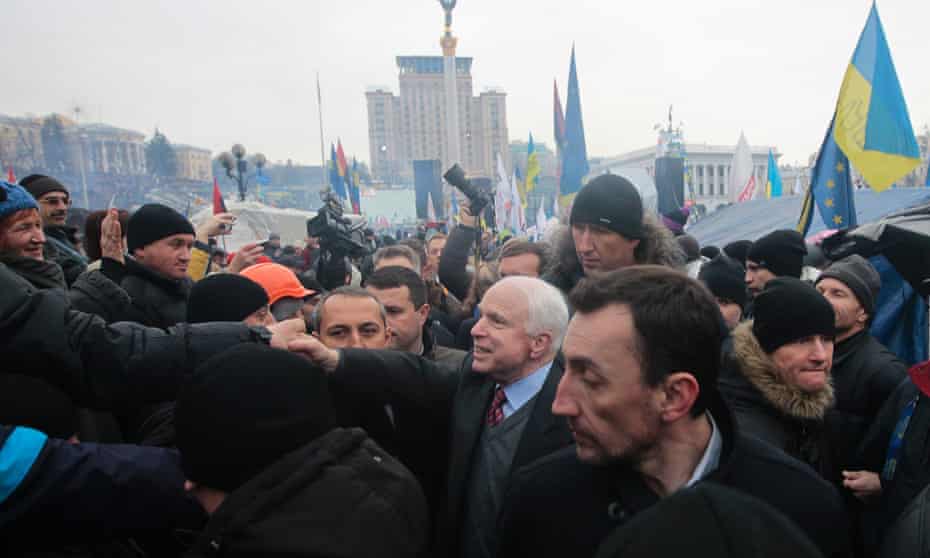
In 2014 Senator John McCain told demonstrators “America is with you,” then, standing shoulder to shoulder with the leader of the far-right Svoboda party as the US ambassador haggled with the state department over who would make up the new Ukrainian government.
Senator
John McCain, center, greets well-wishers in Independence Square in
Kiev. Photograph: Sergei Chuzavkov/AP Photograph: Sergei Chuzavkov/AP
When the Ukrainian president was replaced by a US-selected administration, in an entirely unconstitutional takeover, politicians such as William Hague brazenly misled parliament about
the legality of what had taken place: the imposition of a pro-western
government on Russia’s most neuralgic and politically divided neighbour.
It was all pre-planned, yet another US regime change, another action carried out in the continuation of the Forever wars.
“F—
the E.U.,” Assistant Secretary of State for European and Eurasian
Affairs Victoria Nuland said in a private telephone call that was
intercepted and leaked online.
That was the shocker the media went
with, they pretend the rest of the conversation was chatter. Nuland was
dismissively claiming she was referring to slow-moving European efforts
to address political paralysis and a looming fiscal crisis in Ukraine.
But it was the blunt nature of her remarks, along with the U.S.
diplomatic calculations, that seemed exceptional.
Nuland also
assessed the political skills of Ukrainian opposition figures with
unusual candour and, along with the U.S. ambassador to Ukraine, Geoffrey
Pyatt, debated strategy for their cause, laying bare a deep degree of
U.S. involvement in affairs that Washington officially says are
Ukraine’s to resolve.
At the end of the Nuland-Pyatt video, Lindsey Graham & John McCain tell Ukrainian soldiers they will supply them and that the US will be with them all the way, that was in 2016.
Here is a transcript, with analysis by BBC diplomatic correspondent Jonathan Marcus:
Warning: This transcript contains swearing.
Jonathan Marcus:
At the outset it should be clear that this is a fragment of what may
well be a larger phone conversation. But the US has not denied its
veracity and has been quick to point a finger at the Russian authorities
for being behind its interception and leak.
Voice thought to be Pyatt’s: I
think we’re in play. The Klitschko [Vitaly Klitschko, one of three main
opposition leaders] piece is obviously the complicated electron here.
Especially the announcement of him as deputy prime minister and you’ve
seen some of my notes on the troubles in the marriage right now so we’re
trying to get a read really fast on where he is on this stuff. But I
think your argument to him, which you’ll need to make, I think that’s
the next phone call you want to set up, is exactly the one you made to
Yats [Arseniy Yatseniuk, another opposition leader]. And I’m glad you
sort of put him on the spot on where he fits in this scenario. And I’m
very glad that he said what he said in response.
Jonathan Marcus:
The US says that it is working with all sides in the crisis to reach a
peaceful solution, noting that “ultimately it is up to the Ukrainian
people to decide their future”. However, this transcript suggests that
the US has very clear ideas about what the outcome should be and is
striving to achieve these goals. Russian spokesmen have insisted that
the US is meddling in Ukraine’s affairs – no more than Moscow, the cynic
might say – but Washington clearly has its own game plan. The clear
purpose of leaking this conversation is to embarrass Washington and for
audiences susceptible to Moscow’s message to portray the US as
interfering in Ukraine’s domestic affairs.
Nuland: Good. I don’t think Klitsch should go into the government. I don’t think it’s necessary, I don’t think it’s a good idea.
Pyatt: Yeah.
I guess… in terms of him not going into the government, just let him
stay out and do his political homework and stuff. I’m just thinking in
terms of sort of the process moving ahead we want to keep the moderate
democrats together. The problem is going to be Tyahnybok [Oleh
Tyahnybok, the other opposition leader] and his guys and I’m sure that’s
part of what [President Viktor] Yanukovych is calculating on all this.
Nuland: [Breaks
in] I think Yats is the guy who’s got the economic experience, the
governing experience. He’s the… what he needs is Klitsch and Tyahnybok
on the outside. He needs to be talking to them four times a week, you
know. I just think Klitsch going in… he’s going to be at that level
working for Yatseniuk, it’s just not going to work.
Pyatt: Yeah, no, I think that’s right. OK. Good. Do you want us to set up a call with him as the next step?
Nuland: My
understanding from that call – but you tell me – was that the big three
were going into their own meeting and that Yats was going to offer in
that context a… three-plus-one conversation or three-plus-two with you.
Is that not how you understood it?
Pyatt: No. I think… I
mean that’s what he proposed but I think, just knowing the dynamic
that’s been with them where Klitschko has been the top dog, he’s going
to take a while to show up for whatever meeting they’ve got and he’s
probably talking to his guys at this point, so I think you reaching out
directly to him helps with the personality management among the three
and it gives you also a chance to move fast on all this stuff and put us
behind it before they all sit down and he explains why he doesn’t like
it.
Nuland: OK, good. I’m happy. Why don’t you reach out to him and see if he wants to talk before or after?
Pyatt: OK, will do. Thanks.
Nuland: OK…
one more wrinkle for you Geoff. [A click can be heard] I can’t remember
if I told you this, or if I only told Washington this, that when I
talked to Jeff Feltman [United Nations Under-Secretary-General for
Political Affairs] this morning, he had a new name for the UN guy Robert
Serry did I write you that this morning?
Jonathan Marcus:
An intriguing insight into the foreign policy process with work going
on at a number of levels: Various officials attempting to marshal the
Ukrainian opposition; efforts to get the UN to play an active role in
bolstering a deal; and (as you can see below) the big guns waiting in
the wings – US Vice-President Joe Biden clearly being lined up to give
private words of encouragement at the appropriate moment.
Pyatt: Yeah I saw that.
Nuland: OK.
He’s now gotten both Serry and [UN Secretary General] Ban Ki-moon to
agree that Serry could come in Monday or Tuesday. So that would be
great, I think, to help glue this thing and to have the UN help glue it
and, you know, Fuck the EU.
Jonathan Marcus:
Not for the first time in an international crisis, the US expresses
frustration at the EU’s efforts. Washington and Brussels have not been
completely in step during the Ukraine crisis. The EU is divided and to
some extent hesitant about picking a fight with Moscow. It certainly
cannot win a short-term battle for Ukraine’s affections with Moscow – it
just does not have the cash inducements available. The EU has sought to
play a longer game; banking on its attraction over time. But the US
clearly is determined to take a much more activist role.
Pyatt: No,
exactly. And I think we’ve got to do something to make it stick
together because you can be pretty sure that if it does start to gain
altitude, that the Russians will be working behind the scenes to try to
torpedo it. And again the fact that this is out there right now, I’m
still trying to figure out in my mind why Yanukovych (garbled) that. In
the meantime there’s a Party of Regions faction meeting going on right
now and I’m sure there’s a lively argument going on in that group at
this point. But anyway we could land jelly side up on this one if we
move fast. So let me work on Klitschko and if you can just keep… we want
to try to get somebody with an international personality to come out
here and help to midwife this thing. The other issue is some kind of
outreach to Yanukovych but we probably regroup on that tomorrow as we
see how things start to fall into place.
Nuland: So on
that piece Geoff, when I wrote the note [US vice-president’s national
security adviser Jake] Sullivan’s come back to me VFR [direct to me],
saying you need [US Vice-President Joe] Biden and I said probably
tomorrow for an atta-boy and to get the deets [details] to stick. So
Biden’s willing.
Pyatt: OK. Great. Thanks.
Jonathan Marcus:
Overall this is a damaging episode between Washington and Moscow.
Nobody really emerges with any credit. The US is clearly much more
involved in trying to broker a deal in Ukraine than it publicly lets on.
There is some embarrassment too for the Americans given the ease with
which their communications were hacked. But is the interception and
leaking of communications really the way Russia wants to conduct its
foreign policy? Goodness – after Wikileaks, Edward Snowden and the like
could the Russian government be joining the radical apostles of open
government? I doubt it. Though given some of the comments from Vladimir
Putin’s adviser on Ukraine Sergei Glazyev – for example, his interview
with the Kommersant-Ukraine newspaper the other day – you don’t need
your own listening station to be clear about Russia’s intentions. Russia
he said “must interfere in Ukraine” and the authorities there should
use force against the demonstrators.
Feb 7, 2014 · The
alleged conversation between Assistant Secretary of State Victoria
Nuland and the US Ambassador to Ukraine, Geoffrey Pyatt, appeared on ...



.jpg)
.jpg)
.jpg)
.jpg)





.jpg)
.jpg)