Saturday, March 08, 2025
ON-SHORING: TSMC’s U.S.- Investment Vow shows Asia A Way Around
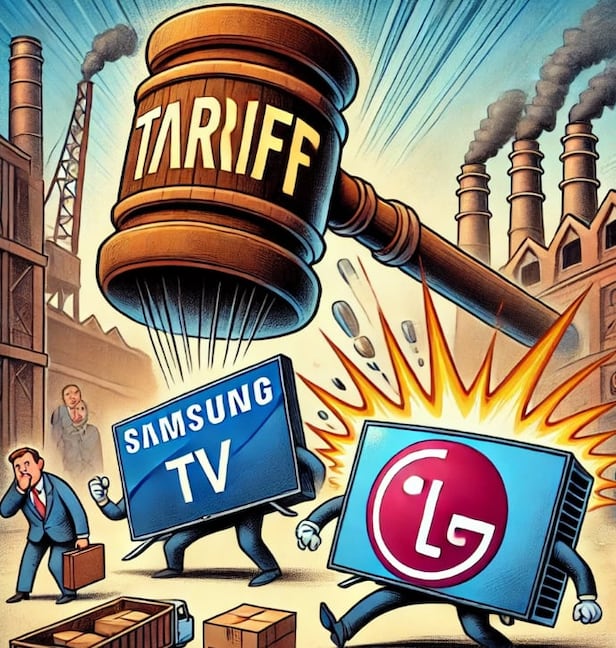
TSMC, LG and Samsung are among those intending to bring some operations to the US in the face of Trump’s trade threats
TSMC’s US-investment vow shows Asia a way around
- The president, who advocates more on-shoring of industry to stimulate the US economy, said that without TSMC’s commitment, tariffs on its chip imports might otherwise reach an eventual 25-50%
- Other major East Asian chipmakers will probably move production to the US, too, as “the Trump administration’s threat of tariffs on imported semiconductors poses a serious challenge for the region’s tech-heavy economies”, said Jeemin Bang, a Taiwan analyst for Moody’s Analytics.
- Taiwan should be extra safe from chip tariffs, as its many smaller fabs do not sell directly to the US, or they lack TSMC’s coveted level of advanced technology, and are therefore not on Trump’s radar, analysts said.
“They’re not Trump’s focus, because the US can already make those chips,” said Liang Kuo-yuan, retired president of a Taipei-based economics think tank, the Yuanta-Polaris Research Institute.
- More chip production in the US gives Washington an advantage in its rivalry with mainland China’s ascendant semiconductor sector, analysts said.
- The US imposes export controls on chips that Washington fears Beijing could use to make advanced weaponry or artificial intelligence (AI) technology.
Taiwan’s own tech-reliant economy stands to lose nothing, for now, analysts said.
TSMC has enough money to go ahead with plans for new factories in Taiwan even with a combined US$165 billion committed now to Arizona, because “its resources are quite ample”, said Darson Chiu, CEO of the Confederation of Asia-Pacific Chambers of Commerce and Industry in Taiwan.
- The company, which has already begun mass production of its advanced 4-nanometer chips in Arizona – part of its initial US$65 billion in investments – anticipates opening two new fabs in Taiwan’s chief port city this year.
- But the chipmaker must be “careful” with the pace of new domestic investments, Chiu said. “If they get too big in Taiwan, then Trump would see that.”


Reports: Bleeping Computer
Update March 07, 14:40 EST: LastPass sent the following statement after publishing time:
Since we initially disclosed this incident back in 2022, LastPass has worked in close cooperation with multiple representatives from law enforcement. To date, our law enforcement partners have not made us aware of any conclusive evidence that connects any crypto thefts to our incident.
US seizes $23 million in crypto stolen via password manager breach

- Investigators believe hackers who breached LastPass in 2022 were behind the attack.
Despite the threat actors' efforts, law enforcement agents traced $23,604,815.09 of the stolen digital assets between June 2024 and February 2025 to the following cryptocurrency exchanges:
- OKX,
- Payward Interactive, Inc. (dba Kraken),
- WhiteBIT,
- AscendEX Technology SRL,
- Ftrader Ltd (dba FixedFloat),
- SwapSpace LLC, and
- Rabbit Finance LLC (dba CoinRabbit).
A forfeiture complaint unsealed by the U.S. Justice Department yesterday and first spotted by crypto fraud investigator ZachXBT reveals that U.S. Secret Service agents who interviewed the victim believe the attackers could have only stolen the cryptocurrency using private keys extracted by cracking the victim's password vault stolen in a 2022 breach of an online password manager.
They found that the stolen data and passwords stored in several victims' password manager accounts were used by attackers to access "their electronic accounts and steal information, cryptocurrency, and other data."
- They also discovered no evidence that the victim's devices were hacked, which points to the decryption of the stolen online password manager data as the only way the attackers could have obtained the keys needed to compromise the victim's crypto wallet.
"The scale of a theft and rapid dissipation of funds would have required the efforts of multiple malicious actors, and was consistent with the online password manager breaches and attack on other victims whose cryptocurrency was stolen," the complaint reads.
"For these reasons, law enforcement agents believe the cryptocurrency stolen from Victim was committed by the same attackers who conducted the attack on the online password manager, and cryptocurrency thefts from other similarly situated victims."
Crypto theft linked to LastPass hacksWhile the investigators didn't name the online password manager, the complaint says that the platform was hit by "two major data breaches" in August 2022 and November 2022.
This timeline aligns with security breaches disclosed by LastPass three years ago when the company said that attackers stole source code and proprietary technical information, as well as customer vault data, after breaching its cloud storage.
Since then, multiple security experts have shared that they believe the LastPass hackers have cracked some of the stolen vault data and used the extracted private keys and credentials in major cryptocurrency heists.
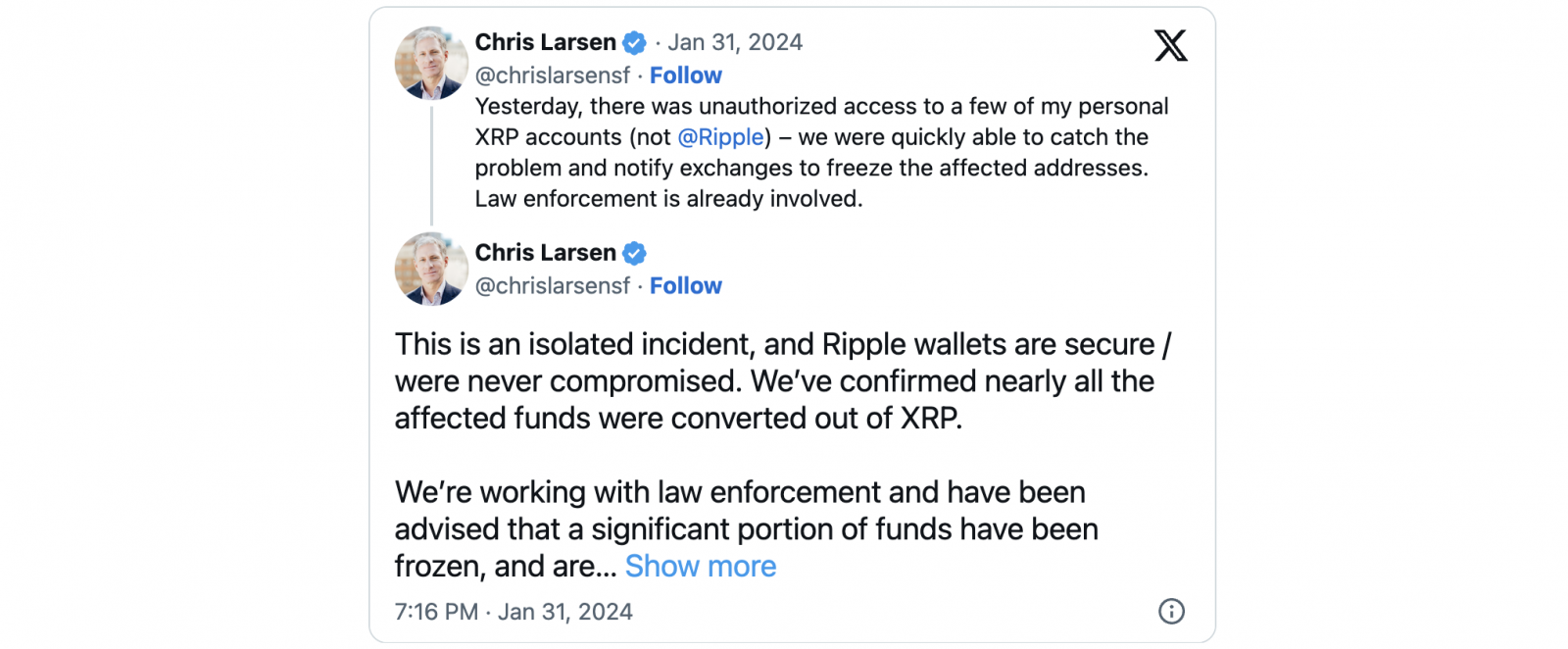
Even though the investigators didn't identify the victim, the details match the hack and the theft of $150 million in cryptocurrency from Ripple co-founder and executive chairman Chris Larsen, which was disclosed on January 31, 2024.
- A Ripple spokesperson was not immediately available when BleepingComputer reached out for comment earlier today.

Microsoft: North Korean hackers join Qilin ransomware gang
Microsoft says a North Korean hacking group tracked as Moonstone Sleet has deployed Qilin ransomware payloads in a limited number of attacks.
- March 07, 2025
- 07:10 AM
 0
0

Microsoft says malvertising campaign impacted 1 million PCs
Microsoft has taken down an undisclosed number of GitHub repositories used in a massive malvertising campaign that impacted almost one million devices worldwide.
- March 06, 2025
- 03:53 PM
- 0
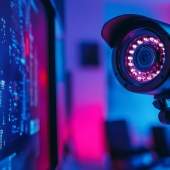
Ransomware gang encrypted network from a webcam to bypass EDR
The Akira ransomware gang was spotted using an unsecured webcam to launch encryption attacks on a victim's network, effectively circumventing Endpoint Detection and Response (EDR), which was blocking the encryptor in Windows.
- March 06, 2025
- 03:31 PM
- 3

US seizes domain of Garantex crypto exchange used by ransomware gangs
The U.S. Secret Service has seized the domain of the sanctioned Russian cryptocurrency exchange Garantex in collaboration with the Department of Justice's Criminal Division, the FBI, and Europol.
- March 06, 2025
- 02:07 PM
- 0

Turn your PDFs into fully editable, searchable files for life with this app deal
That's why SwifDoo PDF Pro is the better way to work with PDFs—a full-featured, pro-level PDF editor that you can own for life for just $27.99 (reg. $129) with code PDFLIFE through March 9.
- March 06, 2025
- 02:05 PM
- 0

Cybercrime 'crew' stole $635,000 in Taylor Swift concert tickets
New York prosecutors say that two people working at a third-party contractor for the StubHub online ticket marketplace made $635,000 after almost 1,000 concert tickets and reselling them online.
- March 06, 2025
- 01:05 PM
- 0

Ethereum private key stealer on PyPI downloaded over 1,000 times
A malicious Python Package Index (PyPI) package named "set-utils" has been stealing Ethereum private keys through intercepted wallet creation functions and exfiltrating them via the Polygon blockchain.
- March 06, 2025
- 12:11 PM
- 0
Enter The Dragon? TSMC’s $165B U.S. Deal Removes Taiwan’s Silicon Shield and National Security
Taiwan’s semiconductor giant TSMC has announced a historic $100 billion investment in the United States, hailed by President Lai Ching-te as a "momentous" development for Taiwan-US relations.
- The investment, set to total $165 billion, is described as the largest foreign direct investment in US history.
- However, the expansion has sparked concerns within Taiwan, with opposition lawmakers warning that it could weaken Taiwan’s geopolitical significance and national security, especially if China escalates military pressure.


- Chinese authorities previously said this just last month, accusing the DPP of selling out to the West in exchange for support for independence.
- Nevertheless, this investment is unlikely to result in TSMC’s dismantling.
- Instead, it would likely give it an advantage in the U.S. market and could even make it stronger globally.
- The same thing could potentially happen to the semiconductor industry, with TSMC gaining an advantage within the U.S. market due to its proximity. However, only time will tell if this will come to pass in the semiconductor business.
- For one, it’s reported that despite the massive investment, the company’s American expansion will only account for 5–7 percent of its total output.
- And even if TSMC builds manufacturing capacity in the U.S., it’s unlikely that those factories will be part-and-parceled to American institutions.
- This is unlike Intel, whose foundry and chip design wings are being considered for sale to TSMC and Broadcom.

-
 Flash News: Ukraine Intercepts Russian Kh-59 Cruise Missile Using US VAMPIRE Air Defense System Mounted on Boat. Ukrainian forces have made ...

