Tuesday, November 11, 2025

BUGONIA Trailer 3 (2025) Emma Stone, Jesse Plemons. . . it is Yorgos Lanthimos’s darkest and most timely work


SEE THIS REVIEW
Bugonia is one of the best films in recent memory to capture what it feels like to be alive right now 

Bugonia review – A bald Emma Stone dazzles in Yorgos Lanthimos’s timely, heartbreaking comic satire

Five Cent Cine: Bugonia - Buffalo Rising


The director and star of ‘Poor Things’ and ‘The Favourite’ reunite for this funny and deeply topical film about conspiracy theorists and a kidnapped CEO who may or may not be an alien
Clarisse Loughrey
Thursday 30 October 2025 12:40 EDT

Bugonia is one of the best films in recent memory to capture what it feels like to be alive right now. Because of that, it is Yorgos Lanthimos’s darkest and most timely work. Here he’s joined forces with new collaborator Will Tracy, the former editor-in-chief of satire site The Onion and a writer on the similarly cutthroat series Succession. Tracy, then, lives at the centre of the great circus show that is contemporary America, and when he’s paired with Lanthimos’s trademark deadpan, we’re delivered a true alchemical wonder: violent, absurd, current, fantastical, shrewd, and unexpectedly heartbreaking.

The film it’s adapted from, Jang Joon Hwan’s Save the Green Planet! (2003), was always meant to feel at least a little outrageous. Yet it doesn’t take much from Tracy and Lanthimos to make its premise – a conspiracy theorist kidnaps a CEO, convinced they’re an alien – uncomfortably plausible in our real-life landscape of internet rabbit holes, loneliness epidemics, and AI-induced psychosis.

At present, the world feels like the punchline to a joke someone would make on their deathbed, and the fact that no one knows whether to laugh or cry about it is an integral part of why everyone seems to be losing their mind. Lanthimos makes sure his film plays that way, too. Take, for example, his and Tracy’s choice to make the CEO here a woman, Michelle Fuller, played by the director’s thespian go-to, Emma Stone. She’s the head of a pharmaceutical company her kidnapper Teddy (Jesse Plemons) blames for, among other things, the decline of the bee population.

She represents performative ethics at their most slickly sinister, declaring that her workers are now free to leave at 5.30pm (“new culture, no more unpleasant incidents!”) – of course, that is, unless there’s work to be finished. So, you don’t exactly want to believe her sneering invocations around the “politicised optics” of her imprisonment. And when Teddy shaves her head and slaps antihistamine cream all over her body (to dampen the extraterrestrial neurotransmitters, you see), you want to laugh at how she looks like a fumbled attempt at an Uncle Fester costume.

And yet, as much as Bugonia keeps you aware that Michelle has always weaponised her gender in order to maintain a portrait of innocence, Stone will still flash up these small, disorientating little moments of humanity (or extraterrestriality, perhaps?). She and Lanthimos are an ideal match, because she can push for the new and the wild – from a Frankenstein’s monster remix to a bald, alleged alien – all while maintaining a tight control over tone, both dramatically and comedically.

ANOTHER ZELFIE! ANOTHER ZELFIE!! Today, I’m in Kherson 11.11.2025

no comment

 https://static.majalla.com/styles/1200xauto/public/2025-11/198322.jpeg?VersionId=qD5bNbkFMVZFxzHR_cfvmW.A3qDaESE3

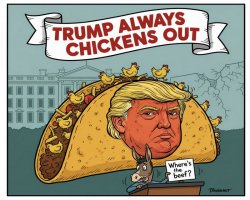
TACO: Trump Always Chickens Out

TACO, an acronym standing for "Trump Always Chickens Out," emerged in May 2025 as a Wall Street shorthand describing a recurring pattern in President Donald Trump's approach to trade policy and, by extension, foreign affairs generally. 
https://www.globalsecurity.org/military/world/usa/images/taco-image01-m.jpg 
 
Financial Times journalist Robert Armstrong introduced the term in a May 2, 2025, opinion piece that analyzed how markets were adapting to what he characterized as a predictable cycle wherein the Trump administration announces aggressive tariffs that send markets plummeting, only to subsequently delay or reduce those measures after economic and political pressure materializes, allowing markets to rebound. 
 
Armstrong wrote that markets were recognizing "the United States administration does not have a very high tolerance for market and economic pressure, and will be quick to back off when tariffs cause pain," a phenomenon he dubbed "the Taco theory: Trump Always Chickens Out."1 
  • The term gained rapid traction among traders, investors, and political analysts as a framework for understanding not merely trade policy but a broader pattern of presidential behavior characterized by dramatic threats followed by strategic retreats.

The concept builds on an earlier Wall Street coinage, the "Trump put," which during Trump's first term described his apparent tendency to modify policies when financial markets reacted negatively, suggesting that investors could effectively rely on market pressure to constrain presidential actions that might harm asset values. The TACO formulation represents a more pointed and provocative articulation of this same insight, transforming what had been neutral financial jargon into explicitly pejorative political commentary. The acronym's adoption reflects growing recognition among market participants and policy observers that Trump's negotiating style, while producing considerable volatility and uncertainty, follows sufficiently consistent patterns to enable strategic positioning. Traders who recognized this pattern early in 2025 reportedly profited by purchasing stocks after tariff announcements drove prices down, then selling after subsequent policy reversals produced rebounds, a strategy some financial professionals explicitly labeled the "TACO trade."2

Liberation Day and the Tariff Cycle

The pattern that crystallized the TACO concept centered on Trump's April 2, 2025, announcement of what he termed "Liberation Day" tariffs, which represented perhaps the most dramatic example of this cycle. In a White House Rose Garden ceremony, Trump signed Executive Order 14257, declaring a national emergency over the United States trade deficit and invoking the International Emergency Economic Powers Act to authorize sweeping tariffs on foreign imports. The order imposed a ten percent baseline tariff on imports from nearly all countries beginning April 5, with country-specific tariff rates scheduled to commence April 9. Trump characterized these measures as "reciprocal," asserting they mirrored trade barriers faced by American exports, and declared April 2 as "one of the most important days in American history" and "our declaration of economic independence."3 The actual tariff structure proved considerably more complex and arbitrary than the reciprocal framing suggested, with rates apparently based substantially on bilateral trade deficits rather than matching foreign tariffs, resurrecting a decades-old proposal from former Representative Richard Gephardt that President Ronald Reagan had vetoed in 1987.4

Markets responded with immediate and severe turbulence. Following the Liberation Day announcement, the United States total stock market index plunged by approximately 12.4 percent over the subsequent week, marking the largest decline since the COVID-19 pandemic disruption in 2020. The S&P 500 fell more than 15 percent from its earlier 2025 highs, erasing trillions of dollars in market capitalization as investors grappled with uncertainties about supply chain disruptions, rising input costs, and potential retaliatory measures from trading partners. Major retailers warned that the tariffs would force immediate price increases and product shortages. Congressional Republicans, while publicly supporting the president, privately expressed alarm about the economic and political consequences.5 China responded by announcing matching retaliatory tariffs, initiating a tit-for-tat escalation that ultimately saw American tariffs on Chinese goods reach 145 percent while Chinese tariffs on United States imports climbed to 125 percent, creating the highest trade barriers between the world's two largest economies in modern history.6

The pattern that gave rise to the TACO meme materialized with striking speed. On April 9, just seven days after the Liberation Day announcement and mere hours before the higher country-specific tariff rates were scheduled to take effect, Trump signed an executive order pausing those increases for 90 days while maintaining the baseline ten percent tariff. White House Senior Counselor for Trade and Manufacturing Peter Navarro promised "90 deals in 90 days," suggesting the administration planned to negotiate bilateral agreements during this period that would render the threatened tariffs unnecessary. Markets responded euphorically, with the S&P 500 rallying approximately 9.5 percent in a single trading session, one of the largest single-day gains in market history, as investors interpreted the reversal as confirmation that market pressure could effectively constrain presidential action. Trading volumes surged as institutional and retail investors rushed to capitalize on what many now explicitly termed the TACO dynamic.7

The 90-day pause would be extended repeatedly over subsequent months as bilateral negotiations proceeded more slowly than the administration had projected. By late July, the United States had announced trade frameworks with only eight partners: the United Kingdom, Vietnam, the Philippines, Indonesia, Japan, South Korea, the European Union, and a temporary truce with China. The substance of many of these agreements appeared limited, often maintaining significant tariff levels while providing modest adjustments to create political cover for both sides. Navarro's promise of "90 deals in 90 days" fell dramatically short of realization, with Commerce Secretary Howard Lutnick subsequently lowering expectations to perhaps ten to twelve significant agreements by Labor Day. Trump announced on July 8 that he would delay implementation of higher tariffs yet again, pushing the deadline from July 9 to August 1, then subsequently offered additional extensions for several countries. By early August, the president was providing Mexico a further 90-day negotiating period, demonstrating the pattern's continuation well beyond the initial Liberation Day cycle.8

Variations on the Theme: Additional Trade Retreats

The Liberation Day sequence, while particularly dramatic, represented merely the most prominent example of a pattern that repeated across multiple policy domains throughout Trump's second term. On May 26, Trump announced that he would impose 50 percent tariffs on European goods, only to delay their implementation to July 9 just three days later on Memorial Day, ostensibly to provide more time for negotiations while the baseline ten percent tariff continued. Markets, which had fallen sharply on the Friday announcement, rallied 2.1 percent when trading resumed after the holiday, with traders expressing increasing confidence that Trump would ultimately retreat from his most aggressive positions when faced with economic pressure. The Financial Times' Katie Martin identified this episode as exemplifying what she termed "the Taco factor," wherein Trump reverses decisions in response to negative market reactions.9

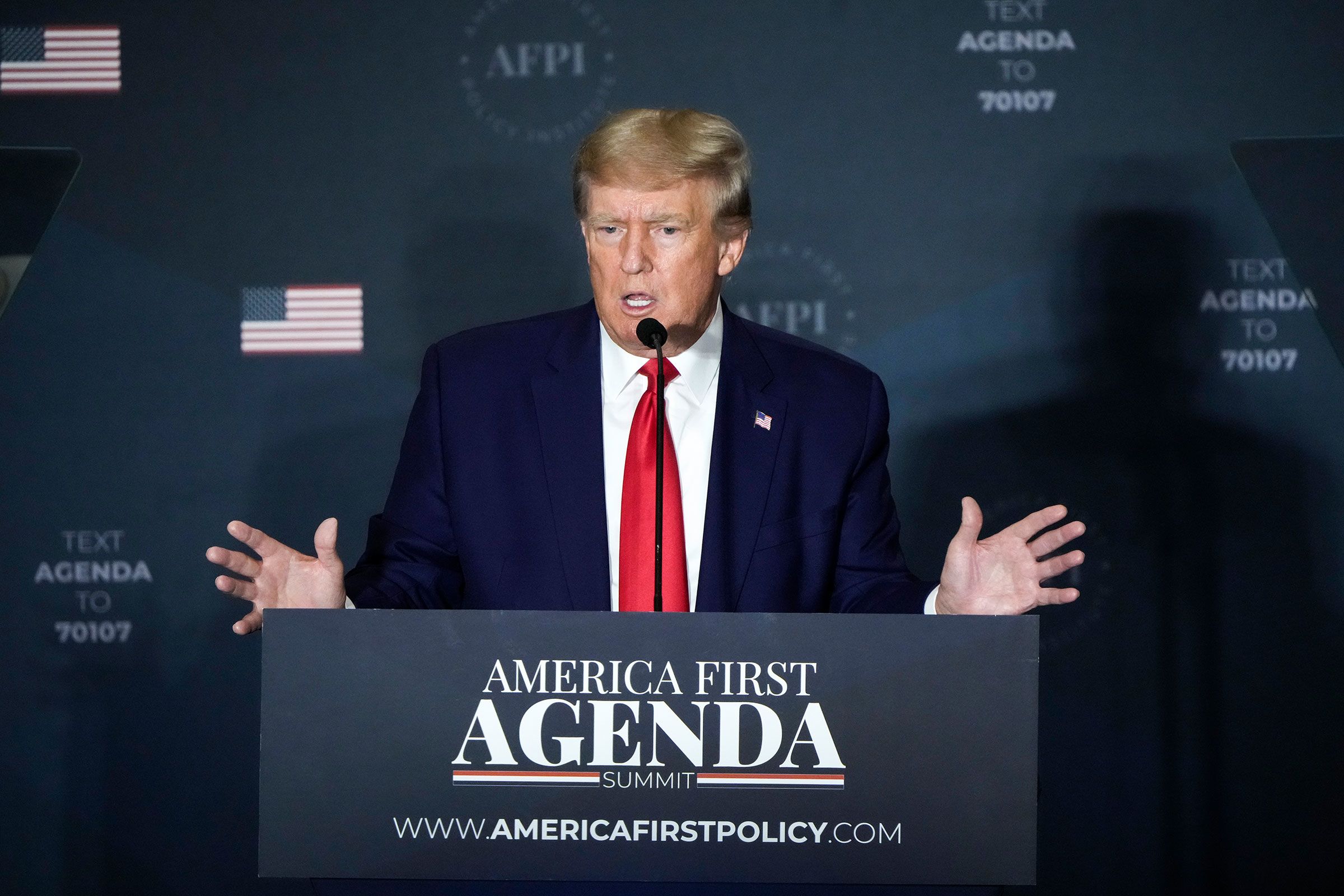
Historic First: Trump Hosts Syria’s President | Fred Fleitz & Carla Sand... | AMERICA FIRST POLICY INSTITUTE

DYK THIS IS MADE FOR PUBLIC CONSUMPTION BY THE AMERICA FIRST POLICY INSTITUTE???


A bold new chapter in U.S. diplomacy—can peace with Syria reshape the Middle East?  
 
Ambassador Carla Sands and national security expert Fred Fleitz examine a historic turning point in U.S. foreign policy: President Trump’s decision to host Syrian President Ahmad al‑Sharaa at the White House. 
Once aligned with Al‑Qaeda and now Syria’s head of state, al‑Sharaa’s rise followed the collapse of the Assad regime amid regional upheaval and Russia’s preoccupation with Ukraine. This conversation dissects what the meeting could mean for global stability, Syria’s potential role in the U.S.‑led coalition against ISIS, and the prospects for normalized relations with Israel and entry into the Abraham Accords
  • Fleitz explains the calculated risk behind engaging a former extremist, while Sands questions whether legitimizing al‑Sharaa can truly bring order to a fractured nation. 
They explore key issues including 
  •  sectarian violence, 
  • Russian military bases, the Druze conflict zone, and the Trump administration’s wider strategy of using diplomacy and economic incentives to stabilize the Middle East. 
Watch as Sands and Fleitz reveal how this unprecedented meeting might redefine alliances, challenge global perceptions, and set a new precedent for American leadership abroad
 
 
https://i.ytimg.com/vi/umYdVrId1D4/sddefault.jpg
CHAPTERS: 

0:00 Introduction by Ambassador Carla Sands  
0:35 Who Is Syria’s New President Ahmad al‑Sharaa?  
1:48 Why Trump Is Hosting a Former Al‑Qaeda Member  
2:45 Violence and Instability in Post‑Assad Syria  
3:42 Economic Reconstruction and U.S. Investment  
4:41 Russia’s Military Presence and Regional Stakes 
5:25 Israel, the Druze, and Control of Syrian Territory 
6:33 Could Syria Join the Abraham Accords? 
7:52 Al‑Sharaa’s Fight Against ISIS 
8:45 Comparing Trump’s Leadership to Past Administrations 
9:27 Trump’s Global Standing and Strategic Vision  
 
10:12 Final Thoughts: The Risks and Rewards of Engaging al‑Sharaa


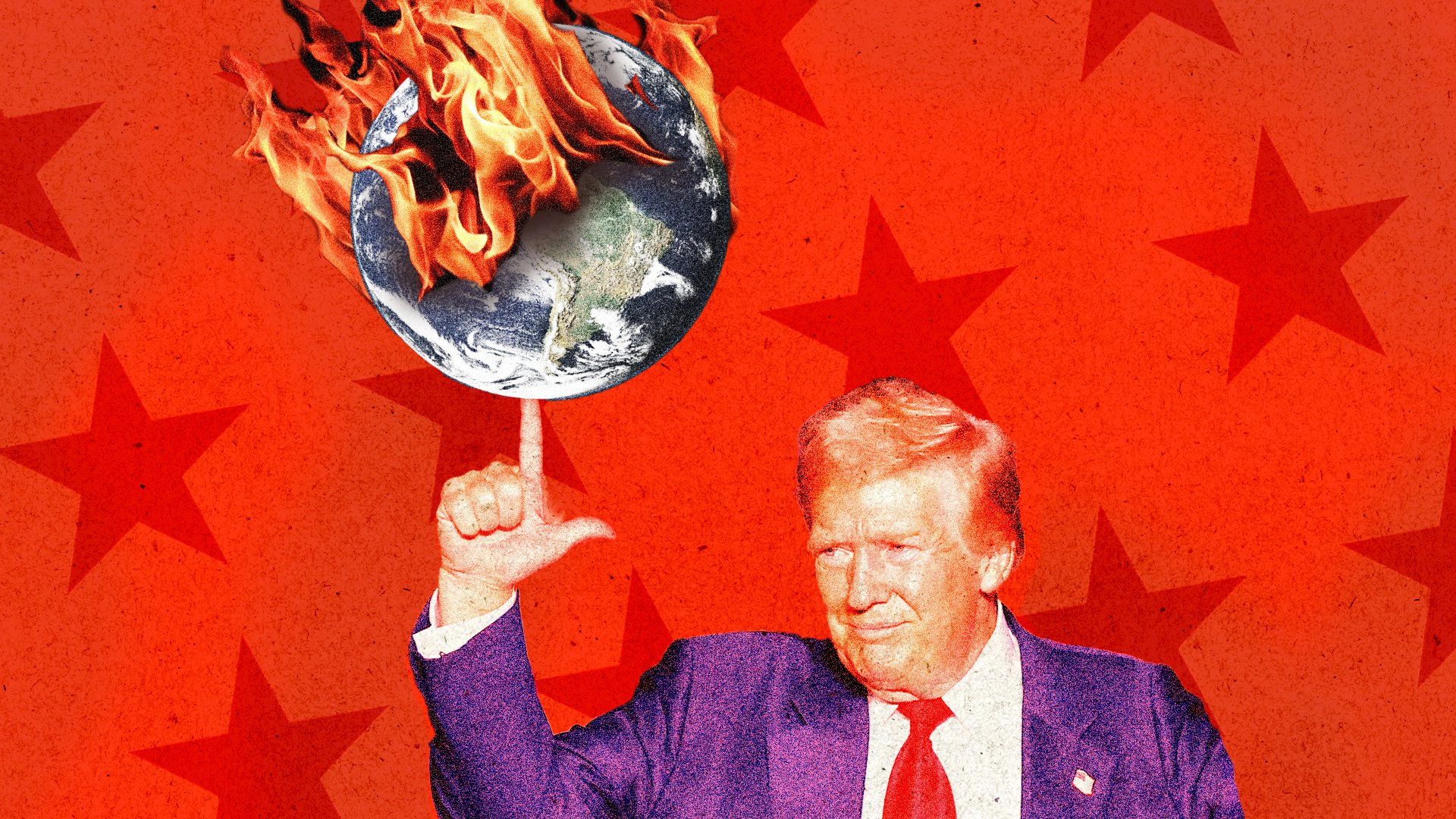
Trump Reshapes The World: SPECIAL SECTION from The Independent

  
https://assets.rbl.ms/53644505/origin.jpg 

Trump Reshapes The World   


South Park Just PRAISED NYC’s New Mayor & DESTROYED The White House In I...