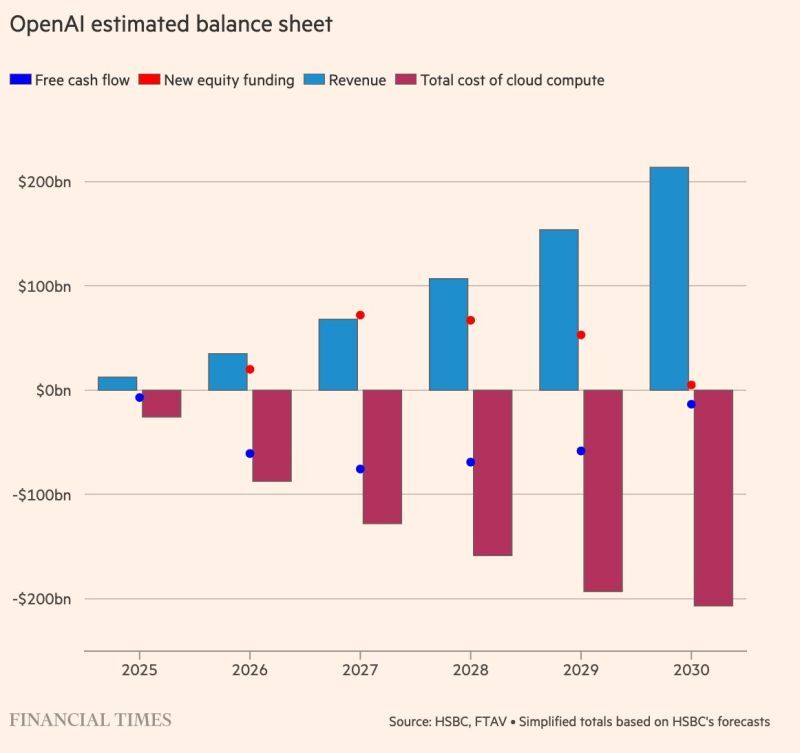
HSBC’s updated research model, distributed to clients this week, follows
OpenAI’s recent long-term cloud and compute agreements with Microsoft,
Amazon, and Oracle. Even under the bank’s upbeat growth assumptions, the
model still leaves OpenAI with a funding gap of about $207 billion by
the end of the decade, with revenues expected to reach $129 billion.
OpenAI needs $200bn to continue losing money – HSBC
Surging computing costs could keep the maker of
ChatGPT scrambling for fresh cash, a bank research report has estimated
OpenAI, the owner of ChatGPT, may need to raise more than $200
billion by 2030 in order to continue operating, according to HSBC
research cited by several media outlets.
The company needs the
funding to continue expansion as computing costs climb amid an
accelerating and increasingly frantic global AI race.
HSBC reportedly estimated that OpenAI’s cloud rental bill could run
to roughly $800 billion in total by 2030.
It is still projecting
explosive user growth, saying ChatGPT could climb to 3 billion regular
users by 2030, versus roughly 800 million last month – about 44% of
adults worldwide outside China.
OpenAI has been at the center of
the AI boom since ChatGPT launched three years ago, drawing huge
investor interest as Big Tech pours tens of billions into data centers
and advanced chips. Some analysts have warned the surge could be causing
a bubble to form, with spending racing ahead of returns and raising the
stakes not only for OpenAI but also for the tech giants backing its
expansion.
Tech companies are scrambling to keep pace with ChatGPT-style
services that have challenged their grip on online search and pushed
investment across the sector to record levels.
In October, OpenAI overtook
Elon Musk’s SpaceX to become the world’s most valuable private company
after a $6.6 billion employee share sale valued it at about $500
billion.
SpaceX's New Plan on Starship HLS Moon Landing Sooner than Expected...
Simplification has always defined SpaceX’s strategy—and it may once again change everything.
Facing skepticism over its Human Landing System, SpaceX is doubling down on efficiency, refining its lunar design to move faster and cut costs without sacrificing reliability.
This streamlined approach could accelerate Starship’s development, reduce risks, and give SpaceX a decisive edge in the Artemis race.
If it succeeds, it won’t just transform lunar exploration—it could reshape humanity’s path to Mars and beyond.
Let’s explore how this “simplified” strategy could redefine the competition in today’s episode of Great SpaceX.
SpaceX's New Plan on Starship HLS Moon Landing Sooner than Expected...
The past few weeks have been some of the most challenging yet defining moments for SpaceX’s Lunar Starship program. The company has faced a storm of criticism, much of it coming from both current and former NASA officials who question Starship’s pace of progress and its technical complexity.
These concerns have reignited discussions about whether SpaceX can meet the demanding timeline for NASA’s Artemis missions and deliver on its bold promise to return humans to the Moon.
Yet, as history has shown, SpaceX rarely shies away from adversity.
SpaceX's New Plan on Starship HLS Moon Landing Sooner than Expected...
Instead, the company confronts it head-on with innovation, agility, and bold decision-making.
This time, SpaceX’s response centers on a single guiding principle that has defined many of its greatest successes: simplification.
In a recent update, SpaceX made its stance clear:
“Since the contract was awarded, we have been consistently responsive to NASA as requirements for Artemis III have changed and have shared ideas on how to simplify the mission to align with national priorities. In response to the latest calls, we’ve shared and are formally assessing a simplified mission architecture and concept of operations that we believe will result in a faster return to the Moon while simultaneously improving crew safety.”
While the company did not specify exactly what these simplifications entail, the tone of their message radiates confidence.
SpaceX also reaffirmed that
“Starship continues to simultaneously be the fastest path to returning humans to the surface of the Moon and a core enabler of the Artemis program’s goal of establishing a permanent, sustainable presence on the lunar surface.”
----
We use images and content in accordance with the YouTube Fair Use copyright guidelines: https://www.youtube.com/intl/en/about...
Any questions about copyright please send us via Gmail: colonbina25@gmail.com
To be resolved, thank you.