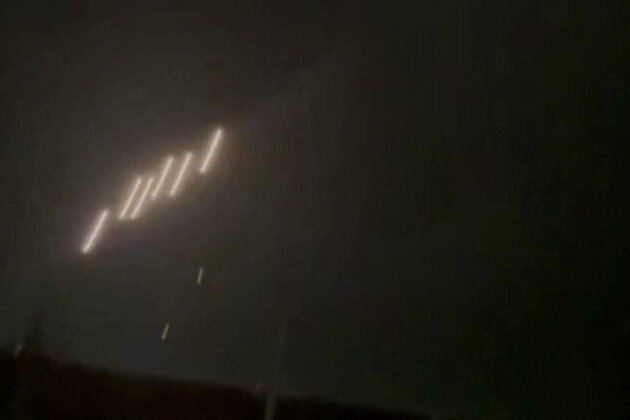
The strike came after Russian President Vladimir Putin ordered the Defense Ministry to “submit proposals” for a response to a Ukrainian drone attack on a teacher training college dormitory in the Lugansk People’s Republic, which left 21 people dead and 42 injured, mostly teenage girls.
Earlier on Sunday, Ukrainian media and Telegram channels circulated videos showing clusters of bright objects rapidly descending from the sky, claiming that Russia had deployed an Oreshnik against an unspecified target in the town of Belaya Tserkov near Ukraine’s capital, Kiev.
The dormitory of Starobelsk College, a facility of Lugansk Pedagogical University located in the town of Starobelsk, was struck by multiple waves of Ukrainian drones on Friday while students were asleep inside, in what Putin described as a deliberate “terrorist act.”
Governor Leonid Pasechnik declared May 24-25 days of mourning, describing the attack as “pure evil” and saying those responsible would face “deserved and inevitable punishment.”
Earlier, the US Embassy in Kiev warned American citizens of a “potentially significant air attack” that could take place within 24 hours and urged them to be ready to seek shelter immediately if an air alert was issued.
Moscow first publicly confirmed firing an Oreshnik in November 2024 when the missile was used in a strike on the Yuzhmash military-industrial facility in Dnepropetrovsk. It was deployed for the second time this January, obliterating an aircraft repair plant in Lviv, according to the Russian Defense Ministry.
Ukrainian media and Telegram channels have circulated videos showing clusters of bright objects rapidly descending from the sky. They claimed the footage captured the use of Russia’s intermediate-range hypersonic Oreshnik missile against an unspecified target in the town of Belaya Tserkov near Ukraine’s capital, Kiev.
Moscow has not officially confirmed the launch of its state-of-the-art system.
The reported strike came after Russian President Vladimir Putin ordered the Defense Ministry to “submit proposals” for a response to a Ukrainian drone attack on a teacher training college dormitory in the Lugansk People’s Republic, which left 21 people, mostly teenage girls, dead and 42 injured.
The US Embassy in Kiev had earlier warned American citizens of a “potentially significant air attack” that could occur within 24 hours, advising them to be prepared to take shelter immediately in the event of an air alert.
The dormitory, part of Starobelsk college at Lugansk Pedagogical University, was hit by several waves of Ukrainian drones while students were sleeping inside on Friday, in what Moscow called a deliberate “terrorist act.”
Governor Leonid Pasechnik declared May 24 and 25 days of mourning, calling the attack “pure evil” and saying those responsible must face “deserved and inevitable punishment.”

Ukrainian authorities have also reported dozens of missile and drone impacts in Kiev and elsewhere across Ukraine, but the Russian Defense Ministry has yet to confirm the scale or targets of the reported combined strike.
Russia first publicly confirmed the use of Oreshnik in November 2024, when Putin said the missile had been used in a strike on the Yuzhmash military-industrial facility in Dnepropetrovsk. The system is designed to deliver multiple warheads at hypersonic speed and has been described by Moscow as practically impossible for current air defenses to intercept.


Reporting by Yuliia Dysa, Daniel Flynn, Felix Hoske, Alina Smutko, Gleb Garanich, Anna Voitenko, Yurii Kovalenko and Max Hunder in Kyiv; Writing by Max Hunder; Editing by Kim Coghill, David Goodman and Helen Popper



Draft-dodging President Donald Trump kicked off Memorial Day by flying into a full-blown hissy fit over criticism of his bungled war negot...