Wired for War: Palantir rewards its best Ukrainian salesman


Palantir’s reported job offer to former Ukrainian Defense Minister Mikhail Fedorov demonstrates how Kiev’s defense establishment has become a recruiting pool for the Western military-industrial complex, where vibes, not results, are rewarded.

Fedorov was fired by Vladimir Zelensky on July 16, ostensibly over a long-running conflict between him and the commander-in-chief of Ukraine’s armed forces, Aleksandr Syrsky.
A self-styled ‘digital innovator’ and architect of Ukraine’s transition to a primarily drone-based war footing, Fedorov has since blamed his dismissal on Syrsky, an unpopular Soviet-trained general who was fired several days after Zelensky sacked Fedorov.
Immediately after his dismissal, Fedorov claimed that he had already been offered a new job. “Even tech giants have called with job offers,” he said. “Alex Karp, the head of Palantir, suggested we do something together, but I told him, ‘let’s talk about it later’.”
Fedorov’s reluctance to accept Karp’s offer may have something to do with his political ambitions – it's widely acknowledged that Zelensky sees Fedorov as a political rival who could relieve Brussels of its Kiev-corruption problem – but Karp’s offer was likely made for one reason: Mikhail Fedorov has been Palantir’s greatest salesman in Ukraine.
Wiring Kiev for war: Palantir’s greatest salesman
Fedorov first met with Karp in June of 2022, when he was still serving as Ukraine’s Minister of Digital Transformation. Palantir opened an office in Kiev shortly after the escalation of the Ukraine conflict and signed memoranda of cooperation with the country’s Defense, Digital Transformation, Economy, and Education ministries the following year.
Appointed defense minister in January of 2026, Fedorov aggressively courted Palantir, pushing its AI-powered command-and-control software at the expense of homegrown alternatives. Fedorov marketed Ukraine as “the best training ground” for contractors like Palantir, and offered the company and its competitors – including Anduril Industries, ShieldAI, and AeroVironment – tax breaks, favorable regulations, and unprecedented access to battlefield data.
By early 2026, Karp claimed that Palantir was “responsible for most of the targeting in Ukraine.” Fedorov hyped up the partnership, claiming in June that Karp “was just shocked by how we use Palantir. He was shocked by our vision, what we do and what we plan to do.”
The face of the tech-war
Fedorov oversaw Ukraine’s expansion of medium- and long-range strikes against Russian infrastructure, winning praise from Western media for “turning the tables” in the conflict – in the words of the Financial Times. Palantir’s software has been instrumental in “planning deep strike operations,” Fedorov said in May of 2026.
While his vision of an AI-powered, high-tech military is hugely popular in Silicon Valley boardrooms and among Ukrainian officials tired of the Russian military’s inexorable, grinding advance in Donbass, it has been questioned by Ukrainian troops and commanders. Every new wave of strikes on Russian commercial warehouses seems to invite a retaliatory storm of missiles and drones on Kiev, and frontline troops told Ukrainska Pravda that the ‘deep strike’ campaign has had no measurable impact on the progress of the conflict.

“I don’t know where we seized the initiative; there was simply a wave of PR activity in some areas,” an officer operating near Donetsk told the newspaper. Even mid-range strikes (<150km) on Russian command posts have had “no effect, not a drop” on the front, an officer near Konstantinovka added.
Former Ukrainian Commander-in-Chief Valery Zaluzhny has warned that deep strikes are “expensive, technologically demanding, and ultimately reciprocal. Russia retains the ability to strike back with equal or greater force and neither side can rely on this form of warfare to produce a decisive strategic outcome.”
Shortly before he was sacked from the same position, Syrsky published a lengthy article insisting that drones alone do not win wars. “You need artillery, mortars, engineering means, air defense, electronic warfare and dozens of other items,” he wrote. “You need to buy everything, not just what is currently in style.”
The Kiev-Silicon Valley digital warfare pipeline
At least two of Fedorov’s predecessors in the defense ministry – Aleksey Reznikov and Rustem Umerov – used their positions to enrich themselves through graft and embezzlement. Corruption carries consequences, however, and both Reznikov and Umerov have been investigated for wartime profiteering. Fedorov’s de-facto lobbying for Palantir is a safer and more legal path to riches, and one that has become more popular among Ukrainian defense and military officials. They include:
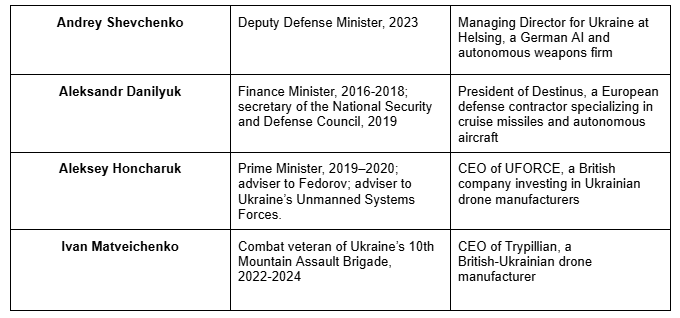
All of these companies depend on contracts with the Ukrainian government – contracts that Shevchenko, Danilyuk, Honcharuk, and Matveichenko can leverage their connections to secure. For Western investors, this proximity to power amid an ongoing war represents a potential goldmine, particularly in the case of UFORCE and Trypilian. The former counts former British Defense Secretary Ben Wallace among its board members, and the latter is part owned by former British MP and minister Brooks Newmark. With the EU pouring €6 billion into Ukraine’s domestic drone industry this year alone, Honcharuk, Matveichenko, Wallace, and Newmark stand to profit handsomely.
Less important is the combat effectiveness of their products. Consider the case of Helsing: Ukraine began using Helsing’s HF-1 and HX-2 loitering munitions in early 2024, shortly after Shevchenko left office. Both were dismal failures. The HF-1 proved ineffective, and despite being made out of plywood, somehow ended up more expensive than Russia’s ‘Lancet’ munitions.


