The European Union on Friday sought to contain a major migrant crisis after around 60,000 people crossed from Morocco into Spain's North African enclave of Ceuta in just days, overwhelming local authorities and triggering diplomatic tensions across the bloc.

- Casualties: At least 34 people have died attempting the crossing. Many drowned while swimming around the marine border fences or were crushed in stampedes near the Tarajal beach breakwater. [1, 2]
- Demographics: The crowd consisted largely of young men, but also included women, babies, and an estimated 7,000 unaccompanied minors. [1]
- Method of Entry: Migrants bypassed border security by swimming along the coast or climbing rock jetties to circumvent the border fence. [1]
- The Legal Catalyst: The sudden surge followed a Spanish Supreme Court ruling earlier in July. The ruling dictated that migrants intercepted at sea while trying to reach Ceuta or Melilla cannot be summarily returned to Morocco. Spanish Prime Minister Pedro Sánchez blamed human trafficking gangs for spreading distorted information about the ruling to spark the rush. [1, 2]


At least 60,000 migrants cross into Spanish territory of Ceuta from Morocco in a single day
At least 60,000 migrants have crossed in recent days from Morocco into Spain's Ceuta enclave, authorities have said, as Spanish Prime Minister Pedro Sánchez arrived to manage the country's biggest migrant crisis in years.
Police also said on Friday that many more people are still arriving in the enclave.
Spanish authorities said they would try to expel those who had entered illegally as quickly as possible, despite a court ruling that has put some new restrictions on special "border rejection" rules that allow immediate expulsions.
Upon arrival in the enclave, Sánchez said "what has emerged from our talks with Moroccan authorities is that trafficking mafias took a self-serving interpretation of a Supreme Court ruling," he said. That interpretation "spread like wildfire in recent hours."
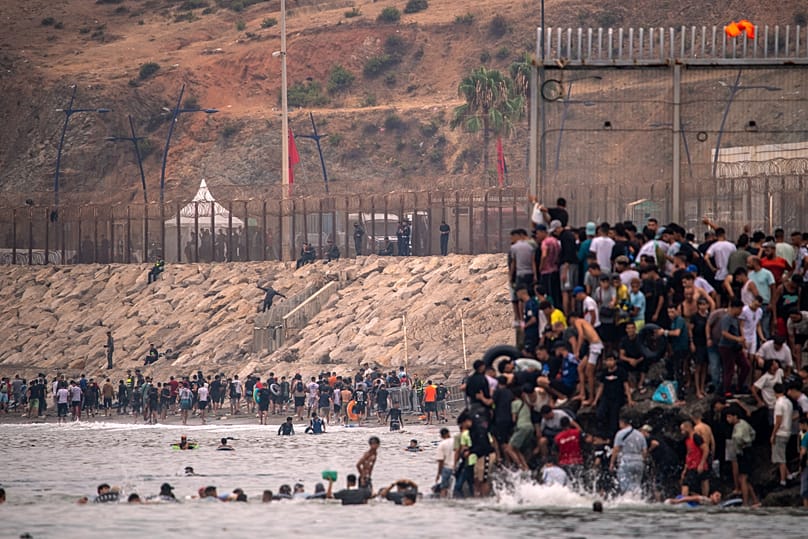
Ebullient migrants on Thursday were walking through the streets of Ceuta, thanking the Spanish police and calling out: "Bye bye Morocco, hello Spain."
Police and Civil Guards in Ceuta appeared to do little to intervene, although some officers attempted to direct the arrivals to the local migrant reception centre.
So far, 34 people have died trying to reach the Spanish territory, police sources said.
Diplomatic fallout
Already, the Ceuta scenes of the surge in migrants were causing diplomatic fallout.
Italy on Thursday called for Spain to be suspended from Europe's open-borders Schengen zone, prompting Spain to summon Italy's ambassador and accuse Rome of using the crisis for political gain.
Two top officials within US President Donald Trump's White House on Thursday also reiterated their anti-immigration politics using video of Ceuta.
Hundreds of migrants who have irregularly entered Ceuta began to return to Morocco through the same chokepoint, the breakwater that separates the autonomous city. The migrants are being led by the military to find a way to return.
France reinforces border controls with Spain
The French Interior Minister, Laurent Nuñez, stated this Friday that controls on the border with Spain will be reinforced.
"In light of the situation in the enclave of Ceuta, I gave instructions yesterday evening to immediately step up controls at the Spanish border. Furthermore, I am mobilising the Rapid Border Intervention Force to carry out thorough checks," says the French Interior Minister.
Spanish authorities 'overwhelmed'
Spanish authorities said they have been "completely overwhelmed" by the situation, El Mundo reports. Only 55 agents were on the front line when the situation broke out, according to the Spanish newspaper.
The active troops on the ground are "three or four times less than what would be needed to face something like this," says to El Mundo David Gomez, secretary of communication of the Justice Professional Association for the Civil Guard.
The influx marks the largest arrival of migrants in Ceuta since 2021 — predominantly young men and adolescents — with 18 deaths reported during the crossing, according to figures released on Friday morning by the same source.
The number of entries means the population of the enclave increased by more than 50%, as around 83,000 people are living in Ceuta.


No comments:
Post a Comment