Saturday, February 06, 2016
Next Generation in The New Urban Downtown Mesa
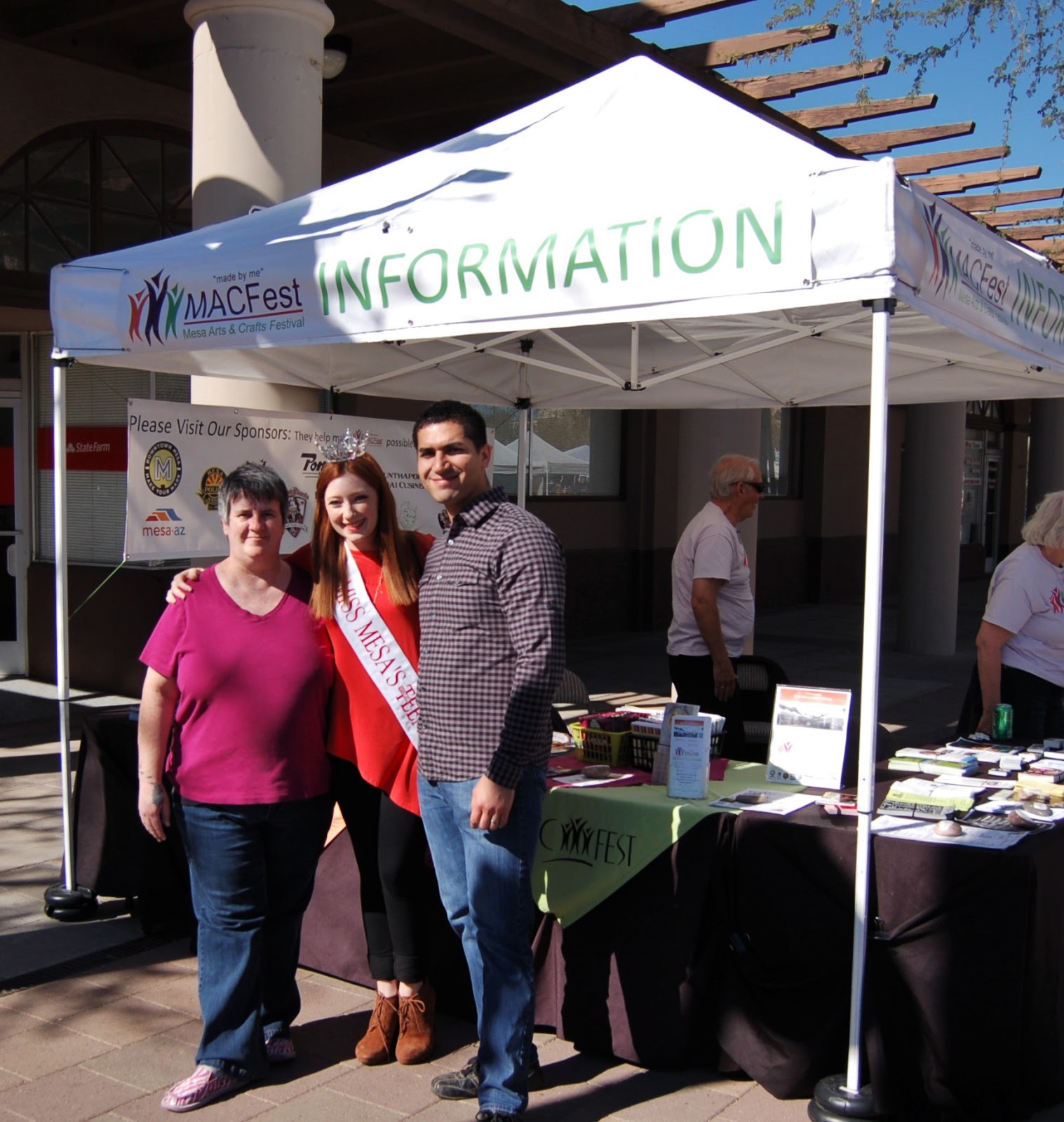
Miss Mesa Outstanding Teen 2016 - Holly Sullivan - took the time today to stop and say hello to the volunteer organizers of MACFest [70 vendors attracting a crowd here]
Born in Mesa > GuitarMan Joel Parker
Friday, February 05, 2016
WhatWorksMesa > Achievement in Open Data from City Hall
Open data is data that anyone can access, use or share.
The future will be built on open data – here’s why
Data has the power to revolutionise and disrupt the way societies are governed. None more so than open data, which is free to access, free to use and can be shared by anyone. It’s non-personal and can be used to identify and predict large-scale trends and behaviours. This is as opposed to closed data that is restricted to internal use by an organization.
That is exactly why your MesaZona blogger has been asking when some of the results from joining Bloomberg Philanthropies WhatWorksCities initiative back in August of last year can be made available. Some three months later appointments got announced on Twitter on 05 Nov 2015 by city manager Chris Brady to the inside-City Hall Leadership Board and now six months later with nothing to report about Open Data.
The future of open data is a collaborative process with the aim of providing civic benefits. Organizations need to share their data and work together to create novel uses for it that make our lives easier or richer. Using data that describes the patterns behind how we live can help us solve problems in ways we might not have foreseen.
Theconversation.com
In all these cases, the way to fast-forward innovation and create new solutions to problems is to create open data partnerships with participants who are willing to share and collaborate on new disruptive initiatives [ Blogger's note: that may challenge Mesa City Hall ].
Many of these initiatives have already proven to bring benefits to people, government and businesses. It is a new era of increased transparency and democracy where data is no longer in the hands of only governments and commercial organizations. Using open data presents opportunities for commerce, while also improving communities and everyday living for citizens.
While this particular department is inside City Hall, the public can access the website for the City Purchasing Department that reports to the Business Services Director,
http://www.mesaaz.gov/business/purchasing
Information about the awarding of contracts or bid solicitations is sometimes a problem in requesting open data. However, those things can be accessed by hitting this link >>
http://mesaaz.gov/business/purchasing/bid-opportunities/open-solicitations/-sortn-RFPNumber/-sortd-desc
Its vision is to be leaders in the field of public procurement and strategic sourcing, bringing value and efficiency to each procurement while at the same time operating within City policy, statute and sound business practices.
Values
The future will be built on open data – here’s why
Data has the power to revolutionise and disrupt the way societies are governed. None more so than open data, which is free to access, free to use and can be shared by anyone. It’s non-personal and can be used to identify and predict large-scale trends and behaviours. This is as opposed to closed data that is restricted to internal use by an organization.
That is exactly why your MesaZona blogger has been asking when some of the results from joining Bloomberg Philanthropies WhatWorksCities initiative back in August of last year can be made available. Some three months later appointments got announced on Twitter on 05 Nov 2015 by city manager Chris Brady to the inside-City Hall Leadership Board and now six months later with nothing to report about Open Data.
The future of open data is a collaborative process with the aim of providing civic benefits. Organizations need to share their data and work together to create novel uses for it that make our lives easier or richer. Using data that describes the patterns behind how we live can help us solve problems in ways we might not have foreseen.
Theconversation.com
In all these cases, the way to fast-forward innovation and create new solutions to problems is to create open data partnerships with participants who are willing to share and collaborate on new disruptive initiatives [ Blogger's note: that may challenge Mesa City Hall ].
Many of these initiatives have already proven to bring benefits to people, government and businesses. It is a new era of increased transparency and democracy where data is no longer in the hands of only governments and commercial organizations. Using open data presents opportunities for commerce, while also improving communities and everyday living for citizens.
While this particular department is inside City Hall, the public can access the website for the City Purchasing Department that reports to the Business Services Director,
http://www.mesaaz.gov/business/purchasing
Information about the awarding of contracts or bid solicitations is sometimes a problem in requesting open data. However, those things can be accessed by hitting this link >>
http://mesaaz.gov/business/purchasing/bid-opportunities/open-solicitations/-sortn-RFPNumber/-sortd-desc
Its vision is to be leaders in the field of public procurement and strategic sourcing, bringing value and efficiency to each procurement while at the same time operating within City policy, statute and sound business practices.
Values
- Accountability - Taking ownership and being responsible to stakeholders for our actions...essential to preserve the public trust and protect the public interest.
- Ethics - Acting in a manner true to these values...essential to preserve the public's trust.
- Impartiality - Unbiased decision-making and action...essential to ensure fairness for the public good.
- Professionalism - Upholding high standards of job performance and ethical behavior...essential to balance diverse public interests.
- Service - Obligation to assist stakeholders...essential to support the public good.
- Transparency - Easily accessible and understandable policies and procedures...essential to demonstrate responsible use of public funds.
BIG FAIL [again] in Arizona Education
Lot of talk and promises about being Mesa being "a leading center in innovation" and "The New American University" [ASU is ranked #31 in pubic institutions-see previous post] and going after "high-pay and high-tech jobs" but the data, facts and report studies strongly point to a basic failure to achieve educational goals time and time again.
Sorry, dear readers for another "downer" dear readers, but on the education front some things are definitely down.
An article from Cronkite News appearing yesterday and the day before was quoting a spokesperson saying "We want Arizona to be at the top of these lists . . ." and that the State is already working on these high-stake challenges". Huh?
Let's get real: wanting does not equate with wish-fulfillment - clearly the rhetoric does not fit the facts and statistics from many sources.
Likewise, unsupported defense and denial for student failure by public education in Arizona does not solve a very serious problem, brought to attention again by yet a national report card released on Tuesday by the Network for Public Education that included the infographic to the right.
Does it soothe any discomfort or pain or hard recognition of the facts for Cronkite News reporter Danika Washington to say that Arizona is one of six states failing?
The infographic to the left is taken from a piece called
Leaders and Laggards:
A State-by-State Report Card
on Public Postsecondary Education
Projections of labor market demand show that two-thirds of all jobs will require some postsecondary education by 2018; however, given today’s disappointing levels of higher education productivity, labor economists estimate that the United States will fall 7 million degrees short. While American employers increasingly struggle to find the talent they need to grow our economy, our youngest workers rank a disappointing 15th out of 34 industrialized countries in the percentage with a college diploma.
https://www.uschamberfoundation.org/reportcard/
In measuring academic achievements these categories are used for evaluation:
Academic Achievement of Low-Income and Minority Students
Return on Investment ROI
Truth in Advertising About Student Proficiency
Rigor of Standards
Post-Secondary and Workforce-Readiness
21st Century Teaching Force
Flexibility in Management & Policy
Data Quality
Arizona is 10th from the bottom of the list
Sorry, dear readers for another "downer" dear readers, but on the education front some things are definitely down.
An article from Cronkite News appearing yesterday and the day before was quoting a spokesperson saying "We want Arizona to be at the top of these lists . . ." and that the State is already working on these high-stake challenges". Huh?
Let's get real: wanting does not equate with wish-fulfillment - clearly the rhetoric does not fit the facts and statistics from many sources.
Likewise, unsupported defense and denial for student failure by public education in Arizona does not solve a very serious problem, brought to attention again by yet a national report card released on Tuesday by the Network for Public Education that included the infographic to the right.
Does it soothe any discomfort or pain or hard recognition of the facts for Cronkite News reporter Danika Washington to say that Arizona is one of six states failing?
While this is the most recent report that so-called education advocates have been hit with naming it "a call to action", apparently nobody or few are listening to calls - or facts - time and time again here in Arizona.The infographic to the left is taken from a piece called
Leaders and Laggards:
A State-by-State Report Card
on Public Postsecondary Education
Why This Report?
#1 It's from the U.S. Chamber of CommerceProjections of labor market demand show that two-thirds of all jobs will require some postsecondary education by 2018; however, given today’s disappointing levels of higher education productivity, labor economists estimate that the United States will fall 7 million degrees short. While American employers increasingly struggle to find the talent they need to grow our economy, our youngest workers rank a disappointing 15th out of 34 industrialized countries in the percentage with a college diploma.
https://www.uschamberfoundation.org/reportcard/
In measuring academic achievements these categories are used for evaluation:
Academic Achievement of Low-Income and Minority Students
Return on Investment ROI
Truth in Advertising About Student Proficiency
Rigor of Standards
Post-Secondary and Workforce-Readiness
21st Century Teaching Force
Flexibility in Management & Policy
Data Quality
Arizona is 10th from the bottom of the list
Thursday, February 04, 2016
Mesa 11 Live Stream STATE OF THE CITY 2016
A slick and over-produced montage with the mayor running into the ballroom at Mesa Convention Center . . "I may look stupid, but ...." . . . . "things are great . . . getting better" . . . . . if we can engage with one another ... presented by the Mesa Chamber of Commerce.
Props and characters used in the mayor's performance:
The mayor and The Sun Devils Mascot
[what's that old metaphor? ...
judged by the company we keep]
Here's a link if you want to watch later >> hit the play arrow on the screen
Props and characters used in the mayor's performance:
The mayor and The Sun Devils Mascot
[what's that old metaphor? ...
judged by the company we keep]
Mesa Sets The Stage > Transformation in New Urban DTMesa Underway
Another well-written article about Mesa that appeared reporting on the recent SWTA Conference that wrapped up here two days ago at the Mesa Convention Center.
One thing that is nice to see is that Mesa Mayor John Giles can admit he was wrong . . .
Mesa Mayor John Giles said when the light rail line was proposed he was highly skeptical, saying it was just bringing a “Disneyland ride to a ghost town,” in downtown Mesa. But now that it’s open and bumped up the line’s monthly ridership from 90,000 to 180,000 and seeing all the life it brought into the area, he’s glad to admit he was wrong.
“I can’t think of anything else that I’ve been so delighted to be so wrong about,” he said.
That honest admission included by Joe Petrie On Feb 2, 2016 appeared in MassTransitMag
Mesa Sets the Stage for Freedom Through Transit
The SWTA annual meeting brought together hundreds of transit professionals and vendors from nine states within the region to find ways to better their systems and find best practices to improve efficiency and safety in their communities.
Coming into downtown Mesa down Main Street, you can see a transformation underway.
Getting off the Main/Center platform of the Valley Metro Light Rail Central Mesa Extension Joe Petrie noticed Main looks different than other areas of Mesa with its new light rail line moving people down the corridor while other roads are wide boulevards designed solely for car traffic and only a few winding sidewalks going past them.
Downtown Mesa also saw its first new residential developments in downtown Mesa in 30 years. [Blogger's note: that's Encore On First at 25 West First Avenue].
Mesa is a standard example of most communities located in the south and west of the U.S., and its change made it a strong host for the 2016 South West Transit Association (SWTA) annual meeting.
While data from many sources shows that less than 10% of the population use public transportation, nonethess The conference is themed “Freedom Through Transit,” as transit officials show ways they improve communities and free people from their cars.
Though transit is chided by detractors as stealing freedom, panelist at the opening session said true multimodal systems give freedom because it gives everyone choices on how they move.
Scott Smith, who officially took over as interim CEO of Valley Metro Feb. 1, and is the former mayor of Mesa, said when planning the initial freeways in the valley in the 1980s transit was very politically unpopular in the region, but that sentiment of lost freedom from transit is waning as the argument if fixed guideway rail causes issues because it can’t be moved.
“Last time I checked, when they were planning the freeways they also weren’t planning on moving it either,” he said.
Maria Hyatt, public transit director for the city of Phoenix, said the addition of light rail in the area has been very effective in moving people and building development.
“Light rail is the best running bus system,” she said. “Light rail can move four times the people that our busiest bus routes can.”
Here's the clincher take-away from Joe Petrie's report
And with the success of the initial system, leaders said they’re seeing residents embrace projects including groups that would normally oppose such a project.
. . . projects like more affordable housing that's transit-oriented development and form-based zoning to support Creative Peacemaking?
One thing that is nice to see is that Mesa Mayor John Giles can admit he was wrong . . .
Mesa Mayor John Giles said when the light rail line was proposed he was highly skeptical, saying it was just bringing a “Disneyland ride to a ghost town,” in downtown Mesa. But now that it’s open and bumped up the line’s monthly ridership from 90,000 to 180,000 and seeing all the life it brought into the area, he’s glad to admit he was wrong.
“I can’t think of anything else that I’ve been so delighted to be so wrong about,” he said.
That honest admission included by Joe Petrie On Feb 2, 2016 appeared in MassTransitMag Coming into downtown Mesa down Main Street, you can see a transformation underway.
Getting off the Main/Center platform of the Valley Metro Light Rail Central Mesa Extension Joe Petrie noticed Main looks different than other areas of Mesa with its new light rail line moving people down the corridor while other roads are wide boulevards designed solely for car traffic and only a few winding sidewalks going past them.
Downtown Mesa also saw its first new residential developments in downtown Mesa in 30 years. [Blogger's note: that's Encore On First at 25 West First Avenue].
Mesa is a standard example of most communities located in the south and west of the U.S., and its change made it a strong host for the 2016 South West Transit Association (SWTA) annual meeting.
While data from many sources shows that less than 10% of the population use public transportation, nonethess The conference is themed “Freedom Through Transit,” as transit officials show ways they improve communities and free people from their cars.
Though transit is chided by detractors as stealing freedom, panelist at the opening session said true multimodal systems give freedom because it gives everyone choices on how they move.
Scott Smith, who officially took over as interim CEO of Valley Metro Feb. 1, and is the former mayor of Mesa, said when planning the initial freeways in the valley in the 1980s transit was very politically unpopular in the region, but that sentiment of lost freedom from transit is waning as the argument if fixed guideway rail causes issues because it can’t be moved.
“Last time I checked, when they were planning the freeways they also weren’t planning on moving it either,” he said.
Maria Hyatt, public transit director for the city of Phoenix, said the addition of light rail in the area has been very effective in moving people and building development.
“Light rail is the best running bus system,” she said. “Light rail can move four times the people that our busiest bus routes can.”
Here's the clincher take-away from Joe Petrie's report
And with the success of the initial system, leaders said they’re seeing residents embrace projects including groups that would normally oppose such a project.
. . . projects like more affordable housing that's transit-oriented development and form-based zoning to support Creative Peacemaking?
News from London: Cross-Border Research Collaborations/Online Course Delivery PLuS Alliance
Press Release
https://asunow.asu.edu/plus-alliance-partnership-announced-to-address-global-challenges
New international university alliance to address global challenges with cross-border research in health, sustainability, social justice and innovation
London - Arizona State University, King’s College London and UNSW Australia have come together to form the PLuS Alliance, a new partnership to help find research-led solutions to global challenges and expand access to world-class learning. Combining the cutting-edge research capabilities and innovative education approach of three universities in different parts of the world, the PLuS Alliance will undertake cross-border research collaborations to address significant issues related to health, social justice, sustainability and innovation.
The research will be supported with a suite of related learning programs to be delivered online.
"Key to solving the challenges facing humankind will be greater access to education so that talented men and women around the world can acquire the training and knowledge needed to join a workforce that operates across cultures and borders," said Dr. Michael Crow, President of Arizona State University.
“The PLuS Alliance will deliver an exceptional international learning experience that builds on our established record of innovative online course delivery.”
Yours truly is not so sure a out that "established record" - one source has this metric showing that online course enrollment has actually declined.
ASU is a public flagship metropolitan research university located on five campuses across the Phoenix Metropolitan Area. A sixth campus located in northwestern Arizona is known as the ASU Colleges at Lake Havasu City.
ASU is the largest public university by enrollment in the United States.
Since 2005 ASU has been ranked among the top research universities, public and private, in the U.S. based on research output, innovation, development, research expenditures, number of awarded patents and awarded research grant proposals.
The Center for Measuring University Performance currently ranks ASU 31st among top U.S. public research universities Source >> Schoolinforme
The international partnership will collaborate on projects to make world class education and research accessible locally, helping communities globally make a direct and positive impact.
PLuS ALLIANCE PROGRAMS More than 20 programs will be available to start from Fall 2016. Degrees to be offered through PLuS Alliance universities will initially include:
https://asunow.asu.edu/plus-alliance-partnership-announced-to-address-global-challenges
New international university alliance to address global challenges with cross-border research in health, sustainability, social justice and innovation
London - Arizona State University, King’s College London and UNSW Australia have come together to form the PLuS Alliance, a new partnership to help find research-led solutions to global challenges and expand access to world-class learning. Combining the cutting-edge research capabilities and innovative education approach of three universities in different parts of the world, the PLuS Alliance will undertake cross-border research collaborations to address significant issues related to health, social justice, sustainability and innovation.
"Key to solving the challenges facing humankind will be greater access to education so that talented men and women around the world can acquire the training and knowledge needed to join a workforce that operates across cultures and borders," said Dr. Michael Crow, President of Arizona State University.
“The PLuS Alliance will deliver an exceptional international learning experience that builds on our established record of innovative online course delivery.”
Yours truly is not so sure a out that "established record" - one source has this metric showing that online course enrollment has actually declined.
ASU is a public flagship metropolitan research university located on five campuses across the Phoenix Metropolitan Area. A sixth campus located in northwestern Arizona is known as the ASU Colleges at Lake Havasu City.
ASU is the largest public university by enrollment in the United States.
Since 2005 ASU has been ranked among the top research universities, public and private, in the U.S. based on research output, innovation, development, research expenditures, number of awarded patents and awarded research grant proposals.
The Center for Measuring University Performance currently ranks ASU 31st among top U.S. public research universities Source >> Schoolinforme
The international partnership will collaborate on projects to make world class education and research accessible locally, helping communities globally make a direct and positive impact.
PLuS ALLIANCE PROGRAMS More than 20 programs will be available to start from Fall 2016. Degrees to be offered through PLuS Alliance universities will initially include:
- BA/BS in: Sustainability, Global Health, Community Health, Whole Person Care, Business, and Global Logistics Management
- Masters in: Science of Healthcare Delivery, Infectious Diseases Intelligence, and Sustainability Leadership
Subscribe to:
Comments (Atom)
Zelensky Calls for a European Army as He Slams EU Leaders’ Response
Jan 23, 2026 During the EU Summit yesterday, the EU leaders ...
-
Flash News: Ukraine Intercepts Russian Kh-59 Cruise Missile Using US VAMPIRE Air Defense System Mounted on Boat. Ukrainian forces have made ...


