Saturday, December 30, 2017

IN REAL ESTATE WE TRUST: Here's Whitestone REIT

This Promising REIT Has A 7.8% Covered Yield
And 12% Upside
____________________________________________________________________________________
Blogger Insert:
_____________________________________________________________________________________
 
Summary
Whitestone REIT is an interesting dividend vehicle for income investors.
The REIT has grown its portfolio, NOI and core FFO/share at a fast clip since its IPO in 2010.
Whitestone REIT's dividend stream is affordable; income investors pay just about eleven times core FFO.
Shares are undervalued and should be able to trade at ~12.5x core FFO.
Whitestone pays a $0.095/share monthly dividend. An investment in WSR yields 7.8 percent.
Whitestone REIT (WSR) is an underrated real estate investment trust in my opinion that has potential to increase its valuation multiple while providing income investors with a stable stream of dividend income. Whitestone REIT is active in high-growth, high-potential markets, and has robust dividend coverage stats for an eight percent yielder. An investment in Whitestone REIT comes with an attractive, covered 7.8 percent yield and monthly distribution frequency.
Whitestone REIT is a smaller, yet promising REIT in the increasingly crowded REIT sector. While most investors would consider buying large real estate investment trusts like Realty Income, Corp. (O) or National Retail Properties, Inc. (NNN), smaller REITs like Whitestone REIT make attractive value propositions, too.

Whitestone REIT - An Overview

Whitestone REIT has come a long way since its IPO in August 2010. The REIT has aggressively grown its real estate presence in the U.S. through acquisitions. At the end of the September quarter, Whitestone REIT had 72 properties comprising 6.6 million square feet in its real estate portfolio.
Whitestone REIT typically invests in markets with strong economic fundamentals, for instance above-average population growth.
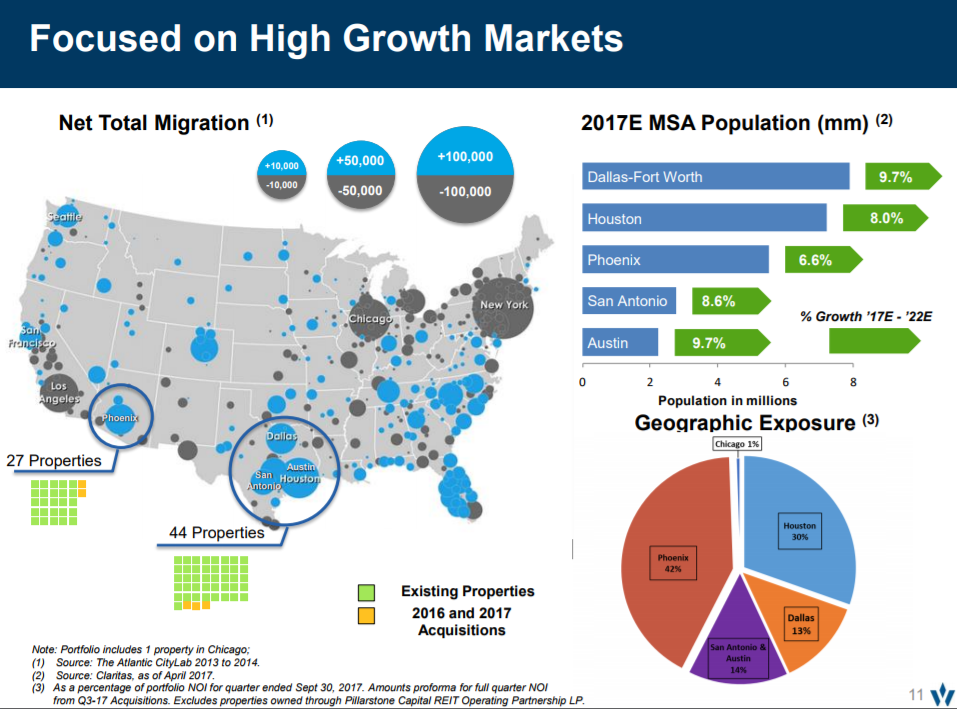
Source: Whitestone REIT

Achilles Research
Long/short equity, special situations


Happy New Year 2018 Maricopa County > 3 Days HIGH POLLUTION ADVISORY


Maricopa County HPA Headers

HPA

 PM2.5 Air Pollutant


(Image insert by Blogger for effect)
The Arizona Department of Environmental Quality (ADEQ) is issuing a High Pollution Advisory (HPA) from Dec. 30, 2017, to Jan. 1, 2018, for fine particulate matter (PM2.5), also known as soot, for Maricopa County, Arizona.
This HPA is due to particle pollutant levels expected to accumulate enough to exceed the federal health standard for PM2.5. 
People with heart or lung diseases, older adults and children are most likely to be affected by particle pollution. Particles in the PM2.5 size range are able to travel deeply into the respiratory tract, reaching the lungs and can cause short-term health effects such as eye, nose, throat and lung irritation, coughing, sneezing, runny nose and shortness of breath. Exposure to these fine particles can also affect lung function and worsen medical conditions such as asthma and heart disease.
BACKGROUND
  • High Pollution Advisory (HPA): Notifies the public that the level of an air pollutant is expected to exceed the federal health standard
  • Health Watch: Notifies the public that the level of an air pollutant is expected to approach the federal health standard
  • Particulate Matter: State and county agencies measure levels of particulate matter (PM) in the air. PM is extremely small solid particles and liquid droplets that circulate in air. PM comes from combustion (cars, industry, wood burning) or dust stirred up into the air. High levels of PM occur when air is especially stagnant or windy. Two types of PM are measured: PM10, commonly called dust, and PM2.5, commonly called soot. PM10 refers to dust particles 10 microns or less and PM2.5 to soot particles 2.5 microns or less. For perspective, one strand of human hair is 70-100 microns in size.
CONTACT: Erin Jordan – 602-771-2215 desk/602-540-8072 cell 
The Maricopa County Air Quality Department (MCAQD) is a regulatory agency whose goal is to ensure federal clean air standards are achieved and maintained for the residents and visitors of Maricopa County. The department is governed by the Maricopa County Board of Supervisors and follows air quality standards set forth by the federal Clean Air Act. The department offers air quality information and resources on its Clean Air Make More website: cleanairmakemore.com.
CONTACT: Bob Huhn – 602-506-6713 desk/602-526-7307 cell
___________________________________________________________________
About ADEQ
AZDEQ Logo
Under the Environmental Quality Act of 1986, the Arizona State Legislature established the Arizona Department of Environmental Quality in 1987 as the state agency for protecting and enhancing public health and the environment of Arizona. For more information, visit http://www.azdeq.gov/.


Thursday, December 28, 2017

Going Rogue Again With Rogue Columnist Jon Talton

Your MesaZona Blogger says Hooray! for this real-life reporter and purveyor of pulp fiction.
Here's a teaser for him most recent posting:
Rogue Columnist >The Winter of Our Discontent
Washington_Crossing_the_Delaware_MET_DP245003
These are the times that try men's souls. The summer soldier and the sunshine patriot will, in this crisis, shrink from the service of their country; but he that stands by it now, deserves the love and thanks of man and woman. Tyranny, like hell, is not easily conquered; yet we have this consolation with us, that the harder the conflict, the more glorious the triumph.

— Thomas Paine, December 23, 1776
__________________________________________________________________________________
"We've made it through the first year of the presidency of Donald Trump (let that name attached to that title sink in) without a nuclear war with North Korea. But there's next year.
Meanwhile, despite all the speculation and hope for a Democratic wave in the fall, great damage has been done to the republic. Total Republican control of the federal government resulted in the passage of a ruinous tax bill. Among its worst consequences will be the opportunity costs — no nice things for us, such as high-speed rail or rail transit for our metropolitan areas — because $1.5 trillion will be looted from the Treasury for the very rich. . . "
__________________________________________________________________________________
Blogger Note: Some snippets from the current piece are included for you interest below.
Here's a link to Jon Talton's blog

About Rogue Columnist

www.roguecolumnist.com/about.html
THE BLOG: Rogue Columnist focuses on sustainability, urban issues and politics in the Great Disruption that is our future. Phoenix and Arizona are a specialty. THE WRITER: Jon Talton is a journalist and author. His 12 novels include the David Mapstone mysteries, the Cincinnati Casebooks and the thriller "Deadline Man.
_______________________________________________________________


I've had an extended discussion of our new abnormality with a journalist. He's a very smart guy but unable to publish his insights without losing his job. So I thought I would offer a few here to get your reaction:
I think the tax cuts issue needs to first, "break the frame," and then people on the left end need to "name it and frame it."  Frame-breaking is replacing the assertion-rebuttal trope of media communication with a counter-assertion in place of a rebuttal . . .
So why does the GOP insist upon reducing the tax burdens of the rich when their claims of job creation and economic stimulus not only never materialize — on  but also follows a pattern of asset bubbles, overheated investments, asset crashes and recessions? . . .
Trump, the GOP and the Deplorables are three points of an unholy trinity. If they find any success, like they did with tax cuts, they will crystallize around it to remain a coherent political entity. Success creates a positive feedback loop that can only be stopped by a negative feedback loop. Just wait for the recession. . .
What will be the point of failure for the coming economic downturn? I see it from cryptocurrencies (a computer simulacrum of currency flows in theory and practice, then using the simulacrum to lay claim to real goods — gee, what can go wrong?), . .
This creates two incompatible and irreconcilable frames on how to analyze society with the progression of time. If you are liberal, you see the broadening definition of individualism to non-white non-males as justice, the righting of a historical wrong. If you are a conservative, you see justice as a personal affront and a humiliating defeat. You see equality as a degradation in cultural status and a devaluation of self-worth; taking of half of everything you have or half of your self worth to give to a nobody and then meeting that nobody halfway. So, yeah, the "good old days" were really good for certain folk, but that's because they yearn for a return to a position of power and status that has been lost and gone forever.
The thing is, it's effective because that exclusive power is a "felt experience" that has been transmitted across generations in a way that liberals stopped transmitting right about the time of the Vietnam war and Robert F. Kennedy's assassination. Since then, the prevailing attitude toward power is that it is an inherently corrupting and corruptible phenomenon that is to be categorically renounced. It's very idealistic and hopeful at a time of violent conflict at home and abroad. The problem was that the sentiment was shared only by a population whose only encounter with power was being on the receiving end of it. A similar renunciation of power did not occur on the right, who began gathering up the power neglected by the left.
SPOILER ALERT: In 50 years since then, the left has only grown only more estranged from power while the right has only grown more enamored of it. The right is legitimizing authoritarianism through the capture of legitimate institutions and the testing of cultural boundaries that go unchallenged. The left, on the other hand, developed an elaborate vocabulary of victimhood and meditated too deeply on oppression as the basis of social relationships. This represents the collective effort of the left experience: sjwiki.org You have to consult that website, not because you want to internalize some or all of its ideology, but if you ever see a young person — say on Twitter, a college campus or a protest — and wonder why they speak a language that sounds like English but carries an emotional connotation not explained by an objective definition of the term, you'll get some idea of their outrage.
_______________________________________________________________
 
outrage


2017 In Review | Area Development Online + Site/Facility Planner Insider

As the year draws to a close, Area Development presents you with several insightful articles that ran in 2017. The information and advice they contain is worth another look and will be valuable to you and your company as you plan for a successful 2018. Our staff wishes you a happy and prosperous New Year!
Q2 2017

How Technology Will Overcome Demographics

Randy Thompson, Senior Managing Director, U.S. Corporate Project Management, Cushman & Wakefield
technology.jpg
As robotics continue to evolve in both agility and intelligence, the day may come when site selectors can take labor availability out of the location equation..
Q3 2017

How U.S. Manufacturers Can Navigate the Route to the New Trade Policy

Robert McCutcheon, U.S. Industrial Products Leader, PwC
manufacturers.jpg
Manufacturers need to prepare now for prospective trade policy changes so that they may recalibrate their supply chains if need be.
Q3 2017

Women in Manufacturing: Closing the Gap

Noelle Salerno, Consultant, Avalanche Consulting, Jennifer Vernon, Consultant, Avalanche Consulting
women.jpg
The manufacturing industry is recruiting and advancing women to close the talent gap.
2017 Auto/Aero Site Guide

The Automotive Industry: On The Eve Of Disruption

Dennis Cuneo, Managing Partner, Fisher & Phillips
automotive.jpg 
Electrification and autonomous driving are just two of the forces disrupting the auto industry, as incumbent automakers compete with new entrants into the field.
2017 Food Processing

Dinner on the Front Porch: How E-Commerce Is Affecting the Food Industry

Jeff Dearduff, Corporate Director, Baking & Snack, The Austin Company
food.jpg
As consumers receive more and more of their food through e-commerce, food manufacturers, assemblers, and distribution networks are going to have to think differently.
Q4 2017

Utilizing Advanced Technologies to Evaluate the Location Decision

Rajiv Jetli, U.S. Industrial Products Operations & Advanced Manufacturing Leader, PwC
advTech.jpg 
Although manufacturers are using advanced technologies, including artificial intelligence, in their operations, they’ve yet to leverage these advances in the site selection process.
Q4 2017

Industry Sea Changes Affecting U.S. Shipping Gateways

Walter Kemmsies, Ph.D., Managing Director, Economist and Chief Strategist, U.S. Ports, Airports and Global Infrastructure Group, JLL
shipping.jpg
Damage from recent hurricanes could have a ripple effect across U.S. seaports, underscoring the rising demand for more sophisticated industrial real estate and infrastructure.
Data Centers 2017

Tackling The Risk Factors of Third-Party Data Centers

Sean Brady, Managing Director, Tenant Advisory Group, Cushman & Wakefield
dataCenters.jpg
Third-party data center users need to assemble an experience team — including IT professionals, engineers, real estate advisors, attorneys, and others — to help reduce risks on all fronts.
Q1 2017

It’s Your Move: Critical Considerations When Relocating Corporate Headquarters

Dean J. Uminski, CEcD, Principal, Crowe Horwath
headquarters.jpg
The improving economy is making it more financially feasible for companies to relocate their corporate headquarters, but such a move calls for careful consideration of a variety of factors that will determine the ultimate success — or failure — of relocation.

Closing the Digital Divide: Broadband Infrastructure and the CRA

Connecting Communities sponsored by the Federal Reserve System
 
Access to broadband is as fundamental to progress as electricity was at the turn of the last century, but broadband access and adoption continues to lag for some populations, particularly lower-income and rural communities.

Under the CRA, infrastructure investment now includes broadband, and the regulatory agencies identify communications infrastructure as an essential community service. This webinar will highlight possible opportunities for financial institutions to help close the digital divide while receiving
 CRA consideration.
 
Thursday, January 11, 201812:00 p.m. Pacific / 3:00 p.m. Eastern

Register
 
The Connecting Communities® webinar series is sponsored by the Federal Reserve System. Participation is free, but preregistration is required. All sessions are recorded and archived.
 
 
2018 National Interagency Community Reinvestment Conference
 
Looking for more on broadband investments and CRA?
 
Join us in Miami for the 2018 National Interagency Community Reinvestment Conference. Speakers will share more on broadband infrastructure as a CRA investment opportunity along with a wide range of other ways to build resilient and inclusive communities.

Don’t miss this opportunity to talk to the regulators, meet with your peers, and learn how CRA loans, investments, and services can have a positive and lasting impact in the communities we serve.
 
Learn more about the 2018 National Interagency Community Reinvestment Conference


Community Development at the Federal Reserve Bank of San Francisco

Happy Holidays from the Center for Accelerating Innovation

EDC News 2016
December 28, 2017
Bookmark and Share

Happy New Year from the Center for Accelerating Innovation!

Thanks for reading EDC News!
Happy Holidays!