Monday, October 15, 2018

2 Mesa City Council Meeting Mon 15 Oct 2018

Regular Meeting: 23:11
Quick consent again after Kevin Christopher takes a few minutes to read the 40-item agenda for this meeting.
It was preceded today by a Study Session that has not yet been uploaded to YouTube, although this regular meeting was uploaded 15 minutes after it ended.
This meeting takes about a total of 23 minutes to dispose of business.
District 4 Councilmember Chris is absent for the second time in-a-row. Giles says
" he's away on city business working with the police department . . . "
Published on Oct 15, 2018
__________________________________________________________________________
. . . and here's the "Study Session" for a duration of  05:58
Council Study Session - 10/15/2018
Please note that the Public Hearings have been removed from this meetings agenda
Mark Freeman chimes in about the opening of the new Household Waste Drop-Off facility and suggests another be built in southeast Mesa . . . it's open 4 days a week and includes what is called 'a swap shop' where you can things right off-the-shelf.
No study session this Thursday 18 Oct.
You can watch the study session > https://www.youtube.com/watch?v=MLaM7cYC1ic
 

Sun-Rich Arizona: We Can Do Better Going Forward In 2018

ACEEE 2018 State Energy Efficiency Scorecard
October 4, 2018 
Media Contact(s):
Patrick Mitchell, 703-276-3266, Hastings Group
States up efficiency investments & power savings; push net-zero buildings & electric vehicles; NJ, CT, CO, SD improve most; MA and CA lead
Washington, DC— As the US government loosens environmental rules, states are investing more in energy efficiency and delivering increased power savings, according to the 2018 State Energy Efficiency Scorecard. This 12th annual report from the American Council for an Energy-Efficient Economy (ACEEE), released today, identifies the leaders (Massachusetts and California), the most-improved states, notably New Jersey, the states that lost ground such as Iowa, and those lagging behind, including North Dakota, West Virginia, and Wyoming.
The scorecard offers mostly good news about energy efficiency — the nation’s third-largest electricity resource. In response to federal efforts to freeze US vehicle and appliance standards, quite a few states worked to retain their own standards and to promote electric vehicles as well as zero-energy buildings. While some, like Iowa and Connecticut, saw legislative attacks within their states, others — including Virginia, New York, New Jersey, Colorado, and Arkansas — unveiled plans to boost investments in efficiency and clean energy, often driven by concerns about climate change.
________________________________________________________________________
Blogger Note: Arizona had a higher rating in 2013

Image result for American Council for an Energy Efficient Economy
________________________________________________________________________
Published on Oct 4, 2018
ACEEE state policy analyst Weston Berg, lead author of the 2018 State Energy Efficiency Scorecard, discusses the report's findings.
For more information on the State Scorecard, visit http://aceee.org/state-policy/scorecard


________________________________________________________________________
The scorecard, which ranks states based on 32 metrics in six areas, has these key findings:
  • New Jersey improved the most, moving up five ranks to #18. The Garden State set new annual energy savings targets and took steps to rejoin the Regional Greenhouse Gas Initiative, a multistate cap and trade emissions compact. Missouri, Connecticut, Colorado, and South Dakota showed marked improvement. Other improved states include Nevada and North Carolina.  
  • Massachusetts continued to rank #1 overall. It launched a plan to set new three-year energy savings targets and approved utility spending for grid-scale modernization. A close second is California, which led efficiency efforts in three areas: buildings, transportation, and appliances. These leaders are followed by Rhode Island, Vermont, Connecticut, New York, Oregon, Minnesota, Washington, and Maryland.  
  • Iowa fell the most, moving down five spots to #24. This drop was due mostly to a bill signed earlier this year (SF2311) that imposes a restrictive cap on efficiency programs and allows customers to opt out of paying for some of them. Sixteen other states also fell in the rankings.
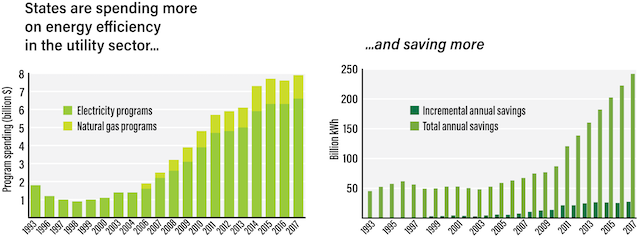
States increased investments in energy efficiency in the utility sector.
They spent nearly $8.0 billion last year, up from $7.6 billion in 2016.
The result was a 7.3% increase in electricity savings (nearly 26.5 million megawatt-hours) — enough to power about 2.5 million US homes per year. 
  • States ramped up efforts to promote zero-emission vehicles (ZEV), mostly electric, as the federal government sought to freeze fuel economy standards for cars and SUVs. California joined with eight other states in rolling out an updated ZEV plan, which incentivizes consumers to buy ZEVs. Missouri moved to incentivize the rollout of more EV charging stations, and Oregon to require new buildings be ready to charge EVs.
  • More states pushed for zero-energy construction (buildings that produce as much power as they use) largely through tougher building codes. California calls for all new homes and commercial buildings to be net zero-energy by 2020 and 2030, respectively. Vermont, Rhode Island, Oregon, Washington, the District of Columbia and Massachusetts have incorporated net zero-energy construction into long-range plans.
_________________________________________________________________________
Here Are The Most — And Least — Energy Efficient States      
A new report by the American Council for an Energy Efficient Economy scored each state for energy efficiency. See how your state fared.
By Daniel Hampton, Patch National Staff |
   

Mesa Opening Hazardous Waste Drop-Site - It's Even Got A Drive-Through!

Household Hazardous Materials Program
OPENING WEDNESDAY, OCTOBER 17, 2018
 
For Convenience, The Facility Will Be Open 4 Days A Week Year-Round!


Mesa city officials on Wednesday, Oct. 17, will open its new household hazardous materials facility 2412 N. Center St., Bldg. 2, off Lehi Road.
Location
2412 N. Center St., Bldg. #2
Mesa, AZ 85201
(enter through Lehi Rd.)

Hours of Operation
OPENING WEDNESDAY, OCTOBER 17th
Sunday CLOSED
Monday CLOSED
Tuesday CLOSED
Wednesday 7:00 a.m. - Noon
Thursday 7:00 a.m. - Noon
Friday 7:00 a.m. - Noon
Saturday 7:00 a.m. - Noon


Closed on City holidays 
____________________
           HHWF Map
Many items found in homes do not belong in the trash or recycle barrel, and should not be poured down the drain or poured into the street, city officials note.  Instead they can be reused, recycled or disposed of properly to prevent pollution.  The new facility even has a convenient drive-through amenity – and motorists must use it.
Only Mesa residents can use it and those who do need to bring proof of residency. Officials also want users to: not mix materials or place them in a bag; seal items in original containers to prevent spillage; label any unmarked containers if contents are known; transport containers in boxes or plastic totes; and mark items to be unloaded with “HHM.”
People can even drop off old appliances and motor vehicle tires, and a list of what’s acceptable and not acceptable can be found at https://www.mesaaz.gov
__________________________________________________________________________________

Duration: 106 seconds.
15 views
2 hours ago
________________________________________________________________________
Image result for hazardous materials

Environmental Excellence Award For Mesa? NO: Mesa Ranked #93 on EcoWatch List

Ooops! Sorry Mr. Mayor, but that news in a report last week from Wallet Hub does not jibe with your goofy Jive. 
It's  nothing to brag about after your badgering at the start of last Thursday's Mesa City Council for someone to "just brag a little more" over the city's finalist mention in the Parks & Trails category runner-up mention at AZ Forward's  Environmental Excellence Awards 
Mesa ranks 93 out of 100 cities - near the bottom of list - in The Top Ten Green Cities in America
Source: https://www.ecowatch.com/greenest-cities-america 
________________________________________________________________________
In a report released this week by Wallet Hub, the personal finance website compared the 100 most populated U.S. cities across 26 key "green" indicators, from greenhouse gas emissions per capita to share of electricity from renewable sources. Even the number of farmers markets and green job opportunities were considered.


Source: WalletHub
In fact, six Californian cities made it to the top 10. The world's fifth largest economy has emerged as one of the nation's environmental leaders. Gov. Jerry Brown signed a law in September requiring that 100 percent of the state's electricity come from renewable sources by 2045, making it the second state after Hawaii to set such a mandate.
These are the greenest cities in the U.S., according to WalletHub:
1. San Diego, CA
2. San Francisco, CA
3. Washington, DC
4. Irvine, CA
5. San Jose, CA
6. Honolulu, HI
7. Fremont, CA
8. Seattle, WA
9. Sacramento, CA
10. Portland, OR

These 10 cities at the ranked at the bottom of the list:
91. Gilbert, AZ
92. Cleveland, OH
93. Mesa, AZ
94. Lexington, KY
95. Detroit, MI
96. Memphis, TN
97. Toledo, OH
98. St. Louis, MO
99. Corpus Christi, TX
100. Baton Rouge, LA
WalletHub said that being environmentally conscious comes with a number of benefits.
"Apart from employing Americans, clean energy and other 'green' practices, such as recycling programs and urban agriculture, benefit the environment and public health, all of which contribute to America's bottom line, according to many experts," the report said. "Recognizing those advantages, cities across the U.S. have increased their sustainability efforts and benefited economically."

In-Depth Analysis: Bloomberg’s Chip Hack Story

Irresponsible reporting
Published on Oct 14, 2018
US media, namely Bloomberg, recently accused China of hacking US servers by planting microchips in a myriad of devices. Subsequently, tech giants like Apple and Amazon came out and denied those assertions. The US Department of Homeland Security has also dismissed the claims. So why is Bloomberg accusing China without hard evidence before the US midterm elections? What is the impact on the companies involved? And will this disturbance propel the ongoing trade tensions further?

Subscribe to us on YouTube:
https://goo.gl/lP12gA

Sunday, October 14, 2018

Opportunities Ahead: The Cannabis Industry


Real estate might be the investment choice for a chosen few, but their are other potential keys to profit that have been featured on this blog for more a few years: Cannabis, formerly known in certain pass-around circles as Marijuana, Ganja, Weed or Greens.
Let's blow away that Reefer Madness bad-shit. There's been a lot of scientific research on the plant species Cannabis.
Until just a few years we didn't know that there is an endogenous cannabinoid sytem in the human body that connects us directly with nature and the botanaceutical properties of plants.
One Stock for the Coming Marijuana Boom
By: Grace Phillips
FROM THE MOTLEY FOOL:
"A little-known Canadian company just unlocked what some experts think could be the key to profiting off the coming marijuana boom.
And make no mistake – it is coming. To the tune of an estimated $50 billion.
Cannabis legalization is sweeping over North America – 10 states plus Washington, D.C., have all legalized recreational marijuana over the last few years, and full legalization comes to Canada in October 2018.
Legal marijuana was worth $10 billion for the U.S. in 2017 alone.
And since experts have projected the U.S. industry to skyrocket to $50 billion by 2026, it’s time for investors to start paying attention.
Because whether or not you’re planning on ingesting any THC, you can’t deny the monumental investing opportunity that a potentially $50 billion industry represents.
_______________________________________________________________
But it’s also a relatively new industry. Untested, unproven.
And while we here at The Motley Fool love being on the cutting edge of new investing trends…
… like picking Amazon at $15.31 a share…
… Netflix at $1.85 a share…
… or Disney at $1.84 a share…
… we’ve been quiet on this growing marijuana industry for a while.
Until now.
Because a game-changing deal just went down . . . READ MORE > The Motley Fool

QUESTION MORE > Is What The Arizona Republic Prints "All You Really To Know" ???

Here we go again! There are stories and then there are more stories, but telling readers "This is all you need to know" falls far short of the minimum in any kind of reporting that upholds higher standards in journalism. Corporate media like The Arizona Republic, owned by The Times Media Group, is just "doing their job": telling you all you need to know before you vote, right? So what is Home Rule?
Like they say, more than half of Arizona cities use home rule . . . ALL YOU NEED TO KNOW (and question more): which goes to a vote Nov.6 in Mesa.
Many Arizona cities use home rule.
Here's what you need to know before you vote
 Source: https://www.azcentral.com/story 
"More than half of Arizona cities use home rule, which goes to a vote Nov. 6  in Mesa.
So what is home rule?
 
 
"Home rule is a provision that, essentially, allows a city to spend the money it collects from taxes and other sources. It lets the City Council, rather than a nearly 40-year-old state spending formula, decide what local services the community needs."
Partially true - but what happens when those who get elected to the Mesa City Council don't listen, represent or respond to what voters want?
Voters here in Mesa didn't let the city council decide on what services or 'pet projects' they wanted to benefit special interests and their questionable possibly corrupt close 'family-and-friends' connections. Voters REJECTED those schemes . . .
In 2018 the Mesa City Council is trying to trick taxpayers and voters all over one more time
JUST SAY NO on
Home Rule
It's like writing a blank check
Would you ever do that?
_________________________________________________________________________________
So what is home rule?
Why do we have home rule?
"The reason for home rule dates back to 1980, when Arizona voters amended the state Constitution to keep cities' spending in check. The amendment set spending limits that increase with population growth and inflation.
For a city or town to exceed the state-set spending limit, the council could send the home rule provision, formally called an Alternative Expenditure Limitation, to voters every four years. . . "
________________________________________________________________________________
More than half of Arizona's 91 cities and towns use home rule.
Data from the League of Arizona Cities and Towns show:
> 49 municipalities use home rule, including Phoenix, Mesa, Chandler, Queen Creek, Avondale and Apache Junction.
> 29 use a permanent base adjustment to the state-set limit, including Gilbert, Glendale, Goodyear, Buckeye, Fountain Hills, Scottsdale, Paradise Valley, Tempe, Peoria and Surprise. 
13 municipalities go with the state-set limit. All are outside of metro Phoenix and include smaller cities such as Bullhead City, San Luis and Quartzsite. 
_________________________________________________________________________________
Impact of home rule
Not a sales tax???
Correction: They say it isn't but it is . . . ?????
 
Home rule isn't a tax increase, but it allows a city or town to spend the tax or other revenue it has in place.
Mesa voters have agreed to home rule since 1982, although city leaders opted not to pursue it through most of the 1990s, saying they could work within the state-set spending limit.

QUESTION
Is your Quality of Life better today than before?
Then, in 1998, Mesa voters approved a "Quality of Life" sales tax to pay for an extensive civic wish list.
Without home rule, Mesa could not have spent that money because it would have been above the state-set spending limit. So the question went back on the ballot in 2000.
It won strong support ???? [NOT TRUE] and has been approved since then.
_________________________________________________________________________________
"City officials say a "no" vote would require a $200 million spending cut that would affect public safety and other departments. . . "
(Here to the right is Mesa City Manager Chris Brady, who is the high-salaried chief Executive Officer. He is not elected.)
In February, March, April, May and June of this year he managed to stage every single city budget presentation in front of the seven members of the Mesa City Council before some, not all of the expenditures, in the Final Budget FY19/20 was passed after contentious discussions.
_________________________________________________________________________
Mesa officials say the state-set spending limit doesn't work for the city because:
> The formula's population and inflation adjustments are based on national trends, which don't match the fast-growing city's needs. 
> Certain voter-approved revenue sources, such as those dedicated to road improvements, are not anticipated in the state-set funding formula.
>The cost of federal regulations, from safe drinking water mandates to security needs that arose after Sept. 11, 2001, have increased faster than inflation.
___________________________________________________________________________
Blogger Note:  
These are  are all LAME EXCUSES 
 
Just Vote NO on Question 1 Home Rule
We all really don't need to go into another Half-A-Billion Dollars
in more debt.
 > To get rid of all the tricks to fool Mesa voters once again,
 YOU CAN VOTE NO ON ALL SIX QUESTIONS across-the-board.
 
Don't be faithful to those who tried to fool  taxpayers before.