This video is made under fair use policy, also this material is made from public published domain for people with hearing and seeing disability As to how the Defense Blog and Scramble Magzine acquired leaked details of the Kamov Design Bureau's future high-speed helicopter for the Russian Armed Forces is beyond us.
"President Donald Trump said he will order that any migrants attempting to cross the southern border be held in what he described as massive tent cities while their immigration case is heard. Meanwhile, immigration authorities are still releasing groups of undocumented families and asylum seekers in Arizona. About 90 undocumented families were expected to be released on Friday, and another 400 people currently being held in Yuma will start to arrive in metro-Phoenix as early as Sunday, said Rev. Magdalena Schwartz, a pastor with Capellania Cristiana Llamados Para Servir. Schwartz has been receiving familiessince early October. “And more churches (are) calling me now, ‘I want to open my church.’ More people calling me say, ‘I want to help,'” she said. Schwartz said stopping the releases is up to the president. But she thinks it's better if the families aren’t in detention. U.S. Immigration and Customs Enforcement said it continues to work with faith groups as it releases families. In October, the agency said the releases were due to volume and the need to follow a court settlement limiting how long kids can be detained.
The Stark Geography of U.S. Immigration Raids
by Tanvi Misra
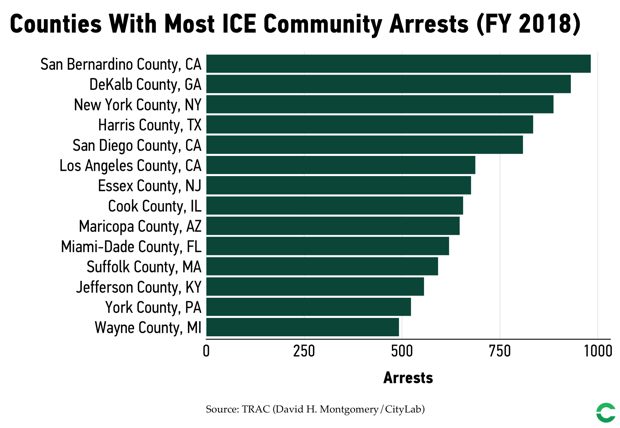
According to a new report from CityLab, 24 out of 3,200 counties see around half of all of ICE’s community arrests.
While both Democratic and Republican administrations have used ICE raids to enforce immigration laws, the current one has expressed a particular enthusiasm for this traumatizing technique: Community arrests have risen in the first two years of the Trump administration compared to the last years of the Obama administration. But while the news of raids may have a widespread chilling effect on immigrant communities, the majority of ICE’s arrests via this method are concentrated in a few places, according to a new report by Transactional Records Access Clearinghouse (TRAC), a data gathering and research organization at Syracuse University. Between October 2017 and May 2018, community arrests happened in a total of 574 of 3,200 counties. But just 10 saw around 28 percent of ICE community arrests. And half of all the raids were conducted in just 24 counties.
Below are the ten counties with the highest number of community arrests:
The report presents snapshot of where this one part of ICE’s enforcement strategy is being heavily deployed. It’s no surprise, because these are immigrant-rich counties with long-established communities of undocumented residents. After the Trump administration broadened the criteria for who can be deported, ICE agents have targeted “low-hanging fruit”—people without criminal records who are being arrested at routine immigration check-ins or after testifying against a crime in court. The TRAC report shows that ICE heavily relies on local police to do this. Of the 1,528 counties where ICE made arrests, only 38 percent were community arrests. The rest were made when local law enforcement transferred a suspected undocumented person to ICE’s custody
This video is made under fair use policy, also this material is made from public published domain for people with hearing and seeing disability The reliability and capability claims attributed to anti-ballistic missile systems are getting way out of step with reality. BY TYLER ROGOWAYhttp://www.thedrive.com/the-war-zone/...
Warthog Defense members are sharing stories, insider tips, news from the front lines, and unique slices of military life including the tough stuff of war. Warthog Defense provides headline news and technology updates since our community answers the call and makes news. We also cover the rest of the military experience —and in our military equipment guide we present what makes the military unique (and fun). We also wan't to revolutionize the way for Americans with military affinity stay connected and informed. The United States Air Force will be a trusted and reliable joint partner with our sister services known for integrity in all of our activities, including supporting the joint mission first and foremost. We will provide compelling air, space, and cyber capabilities for use by the combatant commanders. We will excel as stewards of all Air Force resources in service to the American people, while providing precise and reliable Global Vigilance, Reach and Power for the nation. The U.S. Army’s mission is to fight and win our Nation’s wars by providing prompt, sustained land dominance across the full range of military operations and spectrum of conflict in support of combatant commanders. We do this by: Executing Title 10 and Title 32 United States Code directives, to include organizing, equipping, and training forces for the conduct of prompt and sustained combat operations on land.
Accomplishing missions assigned by the President, Secretary of Defense and combatant commanders, and Transforming for the future.
El .@IICAnoticias designó como su Embajador de Buena Voluntad al CEO de .@gardenpool por sus aportes al desarrollo sustentable.
Es Dennis McClung, fundador, Presidente y Director Ejecutivo de esta organización sin fines de lucro con sede en Arizona.
Instituto Interamericano de Cooperación para la Agricultura. La agricultura, prioridad para el desarrollo sostenible de las Américas
El IICA designó como su Embajador de Buena Voluntad al CEO de Garden Pool por sus aportes al desarrollo sustentable
Garden Pool, una organización sin fines de lucro con sede en Arizona, Estados Unidos, se dedica a la investigación y generación de estrategias educativas asociadas a métodos sostenibles para la producción de alimentos. El reconocimiento a su CEO, Dennis McClung, inicia el programa de Embajadores de Buena Voluntad del IICA.
Dennis McClung (izquierda), fundador, Presidente y Director Ejecutivo de Garden Pool, recibe de parte del Director General del IICA, Manuel Otero, el título de Embajador de Buena Voluntad en temas de Desarrollo Sustentable del Instituto.San José, Costa Rica, 31 de octubre, 2018 (IICA). El Instituto Interamericano de Cooperación para la Agricultura (IICA) otorgó hoy el título de Embajador de Buena Voluntad en temas de Desarrollo Sustentable a Dennis McClung, fundador, Presidente y Director Ejecutivo de Garden Pool, una organización sin fines de lucro con sede en Arizona, Estados Unidos, dedicada a la investigación y generación de estrategias educativas asociadas a métodos sostenibles para la producción de alimentos.El reconocimiento fue otorgado por el Director General del IICA, Manuel Otero, por las contribuciones del trabajo de McClung a la promoción de los ideales del Instituto y su compromiso con la agricultura, la seguridad alimentaria, la equidad y el desarrollo sostenible de los territorios rurales del continente americano. “Los eventos climáticos extremos desorganizan la vida económica, social y productiva de los países que los sufren. Necesitamos diseñar e implementar estrategias diferenciadas en el Caribe, especialmente en el Caribe Oriental para enfrentarlos y desarrollar resiliencia. Esperamos en el futuro seguir trabajando con aliados como Garden Pool con proyectos cada vez más ricos para una agricultura climáticamente inteligente”, comentó Otero. Entre otras iniciativas, McClung desarrolló un sistema autosuficiente de producción de alimentos en miniatura que utiliza un 98 por ciento menos de agua que los métodos tradicionales, no usa fertilizantes químicos o pesticidas y es de fácil mantenimiento. El sistema está siendo construido en varias partes del mundo, contribuyendo a la seguridad alimentaria de comunidades rurales. Garden Pool, también, tuvo una destacada participación en la recuperación de países del Caribe afectados en el 2017 por eventos climáticos extremos. Por su parte McClung manifestó sentirse honrado por el reconocimiento del IICA como Embajador de Buena Voluntad. “Estamos haciendo cosas maravillosas con el IICA. Proyectos sólidos con el apoyo de todos los países miembros. Podemos hacer más aún para mitigar el impacto del cambio climático. Tenemos tecnología para superar barreras y encontrar un futuro mejor. Recibo este reconocimiento con mucha humildad y con el compromiso de hacer cada vez más”, dijo el CEO y fundador de Garden Pool. McClung fundó en 2009 a Garden Pool, organización que se dedicada a la investigación y generación de estrategias educativas asociadas a métodos sostenibles para la producción de alimentos.Acuerdo de cooperaciónEl IICA y Garden Pool también rubricaron hoy un acuerdo de cooperación que centrará sus esfuerzos en la ejecución de acciones para incentivar y promover el progreso del sector agropecuario en los países de la región Caribe a través del desarrollo de capacidades y la generación de condiciones favorables para estas naciones. La alianza, con vigencia de cuatro años, contempla que ambas organizaciones orientarán el trabajo conjunto en ocho áreas de cooperación vinculadas a las tecnologías climáticamente inteligentes, sistemas de producción sostenibles, transferencia de tecnología, desarrollo de capacidades en innovación, tecnologías de comunicación y gestión del conocimiento, análisis de datos, productividad y competitividad del sector agropecuario y el desarrollo de proyectos mediante recursos externos. El desarrollo de proyectos conjuntos que se implementen en el marco de esta alianza serán coordinados por McClung y el Representante del IICA en Trinidad y Tobago, Gregg E. Rawlins. En el acto de reconocimiento a McClung, Rawlings destacó el papel de Garden Pool en la mitigación del cambio climático. “La alianza es parte de los esfuerzos que realiza el IICA para fortalecer, tecnificar, modernizar y diversificar la producción de alimentos, llevando progreso a las comunidades rurales en la región caribeña”, dijo el Representante del IICA en Trinidad y Tobago. Más información: Gregg E. Rawlins, Representante del Instituto en Trinidad y Tobago gregg.rawlins@iica.int
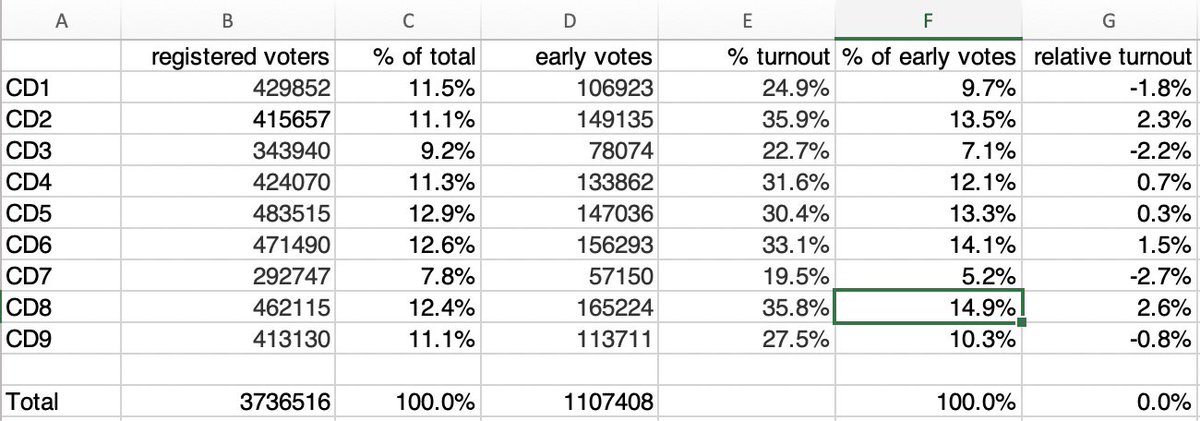
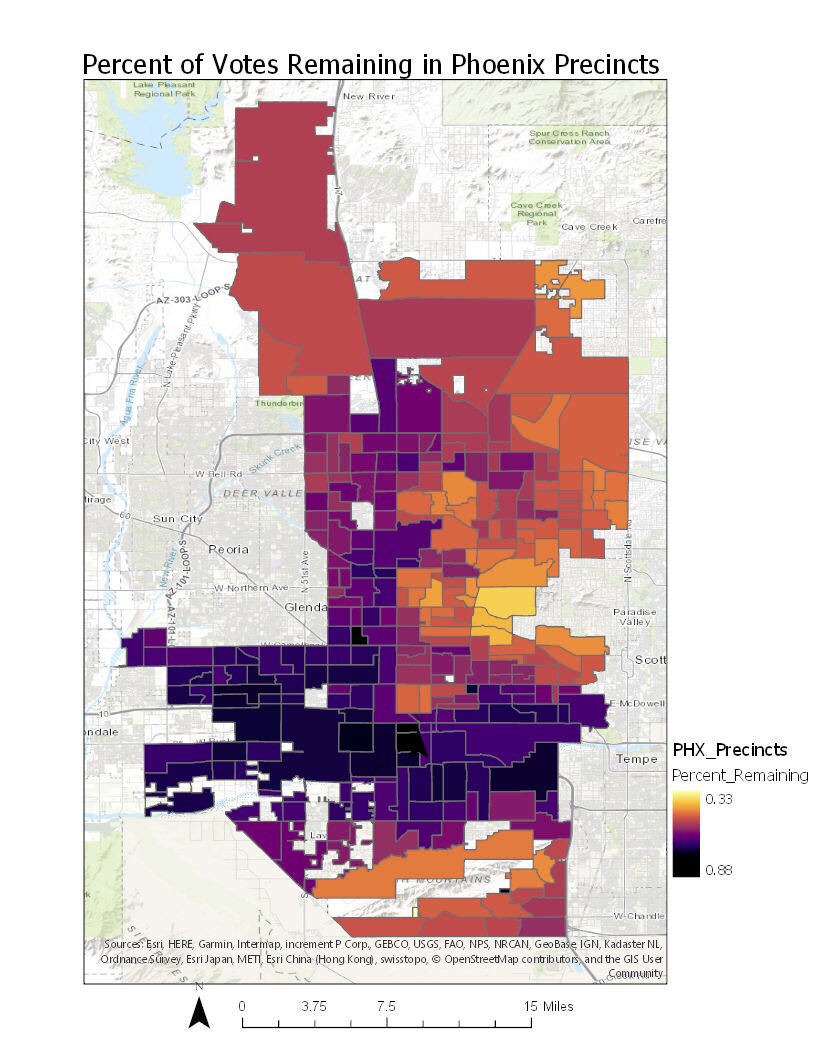
Thanks to the AZ Data Guru we can see the distribution patterns for percentage of early ballot returns that have been sent in - at least in one city here in Maricopa County Phoenix.
At 210k, more people have voted in a #PhxMayor race than ever before.
Your MesaZona blogger would love to get his hands-on an infographic like the one inserted below from Kate Gallego on AZ Data Guru's
Today's ballots bring us to approximately 56% of all ballots that we should expect to see.
More factoids:
> 10% (133k) early ballots returned so far have never voted in a General Election in #AZ. > The largest age category is 18-34 in this subset (36k). 14k of which were Ds, 9.8k Rs, and 11.2k OTH.
12:24 PM - 31 Oct 2018
_________________________________________________________________________
1.23MM in. Parties: GOP 42.7%, DEM 33.6%, OTH 23% (+9.1 R). Estimate for women has increased to 50.8%. Median age drops to 63. Average age has dropped to 60. http://arizona.vote/early-ballot-statistics…
> Maricopa county ballots meanwhile actually had a slight widening of the party split in favor of the Rs. from +3.3 to +5 R
12:06 PM - 31 Oct 2018
_________________________________________________________________________ _________________________________________________________________________ QUESTION: Notice where the concentrations of clusters where the voting percentages remaining are the highest: in the central city core. Check out this spooky map showing the % of votes remaining in each City of Phoenix precinct.
The proposed regulations are effective after a 60-day comment period and once they are later published as final. However, taxpayers and QOFs may rely on the proposed regulations now, provided they apply the proposed rules in their entirety and in a consistent manner.
Treasury, IRS issue proposed regulations on new Opportunity Zone tax incentive
WASHINGTON —The Treasury Department and the Internal Revenue Service today issued proposed regulations and other published guidance for the new Opportunity Zone tax incentive. Opportunity Zones, created by the 2017 Tax Cuts and Jobs Act, were designed to spur investment in distressed communities throughout the country through tax benefits. Under a nomination process completed in June, 8,761 communities in all 50 states, the District of Columbia and five U.S. territories were designated as qualified Opportunity Zones. [That is, to provide tax incentives for private investment in low-income communities across the nation.] Opportunity Zones retain their designation for 10 years. Investors may defer tax on almost any capital gain up to Dec. 31, 2026 by making an appropriate investment in a zone, making an election after December 21, 2017, and meeting other requirements.
The proposed regulations clarify that almost all capital gains qualify for deferral. In the case of a capital gain experienced by a partnership, the rules allow either a partnership or its partners to elect deferral. Similar rules apply to other pass-through entities, such as S corporations and their shareholders, and estates and trusts and their beneficiaries. Generally, to qualify for deferral, the amount of a capital gain to be deferred must be invested in a Qualified Opportunity Fund (QOF), which must be an entity treated as a partnership or corporation for Federal tax purposes and organized in any of the 50 states, D.C. or five U.S. territories for the purpose of investing in qualified opportunity zone property.
The QOF must hold at least 90 percent of its assets in qualified Opportunity Zone property (investment standard). Investors who hold their QOF investment for at least 10 years may qualify to increase their basis to the fair market value of the investment on the date it is sold. The proposed regulations also provide that if at least 70 percent of the tangible business property owned or leased by a trade or business is qualified opportunity zone business property, the requirement that “substantially all” of such tangible business property is qualified opportunity zone business property can be satisfied if other requirements are met. If the tangible property is a building, the proposed regulations provide that “substantial improvement” is measured based only on the basis of the building (not of the underlying land). In addition to the proposed regulations, Treasury and the IRS issued an additional piece of guidance to aid taxpayers in participating in the qualified Opportunity Zone incentive Rev. Rul. 2018-29provides guidance for taxpayers on the “original use” requirement for land purchased after 2017 in qualified opportunity zones. They also released Form 8996, which investment vehicles will use to self-certify as QOFs. More information on Opportunity Zones, including answers to frequently-asked questions, is on the Tax Reform page of IRS.gov. The Tax Reform page will also feature updates on the implementation of this and other TCJA provisions. Click here for complete list of Opportunity Zones. _________________________________________________________________________ October 25, 2018
Treasury Releases Proposed Regulations for Opportunity Zones
On October 19th, 2018 the Department of Treasury has issued proposed regulations for Opportunity Zone Investors and has sent these rules over to the IRS. The proposed regulations provide guidance under new section 1400Z-2 of the Internal Revenue Code relating to gains that may be deferred by investors for investments in a qualified opportunity fund (QOF).
The new proposal extended this time for as long as 30 months, provided that a plan exists that can be audited by the IRS. Further guidance has been proposed regarding the substantially all requirement in Section 1400Z-2(d)(3)(A)(i) whereas if at least 70 percent of the tangible property owned or leased by a trade or business is qualified opportunity zone property then the trade or business will satisfy the substantially all requirement. While the “substantially all” phrase is used throughout the regulations, the specific guidance only applies to Section 1400Z-2(d)(3)(A)(i). We can hopefully anticipate that the next round of guidance provides a better understanding of the definition around the various meaning of “substantially all” as it is used through the regulations. In addition, the proposed regulations offer that land will be excluded from the basis when determining if the building has been substantially improved. Omitting this requirement provides some ease to investors who were concerned about repurposing vacant or otherwise unutilized land. LINK > https://www.pmbusinessadvisors.com/opportunity-zones/ ________________________________________________________________________ October 31, 2018
Eagerly Anticipated Opportunity Zone Regulations Released (From Forbes)
On October 19, the Department of the Treasury released taxpayer-friendly proposed regulations (the “Proposed Regulations”) under Section 1400Z of the Tax Code. Due to the lack of administrative guidance, fund managers and other investors have hesitated taking advantage of new tax benefits designed to incentivize private sector investment into economically-distressed “opportunity zones.” The Proposed Regulations have been well received and will cause many investments to move forward.
> Thus far, there are few restrictions on what kinds of businesses or real estate projects are eligible for Opportunity Fund investments, but the recent rulings do require that 50% of the gross income of a business must come from activity in an Opportunity Zone and 70% of the business’ tangible property be used in an Opportunity Zone. Businesses will have a 31-month window to use the capital from an Opportunity Fund. There is no geographic requirement for Opportunity Funds, so Funds can invest in any Opportunity Zone in the country regardless of where the Fund itself is based. There are already a few funds that focus on real estate, venture capital-type investment in small businesses, and/or particular geographies. In theory, any individual investor could create his or her own Opportunity Fund in which to invest as long as it was certified by the Treasury, but more funds are likely to come from larger institutions. . . > Once an investor has decided to join an Opportunity Fund, he or she would sell an appreciated asset and then put their capital gains into an Opportunity Fund within 180 days of the sale.Investors would then report their investment to the IRS via the appropriate tax form, which is expected to be released soon. As of now, investors can roll the gains from multiple sales of assets into one Opportunity Fund and there is no cap on the amount of gain that can be deferred. Short-term and long-term capital gains as well as section 1231 gains are eligible for tax deferral in an Opportunity Fund, but short-term gains will still be taxed at ordinary income rates when they are ultimately recognized. READ MORE :https://www.forbes.com/sites/adamstrauss/2018/10/31/how-to-generate-tax-savings-by-making-impact-investments-in-opportunity-zones/#4ba09f071e5c
As part of the Tax Cuts and Jobs Act enacted into law in December 2017, the Opportunity Zone statute (codified as Section 1400Z of the Tax Code) provides two main tax incentives designed to encourage investment in opportunity zones. First, the legislation allows for the deferral of gain to the extent that corresponding amounts are reinvested into one of more “qualified opportunity funds” (or QOFs).
Second, the legislation excludes from gross income the post-acquisition gains on investments in QOFs that are held for at least 10 years.
The Opportunity Zone legislation left a lot of questions unanswered regarding how to comply with the rules. This lack of guidance meant that taxpayers have been unwilling to make investments for fear that they would not be entitled to receive the favorable tax treatment that the legislation provides. While the Proposed Regulations still leave some questions unanswered, they provide enough certainty to allow for prudent investment.
Proposed Regulations
The Proposed Regulations both describe and clarify the requirements that must be met by a taxpayer in order to defer the recognition of gains by investing in a QOF and provide rules for QOFs relating to self-certification and some of the ongoing requirements imposed on QOFs.
The proposed regulations do not address all questions. The Department of Treasury and the IRS are working on additional published guidance, including a second round of proposed regulations expected to be published in the near future. While not intended to be a complete description of all changes, we note the following:
Rules Relating to Taxpayers Deferring Gain
Clarification of eligible taxpayers. The proposed regulations clarify that taxpayers eligible to elect gain deferral are those that recognize capital gain for Federal income tax purposes. These taxpayers include individuals, C corporations (including RICs and REITs), partnerships, and certain other pass-through entities.
The proposed rules include special rules for partnerships and their partners. Specifically, while there was no question that a partnership could defer gain, the proposed regulations clarify that a partner may elect gain deferral with respect to its allocable share of partnership gain, assuming the partnership fails to do so. Capital Gains Only. The proposed regulations clarify that only capital gains are eligible for deferral. Eligible gains generally include capital gain from an actual, or deemed, sale or exchange, or any other gain that is required to be included in a taxpayer’s computation of gain. (Certain statutory exceptions apply, including gains from a sale or exchange to a person closely related to the taxpayer.) Short or long term capital gains are both eligible. The proposed regulations provide limitations/exceptions for gains under “Section 1256 contracts” and for gains from positions that are of have been part of an offsetting-position transaction (meaning, a transaction in which the taxpayer has substantially diminished its risk of loss from holding one position with respect to personal property by holding one or more other “offsetting” positions). Equity Investments Only. To unlock QOF benefits, the taxpayer must make an investment in exchange for an equity interest. An equity interest includes preferred stock or a partnership interest with special allocations. Provided that the taxpayer is the owner of the equity interest for Federal income tax purposes, the taxpayer may use that interest as collateral for a loan (whether a purchase-money borrowing or otherwise) without jeopardizing eligibility. That said, if the taxpayer instead chooses to structure its investment as a loan to a QOF (as opposed to an equity investment), the taxpayer will not be entitled to defer its prior gains or otherwise enjoy the tax benefits that the Opportunity Zone legislation provides. Timely Elections. To be able to elect to defer gain, a taxpayer must generally invest in a QOF during the 180-day period beginning on the date of the sale or exchange giving rise to the gain. For a partner (or other person indirectly realizing gain through a pass-through entity), the 180-day period begins on the last day of such entity’s taxable year. That said, the proposed regulations provide a special rule for partners where the partnership is the entity realizing gain and will not elect to defer the gain: In this scenario, if the partner knows both the date of the partnership’s gain and the partnership’s decision not to elect deferral, the partner may choose to begin its own 180-day period on the same date as the start of the partnership’s 180-day period. Similar rules apply to other pass-through entities (including S corporations, decedents’ estates, and trusts) and to their shareholders and beneficiaries. Election for Investments Held at Least 10 Years. Under the opportunity zone legislation, a taxpayer that holds a QOF investment for at least ten years may elect to increase the basis of the investment to its fair market value on the date that the investment is sold or exchanged and thus, effectively exclude that gain from income. This basis step-up election is available only for gains realized upon investments that were made in connection with a proper deferral election. The proposed regulations reiterate that it is possible for a taxpayer to invest in a QOF in part with gains for which a deferral election is made and in part with other funds. This results in a “mixed” QOF, where the tax benefits associated with a QOF are available only with respect to that part of the taxpayer’s investment relating to realized gains. Under the opportunity zone legislation, all qualified opportunity zones will lose their designation on December 31, 2028. This raises issues regarding gain deferral elections that are still in effect when the designation expires. The proposed regulations address these issues by permitting a taxpayer to make a basis step-up election after a qualified opportunity zone designation expires. The ability to make this election is preserved until December 31, 2047, which is 20 ½ years after the latest date that an eligible taxpayer may make an investment that is part of an election to defer gain.
Rules Governing Qualified Opportunity Funds
Certification Process. To facilitate the certification process and minimize the information collection burden placed on taxpayers, the proposed regulations generally permit any taxpayer that is a corporation or a partnership for tax purposes to self-certify as a QOF, assuming the entity is statutorily eligible to do so. It is expected that taxpayers will use IRS Form 8996, Qualified Opportunity Fund, both for initial self-certification and for annual reporting of compliance with the 90-percent asset test.
The proposed regulations allow a QOF both to identify the taxable year in which the entity becomes a QOF and to choose the first month in that year to be treated as a QOF. Any investments made by taxpayers prior to this date will not be eligible for QOF tax benefits. Valuation Method for 90-Percent Asset Test. To avoid penalties, the opportunity zone legislation requires a QOF to hold at least 90 percent of its assets in qualified opportunity zone property, determined by the average of the percentage of qualified opportunity zone property held in the fund (A) on the last day of the first 6 month period of each taxable year and (B) on the last day of such taxable year. The proposed regulations require the QOF to use the asset values reported on the QOF’s applicable financial stated for the taxable year. If the QOF does not have an applicable financial statement, the proposed regulations require the QOF to use the cost of its assets. Nonqualified Financial Property. With certain limited exceptions, the opportunity zone legislation does not consider cash as qualified opportunity zone property. As such, cash held in the QOF may cause the QOF to fail the 90-percent asset test, even if that cash is held with the intent of investing in qualified opportunity zone property. The proposed regulations provide a working capital safe harbor for QOF investments in qualified opportunity zone businesses that acquire, construct, or rehabilitate tangible business property. Provided there is both a written plan that identifies the financial property as property held for the acquisition, construction, or substantial improvement of tangible property in the opportunity zone and a written schedule consistent with the ordinary business operations of the business that the property will be used within 31 months, then this safe harbor will apply, assuming the business substantially complies with this schedule. Substantial Improvements. Among other things, to be considered qualified opportunity zone business property, the original use of such property in the opportunity zone must commence with the QOF or the QOF must substantially improve the property, which is satisfied by the QOF making additions to basis with respect to the property within 30 months of acquisition in an amount which exceeds the acquisition price for the property. In other words, improvements to the property must result in at least doubling the QOF’s basis in the property. For purposes of this requirement, the proposed regulations provide that the basis attributed to land on which a building sits is not taken into account in determining whether the building has been substantially improved. Contemporaneous with the issuance of the proposed regulations, the IRS released Revenue Ruling 2018-29, which addresses the application to real property of the “original use” and “substantial improvement” requirements of the legislation. Qualified Opportunity Zone Businesses. Under the opportunity zone legislation, for a trade or business to qualify as a qualified opportunity zone business, it must (among other requirements) be one in which substantially all of the tangible property owned or leased by the taxpayer is qualified opportunity zone business property. The proposed regulations provide that if at least 70 percent of the business’s tangible property is qualified opportunity zone property, then the trade or business is treated as satisfying this “substantially all” requirement. The proposed regulations note that the phase “substantially all” is used throughout the opportunity zone legislation, and that the 70 percent threshold is intended only to apply to such term as is used for determining whether the business is a qualified opportunity zone business. Mixed Funds. If only a portion of a taxpayer’s investment in a QOF is subject to the deferral election, then the opportunity fund legislation requires the investment to be treated as two separate investments, which receive different treatment for Federal income tax purposes. The proposed regulations reiterate that a taxpayer may make an election to step-up basis in an investment in a QOF that was held for 10 years or more only with respect to that portion of such investment for which a proper deferral election was made. For investments made through partnerships, the proposed regulations clarify that deemed contributions of money under Section 752(a) (i.e., partnership liabilities) do not constitute an investment in a QOF. Therefore, such a deemed contribution does not result in the partner having a separate “mixed fund” investment. Thus a partner’s increase in outside basis is not taken into account in determining what portion of the partner’s interest is subject to the deferral election (or what portion is not subject to the deferral election).
Effective Date: The proposed regulations are effective after a 60-day comment period and once they are later published as final. However, taxpayers and QOFs may rely on the proposed regulations now, provided they apply the proposed rules in their entirety and in a consistent manner.

 :
: 


 .
.