Thursday, February 07, 2019

A New Study Doesn't Dig Far Enough

According to the Environmental Working Group, 85 utilities in Arizona have drinking water with nitrate levels above 5 ppm, affecting 403,910 Arizonans.
“Nitrate can be a marker for other contaminants,” Schaider said. “We’ve found public and private drinking-water wells with high levels of nitrates also have high levels of unregulated wastewater contaminants like pharmaceuticals and consumer product chemicals.”
The problem: if chemical contaminants in underground water sources are not regulation, they don't get measured or monitored.
The source: Nitrates and arsenic were used in vast tracts of former agricultural acreage that were converted to residential land-use.

Results of a new study state at the very start that
"More than 5.6 million Americans have possibly unsafe levels of nitrates in their drinking water, and Hispanic residents are the most affected."
For some reason the study's focus are Hispanic residents who were/are the majority of field workers. The study found that
"The most common source of nitrate contamination is agricultural fertilizer, and 57 percent of all farmworkers in the U.S. are Hispanic, according to the U.S. Department of Agriculture."
Hispanic farmworkers are not the only people impacted >
“The vast majority, over 99 percent, of the systems that we studied do meet the federal drinking-water standard of 10 ppm, . . .But 5 ppm was chosen due to questions about whether the current drinking-water standard is adequately protective to everyone’s health.”
According to the Environmental Working Group, 85 utilities in Arizona  have drinking water with nitrate levels above 5 ppm, affecting 403,910 Arizonans.
This isn't the first time it’s been revealed that Hispanics may be exposed to dangerous drinking water at higher rates than other groups.
A 2005 study found Hispanic residents in Arizona were more likely to get their water from a system that exceeded safe arsenic levels.

Different POVs: Creative Religious Freedom & Discrimination

Time to weigh-in again: The Time is Now
Whether it’s a case about wedding invitations in Arizona, a gender transition cake in Colorado, or a similar case somewhere else, all the parties involved believe that eventually the U.S. Supreme Court will take up the issue once again.
“Your best solution is to get involved and change the law, . . "

_______________________________________________________________
Here in Mesa, Mayor John Giles has made sure the adoption of a City Non-Discrimination Ordinance has effectively been side-lined as a non-issue. He's waiting for the AZ State House to take action, while the other two biggest cities in the state have adopted a Non-Discrimination Ordinance . . . What's he afraid of?
_________________________________________________________________________
Here's a piece [with audio] from http://kjzz.org that just ask more questions.
It does not mention guaranteeing equal rights in public accommodations that are protected by the force-of-law . . .Both challengers - one who makes wedding cakes in Colorado and one in Arizona wedding invitations - claim "“it’s wrong for the state to force me to create artistic products, . .  . Both are Christians who admit
"As Christians, our faith guides everything we do" 
Free Speech Or Discrimination? A View From Arizona, Colorado
By Will Stone
Allison Sherry, Colorado Public Radio
Published: Thursday, February 7, 2019 - 11:12am
Updated: Thursday, February 7, 2019 - 12:58pm 
 "A central question related to LGBTQ rights may again be headed to the U.S. Supreme Court: Can businesses turn away customers because they object to what they’re asking for — weddings invitations or a cake?
Across the country, lawsuits are seeking to clarify when a business owner’s freedom of speech outweighs legal protections against discrimination. . ."
Here is how the Colorado and Arizona cases are similar: they are pitting First Amendment protections of religious freedom and freedom of speech against a state or city’s anti-discrimination laws that protect LGBTQ people.
In Colorado the state's new Democratic attorney general Phil Weiser is defending the law in the latest suit.
In Arizona the case has divided powerful forces in Arizona: the state’s attorney general and Republican leadership are siding with the business and major companies challenging the city of Phoenix.
_________________________________________________________________________
The same influential Christian group is challenging nondiscrimination protections in both states. The Alliance for Defending Freedom has been tremendously successful nationally with similar cases, logging nine Supreme Court wins in seven years.
They argue these business owners are not discriminating; they just can’t be forced to convey a certain message.


Mesa City Council Study Session Thu 07 Feb 2019

A New $195,500,000 GO Bond Package from City Manager Chris Brady is up before the Mesa City Council during a Study Session scheduled to start at 07:30 a.m.  It is Item 2 on the Agenda after a review by Councilmembers of some 26 items for the City Council Regular Meeting @ 5:45 pm on 11 Feb 2019: 9 Contract Awards + 5 Resolutions with 2 Resolutions Endorsing the creation of two new Water Delivery Districts in District 4, Mesa Linda and Green Acres)
The formation of an irrigation water delivery district allows the District to make improvements and perform maintenance and operations of their irrigation system. 
Final designation of the District is determined by the Maricopa County Board of Supervisors.
_________________________________________________________________________
For tomorrow morning's Study Session, here's  a breakdown of the proposed debt obligation financing by category: These require APPROVAL
  • Parks & Recreation: $82,7000,000,
  • Cultural $28,000,000, and
  • Public Safety $84,8000,000.
Item 2 Presentations/Action Items: 19-0120
Hear a presentation, discuss, and provide direction on the proposed 5-year implementation plan and schedule for the 2018 General Obligation Bond projects for
  • parks and recreation
  • cultural
  • public safety
______________________________________________________________________
2018 General Obligation Bond Update February 7, 2019
Scott Butler, Office of Management & Budget
Multi-year bond program (2019 –2024) to manage voter authorization
12-Page Presentation
Here's just one area:
Estimated expenditures $14.9M Design
Communication Fiber
City Center Plaza
Dobson Library Improvements
Federal Building Renovation
Harris Basin Playground
i.d.e.a. Museum Phase 1
Lehi Crossing Shared Use Path
Main Library Improvements
________________________________________________________________________ 
On agenda:
                                
Title: Hear a presentation, discuss, and provide direction on the proposed 5-year implementation plan and schedule for the 2018 General Obligation Bond projects for parks and recreation, cultural, and public safety.
Attachments: 1. Presentation,
2. Proposed Bond Project Schedule                           

Results of New eScooter Online Poll Released By D2 Mesa City Council Member Jeremy Whittaker

Good to know that at least one member of the Mesa City Council has actively asked for public opinion .
Better late than never - or not at all after these "SATVs" were dumped without prior public notice in the public rights-of-way.
< This is only clearly visible example captured on 22 Jan 2019 in an image right across Center/Main Street close to City Hall at a major intersection here in downtown Mesa.
Results of the online survey: 3-to-1 voted for NO LICENSING/REGULATION!
LINK > https://www.facebook.com/CouncilmemberJeremyWhittaker/
"I'm curious what the community sentiment is on these types devices/companies and how you feel the government should regulate them."
74% NO Licensing/Regulation
26% Permit/Fees for each SATV
  • 461 Votes
 
_______________________________________________
The Mesa City Council believes that its people, not leaders, are what makes a City great and actively works to encourage citizen participation in the decision-making process. Whether it is through neighborhood meetings, advisory boards and committees, telephone calls and letters, or email, the Mesa City Council sets policies based on the input and needs of its citizens. 
GilesMayor John Giles
FreemanVice Mayor Mark Freeman
District 1
Whittaker Councilmember Jeremy Whittaker
District 2
Whittaker Councilmember Francisco Heredia
District 3
Jen Duff
Councilmember
Jen Duff
District 4
Luna Councilmember David Luna
District 5
Thompson Councilmember Kevin Thompson
District 6


Councilmap
.
 

Housing Affordability Here In Mesa: A Crisis or A Strong Market?

Apartment Rents Hold Strong to Close Out 2018
Last year was one of the most dynamic years in real estate, especially on the rental market front. As we prepare our 2019 forecasts, let’s look at some of last year’s rental highlights discussed in our report written at the end of last year. Taking into consideration 130 markets across the United States, the report was based on data regarding buildings containing 50 or more units across the country’s 252 largest cities.
The study is based on Yardi Matrix data, covering every multifamily asset within a market coverage areas that includes around 90,000 properties.
> Small Cities, Biggest Changes
Smaller markets are usually where the biggest rent changes take place. According to its methodology, the study includes cities with populations over 100,000 and a rental stock of at least 2,900 apartments. Last year, rent prices increased across the U.S., but small cities with a population of less than 300,000 saw the most significant y-o-y changes.
> Mid-Size City Rent Increase Falls Somewhere in the Middle
In mid-sized markets like Tulsa, OK and Lexington, KY, rents remained relatively unchanged throughout the year, while in cities like Corpus Christi, TX, and Wichita, KS, rents increased by 1.4%. However, California dominates the list of fastest growing rents in mid-sized cities, defined here as cities with a population between 300,000 and 600,000.
NIMBY or Not?
However, the biggest surprise comes from Mesa, AZ, where the monthly rents at the year-end show an 8.3% growth rate.
This percentage is what places the Phoenix suburb in the top 10 nationwide.
> Several Large Cities Meet Affordability Demand
Rent prices in cities with a population of 600,000 or more have been significantly influenced by the need for more affordable accommodation. Such is the case of Las Vegas, Phoenix or Los Angeles, where increasing demand showed its persistent effects at the end of 2018.
__________________________________________________________________________
About the author Alexandra Ciuntu
With a background in microtraining and e-learning content writing, Alexandra is a creative writer for RENTCafé, who enjoys writing about rental lifestyle and residential real estate market trends.
LINK to original content [4-minute read] > https://www.propmodo.com/
 

19 Years-of-Drought . . . Desperately Scrambling Over Drought Contingency Plans?

Much of conservative Arizona is in denial about what the potential drying of the West may mean, if they recognize it at all.

An Info-Graphic: Half-Full or Half-Empty?
Denials aside, and meeting last-minute deadlines not met by the Arizona State House, let's step back from the political-wranglings in Phoenix of the most precious commodity here in the desert: Water.
There's a new  report published today from the Yale School of Forestry & Environmental Studies:Part IV of Crisis On The Colorado: ". . . The fate of the Hohokam holds lessons these days for Arizona, as the most severe drought since their time has gripped the region. But while the Hohokam succumbed to the mega-drought, the city of Phoenix and its neighbors are desperately scrambling to avoid a similar fate — no easy task in a desert that gets less than 8 inches of rain a year. . . " 
The reports cites a two-decade drought earlier in the history of the Salt River Valley:
"The Hohokam were an ancient people who lived in the arid Southwest, their empire now mostly buried beneath the sprawl of some 4.5 million people who inhabit modern-day Phoenix, Arizona and its suburbs. Hohokam civilization was characterized by farm fields irrigated by the Salt and Gila rivers with a sophisticated system of carefully calibrated canals, the only prehistoric culture in North America with so advanced a farming system.
Then in 1276, tree ring data shows, a withering drought descended on the Southwest, lasting more than two decades. It is believed to be a primary cause of the collapse of Hohokam society. . . "
Supplying enough water to sustain the Suburban Sprawl of a Metro Region this size in the desert has long been controversial.
. . . as Phoenix and its neighbors continue their unrelenting sprawl — Arizona’s population has more than tripled in the past 50 years, from 1.8 million in 1970 to 7.2 million today — the state has often been regarded as the poster child for unsustainable development. Now that Colorado River water appears to be drying up, critics are voicing their “I told you so’s.”
_________________________________________________________________________

Featured in the report is Kathryn Sorensen, director of Phoenix Water Services. She’s proud of the work she has done since she was appointed in 2013 — before that she served four years as head of Mesa, Arizona’s water department.
On her desk sits a crystal ball, a joke gift that she says she wishes was real.
". . .in late December, the Phoenix City Council rejected a water rate increase to pay for the infrastructure expansion. The Salt and Gila rivers also may someday be severely impacted by climate change. “They could be affected by a mega-drought,” said Andrew Ross, a sociology professor at New York University and author of Bird on Fire: Lessons from the World’s Least Sustainable City.
 “They are in the bullseye of global warming, too.”
________________________________________________________________
Much of conservative Arizona is in denial about what the potential drying of the West may mean, if they recognize it at all. “We’re just starting to acknowledge the volatile water reality,” said Kevin Moran, senior director of western water for the Environmental Defense Fund.
 “We’re just starting to ask the adaptation questions.”
Ross, of New York University, argues that the biggest problem for Arizona is not climate change, but the denial of it, which keeps real solutions — such as reining in unsustainable growth or the widespread deployment of solar energy in this sun-drenched region — from being considered.
“How you meet those challenges and how you anticipate and overcome them is not a techno-fix problem,” . . . It’s a question of social and political will.”
_______________________________________________________________
 

News From St.George Utah: eScooters

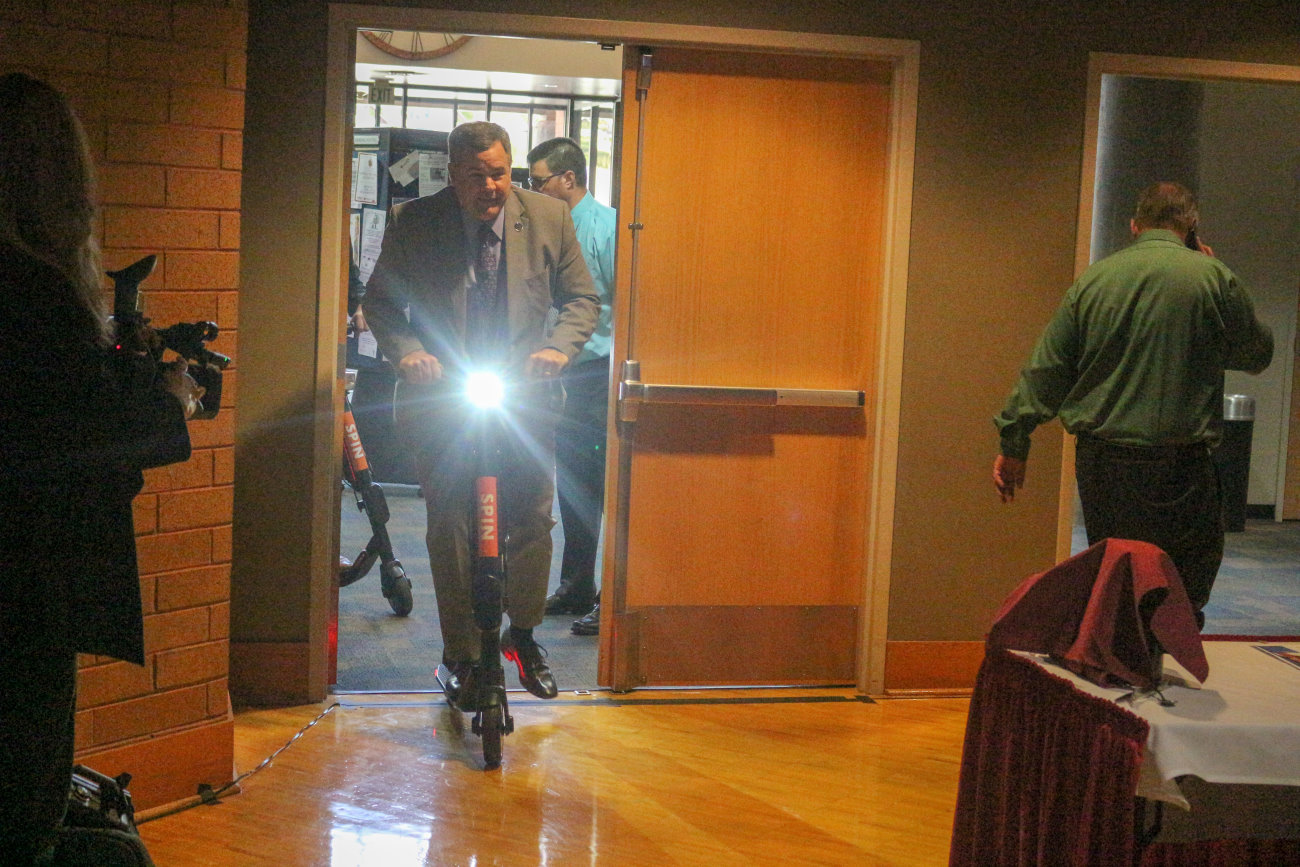
Mesa Mayor John Giles isn't the only mayor who likes to plan stunts to start off their annual State-Of-The-City speeches. . . At least in St.George, UT the public had some prior notice that eScooters would be deployed on the sidewalks and streets ahead of time.
And that's after the city took the time to make an agreement with one commercial supplier.

Pike rides in on electric scooter for 2019 ‘State of the City’ address
Written by Mori Kessler 06 Feb 2019
St. George Mayor Jon Pike rides into the Gardner Ballroom at Dixie State University on a Spin electric scooter as a part of an announcement that the city plans to approve an agreement to bring the scooters to St. George by the end of the month, St. George, Utah, Feb. 6, 2019 | Photo by Mori Kessler, St. George News
To illustrate his point, Pike and members of Dixie State University’s student government rode scooters into DSU’s Gardner Ballroom where the mayor gave his fifth annual State of the City address.
The scooters are supplied through Spin, an electric scooter company owned by Ford Motor Company. It is also attached to Zagster, the bike share program the city partnered with last year.
Read more: St. George bike share program is now up and rolling