Thursday, December 10, 2020

this

The subject of Facial Recognition used in surveillance has been the focus in many posts on this blog. Once again it's time to take one more look: 
The revolution in digital technology has upended our society in many ways. Chief among these is that it has forced Americans to scramble to preserve the foundational balance of power between government and the people. . . According to a report by the Georgetown Center on Privacy and Technology, at least one in four of the nation’s thousands of state and local police departments have the ability to run facial recognition searches using the FBI’s or other systems. However, while facial recognition surveillance is being hastily deployed, oversight rules and basic limits on its use are lagging behind. . ." (2018)
 
Unmasking the Realities of Facial Recognition
(Animated illustration: CJ Ostrosky / POGO)

Unmasking the Realities of Facial Recognition

------------------------------------------------------------------------------------------------------------
QuickTake (2020)

Why Big Tech Wants (Some) Facial Recognition Rules

"The world’s biggest technology companies can usually be counted on to oppose rules reining in new products, but some are making an exception for facial recognition software. The European Union and cities and states across the U.S. are taking up a wide range of ideas for restrictions or outright bans on this branch of the rapidly expanding field of artificial intelligence, including many that go further than the tech companies want.
The New Facial Recognition Feature In Lightroom CC
> One question is whether regulation can protect innovation while preventing what Microsoft Corp. calls “a commercial race to the bottom.”
> Another is whose vision of privacy and security will prevail
". . . news reports that some U.S. police departments were using technology from a startup called Clearview AI have in particular exacerbated a backlash from privacy groups and lawmakers. The startup had scraped billions of photos from social media accounts without consent, using them to build a massive database of people not otherwise in law enforcement databases.
> The EU’s strict privacy rules, the General Data Protection Regulation, already forbid the use of remote biometric identification, a category that includes facial recognition, without consent from the targeted individual, with some public-safety exceptions. New legislation now being worked on is expected to include requirements for companies or agencies wishing to deploy such systems to submit the software’s datasets to public authorities for review before release
> In the U.S., bills involving facial recognition have been introduced in 11 state legislatures, ranging from a proposed ban on real-time use of the technology in Michigan to a requirement that stores in Vermont notify consumers if a system is in use. A handful of cities, including San Francisco and Cambridge, Massachusetts, have banned the use of the technology by their police or other agencies altogether. At the federal level, lawmakers from both major parties have discussed bills to force a moratorium on adoption of facial recognition systems by government agencies, NONE HAVE MOVED FORWARD
-------------------------------------------------------------------------------------------------------------------------------
RELATED CONTENT ON THIS BLOG

30 August 2018

Surveillance & Facial Recognition: Questions + Statements From Experts

Our core concern is that policing in the United States today functions without effective oversight or accountability. There’s a real deficit of trust. And in that ecosystem, it’s really hard to see how any legal requirement could be applied in a way that would truly protect people.
Image result for facial recognition regulation
That's one of the concerns in a report from The Verge yesterday
How should we regulate facial recognition?
Source: https://www.theverge.com/2018/8/29
Facial recognition is everywhere — airports, police stations, and built into the largest cloud platforms in the world — with few federal rules to govern how it’s used. That’s been true for years, but a string of embarrassing stories in recent months has driven home exactly how dangerous the technology can be in the wrong hands, and it’s led to new calls for regulation. Even Microsoft, one of the largest providers, has called on Congress to place some kind of restriction on how and where the technology can be used.
How should we regulate facial recognition?
We asked the experts
That leaves reformers with a difficult question: how can we fix facial recognition?
We put the question to five leading figures on both sides of the policy fight.
Is it time to regulate facial recognition?
> Alvaro Bedoya, executive director of the Center for Privacy and Technology at Georgetown Law. The Center’s Perpetual Lineup project includes a model bill for regulating facial recognition, focused on restricting police access to driver’s license and mug shot databases.
> Brian Brackeen, CEO of the facial recognition company Kairos, an outspoken advocate for regulation in the industry.
> Evan Selinger, philosophy professor at the Rochester Institute of Technology. Together with law professor Woodrow Herzog, Selinger has called for a complete ban on the use of facial recognition, in both public and private use cases, out of concern that the technology is being normalized
> Benji Hutchinson, VP of federal operations at NEC America. A leading vendor for federal facial recognition contracts, NEC has resisted calls for federal restrictions on the technology.
Should police use facial recognition?
> Kade Crockford, director of the Technology for Liberty Program at the ACLU of Massachusetts. The ACLU has called for a moratorium on government use of facial recognition.
Here >  
CASE IN POINT + THE SPOILER ALERT: As an article published by OneZero put it, “the NOPD has back-channel access to the state’s facial recognition program.” According to the report, the police department relied on technology operated by the Louisiana State Police after local investigators sent a wanted poster with a photo of the suspect to the state fusion center.

And that's how the NOPD is going to pretend its previous denials weren't misleading. Here's how it responded to The Lens when contacted about its apparent years of misdirection.

In a statement to The Lens last week, a department spokesperson said that although it didn’t own facial recognition software itself, it was granted access to the technology through “state and federal partners.”

New Orleans PD Finally Admits It Uses Facial Recognition Tech After Denying It For Years

from the cracks-open-COP-TO-ENGLISH-dictionary dept

Another large American law enforcement organization has belatedly admitted it uses facial recognition tech after spending years denying it.

Last month, it was the Los Angeles Police Department, which had denied using the tech all the way up until 2019. But records obtained by the Los Angeles Times showed the department had used it 30,000 times over the past decade.

When confronted, the LAPD's assistant chief claimed the last two denials issued by him and his department were "mistakes."

Welcome to the "I guess we'll come clean" club, New Orleans.

ere

1964 The Honeycombs - Have I the right

Almost 60 years ago the question of consent was set to music . . .

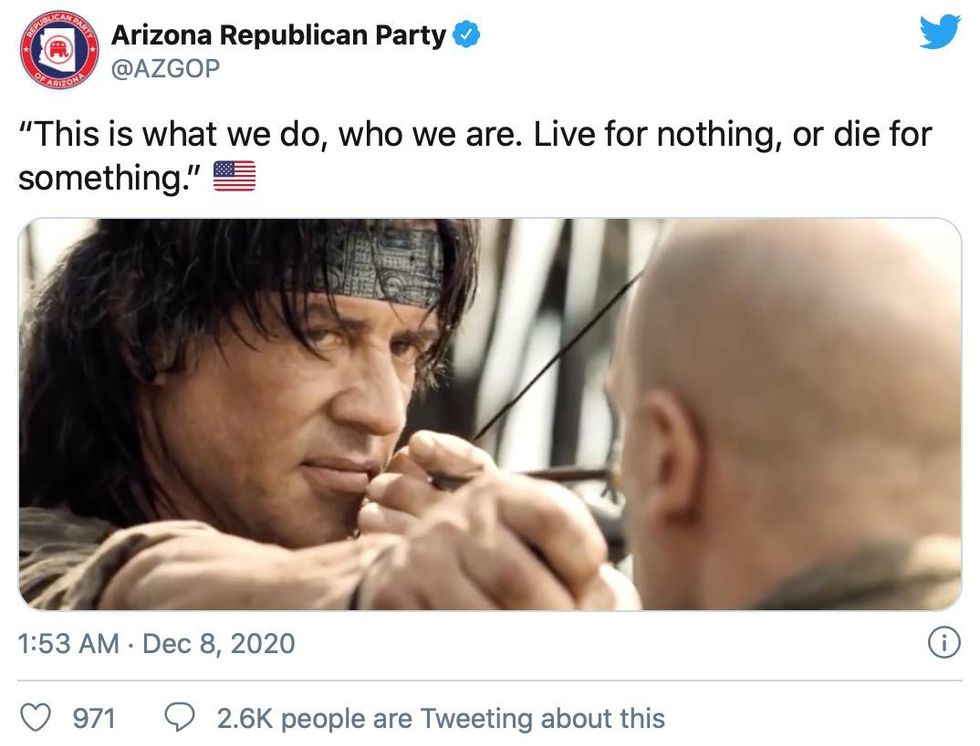
Tweeted-and-Deleted: Coo-Koo AZ Republican Party Chair Kelli Ward's Wacko'Mo Rambo Moment

". . . As Mediaite notes, the AZ GOP also tweeted, then deleted, a quote and clip from Rambo, saying, "This is what we do, who we are. Live for nothing, or die for something." You know, in case you were wondering if these people are really having delusions that the climactic action-movie sequence of their sad, dead-end lives has finally arrived. Mediaite got a screengrab:

John Fetterman, the very cool Democratic lieutenant governor of Pennsylvania, reacted:

He added a few minutes later, "If this isn't full-on death cult rhetoric, what's left?"

So that is how the AZ Republican Party is going under Kelli Ward's watchful eye. Don't worry, she's not just starting fights with her own side on Twitter. Kelli Ward is also losing lawsuits to overturn the election. It's kind of a pattern for her lately . . ."

------------------------------------------------------------------------------------------------------------------------------

More from The Wonkette:

Chemtrail Kelli Ward Just Asking If You Are Willing To Fight And Die For Donald Trump 2020 presidential election

Longtime Wonkette readers and astute political observers are probably aware that Kelli Ward, literally one of the most insane Republicans in US America and who is very worried about chemtrails, failed upward from losing a Senate primary to twice-loser Martha McSally to holding the reins of the entire Arizona Republican Party. Back in 2017, she made news for saying John McCain really needed to quit the Senate after his brain cancer diagnosis, and she knows this because she is a doctor, and anyway, she wanted Arizona GOP Gov. Doug Ducey to appoint her to his Senate seat. . .

Point is, she is wack as fuck. And now her Arizona Republican Party is spending its time on Twitter asking people if they're willing to DIE . . .the New York Times reports that Republicans in Arizona are in an all out war with each other, which is great because it fits right in to our ongoing Wonkette series "Let's Just Watch Republicans Eat Each Other To Death For Fun And Also Joy."

A top Republican told the governor to "shut the hell up." Another official described a lawmaker as a resident of "Crazytown." All this in a state where the party recently reigned supreme.

That's the sub-headline of the Times piece. Y'all, there's about to be some DEMS IN DISARRAY because they are too busy laughing at Republicans to get anything done.

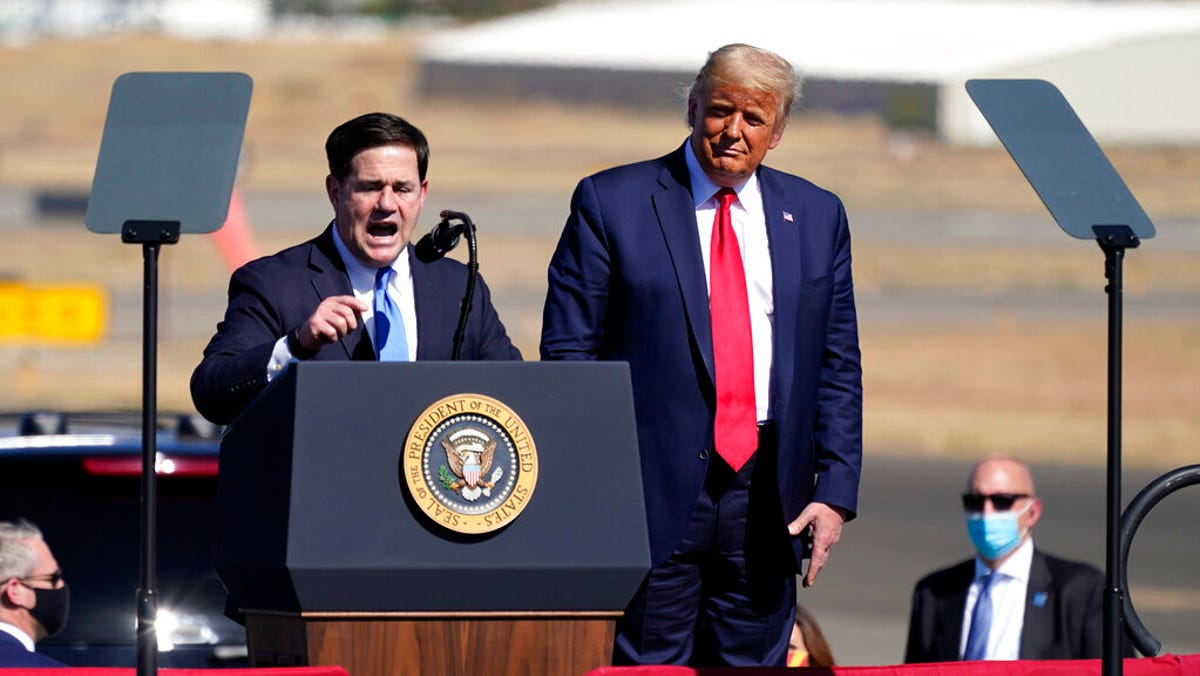
It was Kelli Ward who told Doug Ducey to "shut the hell up" on Twitter, or rather "STHU." Why? Because he won't go along with the Rudy Giuliani KRAKEN plan to just decertify Arizona's election results and give the state to Trump. And Ducey responded:

At a news conference, Mr. Ducey responded, "I think what I would say is the feeling's mutual to her, and practice what you preach."

The Times reports that the nutbags are also going after Arizona GOP House Speaker Rusty Bowers, who not only refuses to do fascist coups for Donald Trump but also took the sane step of shutting down the state House after Rudy Giuliani leaked coronavirus all over everybody. Kelli Ward had one of her trademark measured responses to that:

This is a 100% unnecessary, cowardly move. #DoYourJob #ElectionIntegrity #StopTheSteal https://t.co/Zlixtl4npN

Wednesday, December 09, 2020

HISTORY + TIMELINE: Pandemic Arizona 2020

Thanks to reliable data. . . Now we can stay up-to-date.
First some history:
Arizona mired in pandemic as governor puts profits before people |  Representative Greg Stanton
Arizona mired in pandemic as governor puts profits before people
-------------------------------------------------------------------------------------------------------------------------------
Senator Mark Kelly talked about coronavirus pandemic relief in Arizona
 
Senator Mark Kelly talks pandemic relief, mask mandates in Arizona
--------------------------------------------------------------------------------------------------------------------------------

COVID-19 pandemic in Arizona

From Wikipedia, the free encyclopedia

The COVID-19 pandemic was confirmed to have reached the U.S. state of Arizona in January 2020.

 On December 7, 2020, Arizona public health authorities reported 1,567 new COVID-19 cases and no deaths, for cumulative totals of 365,843 cases and 6,950 deaths since the start of the pandemic.[6]

>  COVID-19 is currently surging in Arizona and much of the Southwest; the 7 day moving average has risen to 5,575 new cases per day, an increase of nearly 2,400 cases per day in just two weeks.[6]

In the two-month period after Governor Ducey abruptly ended Arizona's statewide lockdown on May 15, the seven-day moving average of new COVID-19 cases in Arizona soared, from an average of 377 cases per day to 3,249 cases on July 15.

> On July 8, Arizona reported as many new cases of COVID-19 as the entire European Union, while having 1/60th of the population.[7]

 On June 17 Governor Ducey, under pressure due to rising COVID cases, publicly encouraged Arizona citizens to wear masks and allowed individual cities and counties to issue mask mandates.[8] No statewide mandate was issued, but most major cities and counties in AZ issued local mandates.[8] COVID-19 cases and deaths continued to rise through July, with Arizona's highest single day death toll occurring on Thursday July 30, when 172 deaths were reported.[6]

After four months during which the day over day increase in new COVID-19 cases never dropped below 1%, in August the case rate suddenly dropped dramatically, to a seven-day moving average of 489 cases per day on August 31. Despite the low case rate Arizona still has a high percentage mortality among infected individuals and a high diagnostic test positivity rate (11%).[6] Over five percent (5.09%) of all Arizona residents have been infected by the COVID-19 virus, as confirmed by PCR diagnostic testing.[6]

> As of October 8, 2020, Arizona had the eighth-highest number of confirmed cases in the United States, and the ninth-highest number of confirmed cases per capita, behind Louisiana, North Dakota, Mississippi, Alabama, Florida, Tennessee, Georgia, and South Dakota.[9] It has the eleventh-highest number of deaths related to the virus.[9] 

------------------------------------------------------------------------------------------------------------------------------

TIMELINE

October[edit]

On October 12, San Tan Foothills High School in Pinal County was closed due to a cluster of cases.[72]

On October 13, Maricopa County Public Health reported 21 outbreaks in county school districts, with 77 cases. Nineteen schools with outbreaks remained open. An outbreak is defined as "two or more COVID-19 positive cases that don’t live in the same household." Ventilator use, inpatient admissions and ICU patients with coronavirus had nearly 40% or more statewide over the previous two weeks.[73]

On October 19, a campaign rally by President Trump near Tucson International Airport drew over 2,000 supporters.[74] Few masks were worn, despite requests by Tucson Mayor Regina Romero to heed local public health ordinances.[75] Another rally was held at the Prescott Regional Airport in Prescott.[76]

On October 22, during the presidential debate, President Trump stated "There was a very big spike in Arizona, it's now gone."

However, the newspaper Arizona Republic disagreed, reporting that "the disease is now spreading at its fastest rate here since June, just before the state became a COVID-19 epicenter this summer.

In Arizona, daily case counts, hospitalizations, percent positivity, ventilators in use and the rate at which the virus spreads have all increased in recent weeks."[77]

Arizona National Guard service members prepare and collect COVID-19 test samples, July 15, 2020 in Cibecue, Arizona.

December[edit]

> On December 7, the Arizona State Legislature was forced to close for at least a week after lawyer Rudy Giuliani, who had tested positive for COVID-19, testified without a facemask for eleven hours about allegations of voter fraud.[78]

Sources: ADHS.

---------------------------------------------------------------------------------------------------------------------------

COVID-19 PANDEMIC IN THE UNITED STATES
COVID-19 pandemic in the United States - Wikipedia

County[a] Cases[b] Hospitalized Deaths Population[c] Cases / 100k Deaths / 100k Number of
PCR Tests[d]
Number of
Serology Tests[e]
15 / 15 378,157 28,525 6,973 7,189,020 5,260.2 97.00 2,408,041 372,457
Apache 5,952 516 200 71,808 8,288.8 278.52 20,220 790
Cochise 4,663 331 91 130,808 3,564.8 69.57 30,789 4,130
Coconino 8,494 719 182 147,275 5,767.4 123.58 58,511 4,472
Gila 3,365 354 105 55,159 6,100.5 190.36 19,340 4,085
Graham 2,419 167 38 38,476 6,287.0 98.76 6,959 865
Greenlee 297 15 3 10,375 2,862.7 28.92 1,619 160
La Paz 996 79 21 22,085 4,509.8 95.09 5,278 1,394
Maricopa 236,818 17,592 4,161 4,367,835 5,421.9 95.26 1,421,158 254,221
Mohave 7,621 734 272 216,985 3,512.2 125.35 49,211 6,895
Navajo 9,056 968 278 112,825 8,026.6 246.40 34,816 2,868
Pima 46,849 3,094 730 1,044,675 4,484.6 69.88 360,676 41,867
Pinal 19,579 1,678 276 455,210 4,301.1 60.63 143,289 24,975
Santa Cruz 4,569 309 76 53,161 8,594.6 142.96 19,642 1,419
Yavapai 6,989 569 130 232,386 3,007.5 55.94 60,204 8,883
Yuma 20,490 1,400 410 229,957 8,910.4 178.29 90,051 8,321
As of December 8, 2020
Data is publicly reported by Arizona Department Of Health

MARICOPA COUNTY

COVID-19 pandemic in Arizona
COVID-19 rolling 14day Prevalence in Arizona by county.svg
Map of the outbreak in Arizona by confirmed new infections per 100,000 people (14 days preceding December 8)
  500+
  200–500
  100–200
  50–100
  20–50
  10–20
  0–10
  No confirmed new cases or no data
COVID-19 Prevalence in Arizona by county.svg
Map of the outbreak in Arizona by confirmed total infections per 100,000 people (as of December 8)
  3,000+
  1,000–3,000
  300–1,000
  100–300
  30–100
  0–30
  No confirmed infected or no data

Now We Know [A Month Later] > Yesterday's News from AZ Mirror > Ducey's Not Doing Enough

It's all in THE MESSAGING?
Arizona Gov. Doug Ducey downsizes, buys $1.375M Paradise Valley home after  selling $8.15M mansion
Ducey has resisted calls for a statewide mask mandate, instead telling cities and counties they should enact their own.
TheWhite House Coronavirus Task Force said it was incumbent on states and local governments to implement policies to limit the spread. 
WATCH NOW: Gov. Doug Ducey's latest press availability for COVID-19 (11/18)  | State-and-regional | azdailysun.com
 
And if those policies aren’t in place, “all public health officials must alert the state population directly.” 
A document prepared for the White House Coronavirus Task Force late last month concluded that Gov. Doug Ducey is not doing enough to combat COVID-19 in Arizona.Arizona COVID-19 cases are spiking and Gov. Doug Ducey refuses to lead

“Arizona is experiencing a full resurgence equal to the summer surge but without the needed aggressive mitigation across the state,” the task force wrote in the Nov. 29 document, which includes status reports on all 50 states.

Throughout the pandemic, the weekly reports have been shared directly with governors.

The document was obtained by the Center for Public Integrity, a nonprofit newsroom based in Washington, D.C.

White House Coronavirus Task Force: Arizona needs ‘aggressive’ statewide measures


>

The White House coronavirus officials noted that Americans are facing a “historic high” risk from COVID-19, the illness caused by the novel coronavirus, with confirmed cases more than seven times higher and hospitalizations about triple what they were during June and July. 

We are in a very dangerous place due to the current, extremely high COVID baseline and limited hospital capacity; a further post-Thanksgiving surge will compromise COVID patient care, as well as medical care overall,” the task force wrote in its report on Arizona.

> “New hospital admissions in Arizona are rapidly increasing and mitigation must be increased.”

That hasn’t happened. On Tuesday, a record number of Arizona coronavirus cases were reported.

> On Monday, state health officials reported there were less than 150 ICU beds available across the state and that only 10% of hospital beds were available, the lowest figures since the pandemic began in March.

> On Tuesday, Arizona reported 12,314 new cases, and the seven-day average is 5,860 cases a day. Almost 29% of the state’s cases since the pandemic began have been reported in the last 30 days.

> Since the pandemic began in March, Arizona has reported more than 378,000 cases. More than one in four of those — almost 29% — have come in the past month.

> So far, 6,973 Arizonans have died from COVID-19 since the pandemic began. July still holds the record for the deadliest month for the virus, taking the lives of over 2,000 Arizonans.

> In the past month, 803 have died from the illness


The Economic Outlook for the Coming Decade: Challenges and Opportunities...

O YEAH! Yoda !! >The Mandalorian Season 2 Episode 6 Breakdown OH MY GOD