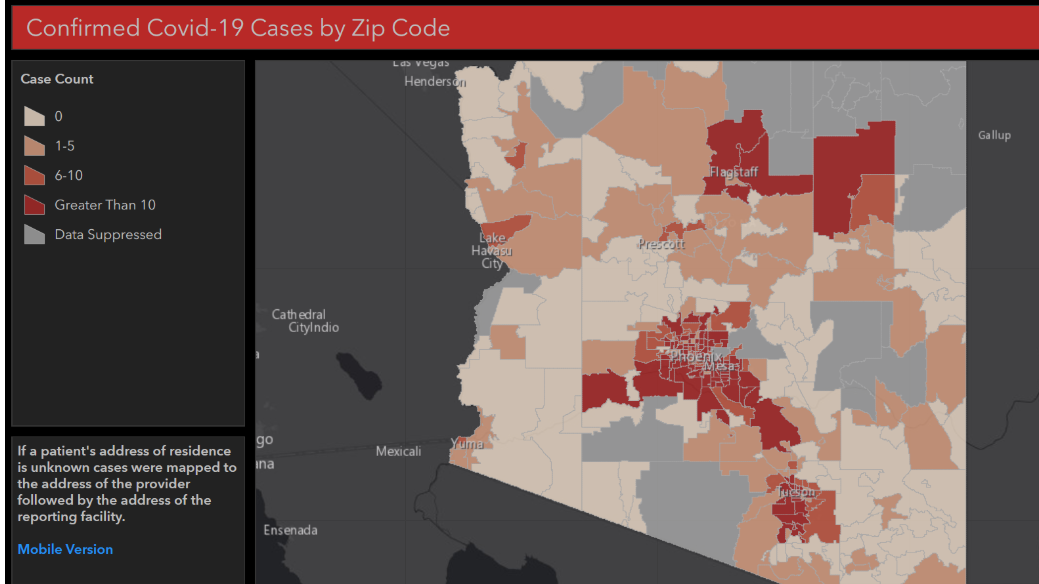
Program supports the promotion and protection of the health of Arizonans through the collection, analysis, and visualization of data related to personal and community health.
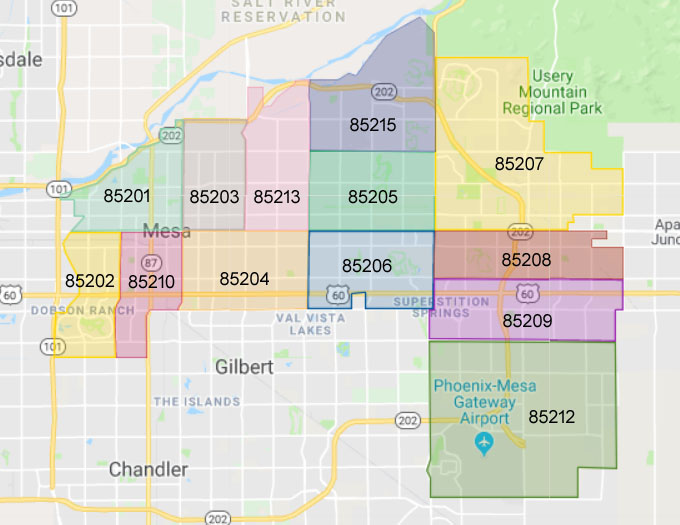
THE TOWN OF GILBERT PUBLISHES A COVID-19 INFORMATION MAP
One of Mesa Mayor John Giles priorities [1 out of 5} is fixing THE DIGITAL DIVIDE.
Can he be serious? Even with recent some recent COVID-19 Aid and Relief? READ ON
An article today by Karl Bode puts some issues in the spotlight with this statement that caught your MesaZona blogger's attention >
". . .Voters should have every right to make local infrastructure decisions for themselves, and if big ISPs and armchair free market policy wonks don't want that to happen, incumbent ISPs should provide faster, cheaper, better service. . ."
There Are Far More Americans Without Broadband Access than Previously Thought
The Federal Communications Commission says 21 million Americans lack high-speed internet access, but a new report says the actual figure is double that.
"We've talked for years about how telecom monopolies like Comcast and AT&T have ghost written laws in more than twenty states, banning or hamstringing towns and cities looking to build their own broadband networks. We've also noted with COVID clearly illustrating how broadband is essential for education, opportunity, employment, and healthcare, such restrictions are looking dumber than ever. . .
THE TAKE-AWAY: The solutions here aren't complicated, we just don't want to do them.
> We could easily ask voters if they want to discard the 20+ protectionist laws written by monopolies, letting local citizens decide local infrastructure issues themselves.
> We could beef up antitrust enforcement, and refuse to rubber stamp mindless telecom mergers that inevitably lead to more consolidation, less competition, and higher prices.
> We could embrace policies that upset incumbent monopolies by driving additional competition to market.
> We could reform campaign finance laws so AT&T and Comcast don't all but own countless state legislatures.
But we don't do that. Instead, we let monopolies write state and federal policy and laws with an eye on protecting the status quo. Laws that make disruption by smaller players expensive, cumbersome, and often impossible. We then throw billions of dollars at said monopolies for networks they routinely only half deploy. We rubber stamp harmful mergers and fail to hold monopolies accountable for much of anything. Once that's done, we then stand around with a dumb look on our collective faces wondering why US broadband is utterly mediocre in nearly every single metric that matters."
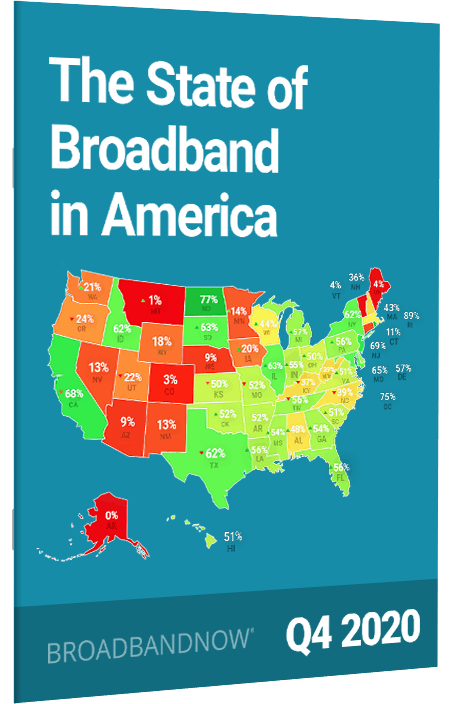
Our final state of broadband report for 2020 concludes our quarterly exploration of the progress being made to bring every American online amidst the COVID-19 pandemic.
Key Findings
Low-priced access expanded during the fourth quarter across many states as more providers expanded their lower cost offerings. 70% of Americans had access to low-priced wired broadband plans compared to 52% measured YoY in the 2019 Q4 report.
Rhode Island remains the state with the highest percentage of residents with access to low-priced plans of speeds 100 Mbps download and 25 Mbps upload.
While 78% of Americans have access to wired providers who report that they can service speeds of 100 Mbps download / 25 Mbps upload, only 30% of Americans have access to low-priced plans at that speed.
For the first time, residents in Alaska have gained access to low-priced broadband plans. Despite this, less than 1% of the population has access. All 50 states plus the District of Columbia now have some level of access to low-priced plans.
21 states had improved or steady internet latency, compared to Q3. The state with the least latency is New Jersey, the one with the most is Hawaii.
Ninety-four ISPs added low-priced plans that were not available in Q3. National providers, such as CenturyLink and Xfinity were among them. For example, Xfinity Performance Starter and Performance Select plans launched in December. Colorado in particular saw massive gains in affordability access going from 3.45% access in Q3 to 80% in Q4 for basic broadband of 25 Mbps / 3 Mbps.
All 50 states and the District of Columbia now have at least some measure of access to low-price broadband, a first since we began tracking this threshold in 2019
About the data
Data for the 2020 Q4 BroadbandNow Report comes from publicly available plan and coverage data from more than 2,000 internet service providers in the fourth quarter of 2020. Wired broadband is defined as all cable, fiber, and DSL technologies. In this report we focused on measuring access to the FCC’s definition of broadband, which is 25 Mbps download and 3 Mbps upload speed, as well as BroadbandNow’s recommended increased standard for the changing digital needs of Americans of 100 Mbps download and 25 Mbps upload speed.
Low-priced plan coverage was based on what providers have reported on their most recent FCC Form 477 submission at the census block level. If a provider has indicated that they have coverage in a given census block, we assume that all of the provider’s national plans are also available in that block, as well as any regional plans serving those blocks. Plan pricing is based on the regular monthly rate offered of standalone internet plans. Promotional rates are only considered if that is the only advertised price publicly available. Speed test (RTT) data comes from M-Lab’s network diagnostic tool speed tests. . .
A Biden-era FCC is expected to revisit the controversial Restoring Internet Freedom Act that was passed under the Trump administration in 2018, as well as work to reverse reductions to the agency’s mainstay Lifeline program.
SpaceX preps for a wider Starlink launch
SpaceX completed four Starlink launches into low orbit in the final quarter of the year, bringing the total number of launched satellites to 955. The company spent the latter part of the year in private beta, testing internet services with consumers across the nation, including in Tribal communities. Looking to 2021, the company is likely to launch commercial services in some form.
FCC’s Funding Plans Solidify
The FCC’s new era of funding is officially underway with the Rural Digital Opportunity Fund recipients being announced. Among the biggest winners were wireless ISPs promising to deliver services to rural consumers that rival wired connections, alongside Starlink, which was awarded nearly $900 million in subsidies.
A Last Minute Push to Keep Americans Online
In December, the U.S. government passed another round of stimulus relief, including a new “Emergency Broadband Benefit” meant to help Amercans keep their internet connection active. The stimulus bill “invests $7 billion to increase access to broadband, including a new Emergency Broadband Benefit to help millions of students, families and unemployed workers afford the broadband they need during the pandemic.”
> Eligible households can receive up to $50 per month to pay for broadband services from participating providers.
> A total of $3.2 billion has been set aside for the program, which is currently set to end after the funds have been expended.
More RELATED CONTENT > Arizona Jan 11, 2021 — Arizona. HB 2814 Appropriates $5 million from the state General Fund for each of the fiscal years, FY 2021, FY 2022 and FY 2023, Funding to the Arizona Commerce Authority to provide broadband grants
With roughly 9 out of 10 adults in America using the internet, many consider it to be a necessity of modern life. Because access to the internet is unavailable or inadequate in parts of the country, states and the federal government are focusing on deploying broadband—the technologies that allow internet data to be transmitted at high speeds—as universally as possible.
In the 2020 legislative session, 43 states and Guam addressed broadband in issue areas such as educational institutions and schools, dig once, funding, governance authorities and commissions, infrastructure, municipal-run broadband networks, rural and underserved communities, smart communities and taxes. Thirty-four states enacted legislation or adopted resolutions: Alaska, Arizona, Arkansas, Colorado, Florida, Georgia, Illinois, Indiana, Iowa, Kansas, Kentucky, Louisiana, Maine, Maryland, Massachusetts, Michigan, Minnesota, Mississippi, Missouri, Nebraska, New Hampshire, New Jersey, New York, North Carolina, Ohio, Oklahoma, Oregon, Pennsylvania, South Carolina, South Dakota, Vermont, Virginia, West Virginia and Wisconsin.
The box allows you to conduct a full text search or type the state name.
www.ncsl.org › research › broadband-2020-legislation
www.ncsl.org › research › broadband-2020-legislation
About this result
BETA
Source
The National Conference of State Legislatures, established in 1975, is a "nonpartisan public officials’ association composed of sitting state legislators" from the states, territories and commonwealths of the United States.
Jan 11, 2021 — Arizona. HB 2814. Allows a county, city or town to establish and ... 31, 2020, be transferred back to the Broadband Infrastructure Grant Account.
First of all, let's take a look at two recent updates - one on the state level and one on the federal level + related content
ARIZONA February 2, 2021
Mesa lawmaker opposes anti-discrimination bill
By Howard Fischer, Capitol Media Services
State lawmakers from both parties are seeking to enact new laws that would nullify last year’s Arizona Supreme Court ruling allowing business owners to cite their “sincerely held religious beliefs’’ to refuse to serve gays.
But a Mesa lawmaker is among those blocking it.The proposals from Sen. Kate Brophy McGee, R-Phoenix, and Rep. Daniel Hernandez, D-Tucson, would expand existing laws that now prohibit discrimination in public accommodation based on race, religion, sex, age, disability or national origin.
Both SB 1321 and HB 2716 would add sexual orientation and gender identification to the list. . .
The potentially more far-reaching part of the plan would alter the current existing laws that now generally make it illegal for government to “substantially burden a person’s exercise of religion’’ even if that burden results from laws that apply to everyone else.
To that end, they are proposing new language to say that if a business is open to the public, it has to provide services to all customers, regardless of whether they run counter to the owners’ beliefs.
Both measures face an uphill fight. Neither Senate President Karen Fann nor House Speaker Rusty Bowers of Mesa has agreed to allow either bill to be heard. . .
> Fann said she’s been trying to keep all legislation dealing with gay rights, on both sides of the issue, off the agenda.
> Bowers said he sees no need to expand existing anti-discrimination laws to cover sexual orientation and gender.
And he was particularly adamant about not overturning the Brush & Nib decision.
“I think that my right of freedom of religion and religious beliefs and expression is at least equal to anybody else’s,’’ Bowers said. . ________________________________________________________________________________
WASHINGTON D.C. February 12, 2021
Historic Decision: Enforcing Fair Housing Act to Prohibit Discrimination on the Basis of Sexual Orientation and Gender Identity
Direct from HUD Press Office Fri, Feb 12, 2021 at 8:47 AM
WHAT THEY ARE SAYING: HUD’s Directive to Enforce the Fair Housing Act to Prohibit Discrimination on the Basis of Sexual Orientation and Gender Identity
There are currently no explicit, comprehensive statewide non-discrimination protections for gay, lesbian, bisexual, or transgender people in Arizona. Public employees in Arizona are protected from employment discrimination based on sexual orientation, via a 2003 executive order.
The Latest on LGBTQ Nondiscrimination in Arizona:
In early 2014, Arizona was the subject of national attention when the passage of a discriminatory bill, S.B. 1062, led to an enormous outcry, including from some of the state’s largest employers and key businesses. The law was ultimately vetoed by Republican Governor Jan Brewer, but the legislature stopped well short of protecting LGBT people in Arizona from discrimination. Now, advocates are working to pass comprehensive LGBTQ nondiscrimination in Arizona.
State/Agency Policies:
A 2003 executive order signed by Arizona Governor Janet Napolitano prohibits discrimination based on sexual orientation – but not gender identity and expression – in state employment.
Municipalities with Non-Discrimination Protections: Last Updated January 5, 2021
The following municipalities protect people from discrimination on the basis of their sexual orientation and gender identity and expression:
Case Seeking Religious Exemption from LGBTQ Nondiscrimination Laws
Key Date: September 16, 2019 • Ruling from the AZ Supreme Court Review Status: Limited Ruling in Favor of Business Seeking Anti-LGBTQ Exemption Legal Team: Alliance Defending Freedom Type: Public Accommodations Discrimination
On June 7, Alliance Defending Freedom indicated it would appeal to the AZ Supreme Court following the Arizona Court of Appeals' ruling, which upheld the city of Phoenix's nondiscrimination ordinance that protects LGBTQ from discrimination in housing, employment, and public accommodations.
For LGBTQ Americans, legal protections and benefits vary widely depending on location -- states and cities have markedly different laws governing discrimination. 20 states have non-discrimination laws that include protections for LGBTQ people in employment, and 19 states have laws that protect LGBTQ people from discrimination in places of public accommodation. But cities are leading the way: since the MEI’s debut in 2012, the number of cities earning perfect scores has increased more than sixfold, and today at least 24 million people live in cities that have more comprehensive, transgender-inclusive non-discrimination laws than their state.
The average score for cities in Arizona is 61 out of 100 points, which falls above the national average of 57.
“This year’s MEI paints a vivid picture: cities big and small, in red and blue states alike, are continuing our progress toward full equality, regardless of the political drama unfolding in Washington, D.C., and in state legislatures across the country,” said HRC President Chad Griffin. “Today, the MEI serves as a vital tool for business leaders and municipal officials alike when it comes to economic development. CEOs know that in order to attract and retain the best employees, they must grow their companies in places that protect LGBTQ citizens from discrimination and actively open their doors to all communities. The MEI is the best tool to help these businesses make crucial evaluations about the welcoming -- or unwelcoming -- nature of towns and cities across the nation.”
If You’re a Big Business, and You Believe in Protecting LGBTQ People from Discrimination, Click Here to Learn About Our America Competes coalition.
Small business owners across the United States are standing together to oppose discrimination and to support comprehensive nondiscrimination laws that protect all Americans, including LGBTQ people.
These business owners know that workforce development, innovation, tourism, economic growth, and quality of life are linked – and that environments that are welcoming to LGBTQ people are more competitive on all of these measures. They know that these same environments give their employees fair and equal opportunities to live, work, earn a living, send their kids to school, raise their families, and participate in their communities.