Sunday, March 07, 2021

Cheers for More Beers? How About A Taproom Arcade?

Here's all the news - once again "canned" - in a press release prepared by
It's all the news stories made-to-order and fit-to-print from none other than the non-profit City of Mesa Newsroom: 
The Beer Research Institute, Mesa's First Brew Pub has just announced that it just signed a lease for 213 and 215 W. Main St in downtown Mesa which will house their new Taproom and Old School Arcade
"We're very excited to partner with Main Street West LLC on this project. The location is perfect for our concept and its going to be a great fit for B.R.I. and Downtown Mesa. This project brings together two of my long-time passions: Craft Beer and classic arcade games" Said, Matt Trethewey, Founder of The Beer Research Institute.
"DTM is about ready to explode and our timing couldn't be better. There's a great feel down here and it's going to be ground zero for craft beer in the state of Arizona"
The 4000 square foot brick building on Main St. will be the area's first Arcade Bar featuring 15 varieties of B.R.I. beer such as 480G IPA, Vamonos Mexican Style Lager and Morning Sex Coffee Milk Stout along with Arizona produced cider, wine and mead. The space will be accented by 30 old school, classic arcade games and a variety of pinball machines.
Projected opening summer of 2021.
____________________________________________________________
About The Beer Research Institute
The Beer Research Institute is Mesa's First Brew Pub.
Opened in November 2014, B.R.I. quickly became one of the highest rated breweries in the state of Arizona and continues to provide world class Craft Beer, Scratch Food and Unmatched Service.
To learn more about our company and our product lines, please visit www.bri.beer

Contact:
Matt Trethewey
480-773-0644
matt@bri.beer 


Explaining Digital Video: Formats, Codecs & Containers

Starlink Review: FAST Internet from Space

Galactic Dust Micronova Trigger Arriving? | S0 News Mar.7.2021

The Nation > Tom Tomorrow

O YEAH > For three decades Repeatedly his cartoons have used the images of a promised future that never arrived to accentuate the failures of the disappointing present. . .The seeds of Perkins’s signature style emerged when he was an art student in the 1980s and became interested in collage. . ."He was the bridge between the earlier radicalism of Jules Feiffer, a pioneer in using alternative newspapers, and the latter flourishing of alternative art in graphic novels and on the Internet. Leftists of Perkins’s cohort, those who came into adulthood in the bleak 1980s and ’90s, tend to be a hardy lot. Perkins has struggled with many setbacks in recent years, including the dwindling of the alternative weekly newspaper as a market for cartoonists.
Yet his work remains as tough, as unflinching, and as necessary as ever.
Life in the Stupidverse is a vivid reminder of why he matters
The Covid pandemic has turned us all into characters in an apocalyptic novel
In his use of advertising clip art in comics, he was flipping around the legacy of Lichtenstein and Warhol: Whereas they had brought commercial art into the museum, Perkins brought the clinical and stylized distillation of Pop Art into political comics. 

Don’t Stop Thinking About (Tom) Tomorrow

Cartoonist Dan Perkins increasingly turns to the iconography of science fiction to keep pace with the absurdity of the moment.

 
__________________________________________________________________________
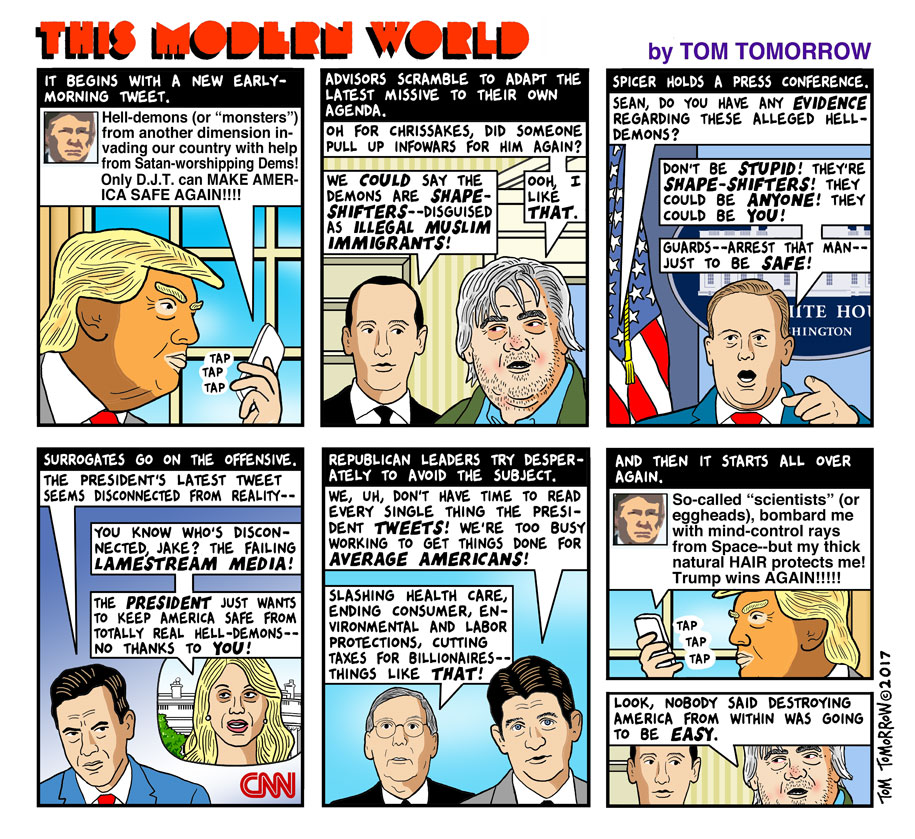
Tom Tomorrow cartoon

Dan Perkins was born in Wichita, Kan., in 1961, back in the days when the future still existed. The Kennedy presidency and the New Frontier gave birth to the last plausible and widely shared utopian moment, one that outlived John Kennedy’s own assassination by a few years but ultimately withered in the face of increasing pessimism. It was the Apollo epoch, the time of the space race, of American engineering and technocratic mastery, of scientists in crew cuts who promised health and happiness via gizmos and pills, of slick and streamlined advertising and pulp art merging with high culture in the works of Roy Lichtenstein and Andy Warhol, and of science fiction dreams entering the public imagination via Star Trek. In that giddy moment, even so misanthropic an artist as Stanley Kubrick could dream, as he did in 2001: A Space Odyssey (1968), of humanity making an alien-assisted evolutionary leap into the stars.

But the shiny, gleaming utopia promised by that moment never arrived. Instead, dystopian anxieties came to the fore: the environmental nightmares that became mainstream in the 1970s, the dreary corporate-controlled future envisioned by cyberpunk in the 1980s, the increasingly frightening futures predicted by climate scientists and cli-fi writers trying to imagine how humanity will wrestle with a warming planet.

Like most good artists, Perkins, who cartoons under the pen name Tom Tomorrow, has never completely let go of his childhood and continues to be nurtured by the wellspring of creativity that comes with our first awareness of the world. He’s never lost a taste for the iconography of Cold War science fiction: bug-eyed aliens who fly around in UFOs that resemble kitchenware, wild-haired mad scientists, metallic robots, and city-crushing monsters. It’s hardly an accident that Perkins has a full-arm tattoo of the poster for Forbidden Planet, the much-loved 1956 science fiction reworking of The Tempest that featured Robby the Robot.

Although the political cartoons he’s been doing weekly for three decades are topical, they also contain in their iconography a hidden argument that goes beyond partisan politics: Repeatedly his cartoons have used the images of a promised future that never arrived to accentuate the failures of the disappointing present.

Here's a Primer on Proxy Wars >> AZERBAIJAN-ARMENIA CONFLICT: HOW BAKU DESTROYED RUSSIAN S-300S WITH ISRAELI ....

The new voice of The Simpsons' Dr Hibbert - BBC News

Zelensky Calls for a European Army as He Slams EU Leaders’ Response

      Jan 23, 2026 During the EU Summit yesterday, the EU leaders ...