Saturday, March 27, 2021
Bureau of Economic Analysis: State Annual Personal Income (Preliminary 2020) + State Quarterly Personal Income Q4 2020
State Annual Personal Income, 2020 (Preliminary) and State Quarterly Personal Income, 4th Quarter 2020
State personal income increased 6.1 percent in 2020 after increasing 3.9 percent in 2019, according to estimates released today by the Bureau of Economic Analysis (BEA) (table 1).
In 2020, the increase in transfer receipts was the leading contributor to personal income growth in all states and the District of Columbia (table 2).
The percent change in personal income across all states ranged from 8.4 percent in Arizona and Montana to 2.4 percent in Wyoming.
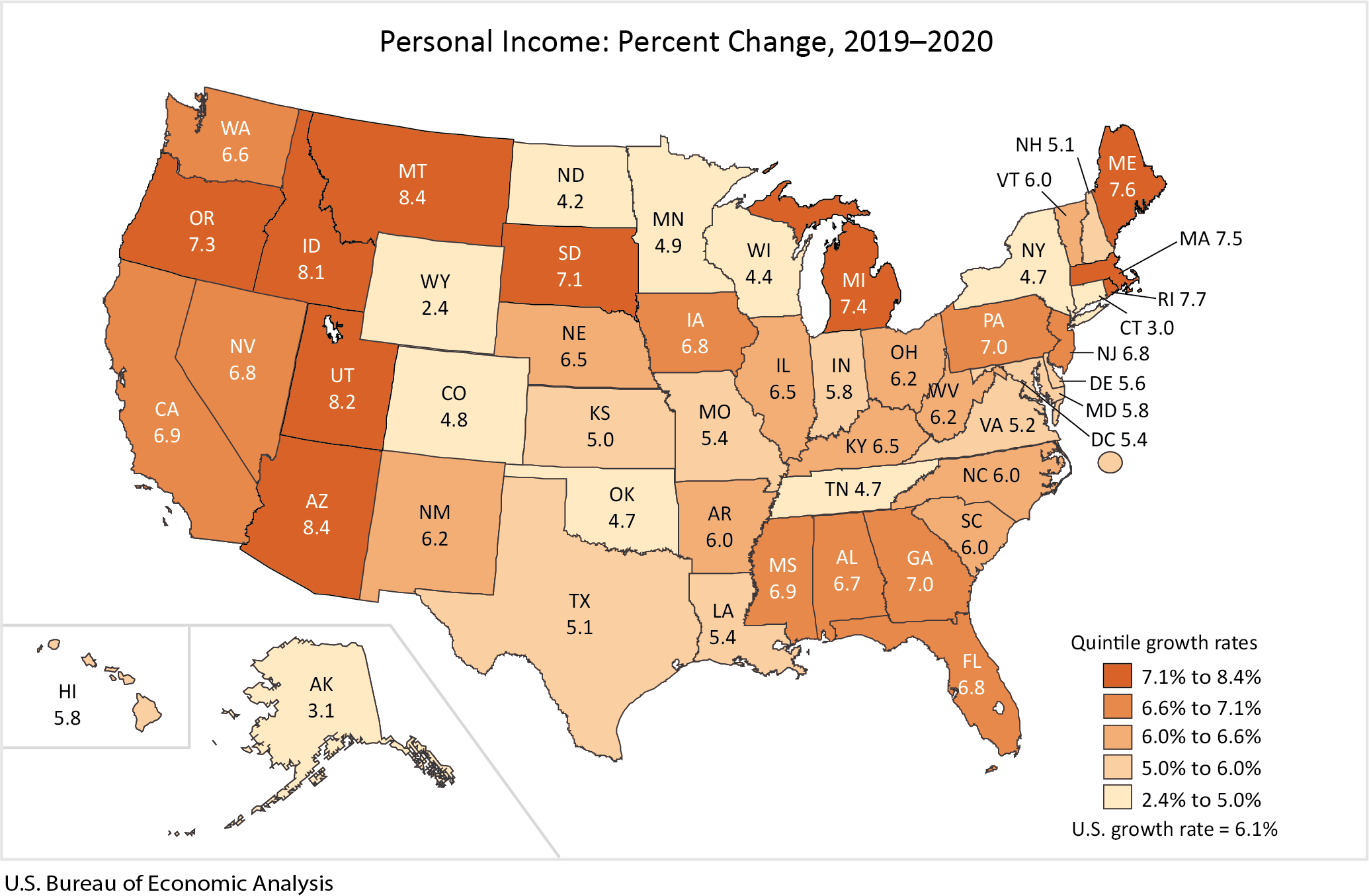
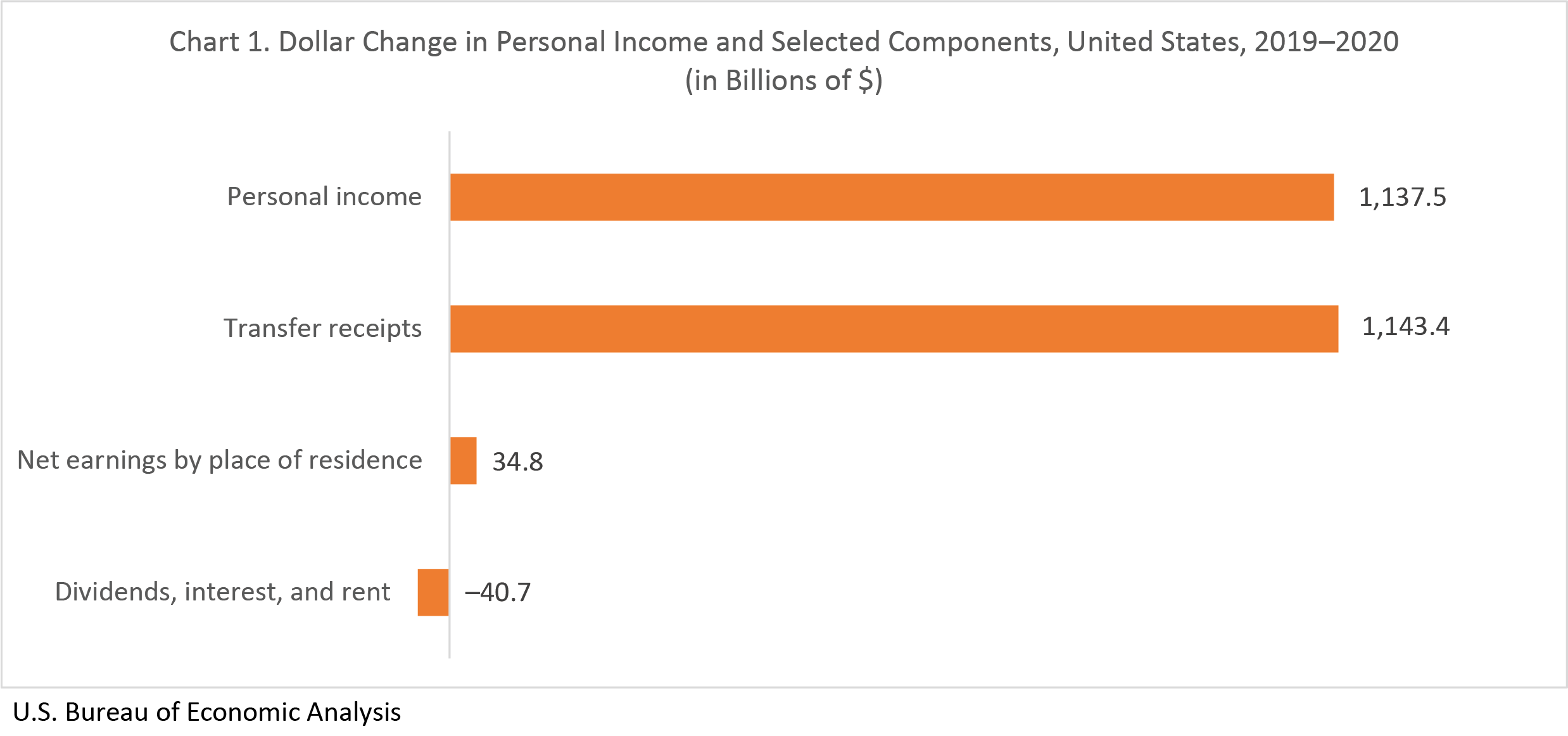
Transfer receipts increased 36.6 percent, accounting for the entire $1.1 trillion dollar increase in personal income for the nation in 2020 (chart 1). The increase in transfer receipts reflected new government relief payments provided by the Coronavirus Aid, Relief, and Economic Security (CARES) Act of 2020. Increases in earnings were more than offset by decreases in property income (dividends, interest, and rent).
Transfer receipts.
The increase in transfer receipts primarily reflected increases in state unemployment insurance compensation and in all other transfer receipts (chart 2).
Transfer receipts increased in all states and the District of Columbia, ranging from 64.2 percent in Hawaii to 23.9 percent in Arkansas (table 2).
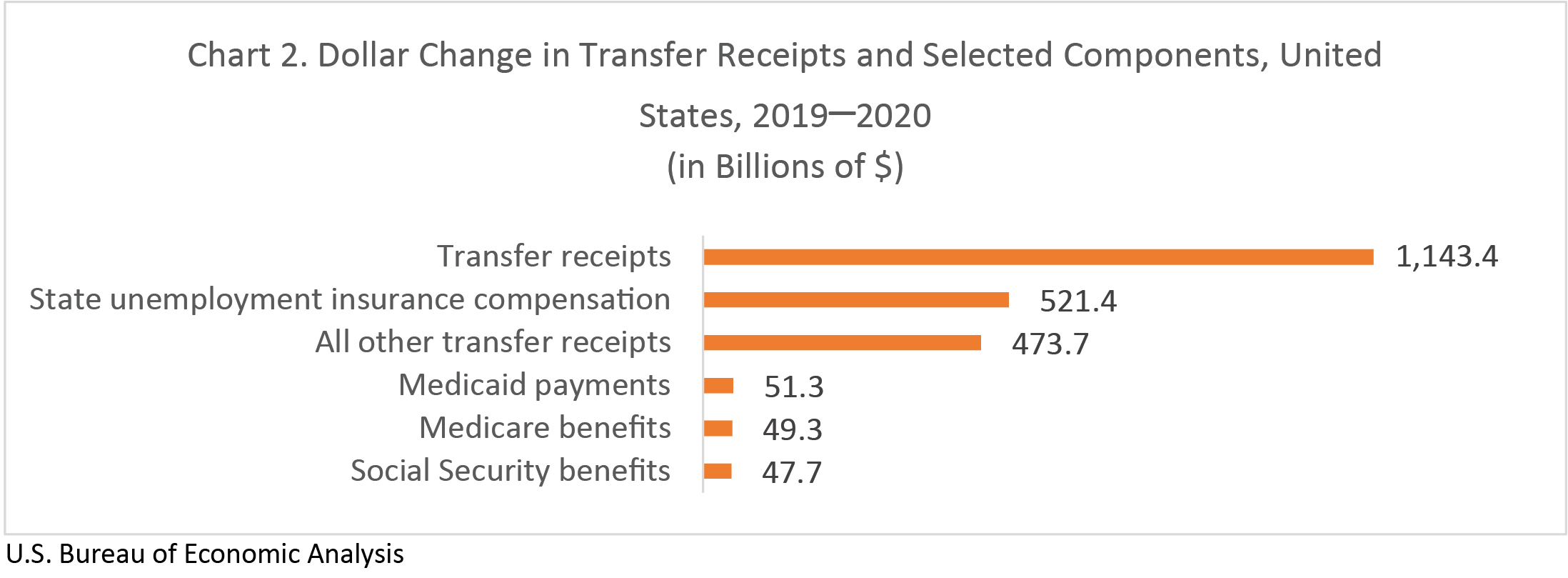
State unemployment insurance compensation was boosted by a temporary $600 increase in weekly benefits provided by the CARES Act as well as an expansion of eligibility of workers not previously covered by state unemployment compensation programs.
The increase in all other transfers primarily reflected the $1,200 economic impact payments to individuals.
Earnings. For the nation, earnings increased 0.3 percent in 2020 (table 2), the smallest increase since 2009.
> Earnings decreased in 10 of the 24 industries for which BEA prepares estimates (table 4).
> The largest decreases were in accommodation and food services and in arts, entertainment, and recreation.
> Earnings in 14 industries increased, with the largest increases in professional, scientific, and technical services and in finance and insurance.
> The percent change in earnings across all states ranged from 5.2 percent in Utah to –6.6 percent in Hawaii.
Property income. Property income decreased 1.1 percent for the nation in 2020 after increasing 1.3 percent in 2019. Property income decreased in all states and the District of Columbia, ranging from –0.4 percent in Hawaii, New Mexico, and West Virginia to –1.9 percent in South Dakota.
The 2020 estimates of state personal income were impacted by the response to the spread of COVID-19, as governments issued and lifted "stay-at-home" orders, and government pandemic assistance payments were distributed to households and businesses. The 2020 Q4 estimates of state personal income continue to be impacted by the response to the spread of COVID-19. Federal economic recovery payments slowed as pandemic-related assistance programs continued to wind down. The full economic effects of the COVID-19 pandemic cannot be quantified in the state personal income estimates because the impacts are generally embedded in source data and cannot be separately identified.
State Personal Income, Fourth Quarter 2020
State personal income decreased 6.8 percent at an annual rate in the fourth quarter of 2020 after decreasing 11.3 percent in the third quarter (table 5).
> Increases in earnings and property income were more than offset by decreases in transfer receipts.
> The percent change in personal income across all states ranged from 16.7 percent in South Dakota to –16.1 percent in Rhode Island and Pennsylvania (table 6).
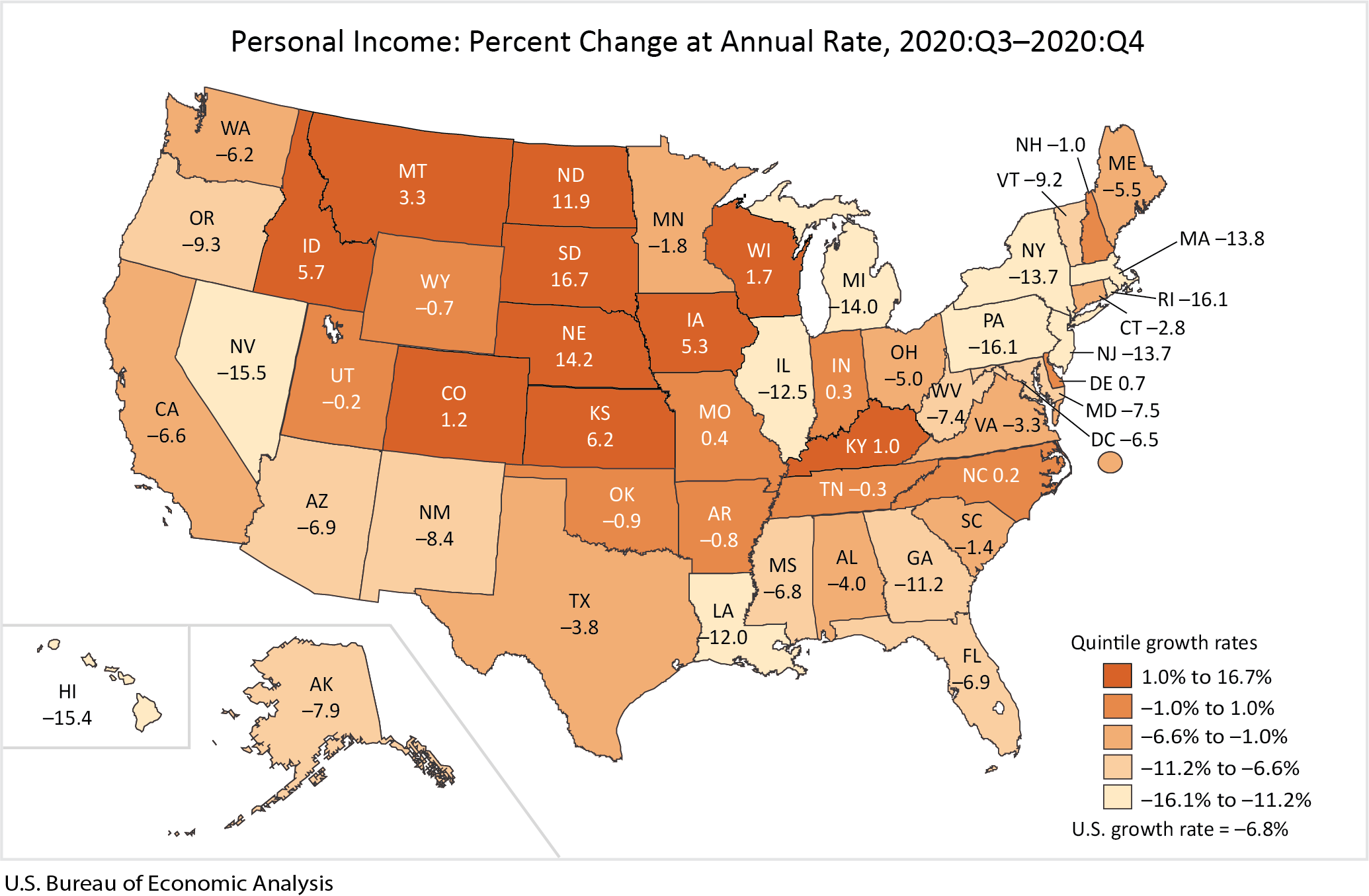
Farm earnings were the leading contributor to increases in personal income in South Dakota and seven other fast-growing states including Nebraska, North Dakota, Kansas, Idaho, Iowa, Montana, and Wisconsin.
> The increase in farm earnings followed increases in payments to farmers from the Coronavirus Food Assistance Program provided by the CARES Act.
> The decrease in transfer receipts in the fourth quarter of 2020 reflected a decrease in benefits from several other CARES Act programs including the expiration of the temporary $600 per week increase in state unemployment insurance compensation.
Today, BEA also released revised quarterly estimates of state personal income for the first quarter of 2020 through the third quarter of 2020.
Updates were made to incorporate source data that are more complete and more detailed than previously available and to align the state estimates with revised national estimates.
BEA also released revised quarterly estimates of population and per capita personal income for the first quarter of 2010 through the third quarter of 2020 and revised annual estimates of population and per capita personal income for 2010 through 2019.
Next release: June 22, 2021, at 8:30 A.M. EDT
Personal Income by State, 1st Quarter 2021
Thursday, March 25, 2021
Remembering Denise Heap In The Wake of The City of Mesa's New Non-Discrimination Ordinance
 Denise Heap July 2012
In Arizona, clash over LGBT rights plays out at city level
In Arizona, where no statewide equality safeguards exist for gay and transgender residents, the fight over whether to extend formal legal protections to those groups is playing out at the municipal level.
Only a few cities have been willing to step into the ring.
" . . Mesa began talks after a public-policy survey revealed discrimination continued to plague some of the city's minority groups. At a council study session in March, Mayor John Giles said he would be "interested in hearing from the community (about) what level of support there is" for each of the elements the ordinance could cover, such as hotels, restaurants and small businesses.
Longtime Mesa activist Denise Heap has urged adoption of a far-reaching ordinance, arguing the more holes poked into an anti-discrimination measure, the less effective it will be.
"We need this. We need it not just in hiring and employment and housing but also a totally inclusive policy in public accommodations," she told the Mesa City Council. "We need to ensure that every one of our residents and every one of our visitors ... is treated well when they visit the city."
[ Image Denise Heap June 2015 from Facebook https://m.facebook.com/denisea.heap/about ]
. . .In Mesa, Councilman Dave Richins said he wanted to be "really careful we don't create a law that can be used to, really, publicly shame someone if they don't want to make a wedding cake," referencing an Oregon case in which bakery owners who declined to make a same-sex couple's cake face tens of thousands of dollars in fines. . ."
-----------------------------------------------------------------------------------------------------------
The Mesa where Dea Montague chose to make his home nearly 50 years ago was "kinder and gentler" — at least when it came to politics. "I remember a day when there were three people running for the same seat," the civic activist and lawyer said. "And they helped each other put up signs." Fast forward to recent elections to see why Montague speaks in the wistful past tense.
Take 2011, which saw the historic recall of then-state Senate President Russell Pearce, the Mesa Republican who wrote the contentious Senate Bill 1070 and got slammed for accepting nearly $40,000 in trips, tickets and other perks from the Fiesta Bowl. . .The recall signaled the majority of Mesa voters were ready to move away from Pearce's single-minded focus on immigration and to see legislators tackle a broader set of issues.
Prominent Mesa Mormons in particular lined up to support Lewis, who, like Pearce, is a member of the Church of Jesus Christ of Latter-Day Saints. Pearce's "enforcement only" policies ran contrary to the church's official position on immigration, they said. The following year, Pearce attempted a comeback. Lewis' seat had been drawn into another district, so SkyMall founder and moderate Republican Bob Worsley stepped in to run against Pearce. After a heated primary campaign, Worsley trounced Pearce with 56 percent of the vote. But the 44 percent of voters who had supported Pearce didn't evaporate.
This year, Worsley's District 25 re-election bid has placed him squarely in the middle of arguably the most hostile race of the primary-election season — and to many onlookers, its "centrist vs. far right" dynamic is a replay of 2012 and the 2011 recall.This time, Worsley's competitor is Ralph Heap, a prominent orthopedic surgeon and active LDS church member who believes government's role in strengthening the economy is "to stay out of the way."
Locally, the race represents a battle for the ideological soul of Mesa, where leaders have been trying to shake the city's extremist political image in the hope of attracting high-profile companies, economic-development opportunities and tourism. The race's dynamics mirror those playing out between moderate and far-right conservatives both at the Arizona Legislature and throughout the nation, . .There's a sort of a side battle that has been occurring for some time in the Republican Party, in terms of the conflict between the more institutional, or traditional, right and the far right," said Merrill, an independent. "The average Republican voter is fairly conservative, of course, but the extreme right of the party falls way to the right of the mainstream." [according to veteran pollster and Arizona political scientist Bruce Merrill.]
Merrill estimated "ultra-right-wing" residents make up about 20 percent of Mesa's population, but they tend to be represented in disproportionately large numbers come election day. Given the makeup of Arizona's 30 legislative districts, where Republicans dominate, the outcome in the primaries generally sets the direction for the next Legislature.
Heap supporter Tom Brown said, "The more I looked into it and did my homework, I started seeing that Heap's position on many things" — such as avoiding "crony capitalism" and eliminating a reliance on unions — "was much closer to what I was looking for, . ."
Worsley isn't hurting for supporters, however — in Mesa or elsewhere. He recently scored a rare endorsement from former Republican presidential candidate Mitt Romney, who said, "Arizona needs the conservative leadership and experience Bob possesses."
Worsley said he ran in 2012 on a platform of "elevating the policies and bills that we run at the Capitol" and overhauling the "image that, as a state, we are extremists."
"Create an inclusive, respectful, and equitable community."
 | The Human Relations Advisory Board advises the City Council about racial, religious, ethnic, cultural, disability or other human relations issues affecting the City of Mesa and delivery of City services to Mesa residents, businesses, and visitors.
|
Posthumous Honor on A New Bank of England 50-Pound Note

The new £50 note featuring Alan Turing is coming on 23 June 2021. Find out about its design and security features: https://t.co/nbOlU9kgCU#TheNew50pic.twitter.com/FhPBJAVFP6
— Bank of England (@bankofengland) March 25, 2021
"Hypocritical for the UK government to act so happy you're putting him on a note when you literally chemically castrated him because he was gay," declared one Twitter user, while another wrote, "Glad he's being honoured but we can't forget what happened."
State sanctioned homophobia literally killed Alan Turing. https://t.co/5JIFquDxxD
— Ruth Sangree (@Ruth_Sangree) March 25, 2021
Others complained about Turing being put on an infrequently used bank note that isn't accepted in many shops, and called on the government to ban gay conversion therapy in his honour.
Sure let's put a gay man on a note that isn't accepted in a lot of places oh the bloody irony 🤦🏻♂️ https://t.co/F3zAxDxIKc
— 🌈🐇Vincent Van Goth🦇🌱 (@gonegal) March 25, 2021
While I’m sure he’d be flattered, I reckon Turing would rather see the Government ban conversion therapy, the (currently legal) form of LGBT torture that he was subjected to before he died in 1954 https://t.co/MBlx03fG6j
— matt horwood (@matthewhorwood) March 25, 2021
The BBC also came under fire for its report on the bank note, with social media users accusing the state-owned news outlet of having "brushed over" Turing's persecution and being loose on the details.
BBC news announces that Alan Turing be the face on a new bank note. Acknowledging he was a brilliant man responsible for breaking the enigma code and inventing the first computer. They avoid detail about the persecution against his sexuality and his chemical castration.#bbcnews
— Lizzy Wicks (@lizzywicks) March 25, 2021
Alan Turing celebrated this morning for his contribution in helping us shorten the 2nd World War they didn't mention he was arrested & prosecuted for homosexual acts chemically castrated as an alternative to prison & less than 2 years later committed suicide BBC obscuring history
— Barbara (@BarbaraSutton15) March 25, 2021
Saw the BBC news report on Alan Turing on the £50 note, hoping for a bit of reflection on how appallingly he was treated for his sexuality and LGBT+ representation in the reportObviously they completely brushed over that aspect of his life, just disappointing but not surprising— Cllr Luke Jeffery 🔶🏳️🌈 (@lukeejeffery) March 25, 2021
Though the BBC did note that Turing was prosecuted for his homosexuality, it did not mention that he was chemically castrated, nor did it speak in detail of his persecution.

ANOTHER LAUNCH AND ANOTHER SMALL BUSINESS TOOLBOX Started in February 2021 to add to Mesa's HUUB



"When the pandemic hit, we recognized the critical need to support Mesa's small businesses with tools and resources to weather the storm," Mayor John Giles said. "We provided vital assistance through Mesa CARES, and today we're excited to expand this effort by providing these business tools and many others via MesaBusinessBuilder.com."
In addition, at MesaBusinessBuilder.com, Mesa businesses can connect to Mesa's HUUB, our online small business digital networking platform that features more than 70 FREE webinars on searchable topics ranging from social media marketing to branding to debt restructuring to operating in and after a pandemic. Mesa businesses can join more than 350 other Mesa companies to network, share ideas, and boost their growth. The Mesa HUUB will be growing with more events, trainings, shoutouts, and new additions in the coming months. Businesses can join this FREE program to stay in touch with the Mesa small business community and the latest news and upcoming happenings.
"Small businesses often don't know where to turn for help when starting or expanding their operations," City of Mesa Economic Development Director, Bill Jabjiniak stated. "Whether starting, relocating, or expanding in Mesa, small businesses can count on MesaBusinessBuilder.com to provide them with the resources they need to succeed at every stage of business growth. We are committed to helping Mesa companies grow and prosper."
To learn more about MesaBusinessBuilder.com, contact Kelley Keffer at 480-644-6958 or Kelley.Keffer@mesaaz.gov.
Office of Economic Development
Contact: Kim Lofgreen
Tel. 480-644-3962
kim.lofgreen@mesaaz.gov
more
Data-Driven Hocus-Pocus: The City of Mesa's Most Recent "Strategic Plan" To Do What? ADRESSING HOMELESSNESS
24 February 2016
The Mayor's Own Challenge to End Veteran Homelessness > Keeping The Promise?

No chance "to under-promise and over-deliver" on this - it's more than "we can" - it is swearing to an oath to finish the goal within one year and complete the criteria to get confirmation from the U.S. Department of Housing & Urban Development. The Mayor of New Orleans did just accomplished, as promised. - with No newspeak
As usual a lot of fanfare and skimpy details left out of Mesa Now press releases coming out of City Hall

City of Mesa announces Strategic Plan for Addressing Homelessness
March 24, 2021 at 12:45 pmThe City of Mesa today released its Strategic Plan for Addressing Homelessness, to help Mesa-based homeless recover and transition to stable housing during and after the COVID19 pandemic. Through the investment of federal funding, including funds from the CARES Act, Mesa will focus on supportive infrastructure and systematic steps, referred to as the Housing Path to Recovery.
Using a data-driven process and collaborative community partnerships within the region, Mesas plan endeavors to keep homelessness rare, brief and non-reoccurring.
"Mesa is a compassionate community, and this plan provides a balanced approach to support those most in need while also working toward community safety in public spaces, like our parks and libraries,"said Mesa Mayor John Giles. "This is a strong plan for Mesa."
"Mesas Strategic Plan for Addressing Homelessness is clear, comprehensive and adaptable," said Vice Mayor Jen Duff. "This will be a tremendous tool for Mesa residents and to City Council as we continue to address the growing needs for those experiencing homelessness."
Mesas Strategic Plan to Address Homelessness is available in its entirety on the City of Mesas website at: mesaaz.gov/homeless.
Contact:
Mayors Office
Contact: Casey Blake
Tel. (480) 644-3662
casey.blake@mesaaz.gov
-----------------------------------------------------------------------------------------------------------------------------

At one point-in-time in a public meeting, District 1 Mesa City Councilmember Mark Freeman, ensconced comfortably in his own family compound-enclave, reacted to seeing the homeless on public transit as 'the awfulness'.
In one of the first reactions to the extension of lightrail service into downtown Mesa, city officials wanted a police bike patrol first of all.

____________________________________________________________________________
17 September 2018

Let's start off with saying that
ENGAGED RESIDENTS MAKE MORE EFFECTIVE GOVERNMENT
Mesa Has A Problem
Many people here in Mesa might consider the homeless a nuisance.
That issue was addressed here in a report from Arizona Attorney Digital Mag
One of the major findings > Working to develop more permanent supportive housing is the true answer.*
Nuisance and Vagrancy Laws: The New Exclusionary Zoning

< What’s Going on in Arizona?

21 December 2020
The 2020 PIT Count was conducted on January 28, 2020.

City Staff "Talking Heads" Produce Another Scripted Summit
Point-in-Time Count
The Point-in-Time (PIT) Homeless Count is an annual street and shelter count to determine the number of people experiencing homelessness in Maricopa County during a given point in time. This count is part of a national effort to identify the extent of homelessness throughout the country. The count includes a brief survey to identify the needs of those experiencing homelessness in the community. MAG coordinates the PIT Count each year for the Maricopa Regional Continuum of Care. MAG serves as the hub of collaboration between the Continuum of Care and local communities. The 2020 PIT Count was conducted on January 28, 2020.
Please Note: There are a number posts on this blog for related content from prior years that will help readers assess if the city government - and its administrators - have produced positive outcomes or if the issues and numbers of the homeless population have increased over time. It's a reality-check no matter what they say all the time year-after-year. Obviously they are trying once again to manipulate the news - as you can see right from the start when District 4 City Council member Jennifer Duff has to correct the mayor directly that the homeless are not just visible downtown. . .
-----------------------------------------------------------------------------------------------------------------------------

-
 Flash News: Ukraine Intercepts Russian Kh-59 Cruise Missile Using US VAMPIRE Air Defense System Mounted on Boat. Ukrainian forces have made ...

