
- Air Force to buy up to 1,000 missiles for B-52, B-21 planes
- Award comes as Pentagon starts new Nuclear Posture Review
Saturday, July 03, 2021
SUSPICIOUS BEHAVIOR NOT CAUGHT IN A SCREEN-GRAB Any Way and Any How > ZOOM REMOTE Mesa Council Study Session - 7/1/2021
Now really there's not much that District 2 Council member Julie Spilsbury had to
say . . . A slide presentation on proposed internal city audits starts at 14:00 running
for about 10 minutes. Lots of banter that looks like time-killers
An announcement by Hizzoner that he will be "on a family-vacation" and that Vice-Mayor
Jennifer Duff will be in charge in what might be controversial meetings on next Thursday
July 8th...and
O YEAH > Summer Break Starts July 9 - until August 19th
Another retirement after after 23 years for Heather Wolf, who's given a send-off by
John Pombier.
Everything closely monitored byCity Manager Chris Brady
GOTCHA AGAIN ONE MORE TIME!
"The Blame-Game" goes on and it's getting us nowhere fast to strengthen international information security

‘Colossal and devastating’ ransomware attack targets hundreds of US companies, cyber researchers say
"A ransomware attack appears to be underway against the remote IT management platform Kaseya, affecting many of its clients, the US cyber security agency said. Researchers blame the same hackers who went after the meatpacker JBS.
The US Cybersecurity and Infrastructure Security Agency (CISA) said on Friday evening it was “taking action to understand and address the recent supply-chain ransomware attack against Kaseya” and providers that employ their software.
Supply chain attack of Kaseya, commonly used in managed service provider environments in the United States, leading to mass ransomware event.Details in link and thread as they develop:https://t.co/YStENYMTdW
— Kevin Beaumont (@GossiTheDog) July 2, 2021
Kaseya has taken their cloud service offline. It initially said 200 companies were affected, but later changed that to “a small number.” Neither the company nor CISA have said anything about how the hackers may have gained access.
John Hammond of the cybersecurity firm Huntress Labs said “thousands” of computers were affected. “We currently have three Huntress partners who are impacted with roughly 200 businesses that have been encrypted,” he said, calling it a “colossal and devastating supply chain attack.” . . .
While the US government has blamed last year’s SolarWinds breach on Russia – Moscow has denied any involvement, calling the insinuations “absurd”and “pathetic” – the Kaseya hack seemed to be the work of REvil, a group many US researchers have described as “Russian-speaking.”
“Based on everything we are seeing right now, we strongly believe this (is) REvil/Sodinikibi,” Hammond said. . .
While the White House did not blame Russia for the JBS attack, White House Press Secretary Jen Psaki said that “responsible states do not harbour ransomware criminals” after the FBI pointed to REvil as the likely culprit behind the breach.
Cyber-sleuths also don’t believe the timing of the reported Kaseya hack was an accident. It came as the US was gearing up for a three-day weekend to celebrate the Independence Day holiday, and many companies as well as government agencies were closing up shop early.
“There’s zero doubt in my mind that the timing here was intentional,” Jake Williams of Rendition Infosec told AP.

Washington has repeatedly accused Moscow of either orchestrating cyber attacks on US infrastructure or “harboring criminal entities” that do so. Last month’s summit between US President Joe Biden and Russian President Vladimir Putin in Geneva prominently featured a discussion on hacking.
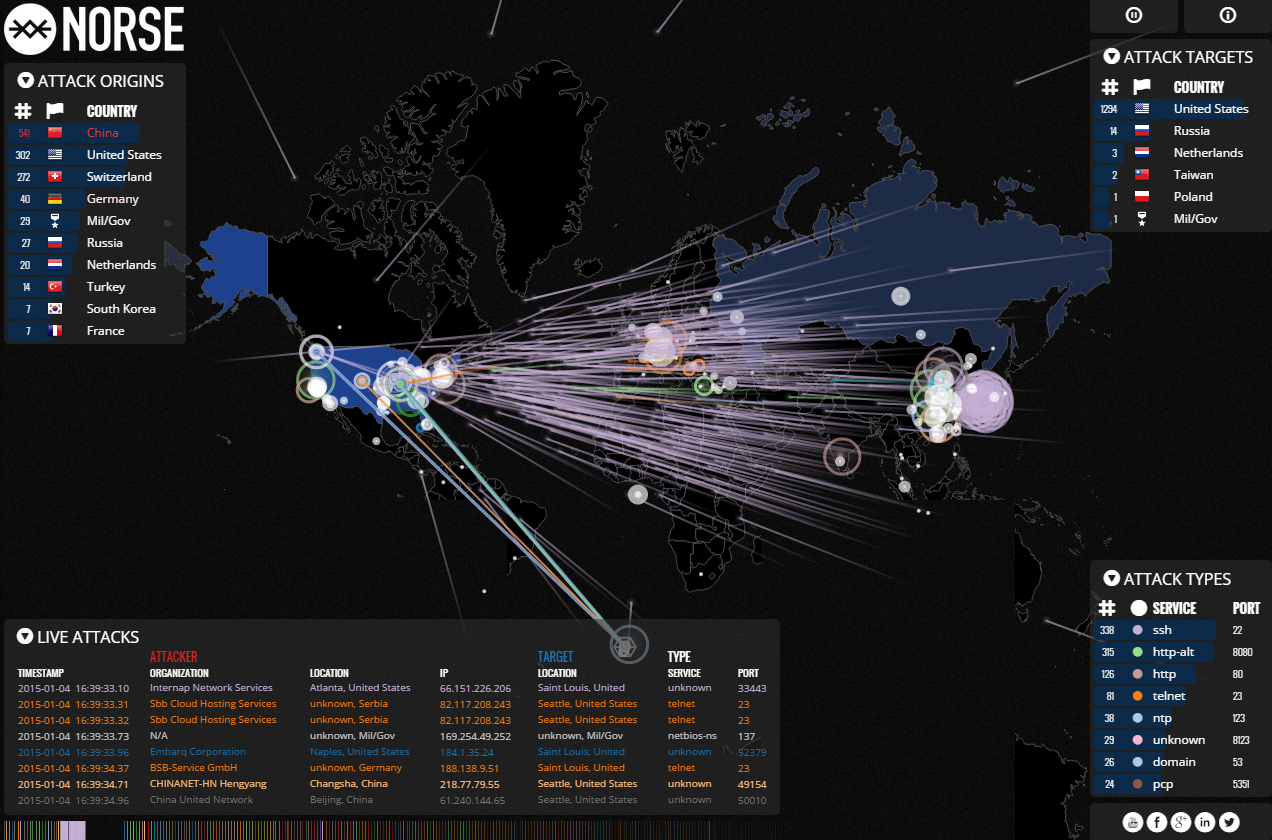
WHO'S ATTACKING WHO? . .On Friday morning, the Russian Embassy in Washington issued a statement noting that “constant attacks on critical infrastructure in Russia” are coming from US soil, and expressed hope the Americans would “abandon the practice of unfounded accusations and focus on professional work with Russian experts to strengthen international information security.”
=========================================================================
Who’s Attacking Whom?
Realtime Attack Trackers
It seems nearly every day we’re reading about Internet attacks aimed at knocking sites offline and breaking into networks, but it’s often difficult to visualize this type of activity. In this post, we’ll take a look at multiple ways of tracking online attacks and attackers around the globe and in real-time.
A couple of notes about these graphics. Much of the data that powers these live maps is drawn from a mix of actual targets and “honeypots,” decoy systems that security firms deploy to gather data about the sources, methods and frequency of online attacks. Also, the organizations referenced in some of these maps as “attackers” typically are compromised systems within those organizations that are being used to relay attacks launched from someplace else.
The Cyber Threat Map from FireEye recently became famous in a 60 Minutes story on cyberattacks against retailers and their credit card systems. This graphic reminds me of the ICBM monitors from NORAD, as featured in the 1984 movie War Games (I’m guessing that association is intentional). Not a lot of raw data included in this map, but it’s fun to watch.
Modernizing The Military: The Nuclear Triad Gets Go Ahead with New $2B Contract
Missiles and more missiles to deliver nuclear weapons by air, land and sea. In its latest review of long-term triad costs, the Congressional Budget Office estimated in May that if carried out, the Pentagon and Energy Department’s nuclear forces plans would cost a total of $634 billion through 2030. The Air Force declined to release the new cruise missile’s development and procurement cost estimates.
Raytheon Awarded $2 Billion Contract for Nuclear Cruise Missile
By Anthony Capaccio
" Raytheon Technologies Corp. was awarded a contract worth as much as $2 billion to develop a new nuclear cruise missile, the first major Biden administration move to field replacements to America’s aging nuclear arsenal, the Pentagon said Thursday.
The Air Force plans to buy up to 1,000 Long-Range Standoff Weapons to replace the Air Launched Cruise Missile first fielded in 1982. The new weapon, if fielded, would be carried on B-52 and B-21 bombers.
The next-generation cornerstones of the so-called nuclear triad are the Navy’s Columbia-class submarine, the Air Force’s new ICBM known as the Ground-Based Strategic Deterrent and an upgraded nuclear command and control infrastructure.
Work on the new cruise missile will be performed in Tucson, Arizona, and is expected to be completed in early 2027. It will form the basis of a production decision later that year, the Air Force said Thursday. The missile would be paired up with a new W80-4 warhead under development by the Energy Department’s National Nuclear Security Administration. The W80-4 will be the first warhead designed for use with a new missile since nuclear testing ended in 1992. The integration and certification must be accomplished without additional explosive nuclear testing
. . .The contract award was made even as the Pentagon launches a new Nuclear Posture Review, which could revive debate about America’s nuclear strategy, the types of weapons that should be procured and their costs.

. . .The Government Accountability Office warned last year that the National Nuclear Security Administration was sticking to a September 2025 first delivery date for the W80-4 warhead in spite of program risks. NNSA, which manages the development of U.S. nuclear weapons, did a credible job developing the program’s cost estimate but “has introduced potential risk” by adopting “an unrealistic” first delivery date “that is more than 1 year earlier than the date projected by the program’s own schedule risk analysis,” GAO said.
Friday, July 02, 2021
Trump Deja Vu Season 6: Running-The-Tables To Turn Over The State's Elections Laws
Law-and-Order . . . . . . . . . . . . . . . . . . . . . . . . . . . . . . . . . . . . . . . . . . . .Free-and-Fair Elections
"In June, 200 prominent American scholars of democracy signed a letter warning that changes to state laws are “transforming several states into political systems that no longer meet the minimum conditions for free and fair elections”. Another longtime student of American democracy, the Republican leader in the Senate, Mitch McConnell, said in January that if an election could be overturned by fact-free allegations from the losing side, “Our democracy would enter a death spiral.”
Yet that is just what his party is facilitating.

The real risk to America’s democracy
Elections
HAVING CAMPAIGNED for the presidency on a promise to rejuvenate democracy around the world, Joe Biden finds himself in a battle to defend it at home. . . For Democrats the threat to elections is about who can cast votes.
They decry changes to laws on identification, postal ballots and so on, which they call “the new Jim Crow". Instead the real threat comes after votes have been cast.
> In Arizona, for example, the legislature wants to limit the independence of the chief elections officer; a state representative introduced a law letting the legislature overturn the results of a presidential election, and then started campaigning to oversee elections herself.
> In Georgia the state legislature can now replace the leadership of county election boards.
> Texas is considering a bill that makes it easier to prosecute election officials. Across the country, the officials who administer elections in states where Republicans hold sway have been attacked for upholding the election results. Many are at risk of being replaced.
These might seem like distant, bureaucratic changes. In fact they raise the chances of a contested election that the courts cannot sort out. They weaken America’s voting system in ways that will outlast the hysteria over the 2020 result.
Trump may or may not run again. By contrast, the changes to state election machinery being made by Republican legislators will be in place in 2024 and beyond for a candidate of either party to exploit. The greater risk is that the chaos following the 2020 election becomes normal.
The silent non-Trump faction of the Republican Party may hope that all this will blow over and that those sounding the alarm about democracy are exaggerating. They may believe they can play a greater role in safeguarding America so long as they stay on good terms with their base.
Yet that logic has proved faulty since Mr Trump’s inauguration in 2016
Subscribe to:
Posts (Atom)
TOMORROW > Angel Robles
ANGEL ROBLES is k nown for an eclectic set list t hat spans multiple genres, . . He utilizes loop pedals, acoustic guitars, and backing...

-
 Flash News: Ukraine Intercepts Russian Kh-59 Cruise Missile Using US VAMPIRE Air Defense System Mounted on Boat. Ukrainian forces have made ...
 -
A nor’easter is about to hit the Northeast in May. That’s very unusual.

