Saturday, August 07, 2021

On Language: KINDERGARTEN (German word) All of This + More Than Baby-Sitting, Daycare, Pre-School

Looks like it's an either-or-choice in different degrees and silos where the origins were places where children could be nurtured, grow and thrive. You can quickly see how fast it's been changed - not only the consequence of Pandemic disruptions

The Kindergarten Exodus

As the pandemic took hold, more than 1 million children did not enroll in local schools. Many of them were the most vulnerable: 5-year-olds in low-income neighborhoods. 

PHILADELPHIA — On a sweltering July afternoon, Solomon Carson, 6, jumped off the stoop of his family’s tidy rowhouse in West Philadelphia, full of what his father, David, called “unspent energy.”

When a stranger asked his name, he answered brightly, but added that he couldn’t spell it. “I can help you with that,” his father said, patiently pronouncing each letter, with Solomon repeating after him.

Solomon was supposed to have learned the basics in kindergarten this past year, but his first year of formal education was anything but.

When Covid-19 closed classrooms, his parents chose not to enroll him in city schools that they already had doubts about. As they were not working, they decided to teach him at home along with his two older brothers. And they signed him up for a virtual charter school that advertised in-person tutoring — and failed to provide it. . .

Solomon is part of a vast exodus from local public schools.

As the pandemic upended life in the United States, more than one million children who had been expected to enroll in these schools did not show up, either in person or online. The missing students were concentrated in the younger grades, with the steepest drop in kindergarten — more than 340,000 students, according to government data.

Fall enrollment change by grade, 2019 to 2020

12th

11th

10th

8th

+1.1%

+0..8%

K

1st

2nd

3rd

4th

5th

6th

7th

9th

+0.6%

+0.6%

–0.8%

–1.5%

–2.7%

–3.0%

–3.4%

–3.7%

–3.8%

–4.1%

–9.3%

Sources: National Center for Education Statistics; Illinois State Board of Education

By Alicia Parlapiano and Jugal Patel

Now, the first analysis of enrollment at 70,000 public schools across 33 states offers a detailed portrait of these kindergartners. It shows that just as the pandemic lay bare vast disparities in health care and income, it also hardened inequities in education, setting back some of the most vulnerable students before they spent even one day in a classroom.

The analysis by The New York Times in conjunction with Stanford University shows that in those 33 states, 10,000 local public schools lost at least 20 percent of their kindergartners. In 2019 and in 2018, only 4,000 or so schools experienced such steep drops.

The months of closed classrooms took a toll on nearly all students, and families of all levels of income and education scrambled to help their children make up for the gaps. . .

READ MORE > https://www.nytimes.com/2021/08/07/us/covid-kindergarten-enrollment.html
 

TURKEY’S BAYKAR PREPARING SHIPBORNE FLEET OF COMBAT DRONES || 2021

LESSONS WE LEARNED FROM HISTORY / Should we be worried about technology? | The Economist

SUSPICIOUS OBSERVERS NEWS Sat 07 Aug 2021: Serious Volcano Risk, Earth Rotation Glitches, Moon Magnetism

CBDC/Stable-Coins: Central Banks Realize They Need To Provide An Alternative To Money - or The Future Will Pass Them By > The World Wide Crypto Market In Different Phases of Development

Today an information-piece mostly about another form of fun-gible money soon becoming more fungible in the sense it is 'legal tender' of a different kind - digital versions of already existing currencies that are issued, governed and backed by a central bank. You know, talking the place of what we used to rely on and have confidence in: gold and silver held in stockpile reserves that we could exchange for paper money that traded hands.
First up > Source
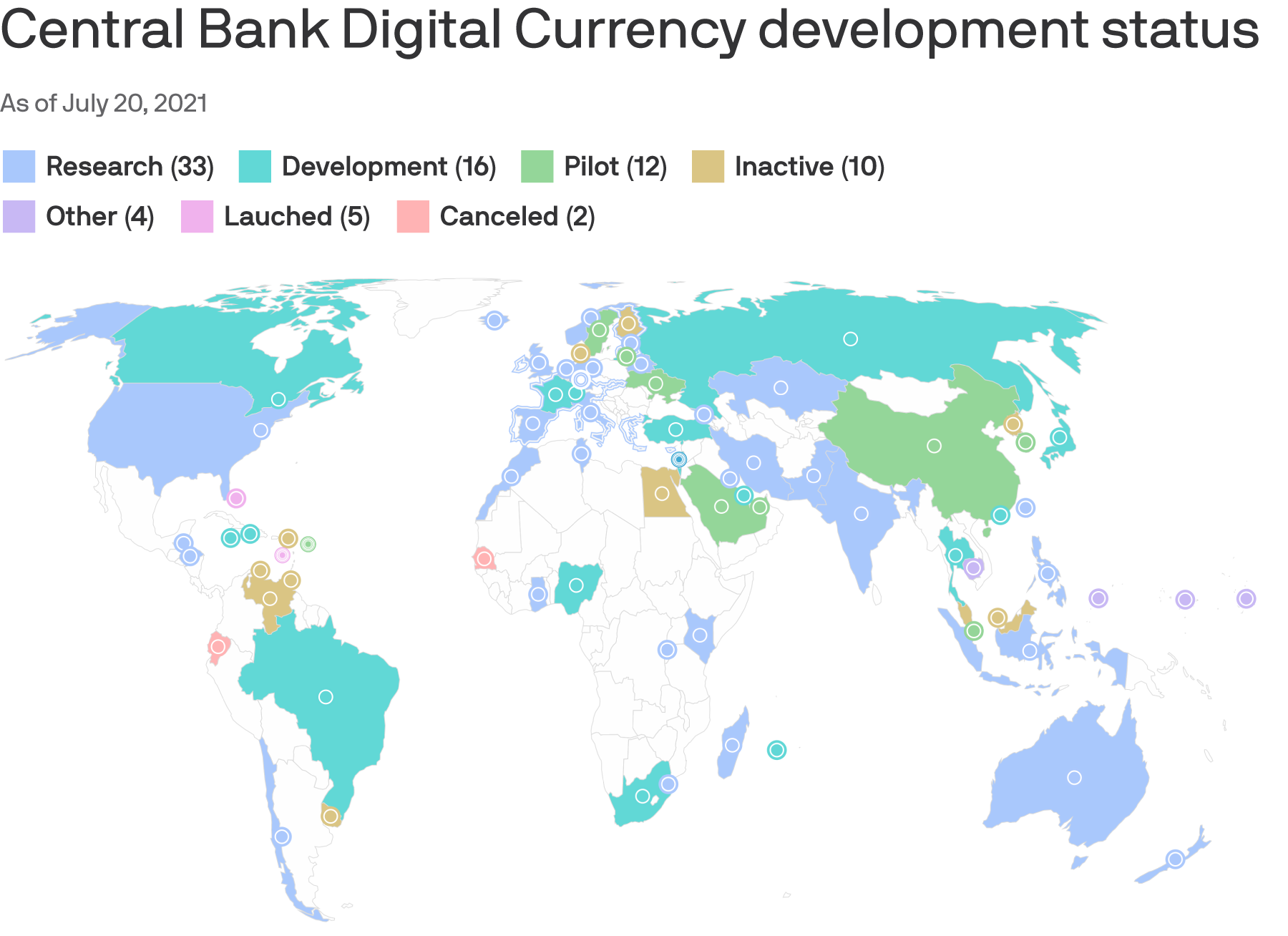
A map of countries exploring digital currencies
 
Insert copy > "Central bank digital currency (CBDC) is probably not top of mind for most global consumers. But we may soon have no choice but to think about it — since 81 countries, representing over 90% of global GDP, are now exploring the development of one.
Why it matters: The U.S. lags much of the world. It could miss out on the opportunity to take a leadership role in an increasingly likely global transition to some form of digital currencies.
  • "If the U.S. doesn't help standard-set and provide guidance on issues like privacy and cybersecurity, we could be headed into a fractured digital currency ecosystem that threatens the smooth operation of international finance," Josh Lipsky, director of the Atlantic Council's GeoEconomics Center, tells Axios.

Driving the news: The Atlantic Council, a think tank that will testify at a July 27 Congressional hearing on CBDCs, gave Axios a first look at its new interactive map showing just how many world governments are now considering it.

The backstory: CBDCs are digital versions of existing currencies — legal tender issued, governed and backed by a central bank.

State of play: China is furthest along among major global powers, having launched its pilot digital yuan in April.

  • A total of 16 other countries are in the pilot phase or have launched, and another 15 countries have CBDCs in development.
  • The U.S. is one of 33 countries still in the research phase.

What's next: Fed chair Jerome Powell has said that the U.S. central bank won't issue a CBDC without Congressional approval.

  • In response, Congressional committees have stepped up their inquiries. Tuesday's hearing is before the House Financial Services Committee and will focus on national security implications.

The bottom line: The U.S. doesn't need to create a digital dollar immediately in order to have an impact on the development of digital currencies, Lipsky says.

  • But it should engage with groups like the G7 and G20 nations to set standards for security and privacy, he adds
____________________________________________________________________________
MORE DETAILS
Insert copy >

Central Bank Digital Currency Tracker

SCROLL TO EXPLORE

What exactly is a Central Bank Digital Currency (CBDC)?

A CBDC is virtual money backed and issued by a central bank. As cryptocurrencies and stablecoins have become more popular, the world’s central banks have realized that they need to provide an alternative—or let the future of money pass them by.

81 countries (representing over 90 percent of global GDP) are now exploring a CBDC.

In our original report published in May 2020, only 35 countries were considering a CBDC.

China is racing ahead, including by allowing foreign visitors to use digital yuan if they provide passport information to the People’s Bank of China during the upcoming Winter Olympics.

Of the countries with the 4 largest central banks (the US Federal Reserve, the European Central Bank, the Bank of Japan, and the Bank of England), the United States is furthest behind.

> 5 countries have now fully launched a digital currency. The Bahamian Sand Dollar was the first CBDC to become widely available.

> 14 other countries, including major economies like Sweden and South Korea, are now in the pilot stage with their CBDCs and preparing a possible full launch.

Without new standards and international coordination, the financial system may face a significant currency exchange problem in the future.

What precisely will the US Treasury Department do about the rise of digital currencies? Secretary Yellen and Federal Reserve Chairman Jerome Powell should quickly harness the potential of these evolving financial tools, including a US-backed digital dollar.

Digital payment systems are bringing millions of unbanked and underbanked online and rapidly revolutionizing global finance.

But new technology brings new challenges. From cybersecurity to sanctions evasion to money laundering. Should more governments step in and create their own Central Bank Digital Currencies (CBDCs)? What are China’s ambitions for its digital yuan? Can a transatlantic cooperative project can set new standards on digital currencies and ensure stable and transparent cross-border payments?                           


Insert map

Friday, August 06, 2021

How Altcoins Like Ether And USDC (and DogeCoin) Took Over More And More Of The Crypto Market

On Language Again: 'The Proof is in The Pudding'

Just happened to half tune-in to an interview with AZ Bisexual Democratic Senator Kirsten Sinema - who likes to straddle both sides of Congressional politics - using nearly every buzzword in the current book of push-button hot points, when out jumped an old phrase "The Proof is In The Pudding" - when's the last time you had some of that treat or snack?
> HERE IS Proof there is more than what's in the Pudding:
In the AM on ArsTechica today

Climate contrarians predicted the world would cool—it didn’t 

A stylized photograph of the Sun renders it blue.

The anticlimate-science blogosphere’s trophy cabinet is bare.

> HERE"S Proof there is more than what's in the Pudding:
In the PM today on ArsTechnica today

Facebook blocks research into political ads, falsely blames FTC privacy order

FTC says Facebook privacy settlement doesn't require blocking researchers.

<div class=__reading__mode__extracted__imagecaption>EnlargeGetty Images | GreyParrot

Insert copy >

When Facebook disabled the accounts of New York University researchers who were investigating misinformation and political ads on the platform, the social-media giant claimed it did so to comply with a consent decree that it previously agreed to with the Federal Trade Commission. "We took these actions to stop unauthorized scraping and protect people's privacy in line with our privacy program under the FTC Order," Facebook wrote in its explanation of the account suspensions. Facebook said it "disabled the accounts, apps, Pages and platform access associated with NYU's Ad Observatory Project and its operators."

But Facebook's claim that the FTC order forced it to suspend the researchers is false, FTC Bureau of Consumer Protection Acting Director Samuel Levine wrote in a letter to Facebook CEO Mark Zuckerberg on Thursday. The FTC order did require Facebook to create a privacy program, but there was no requirement that would have forced Facebook to shut down the NYU research project. Despite that, Facebook's statement that it suspended the accounts "in line with our privacy program under the FTC Order" conveys the false message that Facebook had no choice in the matter.

Levine's three-paragraph letter to Zuckerberg said:

I write concerning Facebook's recent insinuation that its actions against an academic research project conducted by NYU's Ad Observatory were required by the company's consent decree with the Federal Trade Commission. As the company has since acknowledged, this is inaccurate. The FTC is committed to protecting the privacy of people, and efforts to shield targeted advertising practices from scrutiny run counter to that mission.

While I appreciate that Facebook has now corrected the record, I am disappointed by how your company has conducted itself in this matter. Only last week, Facebook's General Counsel, Jennifer Newstead, committed the company to "timely, transparent communication to BCP staff about significant developments." Yet the FTC received no notice that Facebook would be publicly invoking our consent decree to justify terminating academic research earlier this week.

Had you honored your commitment to contact us in advance, we would have pointed out that the consent decree does not bar Facebook from creating exceptions for good-faith research in the public interest. Indeed, the FTC supports efforts to shed light on opaque business practices, especially around surveillance-based advertising. While it is not our role to resolve individual disputes between Facebook and third parties, we hope that the company is not invoking privacy—much less the FTC consent order—as a pretext to advance other aims."   . .

Researchers deny Facebook claims

When suspending the NYU researchers, Facebook said the Ad Observer browser extension "was programmed to evade our detection systems and scrape data such as usernames, ads, links to user profiles and 'Why am I seeing this ad?' information, some of which is not publicly viewable on Facebook. The extension also collected data about Facebook users who did not install it or consent to the collection."

The researchers deny this, with Edelman telling NPR, "We really don't collect anything that isn't an ad, that isn't public, and we're pretty careful about how we do it."

The Ad Observer website says the browser extension does not collect any personally identifying information. "It copies the ads you see on Facebook and YouTube, so anyone can see them in our public database," the site says. "If you want, you can enter basic demographic information about yourself in the tool to help improve our understanding of why advertisers targeted you."

This is important because . . ."

READ MORE > Jon Brodkin -  Ars Technica | 8/6/2021, 12:00 PM