Thursday, September 09, 2021

INTRODUCTION TO SCI-HUB [taken from a report by Glyn Moody published yesterday in Techdirt]

FYI: Reproduced in this post  

Sci-Hub Celebrates 10 Years Of Existence, With A Record 88 Million Papers Available, And A Call For Funds To Help It Add AI And Go Open Source

from the paypal-not-accepted dept

To celebrate ten years offering a large proportion of the world's academic papers for free -- against all the odds, and in the face of repeated legal action -- Sci-Hub has launched a funding drive:

Sci-Hub is run fully on donations. Instead of charging for access to information, it creates a common pool of knowledge free for anyone to access.

The donations page says that "In the next few years Sci-Hub is going to dramatically improve", and lists a number of planned developments. These include a better search engine, a mobile app, and the use of neural networks to extract ideas from papers and make inferences and new hypotheses. Perhaps the most interesting idea is for the software behind Sci-Hub to become open source. The move would address in part a problem discussed by Techdirt back in May: the fact that Sci-Hub is a centralized service, with a single point of failure. Open sourcing the code -- and sharing the papers database -- would allow multiple mirrors to be set up around the world by different groups, increasing its resilience.

Donations can only be made in cryptocurrencies -- Sci-Hub accepts most of the main ones. A short interview with Sci-Hub's founder, Alexandra Elbakyan, on the donations page explains why she moved away from PayPal:

in the past I used also PayPal account to collect donations from abroad. It worked well for a while, but when I posted a message on Sci-Hub urging people to donate, if my memory is correct it was in 2013, donations started to come at a cosmic speed... in a couple of days two or three thousands of dollars were collected. But then the account was frozen by PayPal. It turned out that Elsevier has complained to PayPal about Sci-Hub so they froze the account.

Later I tried registering another PayPal account, and use it carefully, but after some time it also got frozen. I have several frozen PayPal accounts by now.

The main Sci-Hub site claims to hold some 87,977,763 papers -- an impressive number. It's a reminder of just how much research has been funded by the public, and how much could be available for researchers across the globe to access if unjustified claims of ownership were not made by academic publishers desperate to preserve their 35-40% profit margins.

Follow me @glynmoody on Twitter, Diaspora, or Mastodon.

Filed Under: academic knowledge, academic publishing, access to knowledge, decentralized, fundraising
Companies: sci-hub


SCI-HUB: A Controversial Project with An Ambitious Goal

An information post: Sci-Hub is a controversial project
with an ambitious goal to make
scientific knowledge accessible to
everyone – free of charge, in any
place of the world.
 
How did it come about?
It started in 2011 as a simple tool to help researchers unlock paywalled research papers. It could break the wall between a human being and a scientific knowledge.
Today Sci-Hub is a freely accessible decentralized database of more than 85,000,000 research papers, used by more than 500,000 people every day. These people are scientists and students, medical practitioners and journalists.
Sci-Hub is run fully on donations. Instead of charging for access to information, it creates a common pool of knowledge free for anyone to access.
How can I donate?

Sci-Hub accepts donations in cryptocurrencies.

Cryptocurrency is a modern digital and decentralized version of money that is not controlled by any government or other entity. Currently there are more than 10,000 various cryptocurrencies available. Sci-Hub accepts the most popular of them.

Bitcoin is the first cryptocurrency that was invented in 2009 by Satoshi Nakamoto. Currently it is the most popular one. To donate by Bitcoin use the QR code, or send your bitcoins directly to this address:

bc1q7eqheemcu6xpgr42vl0ayel6wj087nxdfjfndf

What should I do if I do not have Bitcoin
and do not know how to use it?

Using Bitcoin is easy. You can register account on a web platform such as Coinbase, or install mobile app such as Exodus or Mycelium that allow you to purchase Bitcoin with credit card and send it to the address above. These applications also support other cryptocurrencies different from Bitcoin.

To get introduction about bitcoin you can take the book
The Bitcoin Standard: The Decentralized Alternative to Central Banking that you can download for free here 

Sci-Hub also accepts donations in other cryptocurrencies:

Bitcoin Cash
BCH
Cardano
ADA
Dash
DASH
Dogecoin
DOGE
Polkadot
DOT
Ethereum
ETH
Litecoin
LTC
Monero
XMR
Ripple
XRP
Nano
NANO
=========================================================================
6  QUESTIONS & ANSWERS
For the Answers please use this link: https://sci-hub.ru/cryptodonate
 
Q Why did you create Sci-Hub?
Q Where did you get the initial funding for the project? How big it was?
Q How much was that? Was it enough to cover Sci-Hub expenses?
Q Did you try using methods other than donations? Such as advertisements, premium accounts...
Q Previously you said that most donations came from Russia, do international users donate?
Q So that was the time when you started to collect donations by Bitcoin?


Emerson Collective Backs New Climate Technology Fund

Wednesday, September 08, 2021

From Andrea Noble at Route Fifty: 10 States Didn’t Pay Off Unemployment Loans Ahead of Interest Deadline

"At least four states paid back money in the last week they borrowed from the federal government to cover unemployment benefits—narrowly avoiding additional interest on the loans.

Reference: https://www.route-fifty.com/finance/2021/09/10-states-didnt-pay-unemployment-loans-ahead-interest-deadline/185172/

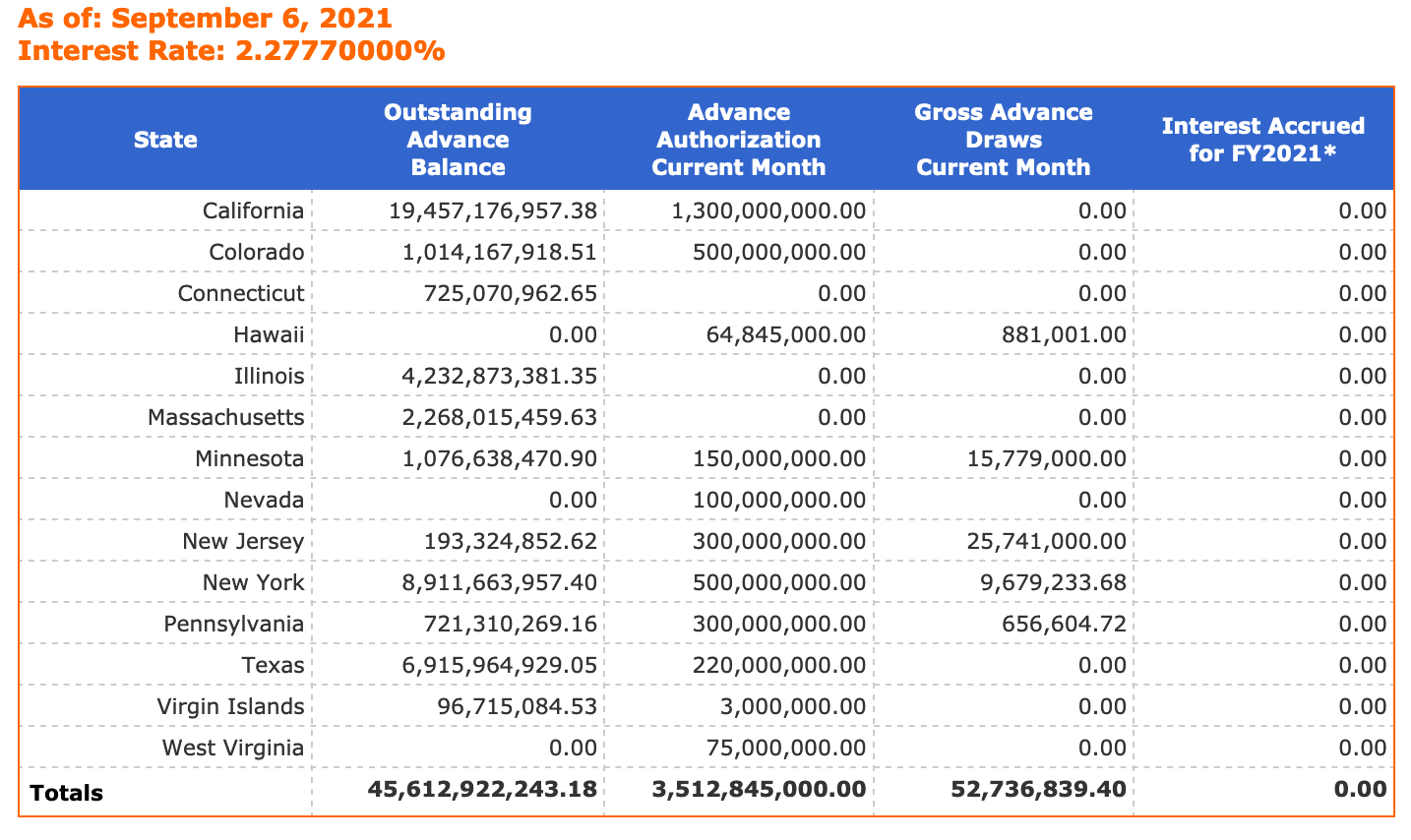
Hawaii, Nevada, Ohio and West Virginia announced the loan repayments within the last week. A remaining 10 states have a combined outstanding balance of more than $45 billion that they will now begin to accrue interest on, according to the Treasury Department.

When states exhaust their unemployment trust funds, they are allowed to borrow money from the federal government to ensure benefits continue to be paid. Twenty-two states took out what are referred to as Title XII advances during 2020. The loans were initially interest free, but starting Monday, states with outstanding loans began to accrue 2.3% interest on the borrowed sums.

The states that announced repayments are:

  • Ohio repaid $1.5 billion.
  • Hawaii repaid $700 million.
  • Nevada repaid $335 million.
  • West Virginia repaid $185 million.

Officials from those states said they acted before Monday’s deadline to prevent negative economic impacts on businesses. Several states said they used federal funding allocated through the American Rescue Plan Act to repay the borrowed funds.

Hawaii used a combination of federal funding—$39 million in CARES Act funding and $700 million in ARPA funding—to fully pay back the amount borrowed. The state, where the tourism industry was hard hit during the coronavirus pandemic, paid out more than $6.4 billion in unemployment insurance benefits, officials with the Department of Labor and Industrial Relations said.

Unemployment benefits are paid for through taxes that states levy on businesses. When unemployment trust funds are depleted, state and federal laws trigger higher business tax rates on employers to replenish the funds. The 10 states that have outstanding loan balances California, Colorado, Connecticut, Illinois, Massachusetts, Minnesota, New Jersey, New York, Pennsylvania and Texas—could be poised to see significant tax hikes on employers next year if they do not pay the money back before increases are triggered. 

Source: Department of Treasury.

In Nevada, lawmakers approved using $335 million in Coronavirus State and Local Recovery Funds allocated through ARPA to pay down the borrowed unemployment funds.

Paying off the loan before interest began to accrue put the state in a good fiscal position, said Heidi Saucedo, a spokeswoman for the state’s Department of Employment, Training and Rehabilitation.

Ohio similarly sought to avoid a tax hike on employers by putting off repayment. Gov. Mike DeWine said the state used $1.5 billion in ARPA funds to pay back the loans.

“By repaying this loan in full, we ensure that Ohio businesses won't see increases in their federal unemployment payroll taxes,” DeWine said in a statement. “Without this added tax burden, our employers can invest more money into their businesses and hire more staff.”

Employers in the state would have faced a 50% hike in federal unemployment payroll taxes next year had the loan not been repaid, according to Steve Stivers, President of the Ohio Chamber of Commerce.

West Virginia used a combination of CARES funding and employer payments to pay off the $185 million it borrowed. The state was also able to put $220 million back into its unemployment trust fund, a move that state officials said would reduce employer contributions by 25%.

SLUDGE FROM MARICOPA ASSOCIATION OF GOVERNMENTS

The agenda for the September 13, 2021, Transit Committee meeting has been posted on the MAG website at https://azmag.gov/Event/26956

Please contact Cara Nassar at (602) 254-6300 if you have any questions.


Maricopa County Board Published Meetings Update

Maricopa County 

You are subscribed to Board Published Meetings for Maricopa County.

This information has recently been updated and is now available here:

https://www.maricopa.gov/DocumentCenter/View/61736/Special-Meeting-Notice


Special Meetings are scheduled as needed for time sensitive action items and /or other meetings where a quorum of the Board may be participating in an event or meeting. 
Corresponding public agendas will be posted at https://www.Maricopa.Gov/324.

 Agenda Button


ARIZONA CORPORATE COMMISSION > Email Correction Only - 10-4-2021 APS Special Open Meeting

arizona-corporation-commission-logo-sm

ARIZONA CORPORATION COMMISSION


EXECUTIVE DIRECTOR
Matthew J. Neubert

SECRETARY
Carolyn D. Buck
Phone: 602-542-3931
CDBuck@azcc.gov

COMMISSIONERS
Chairwoman Lea Márquez Peterson
Sandra D. Kennedy
Justin Olson
Anna Tovar
Jim O'Connor


printer-icon

N O T I C E

SPECIAL OPEN MEETING OF THE ARIZONA CORPORATION COMMISSION

Monday, October 4, 2021, and continuing through
Tuesday, October 5, 2021, and
 
Wednesday, October 6, 2021, if necessary

9:00 a.m.

Hearing Room One
1200 W. Washington St.
Phoenix, AZ 85007

This shall serve as notice of an open meeting at the above location for consideration, discussion, and possible vote of the item on the agenda and other matters related thereto.  Commissioners may attend the proceedings in person, or by telephone, video, or internet conferencing,and may use this open meeting to ask questions about the matters on the agenda. The parties to the matters to be discussed or their legal representatives are requested, though not required, to attend telephonically.  The Commissioners may move to executive session, which will not be open to the public, for the purpose of legal advice pursuant to A.R.S. § 38-431.03 (A) (3) and (4) on the matters noticed herein.

Because of the Covid-19 pandemic, only essential Commission staff will attend in person. The public is strongly discouraged from attending in person.  The public will be able to participate by either watching and listening to the meeting online or listening to the meeting via telephone.  For those wishing to enter an appearance or provide public comment, please use the dial in phone numbers.

Each party to and stakeholder interested in an Open Meeting agenda item will be permitted to appear by videoconference during the Commission’s consideration of the item at Open Meeting.  To participate by videoconference for an agenda item, a person must have an ACC Portal Account (create an account for free at https://efiling.azcc.gov/cases ) and must, by no later than 8:00 a.m. on the day of Open Meeting, complete the process on the ACC Portal to “Request to Speak at Open Meetings” for the item.  A person who has completed the Request to Speak process for an agenda item will, at approximately 8:30 a.m. on Open Meeting day, receive an email with a WebEx link and instructions to participate in the Open Meeting.  Parties and stakeholders may also opt to participate via telephone, using the phone number and code to speak shown below. 

Persons with a disability may request reasonable accommodations by contacting the Commission Secretary listed above at least 48 hours prior to the scheduled commencement of the Open Meeting.

Agendas are also available online at: https://azcc.gov/live

Dial-in Phone Number: 1-866-705-2554 Passcode to Speak: 241497
                                        1-866-705-2554 Passcode to Listen Only: 2414978

NOTE: The Commission may choose to take testimony under oath.

AGENDA

  1. Arizona Public Service Company(E-01345A-19-0236) – Commission Discussion, Consideration, and Possible Vote to Determine the Fair Value of the Utility Property of the Company for Ratemaking Purposes; to Fix a Just and Reasonable Rate of Return Thereon; to Approve Rate Schedules Designed to Develop Such Return. Opportunity for members of the public to provide brief comments.

###

Arizona Corporation Commission | 1200 W. Washington Street | Phoenix, AZ 85007

HUD Releases New Research on Increasing Affordable Housing Production and Preservation

HUD NEWS

U.S. Department of Housing and Urban Development – Marcia L. Fudge, Secretary

Office of Public Affairs, Washington, DC 20410                           

HUD No. 21-137                                                                                            FOR RELEASE

HUD Public Affairs                                                                                        Wednesday

202-708-0685                                                                                                 September 8, 2021

HUD.gov/Press


HUD Releases New Research on Increasing Affordable Housing Production and Preservation

Research Part of Biden-Harris Administration’s Effort to Increase Affordable Housing Supply


WASHINGTON – The U.S. Department of Housing and Urban Development today released its latest research on innovative strategies being pursued by state and local governments to remove regulatory barriers to affordable housing and increase housing supply.  

“This research is a testament to the Biden-Harris Administration’s commitment to increasing and preserving our nation’s affordable housing supply,” said Secretary Marcia L. Fudge. “The research makes clear that there is bipartisan support for state and local reform to improve housing affordability, and underscores how the President’s Build Back Better Agenda would strengthen the federal government’s capacity to help jurisdictions meet the housing needs of their residents. HUD and the Administration will remain hard at work to build inclusive, equitable communities through affordable housing.” 

The new research, published by HUD’s Office of Policy Development & Research (PD&R), was promised as part of the Department’s September 1 announcement of a series of actions it is taking as part of the Biden-Harris Administration’s plan to create, preserve, and sell nearly 100,000 additional affordable homes for homeowners and renters across the country over the next three years. As stated in that announcement, the lessons from the research “will be incorporated into HUD’s Regulatory Barriers Clearinghouse, which contains over 4800 barriers and solutions and provides a catalog of information that spans all 50 states and over 460 cities and counties. They will also inform the locally driven zoning reform initiative in the President’s Build Back Better Plan.” 
 
According to this new research, “Opportunities to Increase Housing Production and Preservation,” without significant new supply, cost burdens are likely to increase as current home prices reach all-time highs, with the median home sales price reaching nearly 
$375,000 in July 2021. The research also makes clear the consequences that inadequate housing supply will have on homeowners and renters. In 2019, more than 37 million renter and owner households spent more than 30 percent of their income for housing.  

The new research cites two reports – a HUD-published report from January 2021 under the previous administration and a June 2021 report to Congress – that highlight actions state and local governments are taking to reduce barriers that are limiting housing production and preservation. These activities range from state tax policies and incentives to encourage local housing production to local zoning changes, process improvements, and community engagement reforms. 

Additionally, the research highlights HUD tools and grant opportunities to assist jurisdictions seeking to increase the supply of affordable housing in their communities, and makes clear that “a comprehensive zoning reform program, such as the one proposed in the Build Back Better Plan currently before Congress, would enhance HUD’s efforts to help communities plan and implement housing policy reforms, study the impact of those reforms, and share the most effective approaches to community engagement and policy actions." 


###  


HUD's mission is to create strong, sustainable, inclusive communities and quality affordable homes for all. 
More information about HUD and its programs is available on the Internet 
at 
www.hud.gov and http://espanol.hud.gov.  


You can also connect with HUD on social media and follow Secretary Fudge on Twitter and Facebook or sign up for news alerts on HUD's Email List