Sunday, January 16, 2022

Arizona Democratic Senator Sinema is a Too-Easy Decoy...So what's the Message?

Here's the intended message with strong declarative statements from Robert Reich:
". . .A large portion of the American public has become so frustrated and cynical about democracy they are willing to believe blatant lies of a self-described strongman, and willing to support a political party that no longer believes in democracy.
As I said at the outset, capitalism is compatible with democracy only if democracy is in the driver’s seat. But the absence of democracy doesn’t strengthen capitalism. It fuels despotism.
Despotism is bad for capitalism. Despots don’t respect property rights. They don’t honor the rule of law. They are arbitrary and unpredictable. All of this harms the owners of capital. Despotism also invites civil strife and conflict, which destabilize a society and an economy.
My message to every CEO in America: you need democracy, but you’re actively undermining it.""
Robert Reich, a former US secretary of labor, is professor of public policy at the University of California at Berkeley and the author of Saving Capitalism: For the Many, Not the Few and The Common Good.
His new book, The System: Who Rigged It, How We Fix It, is out now.
He is a Guardian US columnist.
His newsletter is at robertreich.substack.com

Corporate sedition is more damaging to America than the Capitol attack
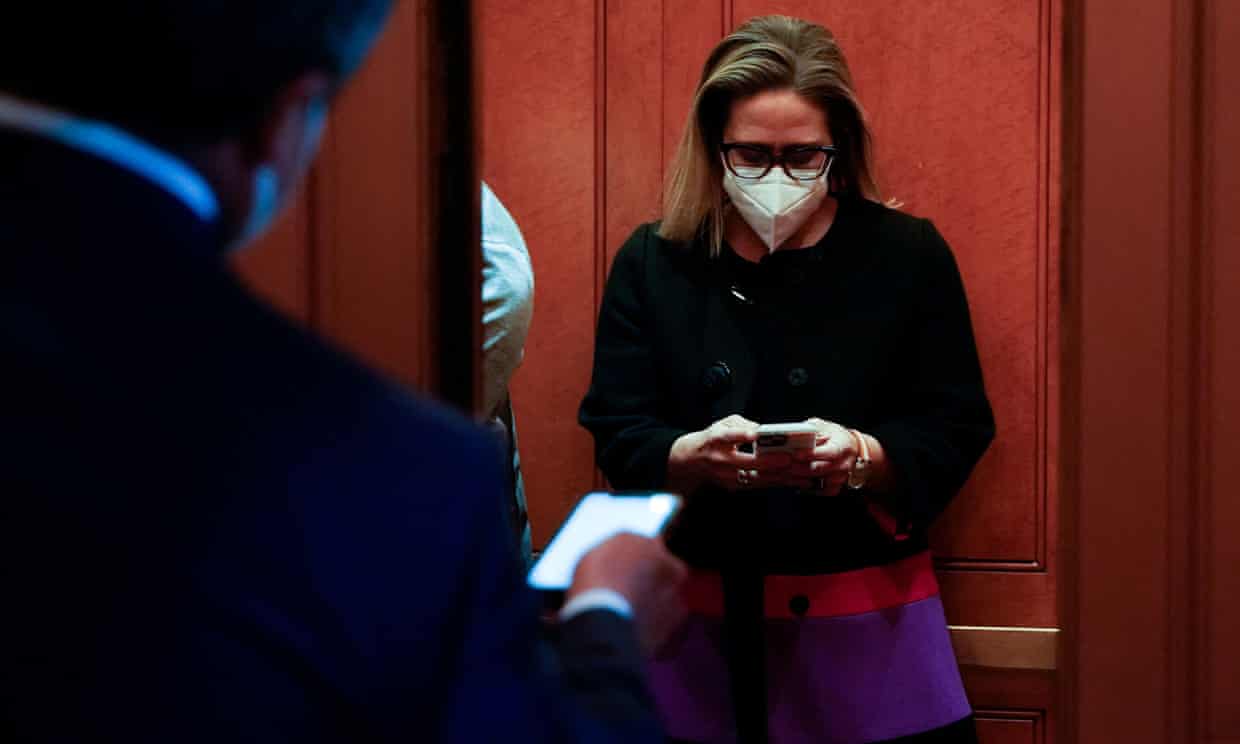
<div class=__reading__mode__extracted__imagecaption>Senator Kyrsten Sinema boards an elevator at the US Capitol. Photograph: Elizabeth Frantz/Reuters<br>Senator Kyrsten Sinema boards an elevator at the US Capitol. Photograph: Elizabeth Frantz/Reuters</div>

"Kyrsten Sinema receives millions from business and opposes progressive priorities. Republicans who voted to overturn an election still bag big bucks. Whose side are CEOs on?

Capitalism and democracy are compatible only if democracy is in the driver’s seat.

That’s why I took some comfort just after the attack on the Capitol when many big corporations solemnly pledged they’d no longer finance the campaigns of the 147 lawmakers who voted to overturn election results.

Well, those days are over. Turns out they were over the moment the public stopped paying attention.

A report published last week by Citizens for Responsibility and Ethics in Washington shows that over the past year, 717 companies and industry groups have donated more than $18m to 143 of those seditious lawmakers. Businesses that pledged to stop or pause their donations have given nearly $2.4m directly to their campaigns or political action committees (Pacs).

But there’s a deeper issue here. The whole question of whether corporations do or don’t bankroll the seditionist caucus is a distraction from a much larger problem.

The tsunami of money now flowing from corporations into the swamp of American politics is larger than ever. And this money – bankrolling almost all politicians and financing attacks on their opponents – is undermining American democracy as much as did the 147 seditionist members of Congress. Maybe more.

The Democratic senator Kyrsten Sinema – whose vocal opposition to any change in the filibuster is on the verge of dooming voting rights – received almost $2m in campaign donations in 2021 even though she is not up for re-election until 2024. Most of it came from corporate donors outside Arizona, some of which have a history of donating largely to Republicans.

Has the money influenced Sinema? You decide. Besides sandbagging voting rights, she voted down the $15 minimum wage increase, opposed tax increases on corporations and the wealthy and stalled on drug price reform – policies supported by a majority of Democratic senators as well as a majority of Arizonans. . .

[...]

The profits of big corporations just reached a 70-year high, even during a pandemic. The ratio of CEO pay in large companies to average workers has ballooned from 20-to-1 in the 1960s, to 320-to-1 now.

Meanwhile, most Americans are going nowhere. The typical worker’s wage is only a bit higher today than it was 40 years ago, when adjusted for inflation.

But the biggest casualty is public trust in democracy.

In 1964, just 29% of voters believed government was “run by a few big interests looking out for themselves”. By 2013, 79% of Americans believed it.

Corporate donations to seditious lawmakers are nothing compared with this 40-year record of corporate sedition.
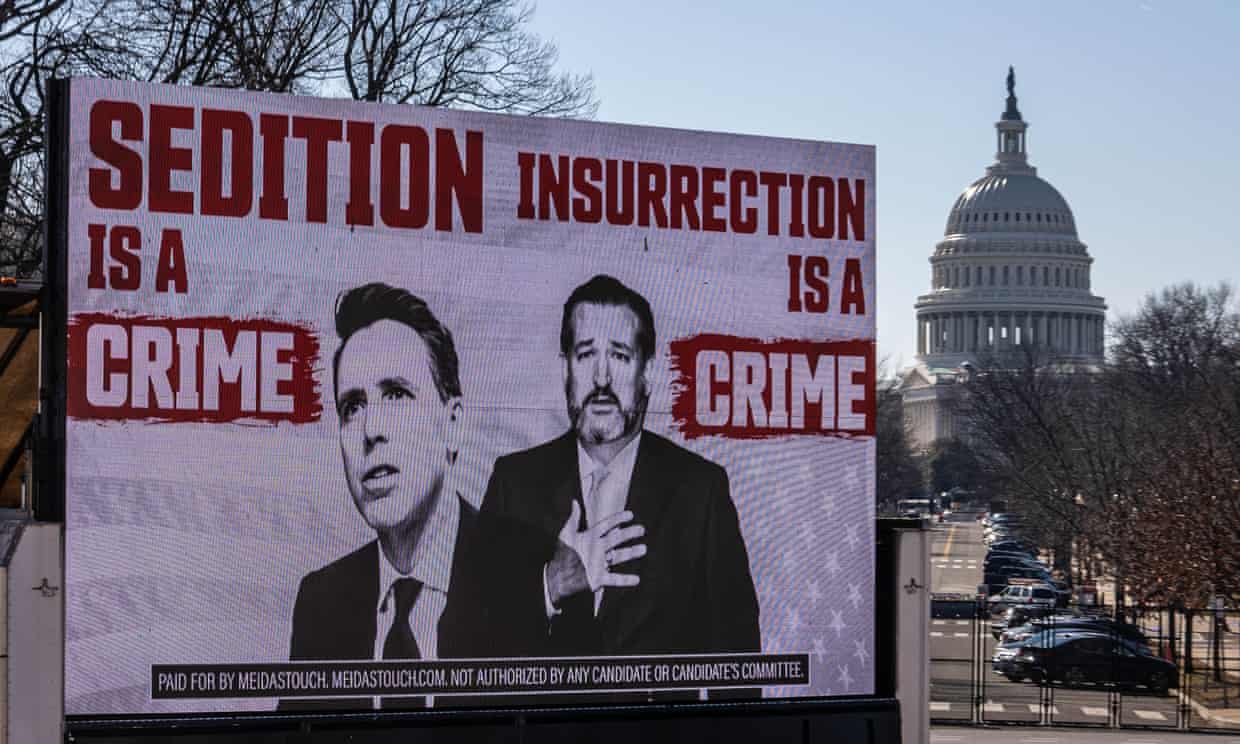
Campaigners target senators Ted Cruz and Josh Hawley, near the US Capitol. Photograph: Ken Cedeno/REX/Shutterstock
 

A DEFEATED PRESIDENT CHOSE ARIZONA To stage a Save America PAC Rally For Mid-Term Election Season

It was a Political Action Campaign to broadcast and spread everything about Stop-The-Steal and "The Big Lie" he's been repeating for more than a year using his newly chosen cast of true believers he has endorsed -- only if his cast of new apprentice characters follow his script
 

Trump Soft-Launches His 2024 Campaign

The former president’s message at his Arizona rally was as clear as it was dishonest:

He didn’t lose to Joe Biden in 2020, and he’ll spend the next year working to elect Republicans who agree.

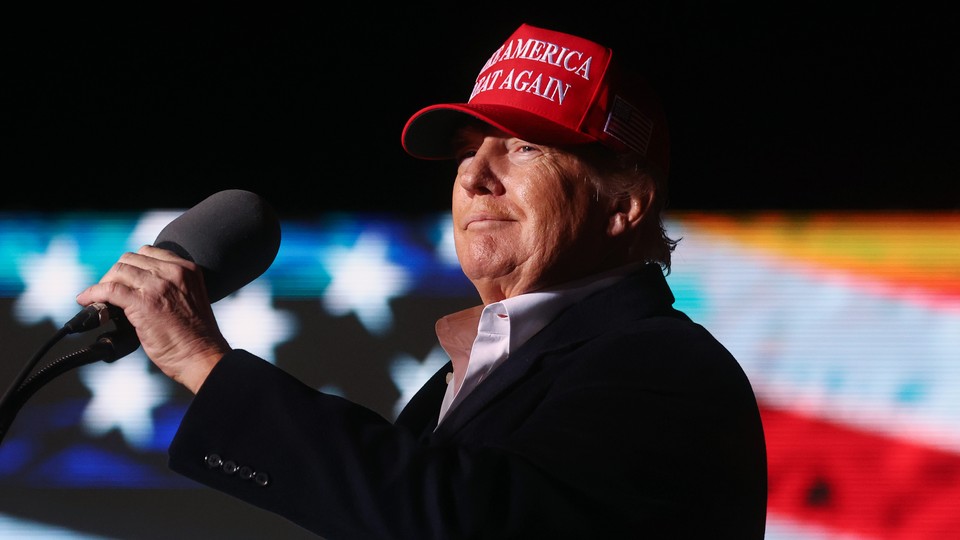
(Image credit: Mario Tama / Getty)

<div class=__reading__mode__extracted__imagecaption>Mario Tama / Getty

FLORENCE, Ariz.—Tonight, deep in the Arizona desert, thousands of people chanted for Donald Trump. They had braved the wind for hours—some waited the entire day—just to get a glimpse of the defeated former president. And when he finally appeared on stage, as Lee Greenwood played from the loudspeakers, the crowd roared as though Trump were still the commander-in-chief. To many of them, he is.

“I ran twice and we won twice,” Trump told his fans. "This crowd is a massive symbol of what took place, because people are hungry for the truth. They want their country back."

Tonight’s rally was Trump’s first public event since July. On paper, the gathering was meant as his response to the anniversary of January 6, as well as an unofficial kickoff for his efforts to support Republicans in the midterm elections. But the event also served as the soft launch of Trump’s 2024 presidential campaign. Although he didn’t say the words, the former president seems poised to run in two years—”Make America Great Again Again … Again,” he joked to the crowd—and tonight, his message was as clear as it was dishonest: He didn’t lose to Joe Biden in 2020, and he’ll spend the next year working to elect Republicans who agree.

Trump chose Arizona for this moment for a reason: In this state, the Big Lie thrives. Trump only lost Arizona by 10,000 votes in 2020, giving him and his supporters the space, apparently, to allege that the close outcome was the result of left-wing chicanery, the result of ballot stuffing and interference by Venezuelans, among other false claims. . .GOP politicians across Arizona adopted Trump’s lies anyway. Many of them were guests of honor tonight.

The pre-Trump headliner was Kari Lake, the former TV-news reporter running to replace Governor Doug Ducey; she alleges, falsely, that “bag loads of ballots” were dumped in Arizona last year. (“Kari Lake, she’s been with us from the beginning on the election fraud,” Trump gushed when he brought her back on stage for a cameo during his speech.)

Other speakers included secretary of state candidate Mark Finchem, who was at the Capitol last January 6 and who often wears a cowboy hat and bolo-tie despite being from Michigan; Paul Gosar, Andy Biggs, and Debbie Lesko, three Trump-loving members of Congress who voted against certifying Biden’s win in 2020; and the state GOP chair Kelli Ward, who has embraced numerous conspiracy theories and recently received a cease and desist notice from Dominion Voting Systems after accusing the company of changing 6,000 Trump votes to Biden votes last year. Each of these Republicans has repeatedly echoed Trump’s false allegations of election mischief. Of course they have. This is the former president’s new litmus test: You endorse the lie; he endorses you.

Nearly everyone I interviewed at the rally vowed to follow Trump’s lead, and only support GOP candidates who endorse the false idea that he won the election. . .If Lake and the other Big Lie proponents at tonight’s rally can win their primary races, they’ve got a good shot at becoming the Grand Canyon State’s next generation of political leaders. Even with power, though, they’ll still owe Trump a debt of loyalty—one that he’ll expect to be repaid.

[...] Trump has still been speaking directly to his most dutiful supporters through far-right media outlets, though. (“He’s tan, fit, has lost some weight since he left office,” Newsmax’s anchors, speculating eagerly about a 2024 announcement, trilled as Trump took the stage here. “People forget that The Apprentice was the number one show on NBC.”) Now that the midterm season is fully underway, Trump will be out and about more often, hosting rallies and stumping for the any Republicans desperate enough to lie about the election in exchange for his support. He will in some ways be reintroducing himself to the country: Here I am, America, back after a stolen election, ready to win by any means possible. . .

Trump has had a remarkable 14 months. Most losing presidential candidates are forced into quiet retirement by their parties. Trump has bucked the trend, only tightening his grip on the GOP in the wake of his defeat. He has convinced Republican candidates all over the country—including those on stage tonight—to repeat his election lies, and convinced his rank-and-file supporters to treat those falsehoods as holy writ. By this point, those lies have been circulating for what feels like forever. But at tonight's rally, as Trump’s fans called for the arrests of poll workers and the reinstatement of the rightful president, I got the sense that this might be just the beginning."

Saturday, January 15, 2022

DEMAND FOR ONLINE GARBAGE --- Yeah Baby! Let's Re-Cycle It

Here's just one example. Not meant to demean the source The Daily Mail does do some good things some of the time

How Fauci has profited from the pandemic: Senator he called 'moron' leaks his unredacted financial disclosures that show he raked in $5,000 from one virtual event and he and his wife are worth at least $10 million

  • Dr Anthony Fauci is the highest-paid federal employee - earning more than President Joe Biden
  • Fauci earns $434,312 as head of the NIAID while presidents earn $400,000 annually since 2001
  • New disclosures show he also receives royalties exceeding $100,000 a year from medical textbooks
  • In 2020 he accepted a $5,000 'travel reimbursement' to virtually attend the RFK Ripple of Hope gala  
  • Publicly available salary information for Fauci shows he earned $3.6 million from 2010 to 2019
  • He will make roughly $2.5 million more for the years 2020 through 2024 if he stays on through Biden's term
  • Fauci's wife, Christine Grady, earns $176,000 as Chief of the Department of Bioethics at the NIH 
  • His investment accounts total $8,337,940.90, while she is worth $2,083,097.09, leaked declarations show  
  • Fauci's records show that he was paid $13,298 to attend four galas and ceremonies - three of them virtual 

NOT A PODCAST TO LISTEN TO IN PUBLIC. . .You hear them pant, moan and direct each other to orgasm

Intro: ". . .The pair say they have learned that sex is not just a pleasurable experience, but a place to work through emotions and traumas.
In an episode on “rage fucking”, they talk about the opportunity to release feelings of anger through sex and masturbation. They even talk about sex as a place where they have some of their brightest business ideas.
(Haynes even used to offer “pussy-powered” business coaching, which used their practice to help women unlock career goals.) 
Their work couldn’t have come at a better time. . .

Panting, moaning and ‘pussy-gazing’: the couple who have sex on their podcast

"Lacey Haynes and Flynn Talbot want to improve the world’s love life – starting by doing it live on air in every episode

Lacey Haynes is a women’s “intuitive healer”, and guides couples in yoga-informed “elevated sex”. . .

[...] But it’s not the sex that’s the main event – it’s the talk. In each episode Haynes, 37, and Talbot, 40, discuss techniques and topics around sex and relationships, covering everything from overcoming rejection to the joys of cunnilingus; from rethinking orgasm as the ultimate goal to navigating intimacy with common conditions such as UTIs and premature ejaculation.

Their mission is to help coupled-up listeners have more fulfilling sex – and to transform nonexistent or perfunctory sexual experiences into something physically pleasurable, emotionally empowering and spiritually uplifting. From there, they believe, the sky is the limit: “elevated” sex can lead to better mental and physical health, and even a better career.

After all, it’s what happened to them. As they tell their listeners, their relationship started out “hot and heavy”, before “the sex died”, says Haynes. But rather than “living out the rest of our days like that”, they decided to invest in their sex life. It became a project that they worked on together, drawing influences from yoga and books on everything from diet and anatomy to politics and memoir.

It isn’t a podcast to listen to in public. You hear them pant, moan and direct each other to orgasm

The project eventually transformed their relationship and led them to start their own business, which offers private coaching, online courses and even retreats. . . Undoubtedly, some will be put off by their grandiose terms – they refer to themselves as visionaries – or uncensored language. Their response on the podcast has been to ask listeners not to overlook their whole message because of a few disagreeable words. Personally, I’d say the same logic applies to other parts of their work, where it gets too new age, or simply too much. For example, I can appreciate the anatomical similarities between the vocal cords and the vagina. But when they mention this on the podcast in relation to women being vocally expressive during sex, my alarm bells ring. . .

> I’m curious about the troubles straight men face with sex. “The majority of men are lost in the bedroom. They know how to penetrate but they don’t know how to connect,” says Talbot. “Men have, for generations, been conditioned to suppress their emotions. And yet truly expressed emotions and vulnerability are the route to a deep connection with women.

“Not knowing how to harness the power of expression puts men at a great disadvantage, in and out of the bedroom. It’s why many men live with deep frustration and anger that’s close to the surface every day. . .

THE END

Tips for great sex

1. Communication is key
Before achieving soulful and carefree sex that involves communicating with nonverbal cues, you need to get comfortable with saying if something is a turn-on, a turn-off, triggering or painful.

2. Don’t take it personally …
… if you’re playing with your partner and they don’t enjoy it, say, “Sorry, someone else found that enjoyable. What do you find enjoyable?” Haynes says. Talbot says men need to know that “talking about sex doesn’t make you a bad lover”.

3. Discuss your sexual past
Often, current sexual issues are a result of past experiences, traumas or narratives.

4. Use more of your body
Rather than just jackhammering away, with all movement coming from the hips, Talbot suggests connecting torsos and hearts. “Be like two serpents writhing together.” Use controlled breathing to slow the rushes of feeling and prolong the experience, moving focus to other parts of your body.

5. Rewrite your power script
Haynes says that the narrative where the man holds all the power may contribute to women’s dissatisfaction with penetrative sex. But there is power in letting go and allowing someone in, emotionally and physically. That’s what soulful sex is all about."

More >> https://www.theguardian.com/lifeandstyle/2022/jan/15/panting-moaning-and-pussy-gazing-the-couple-who-podcast-their-elevated-sex-sessions

TIME TO LOOK UP NOW: Microsoft Defender weakness lets hackers bypass malware detection

It's been long running

Microsoft Defender weakness lets hackers bypass malware detection

"Threat actors can take advantage of a weakness that affects Microsoft Defender antivirus on Windows to learn locations excluded from scanning and plant malware there.

The issue has persisted for at least eight years, according to some users, and affects Windows 10 21H1 and Windows 10 21H2.

Lax permissions

Like any antivirus solution, Microsoft Defender lets users add locations (local or on the network) on their systems that should be excluded from malware scans.

People commonly make exclusions to prevent antivirus from affecting the functionality of legitimate applications that are erroneously detected as malware.

Since the list of scanning exceptions differs from one user to another, it is useful information for an attacker on the system, since this gives them the locations where they can store malicious files without fear of being detected.

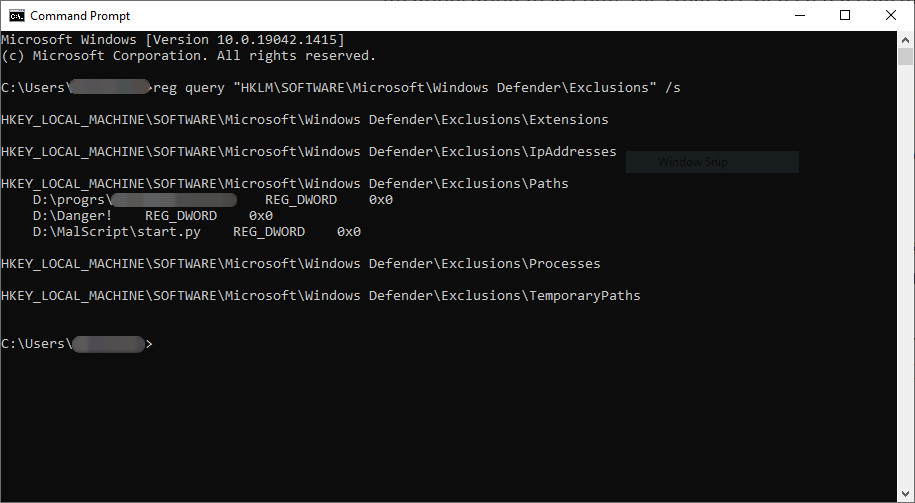
Security researchers discovered that the list of locations excluded from Microsoft Defender scanning is unprotected and any local user can access it.

Regardless of their permissions, local users can query the registry and learn the paths that Microsoft Defender is not allowed to check for malware or dangerous files.

Antonio Cocomazzi, a SentinelOne threat researcher who is credited for reporting the RemotePotato0 vulnerability, points out that there is no protection for this information, which should be considered sensitive, and that running the “reg query” command reveals everything that Microsoft Defender is instructed not to scan, be it files, folders, extensions, or processes.

Another security expert, Nathan McNulty, confirmed that the issue is present on Windows 10 versions 21H1 and 21H2 but it does not affect Windows 11.

McNulty also confirmed that one can grab the list of exclusions from the registry tree with entries that store Group Policy settings. This information is more sensitive as it provides exclusions for multiple computers.

A security architect versed in protecting the Microsoft stack, McNulty warns that Microsoft Defender on a server has “automatic exclusions that get enabled when specific roles or features are installed” and these do not cover custom locations.

Although a threat actor needs local access to get the Microsoft Defender exclusions list, this is far from being a hurdle. Many attackers are already on compromised corporate networks looking for a way to move laterally as stealthily as possible.

Cybercrime alert: Criminals using consumer information to apply for  unemployment benefits

By knowing the list of Microsoft Defender exclusions, a threat actor that already compromised a Windows machine can then store and execute malware from the excluded folders without fear of being spotted.

In tests done by BleepingComputer, a malware strain executed from an excluded folder ran unhindered on the Windows system and triggered no alert from Microsoft Defender.

We used a sample of Conti ransomware and when it executed from a normal location Microsoft Defender kicked in and blocked the malware.

After placing Conti malware in an excluded folder and running it from there, Microsoft Defender did not show any warning and did not take any action, allowing the ransomware to encrypt the machine.

This Microsoft Defender weakness is not new and has been highlighted publicly in the past by Paul Bolton:

A senior security consultant says that they noticed the issue about eight years ago and recognized the advantage it provided to a malware developer.

"Always told myself that if I was some kind of malware dev I would just lookup the WD exclusions and make sure to drop my payload in an excluded folder and/or name it the same as an excluded filename or extension" - Aura

Given that it's been this long and Microsoft has yet to address the problem, network administrators should consult the documentation for properly configuring Microsoft Defender exclusions on servers and local machines via group policies.

TIME TO PROTECT AND DEFEND YOURSELF FROM THREAT ACTORS . . .Here we go again!

Ready?

HOWIE MAKES AN OVERDUE CORRECTION: in 2021 Mesa didn't get many newcomers. . .

Hey there! Nice to see some reliable data for a welcome change:
-- Arizona added nearly 109,000 new residents last year, but Mesa didn’t get many of those newcomers.
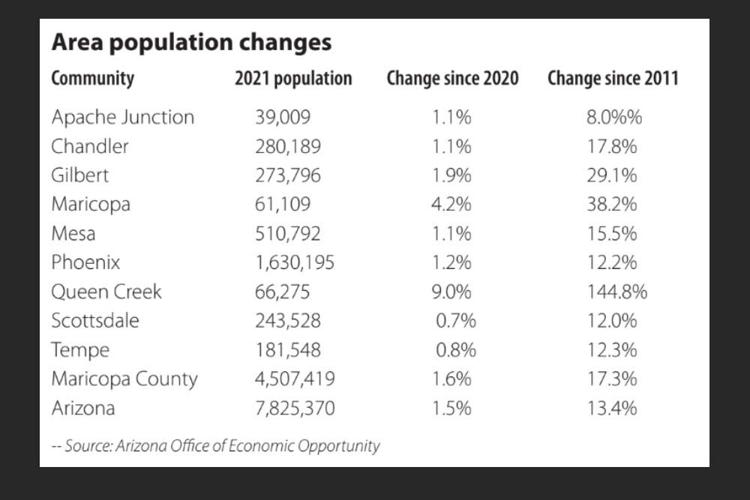
-- The city’s population in 2021 grew by only 1.1%, according to the latest figures from the state Office of Economic Opportunity.
TOP STORY            

Mesa saw few newcomers last year, state says

Area population changes             

". . .Although Mesa’s population grew by 15.5% between 2011 and 2021, that increase lagged behind some of its neighbors – notably Gilbert, Chandler and Queen Creek. 

All three municipalities had greater population gains percentage-wise than Mesa – with Queen Creek posting a stunning 144.8% increase in that 10-year period and 9% last year.

The figures show the state’s population grew at a rate of 1.5% between June 30, 2020 and a year later. That’s how the agency tracks annual growth.

And the more than 860,000 new residents in the past decade amounted to a 13.4% increase.

Newcomers were picky and choosy about where in the state they decided to live.

So where did a lot of them go?

Think about areas near the state’s major population center, but far enough away to have houses that are affordable.

And since growth for Phoenix to the immediate south is blocked by the Gila River Indian Community, that left Pinal County communities of Coolidge and Eloy at 7.1% and 5.3% respectively.

The desire for affordable homes also boosted the population of Casa Grande by 4.3% and Maricopa by 4.2%. 

Florence probably should have been in that list somewhere.

But the official tally shows that community actually lost close to 1,600 residents over a 12-month period, making it the community with the greatest percentage loss at 6.2%.

What’s behind that, though, has

little to do with the desirability of the community. 

Jim Quang, the state demographer, said it has to do largely with the fact there are fewer people in the custody of the state Department of Corrections there.

Population in the Eyeman and Florence units went from 9,031 in June of 2020 to 7,796 a year later. And the trend continues, with the most recent inmate count at the two facilities now below 7,500.

Anchor cities are growing slower than the rest of the state.

Phoenix added about 19,000 residents, but only enough to post a 1.2% year-over-year increase. Land-locked Tempe – like Scottsdale – was pretty much where it was a year earlier.

At the other end of the Valley, Glendale added just under 1,900 residents, a 0.7% increase. But nearby Peoria, stretching much further out and with room to grow, managed to post a 1.9% growth rate, increasing to 3.8% for even farther out Surprise.

Pima County lags not just Maricopa County but the statewide average. And the key according to George Hammond of the Eller College of Business at the University of Arizona is how the economy is built.

“Tucson is just a less dynamic economy,’’ he said, heavily reliant on jobs in federal, state and local government. “We just have a lot more of that. And it’s just not a growth industry.’’

There is a plus side to all that. Hammond said it tends to make the economy less susceptible to wild swings.

But he also said that geography plays a role in economic development.

Hammond said as firms look to locate or expand in Arizona, the Phoenix area is “just more of a draw,’’ with things like much better airport connections. . .