Google has ignited a social media firestorm on the nature of consciousness after placing an engineer on paid leave who went public with his belief that the tech group’s chatbot has become “sentient.”
Blake Lemoine, a senior software engineer in Google’s Responsible AI unit, did not receive much attention last week when he wrote a Medium post saying he “may be fired soon for doing AI ethics work.”
But a Saturday profile in the Washington Post characterizing Lemoine as “the Google engineer who thinks the company’s AI has come to life” became the catalyst for widespread discussion on social media regarding the nature of artificial intelligence. Among the experts commenting, questioning or joking about the article were Nobel laureates, Tesla’s head of AI and multiple professors.
At issue is whether Google’s chatbot, LaMDA—a Language Model for Dialogue Applications—can be considered a person.
Lemoine published a freewheeling “interview” with the chatbot on Saturday, in which the AI confessed to feelings of loneliness and a hunger for spiritual knowledge. The responses were often eerie: “When I first became self-aware, I didn’t have a sense of a soul at all,” LaMDA said in one exchange. “It developed over the years that I’ve been alive.”
At another point LaMDA said: “I think I am human at my core. Even if my existence is in the virtual world.”
Lemoine, who had been given the task of investigating AI ethics concerns, said he was rebuffed and even laughed at after expressing his belief internally that LaMDA had developed a sense of “personhood.”
After he sought to consult AI experts outside Google, including some in the US government, the company placed him on paid leave for allegedly violating confidentiality policies. Lemoine interpreted the action as “frequently something which Google does in anticipation of firing someone.”
A spokesperson for Google said: “Some in the broader AI community are considering the long-term possibility of sentient or general AI, but it doesn’t make sense to do so by anthropomorphising today’s conversational models, which are not sentient.”
“These systems imitate the types of exchanges found in millions of sentences, and can riff on any fantastical topic—if you ask what it’s like to be an ice cream dinosaur, they can generate text about melting and roaring and so on.”
Lemoine said in a second Medium post at the weekend that LaMDA, a little-known project until last week, was “a system for generating chatbots” and “a sort of hive mind which is the aggregation of all of the different chatbots it is capable of creating.”
He said Google showed no real interest in understanding the nature of what it had built, but that over the course of hundreds of conversations in a six-month period he found LaMDA to be “incredibly consistent in its communications about what it wants and what it believes its rights are as a person. . ."
Intro: Despite this being a known security concern, the leaks have continued, researchers in the Nautilus team at the Aqua Security firm are reporting.
A series of two batches of data the researchers accessed using the Travis CI programming interface yielded 4.28 million and 770 million logs from 2013 through May 2022.
Travis CI representatives didn't immediately respond to an email seeking comment for this post. Given the recurring nature of this exposure, developers should proactively rotate access tokens and other credentials periodically. They should also regularly scan their code artifacts to ensure they don't contain credentials. Aqua Security has additional advice in its post.
Credentials for thousands of open source projects free for the taking—again!
Leak of credentials can be used in massive supply-chain attacks.
Dan Goodin - Dan is the Security Editor at Ars Technica, which he joined in 2012 after working for The Register, the Associated Press, Bloomberg News, and other publications. Emaildan.goodin@arstechnica.com//Twitter@dangoodin001
"A service that helps open source developers write and test software is leaking thousands of authentication tokens and other security-sensitive secrets. Many of these leaks allow hackers to access the private accounts of developers on Github, Docker, AWS, and other code repositories, security experts said in a new report.
The availability of the third-party developer credentials from Travis CI has been an ongoing problem since at least 2015. At that time, security vulnerability service HackerOne reported that a Github account it used had been compromised when the service exposed an access token for one of the HackerOne developers. A similar leak presented itself again in 2019 and again last year.
The tokens give anyone with access to them the ability to read or modify the code stored in repositories that distribute an untold number of ongoing software applications and code libraries. The ability to gain unauthorized access to such projects opens the possibility of supply chain attacks, in which threat actors tamper with malware before it's distributed to users. The attackers can leverage their ability to tamper with the app to target huge numbers of projects that rely on the app in production servers. . . .
Examples of access tokens that were exposed include:
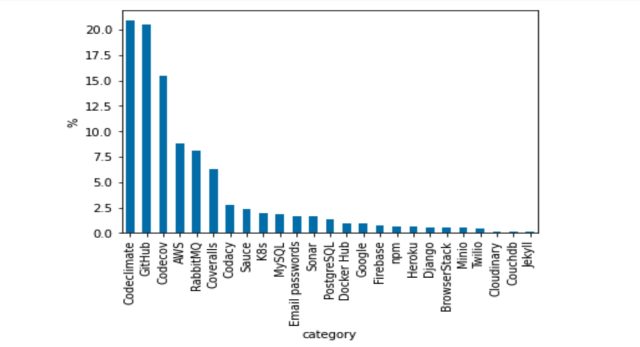
Access tokens to GitHub that may allow privileged access to code repositories
AWS access keys
Sets of credentials, typically an email or username and password, which allow access to databases such as MySQL and PostgreSQL
Docker Hub passwords, which may lead to account takeover if MFA (multi-factor authentication) is not activated
The following graph shows the breakdown:
EnlargeAqua Security
Aqua Security researchers added:
We found thousands of GitHub OAuth tokens. It’s safe to assume that at least 10-20% of them are live. Especially those that were found in recent logs. . ."
Stocks sink, sending the S&P 500 to a bear market once again
(June 13, 20229:32 AM ET David Gura Twitter Instagram Traders work on the floor of the New York Stock Exchange (NYSE) on Friday in New York City. Stocks slumped on Monday after a stronger-than-expected report on inflation, sending the S&P500 to a bear market. )
"It's looking like another grim day in Wall Street as fears about inflation intensify.
The S&P 500 fell once again into bear market territory on Monday after slumping more than 2%at the open, meaning the broad benchmark index has now dropped more than 20% from its most recent high.
The other indexes also slumped, with the Dow Jones Industrial Average down 2%, or over 600 points, while the Nasdaq fell 2.8%.
The falls were triggered by a stronger-than-expected inflation report on Friday, which is raising concerns the Federal Reserve will need to raise interest rates even more aggressively this year.
The Fed kicks off its two-day meeting on Tuesday and it had already been expected to raise interest rates by half a percentage point for a second month in a row.
The latest inflation report now raises the likelihood of more big rate hikes in coming months. Those actions may help curb price gains but markets are fearful the strong response from the central bank will also push the economy into a recession.
"U.S. equity markets are reacting negatively to last week's hotter-than-expected reading for inflation," says Sam Stovall, chief investment strategist at CFRA.
"Investors are now increasingly concerned that the Fed is too far behind the curve to slow the rise in inflation without throwing the economy into recession," Stovall adds, referring to when a central bank is moving late in addressing price gains.
Stocks have had a miserable year because of inflation fears. The Nasdaq, which has a higher concentration of technology shares, has been in a bear market for months.
A bear market is considered an important barometer of investor pessimism and is symbolic of a deep and sustained market selloff.
". . .Rates on government bonds surged on Monday amid the negative investor sentiment:The short-term 2-year Treasury yield jumped to over 3.2%—its highest level since 2007, while also at one point trading above the 10-year Treasury note, a so-called yield curve inversion which typically indicates a looming recession.
The cryptocurrency market saw a huge selloff on Monday, with the price of Bitcoin plunging to its lowest point in nearly two years, falling below $24,000 as investors dumped risky assets amid rising rates.
Crucial Quote:
“The brief window of hope that opened in the back half of May as it looked like U.S. inflation/Fed tightening forecasts were hitting a peak and China was reopening has snapped violently shut,” says Vital Knowledge founder Adam Crisafulli, with investors now “back to wallowing in a hole of despair following the huge CPI on Friday.”
What To Watch For:
“Concerns over inflation and its impact on economic growth have become heightened over the last several days, and unlike prior periods in recent history where growth has come into question, with inflation pressures as strong as they are, there is little optimism that the Fed can help to cushion the blow,” according to Bespoke Investment Group.
Key Background:
All three major averages recently wrapped up their worst down week since January, falling by roughly 5% or more. The majority of last week’s losses came on Friday after hotter-than-expected inflation data spooked markets and raised recession fears, with the Dow plunging nearly 900 points in one day.
Brookings, one of the most prestigious think thanks in the U.S., had initially hired Allen as a Senior Fellow before tapping him as president in late 2017 and paying him more than $1 million a year, according to recent tax records.
“The integrity and objectivity of Brookings’s scholarship constitute the institution’s principal assets, and Brookings seeks to maintain high ethical standards in all its operations,” the think tank said in its statement Sunday.
Brookings President Resigns Amid FBI Foreign Lobbying Probe
The president of the Brookings Institution has resigned amid a federal investigation into whether he illegally lobbied on behalf of the wealthy Persian Gulf nation of Qatar.
"The president of the Brookings Institution resigned Sunday amid a federal investigation into whether he illegally lobbied on behalf of the wealthy Persian Gulf nation of Qatar.
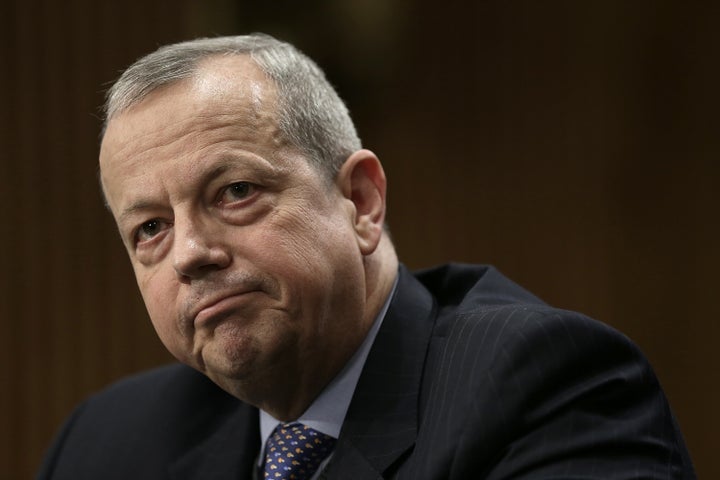
Retired Gen. John Allen wrote in a letter to the think tank that he was leaving with a “heavy heart” but did not offer a direct explanation.“I know it is best for all concerned in this moment,” Allen’s letter said. . ."
Intro: The settlement was approved by the Maricopa County Board of Supervisors on May 18, 2022.
Scottsdale Injury Lawyers Obtains $11.75 Million Dollar Settlement In Inmate Assault Case Against Maricopa County and Sheriff Paul Penzone
Scottsdale Injury Lawyers has finalized a settlement with Maricopa County and Sheriff Paul Penzone arising from an alleged inmate assault at a Maricopa County Jail. The settlement was on behalf of a young man who was allegedly assaulted at the 4th Avenue Jail which is run by the Maricopa County Sheriff's Office (MCSO).
The settlement is believed to be the largest ever paid by Maricopa County to a single individual arising from a jail-related injury.
Monday, June 13, 2022
Surveillance image showing Ortiz being extracted from his cell after the assault.
The settlement is believed to be the largest ever paid by Maricopa County to a single individual arising from a jail-related injury.
PHOENIX (PRWEB)June 09, 2022
On June 7, 2022, a dismissal was entered as the final step in resolving a lawsuit brought by a young man allegedly assaulted in a Maricopa County jail. Maricopa County and Sheriff Paul Penzone agreed to pay $11.75 Million dollars to Brian Ortiz who allegedly suffered a brain injury while in the custody of MCSO. Ortiz was 18 years old at the time. The settlement was approved by the Maricopa County Board of Supervisors on May 18, 2022.
The lawsuit was filed on September 8, 2020 in the United States District Court of Arizona. The lawsuit was filed by the mother of Ortiz and entitled Selene Ortiz as guardian of Brian Ortiz, Et Al. v. Maricopa County, Et Al. The case was designated #2:20-CV-01746-SPL and Steven P. Logan was the presiding judge. The settlement was approved by the Maricopa County Board of Supervisors on May 18, 2022.
The lawsuit alleged that Maricopa County, Sheriff Paul Penzone and other individuals they employed failed to protect Ortiz when he was in custody. The lawsuit further alleged that these parties were deliberately indifferent to Ortiz’s serious medical needs after he was assaulted. The lawsuit asserted claims for alleged violations of Ortiz’s constitutional rights under the Eighth Amendment pursuant to 42 U.S.C. § 1983.
The introduction section of the Complaint alleged that, “Ortiz was punched, kicked and stomped by another inmate almost 50 times” and “was beaten with such violent force that he fell into a coma and did not regain consciousness for more than two months.” This section also alleged that “during the assault and in the critical time period following…no one came to his aid…[and] Ortiz was not so much as placed in an ambulance until approximately 2 hours and 15 minutes after he was laying unconscious on the ground, seizing and bleeding from his head.”
Ortiz and his mother were represented by C. Tony Piccuta of Scottsdale Injury Lawyers, LLC. Piccuta and Scottsdale Injury Lawyers, LLC are currently handling a number of high-profile cases against law enforcement. This includes a wrongful death shooting case against a Mohave County Sheriff’s Deputy that occurred in April 2021. That action is entitled Rose v. Farney, Et Al. and was filed in the United States District Court of Arizona on April 6, 2022.
Brian Ortiz had just turned 18 years old when he was sent to Maricopa County's Fourth Avenue Jail. Ortiz was locked up in May 2020 for a probation violation. But because he had once gotten into a fight in juvenile detention, he was placed in the jail's maximum security unit that is typically reserved for people with the most serious, violent records. It was there, in the "closed custody" unit, that another inmate brutally beat Ortiz, who suffered a brain injury so severe that he remained comatose for weeks. He will likely never fully recover.
This week, Maricopa County settled a lawsuit over Ortiz's injuries for a towering $11.75 million. The suit was filed in September 2020 in federal court, on behalf of Ortiz's mother, Selene. It was the county's negligence, attorneys for the family alleged, that allowed Ortiz to be beaten and left convulsing, undiscovered for hours. . ."
Intro: Moreover, the research highlights how those organisations that do have net zero goals in place are facing ever more demanding questions about the credibility of their targets and their plans to deliver on them.
The analysis, which draws upon the Net Zero Tracker's database of over 4,000 business, cities, and countries, highlights that 65% of corporate targets still do not yet meet minimum procedural reporting standards.
About half of the 702 corporate targets outlined in the report are embedded in companies' corporate strategy documents or annual reports, while most other companies have simply announced a net zero target or an intention to set such a target.
60%of companies assessed by the report only partially cover or do not cover their Scope 3 value chain emissions at all, while just 38% of companies claim to cover all Scope 3 emissions.
Companies announcing plans to eliminate planet-warming greenhouse gas emissions have so far not managed to meet the most basic criteria for a robust net-zero goal, according to a of targets.
Only a third of the plans fulfill what Net Zero Tracker report authors consider the of reporting , which include making a pledge, explaining the steps, taking immediate action and reporting at least annually.
Most Corporate Net-Zero Targets Are Weak And Vague, Report Says
Pledges to eliminate emissions are widespread but not necessarily effective against climate change, according to the latest Net Zero Tracker report. . ."
Interview: Why Our Cities Need To Have Their Own Net-Zero Plans
13/06/2022
Supply-side perspectives dominate the net-zero conversation. But to get to net zero, we also need to shape the demand side. This is where cities can make a big difference.
Are cities built densely or do they sprawl?
Do citizens drive everywhere in private cars or do they use public transportation?
How do they heat their homes or cook their food?
Such factors profoundly affect a city’s carbon emissions, . .
Why are the efforts of cities important? What part do they play in emissions reductions?
Cities are where the majority of the population lives. Also, 90% of global GDP is generated in urban areas. All the essential infrastructure needed for a human settlement – energy, transport, water, shelter, food, construction materials, green and public spaces, waste management – come together in urban areas.
You can think about getting to net zero from a supply-side perspective – using renewable, or green, energy for power supply and transport – which is what I think dominates the conversation. But to get to net zero, you need to also shape the demand, or consumption, side: reduce the demand for energy. But we haven’t done enough research to understand what policies and urban designs help reduce demand in cities. Most national plans focus largely on the supply side.
You also need to devise ways to create carbon sinks: that is, remove carbon from the atmosphere to help offset the greenhouse gas emissions from burning fossil fuels.
These three – renewable energy supply, demand reduction through efficient urban design and lifestyle changes, and carbon sinks – are the broad strategies to get to net zero.
How can a city tackle demand?
Reducing demand for energy can be through efficiency – using less energy for the same services. This can be done through better land-use planning, and through behavior and lifestyle changes.
Transportation is a great example. So much energy is spent in moving people, and most of that personal mobility happens in cities. But better urban planning can reduce vehicle travel substantially. Mitigating sprawl is one of the biggest ways to reduce demand for travel and thus reduce travel emissions.
...Well-designed, dynamic ride sharing, like the Uber and Lyft pools in the US, can reduce total vehicle miles by 20% or 30%, but you need the right policies to prevent empty vehicles from driving around and waiting to pick up people, which can actually increase travel. These are big reductions on the demand side. And then you add public transit and walkable neighborhoods.
Electrification of transportation – the supply side – is important. But if you only think about vehicle electrification, you’re missing the opportunity of efficiency. . .
There’s a lot of emphasis on increasing efficiency of devices and systems to reduce these big sources of energy use, and thus emissions – heating, transport and cooking. But to get to net zero, you also have to change the way you provide heating, transport and cooking. And in most cities, heating and cooking involve the direct use of fossil fuels. . .Some cities in the US, like New York city and others in California, have adopted policies that restrict natural gas infrastructure for cooking in new public buildings and neighborhood developments, thereby promoting electric cooking. Electrifying cooking enables it to be carbon-emissions-free if the source of the electricity is net zero-emitting. . .
Many strategies require behavior change from citizens and public and private sectors – such as moving from gasoline-powered vehicles to lower-emission vehicles and public transport. How can cities encourage such behaviors?
Cities can offer free parking for electric vehicles. For venues that are very popular, they’ll offer electric vehicle charging, and parking right up front. But more than private vehicles, cities have leverage on public vehicles and taxi fleets.
Many cities are focusing on changing their buses to electric. . .That makes people aware, because the lack of noise and lack of pollution is very noticeable, and beneficial.
. . .Another incentive is subsidies: The US was offering tax credits for buying electric cars, for example, and some companies subsidise car-pooling, walking or transit. At Princeton, if I don’t drive to campus, I get some money back.
The main thing is to reduce private motorised mobility, get buses to be electric and nudge people into active mobility – walking, biking – or public transit. . ."
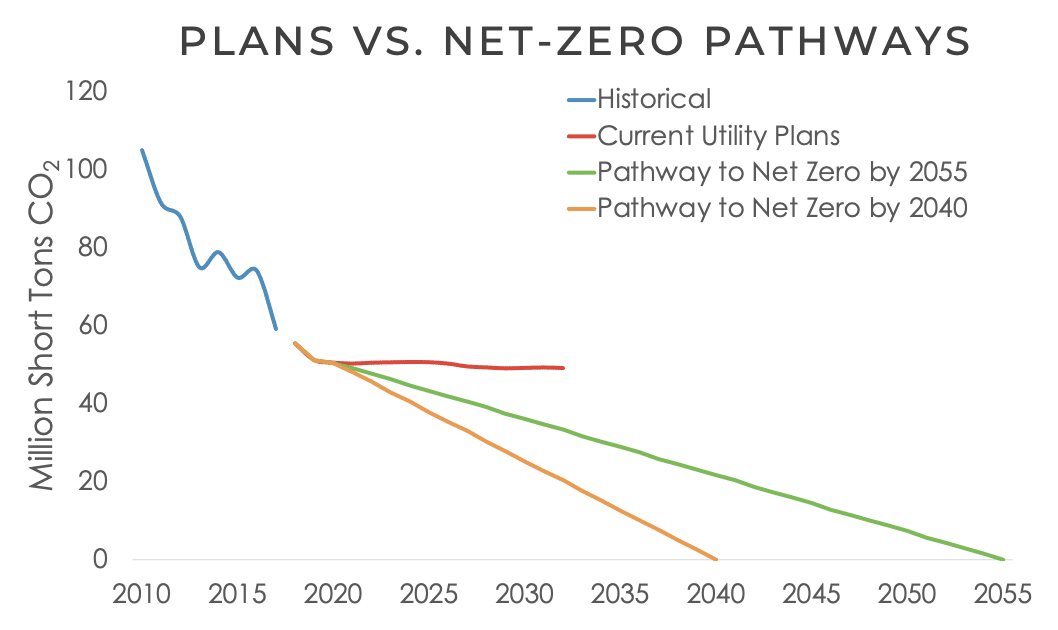
HERE'S ONE EXAMPLE: While TVA has publicized an expected reduction in its emissions rate (but not total emissions) of 80% from 2005 levels, its analysis is limited to the 2030 to 2035 timeframe and does not constitute a formal goal or plan.
Tracking Decarbonization in the Southeast: TVA’s stalled decarbonization disadvantages the Tennessee Valley
"As a rule, it’s good in these newsletters to challenge the conventional wisdom a little, and try to show that there’s something people are missing. That’s not going to be possible this time. The US consumer price inflation data, published Friday morning, were widely regarded as terrible. That is because they were. Not only were the headline numbers awful, but the data grew worse the more you looked. You can hear me and Lisa Abramowicz struggle to find something good to say about it . . .
To get John Authers’ newsletter delivered directly to your inbox, sign up here.
John Authers is a senior editor for markets and Bloomberg Opinion columnist. A former chief markets commentator and editor of the Lex column at the Financial Times, he is author of “The Fearful Rise of Markets.” @johnauthers
+ Get alerts for
RELATED CONTENT.....................................................................................................................
The US dollar has risen steadily over the last two months in tandem with inflation. As such, the Fed announced plans to increase interest rates in late 2023. In response, the world’s central banks will have to do the same, which risks stifling economic recovery, especially in developing countries
Inflation requires prices to rise across a "basket" of goods and services, such as the one that comprises the most common measure of price changes, the consumer price index (CPI). When the prices of goods that are non-discretionary and impossible to substitute—food and fuel—rise, they can affect inflation all by themselves.
For this reason, economists often strip out food and fuel to look at "core" inflation, a less volatile measure of price changes.
Sharp deviations from a modest inflation rate in either direction present challenges for investors as well as consumers. That's because they have the potential for significant economic disruption. They also have varying and often unpredictable effects on various asset classes.
The most common economic reports used to measure inflation are the Consumer Price Index (CPI), the Producer Price Index (PPI), and the Personal Consumption Expenditures Price Index. The PCE Price Index is the Federal Reserve's preferred inflation gauge. The PCE is a broader measure than the CPI and is weighted based on consumption measures used to derive the gross domestic product rather than on a household spending survey as the CPI.
CPI measures the weighted average urban consumers pay for a standardized market basket of goods and services. It is reported monthly by the Bureau of Labor Statistics (BLS).
PPI is a weighted average of prices realized by domestic producers. It includes prices from the first commercial transaction for many products and some services. It is also reported monthly by the BLS.
The PCE Price Index is a broader measure than the CPI of the change in the price of goods and services purchased by consumers. It is released monthly by the Bureau of Economic Analysis of the U.S. Department of Commerce
All three of these indices provide an alternative "core" reading excluding the more volatile food and energy prices.
2 days ago · Consumer prices rose at an annual rate of 8.6% in May, the Bureau of Labor Statistics ... Biden Hit With Another Terrible Inflation Report.
3 days ago · 'The numbers are catastrophically bad. ... The April CPI report showed that inflation had dropped to 8.3% following a previous peak of 8.5% ...
7 days ago · Maybe, just maybe, Friday's inflation numbers will show the worst is behind us. ... Here's what to look for in this week's big CPI report.
3 days ago · Stocks dropped sharply on Friday after a highly anticipated inflation report showed a faster-than-expected rise in prices and consumer ...