The race is one of a number of primary races that have been seen as a test of the future direction of the Republican Party.
Former
President Donald Trump has endorsed dozens of candidates around the
country, and while he did not directly endorse Mr Bolduc, he did
describe him during a radio interview as a "strong guy" who had "said
some great things".
Don Bolduc: Pro-Trump candidate wins New Hampshire primary
By Bernd Debusmann Jr
3 - 4 minutes
By Bernd Debusmann Jr in Washington
Image source, Getty Images
Image caption,
New Hampshire Republican primary winner Dan Bolduc has falsely claimed that Donald Trump won the 2020 election
A retired general and outspoken Donald Trump supporter has won the Republican Senate nomination in New Hampshire.
Don Bolduc will face Democrat Maggie Hassan in November, who analysts suggest is at risk of losing her seat.
Defeating the incumbent could give Republicans the seat they need to regain a majority in the Senate.
But
some party members have questioned whether Mr Bolduc can appeal to more
moderate voters and rallied unsuccessfully around other candidates.
A
veteran of 10 tours of Afghanistan, the 61-year-old has falsely claimed
coronavirus vaccines contain microchips and that Donald Trump won the
2020 presidential election.
He
has also raised less than $600,000 (£514,000) from grassroots donors in
the same amount of time that Ms Hassan has amassed more than $31m. . '
2 hours ago · Retired Army Brig. Gen. Donald Bolduc has won New Hampshire's Republican Senate primary and will face potentially vulnerable Democratic ...
1 hour ago · A retired general and outspoken Donald Trump supporter has won the Republican Senate nomination in New Hampshire. Don Bolduc will face ...
45 minutes ago · Mainstream Republicans are worried that Don Bolduc, a 2020 election denier, is too right-wing to beat Senator Maggie Hassan in the general ...
6 hours ago · New Hampshire Republicans' decision to nominate Don Bolduc to take on Democratic Sen. Maggie Hassan locks in the final key matchup in ...
Please Note - This is Google's second big loss in the EU courts. The company was also fined 2.4 billion euro for bundling Google shopping with search and 1.5 billion euro for bundling search and advertising. In total, Google has been fined 8.25 billion euro in the EU.
EU upholds Google’s 4.1B euro fine for bundling search with Android
by
Ron Amadeo
- Sep 14, 2022 3:10 pm UTC
Ron Amadeo
/ Ron is the Reviews Editor at Ars Technica, where he specializes in
Android OS and Google products. He is always on the hunt for a new
gadget and loves to rip things apart to see how they work.
5 - 6 minutes
Google will have to pay the EU's biggest fine ever.
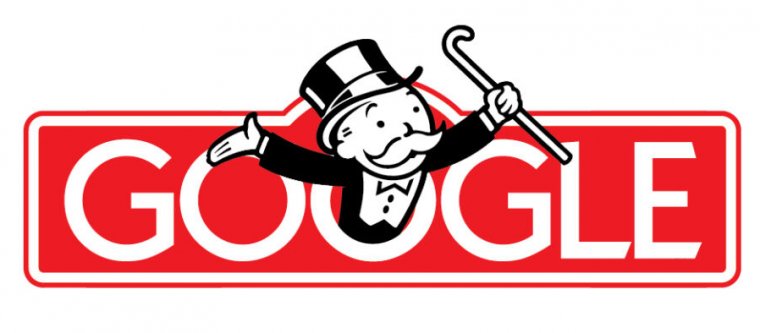
Let's see, you landed on my "Google Ads" space, and with three houses... that will be $1,400.
Ron Amadeo / Hasbro
"Google has lost its latest battle with European Union regulators. This morning, the EU General Court upheld Google's record fine
for bundling Google Search and Chrome with Android. The initial ruling
was reached in July 2018 with a 4.34 billion euro fine attached, and
while that number has been knocked down to 4.125 billion euro ($4.13
billion), it's still the EU's biggest fine ever.
The EU takes issue with the way Google licenses Android and
associated Google apps like the Play Store to manufacturers. The Play
Store and Google Play Services are needed to build a competitive
smartphone, but getting them from Google requires signing a number of
contracts that the EU says stifles competition.
The Commission zeroed in on three unlawful restrictions.
1 First, Google bundles Google Chrome and Search with Android. The company requires Android manufacturers to sign a "Mobile Application Distribution Agreement"
(MADA) contract, which says that manufacturers that want to include one
Google product must include a large collection of them and make Google
the default. There are even requirements for where icons and widgets
should be placed.
2 The second unlawful restriction is the contract's "anti-fragmentation
agreement," which says that anyone who creates a fork of Android, even
as a separate product or under a different brand, will have their
company's Google app license instantly revoked.
3 The third issue concerns Google's revenue-sharing agreements, which give
manufacturers adhering to all these rules a share of the Google search
and Google ad revenue that a customer generates.
The EU Commission found that "the objective of all those restrictions
was to protect and strengthen Google’s dominant position in relation to
general search services and, therefore, the revenue obtained by Google
through search advertisements."
Google
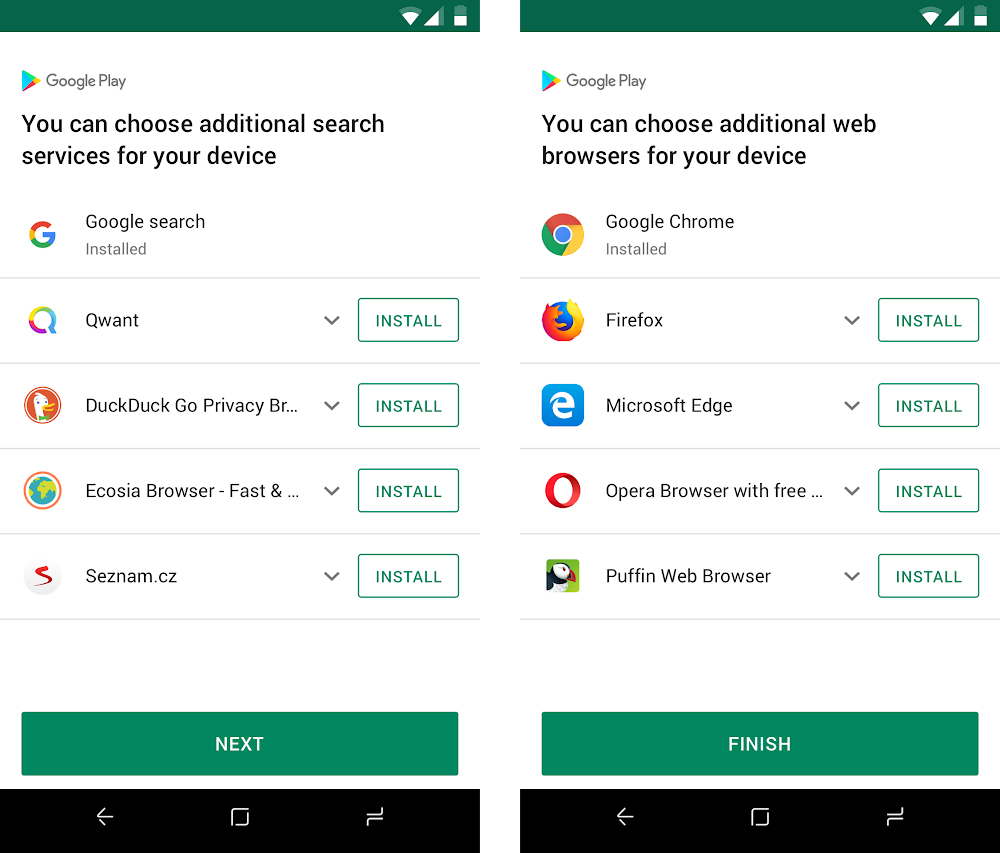
The original ballot screens. In the EU, these will pop up when users open the Play Store or during initial setup.
Google
The original ballot screens. In the EU, these will pop up when users open the Play Store or during initial setup.
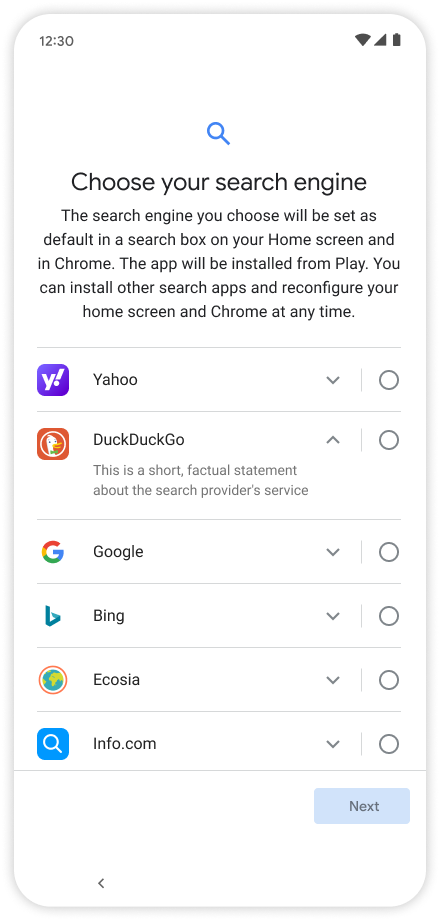
The updated version has a new design and scrolls to show more search providers.
Google
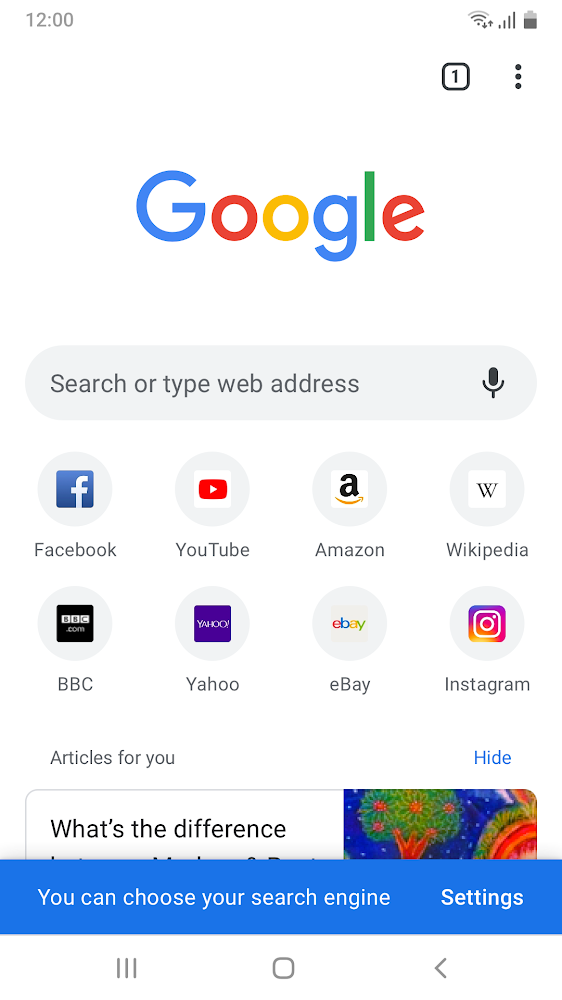
Chrome will also give users the option to pick an alternate search engine.
While the appeal has only just been shot down, Google's solutions for
its issues were already rolled out around the time of the initial
ruling. In the EU, Google took a page out of Microsoft's antitrust compliance book, and Android now shows browser and search engine ballots that
let users pick a non-Google option. Google says it used the ad revenue
from default Google apps to fund Android development, and now that these
apps don't have to be included, manufacturers can choose to pay for
Android directly instead of getting it for free. If manufacturers don't
bundle Google's apps, Google will charge as much as $40 per phone in the EU. The EU also forced Google to allow partners to build Android forks
without facing retribution from the company. You can now sell Google
Play Android and a forked device based on Android next to each other
without getting kicked out of the ecosystem. . ."
35 minutes ago · This morning, the EU General Court upheld Google's record fine for bundling Google Search and Chrome with Android. The initial ruling was ...
8 hours ago · Google loses appeal over illegal Android app bundling, EU reduces fine to €4.1 billion | The EU has upheld a 2018 antitrust charge against
The
news broke here in Mesa yesterday, after a closed-door Executive
Session of the Mesa City Council at a study session about 'a very big
deal". However, back in March there was an un-notice hearing in front of
the Planning & Zoning Board that tells the story and gives a
narrative to rezone and qualify Red Hawk as a job-creation area - Red Hawk Employment Opportunity District
Very careful wording with this disclaimer more than three months ago: Please read the official narrative and City Council staff report with the denial "not known at this time" The following is part of a post on this blog earlier this year
Here we go Loop-de-Loop! We're
talkin' here about massive developments in-the-works mostly in the
"Outer Loops" that were up at a Public Hearing last week on Wednesday 20
March 2019 in front of the Mesa Planning & Zoning Board - nothing
to get bored about in either the Outer or Outer Loops or the east-west
tech corridors and industrial parks on the planning boards. Seriously -
Take the time to find out. Here are all the links you need > Digitize ________________________________________________________________________ Two geographic hot spots: Scroll down to see new OZone Redhawk RHEOD Northeast Mesa District 5 and Southeast Mesa District 6 There are Minutes available that will take you a long to take a look at - just enough extracted here for your interest. . .
Item 4-e: 187 acres to create the Red Hawk Employment Opportunity Zone Project Red Hawk Employment Opportunity District Project Narrative [7 Pages] Revised February 19, 2019 Introduction Pew
& Lake, PLC is pleased to provide this project narrative and
related materials to the City of Mesa in support of the proposed Red Hawk Employment Opportunity District (RHEOD). . .
The area is a minimum of 160 contiguous acres. As
noted above, the Red Hawk property is approximately 187 acres and is
currently designated in the Mesa 2040 General Plan as Employment Mixed
Use Activity District. Accordingly, this property is appropriate for
designation as an Employment Opportunity District.
Apr 2, 2020 · The Arizona town of Mesa, where Google plans a 750,000 square-foot data center, gets half its water from the drought-prone Colorado River. A ...
✓ www.datacenterdynamics.com Mesa Council approves $1bn Google data center, with $16m in tax breaks Sebastian Moss 3 - 4 minutes
Mesa City Council has voted to approve a development agreement for a large Google data center in the Phoenix, Arizona suburb.
The $1 billion facility will span 750,000 square feet (70,000 sq m) once fully built out. The deal was negotiated over the past year under the codename 'Project Red Hawk,' with Google operating under the pseudonym 'Stone Applications, LLC' as it sought planning permission for the data center on 187 acres of farmland on the northwest corner of Elliot and Sossaman roads.
City of Mesa's "Home-Run" Deal on Google Data Center ? (What They Didn't Tell Us)
Hold on! Report from Bloomberg News today: How much water do Google Data Centers use? Billions of gallons NOTE: According to that report, "In
Mesa, the company is working with authorities on a water credits
program, but said it’s too early to share more details. . ." Google Data Centers’ Secret Cost: Billions of Gallons of Water
By
Nikitha Sattiraju
To
meet surging demand for online information, internet giant taps public
water supplies that are already straining from overuse.
In
August 2019, the Arizona Municipal Water Users Association built a
16-foot pyramid of jugs in its main entrance in Phoenix. The goal was to
show residents of this desert region how much water they each use a
day—120 gallons—and to encourage conservation.
“We must continue to do our part every day,”executive director Warren Tenney wrote in a blog post. “Some of us are still high-end water users who could look for more ways to use water a bit more wisely.”
A few weeks earlier in nearby Mesa,Googlebegan building a giant data center among the cacti and tumbleweeds. The town is a founding member of the Arizona Municipal Water Users Association, but water conservation took a back seat inthe dealit struck with the largest U.S. internet company.
>
Google is guaranteed 1 million gallons a day to cool the data center,
and up to 4 million gallons a day if it hits project milestones. If that
was a pyramid of water jugs, it would tower thousands of feet into
Arizona’s cloudless sky.
>
The company has boasted for years that these huge computer-filled
warehouses are energy efficient and environmentally friendly. But
there’s a cost that the company tries to keep secret. These facilities
use billions of gallons of water, sometimes in dry areas that are
struggling to conserve this limited public resource.
The
Arizona town of Mesa, where Google’s 750,000 square-foot data center
has been under construction for months, gets half its water from the
drought-prone Colorado River.A contingency planwas
signed into law last year requiring states dependent on the river to
take voluntary conservation measures. Still, Mesa officials say they
remain confident about future supply while continuing to remind
residents to limit their water consumption.
“We do not have any immediate concerns,” said Kathy Macdonald, a water resources planning adviser with the city.
In
2019, Mesa used 28 billion gallons of water, according to Macdonald.
City officials expect that to reach 60 billion gallons a year by 2040, a
demand Mesa is capable of meeting, she said.
Big companies like Google wouldn’t locate to the city if it couldn’t meet their water demands, Macdonald said. Mesa passed an ordinance in 2019 to ensure sustainable water use by large operations and fine them if they exceed their allowance.
. . .Google
considers its water use a proprietary trade secret and bars even public
officials from disclosing the company’s consumption. But information
has leaked out, sometimes through legal battles with local utilities
and conservation groups. In 2019 alone, Google requested, or was
granted, more than 2.3 billion gallons of water for data centers in
three different states, according to public records posted online and
legal filings.
Apr 14, 2022 · According to DarkPatterns.org, dark patterns are tricks used in websites and apps that dupe you into doing something, such as buying or signing ...
. . .“First, Google employs dark patterns through the use of
confusing terminology that requires the user to intuit that location
data is not only contained within Location History,”
Gray said in his report. “Second, the use of opt-in by default for (Web
and App Activity) automatically tracks users’ location data, possibly
without their knowledge.”
Gray also added that even if “every setting on an Android
device were disabled Google would still collect a user’s location data
through IPGeo” and another tool whose name was redacted from the
documents. Both of those tools operate independent of settings.
Google court docs show that users who opt out of tracking are still monitored
By: Jerod MacDonald-Evoy - September 9, 2022 4:40 pm
10 - 12 minutes
Newly released documents
in the Arizona Attorney General’s lawsuit against tech behemoth Google
reveal more details about the company’s response to reporting on its
privacy policies and how Google users’ IP addresses are used to obtain
exact location information.
Attorney General Mark Brnovich’s case, filed in 2020, is part of a larger investigation that has been going on since at least 2018, after an Associated Press article revealed certain Google applications store location data without asking, and that deleting the data is a time-intensive process.
AP found that Google Maps, for example, creates a snapshot of where
users are whenever they open the application, even when location history
is turned off..."
What Are Dark Patterns And Why Google, YouTube In Trouble
By Nidhi Singh Published April 14, 2022
6 - 8 minutes
Google and Facebook could face further penalties if they don’t change their practices.
There’s
no doubt that Google and Facebook are two of the biggest tech giants in
the world. But recent revelations about their use of deceptive design
patterns, or dark patterns, have put them in hot water with regulators
and consumers alike.
Decoding dark patterns
According to DarkPatterns.org,
dark patterns are tricks used in websites and apps that dupe you into
doing something, such as buying or signing up for things, contrary to
your intent. Regulators and lawmakers in the U.S. and European Union
(EU) are highly concerned about dark patterns and have introduced bills to crack down on their use. Below are some commonly used dark patterns:
Manipulative cookie banners:
When you enter a website, you will usually be asked by the cookie
banner whether you want to allow cookies for browsing the site. Some
cookie banners are designed to have a bigger “accept all” button, and if
you want to change your cookie settings, you will have to get into
another window by clicking a “manage to set” button. This makes it
harder for users to reject cookies for the website.
Confirmshaming: Users
are shamed for not doing something suggested by the website, such as
taking a survey or subscribing to a newsletter. For instance, an
e-commerce website might want to collect your email address by offering
you a coupon. If you don’t want to share that with the site, you might
have to click a button that says, “No thank you, I don’t want to save
money”.
Forced continuity: This dark pattern
makes it hard for users to cancel their subscriptions. Some companies,
like Netflix and Hulu, might extend your subscriptions without telling
you and charge you automatically when the next payment date arrives.
Disguised ads: Ads
designed to look like part of the content on a page, making it
difficult for users to distinguish between ads and the actual content.
Privacy zuckering: Named
after Facebook CEO Mark Zuckerberg, this dark pattern design refers to
users being tricked into sharing more personal information than they
intended to. Data brokering, in which users consent to companies selling
your data collected by them, is a common and less obvious way to “zuck”
up your privacy.
These dark patterns have one thing in
common: they exploit human psychology to get us to do something we
wouldn’t normally do. Now that you know what dark patterns are, let’s
delve into how they have brought Google and Facebook into huge trouble.
Google & Facebook fined for leading users into cookie traps
Amplifying the voices of Arizonans whose stories are unheard; shining a light on the relationships between people, power and policy; and holding public ...
.jpg)

.jpg)
.jpg)


.jpg)
.jpg)
.jpg)
.jpg)
.gif)


.jpg)


.jpg)


