Wednesday, November 05, 2025

How the shutdown threatens food aid across the U.S.


The threatened, on-again-off-again, now partial lapse in SNAP benefits has made the public aware of a disturbing statistic: that 42 million of our neighbors rely on government assistance to feed their families.¹ That’s nearly 12 percent of households and, more shockingly, one in five children.²


Where any SNAP lapse will bite hardest

How the shutdown threatens food aid across the U.S.


How many Americans are potentially at risk of losing some of their Supplemental Nutrition Assistance Program (SNAP) payments because of the seemingly interminable federal government shutdown? . . .

Sadly, we at EIG were all too aware of these facts because of our prior work on transfers, which chronicled the dramatic rise in income and support that Americans have derived from federal programs over the past several decades. 

  • Here we zoom in on SNAP payments specifically to better understand how they are distributed throughout the country and the communities that most rely on them.

Who receives SNAP and where do they live?

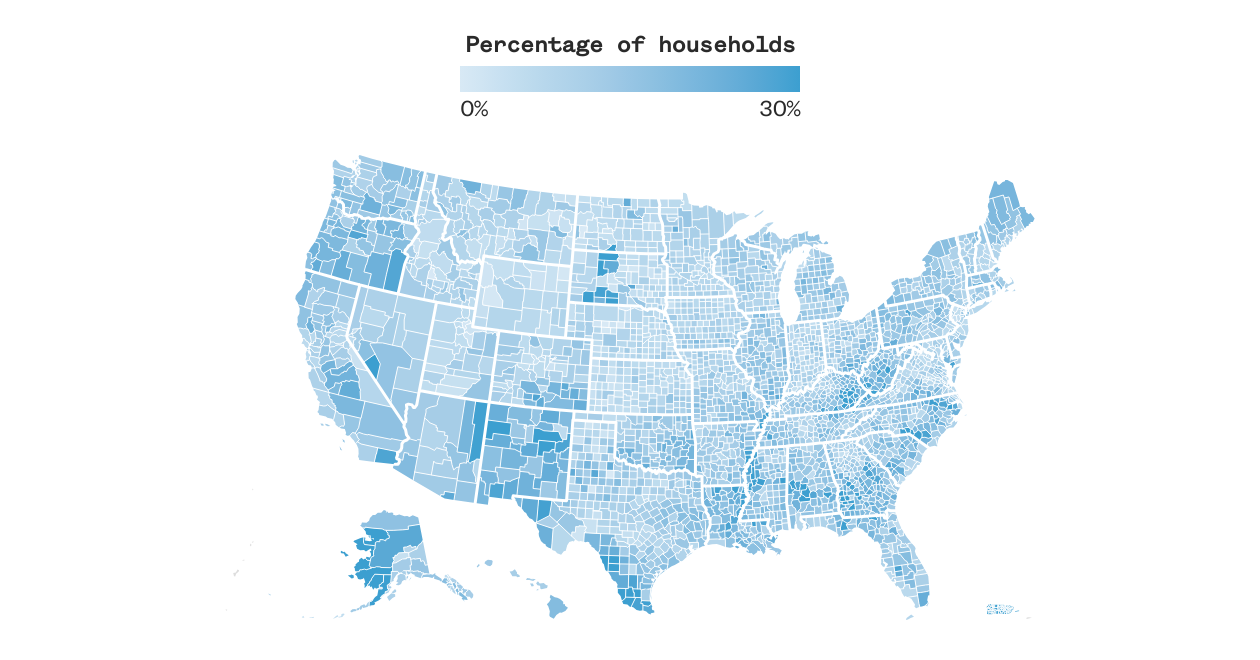
The share of households that rely on SNAP to fill the pantry each month varies significantly from place to place.

  • On the high end, 30 percent or more of households depend on SNAP in some of the country’s most distressed corners. These 138 counties are nearly fully rural, and have some of the highest poverty rates in the nation.

  • But even on the low end, in the most well-off communities, around one in 20 households receive SNAP each month.

  • Generally, SNAP usage runs higher in rural parts of the West and South, and highest of all in struggling tribal areas.


Voting patterns and SNAP

SNAP has become such a salient issue for both parties during the shutdown because it affects them both:

  • 48.5 percent of households receiving SNAP benefits live in counties that voted for Trump in the 2024 election and 51.5 percent live in those that voted for Harris.

  • Among counties that voted for Harris, 11.9 percent of households received SNAP benefits, and 11.6 percent of households living in counties that went for Trump did.

But a striking political difference does emerge when looking at the counties that rely on SNAP the most:

  • Among counties that received more than 1.0 percent of total income from SNAP, 82.2 percent voted for Trump and 17.8 percent voted for Harris.

Extreme economic exposure

To really understand the economic impact of a lapse in SNAP benefits, it’s helpful to look at the share of total personal income that the program represents for households.³

  • Nationwide, SNAP accounts for 0.6 percent of total personal income annually, but for some counties, it accounts for significantly more. (See the next two figures below.)

  • Since SNAP benefits are nearly always spent on local consumption, and quickly, any lapse would directly drain local economies of income. In places of high reliance, the suspension of even this modest overall income stream could meaningfully dent the local economy.

  • SNAP exceeds 1.0 percent of total personal income in 26.6 percent of counties — home to 56.8 million people. In these counties, 19.5 percent of households receive SNAP benefits, relative to 12.1 percent across all counties.


  • The 15 counties most reliant on SNAP benefits to top up local area personal income are economically distressed rural communities. Many are home to large Native American populations, and others such as Alexander, IL (at the confluence of the Mississippi and Ohio Rivers), or McDowell, WV (deep in coal country), are among the highest poverty counties nationwide.


What’s next?

SNAP payments were scheduled to end on November 1st amid the continuing government shutdown. However, last week two federal judges ordered the Trump administration to use emergency funds to continue payments until Congress passes a funding bill. According to Treasury Secretary Bessent, the administration does not plan to appeal the ruling. And just today, the Administration announced that it will resume paying partial SNAP benefits (roughly 50 percent) in the coming days but expects delays as states resume and adjust disbursements.

Meanwhile, the shutdown and ongoing threat to SNAP payments have underscored the increasing risk in Congress’ lurching, short-termist approach to public finance. As dependence on transfers has climbed across the United States, the human stakes of political brinksmanship have climbed with it.

View the Github with code for replicating this analysis here.

3

Note that detailed county level income by transfer program data are only available through 2022 from the Bureau of Economic Analysis, and nationwide county level household SNAP usage figures are available through 2023 from the U.S. Census Bureau.

 RELATED

As millions of Americans prepare to lose SNAP benefits, some states are  moving to bridge the gap


What is subsidized housing? } Summary from Google Gemini

ummary of Subsidized Housing: Do You Qualify?


Overview and Context

This segment is from Episode 3 of "Just the Facts: Do You Qualify?" (running 7 minutes and 36 seconds), which explores federal housing support given that housing is the biggest expense for many American families. USAFacts founder Steve Ballmer discusses the topic.

What is subsidized housing?


The video covers critical aspects of federal housing assistance, including:

  • Affordability Measurement: How the government determines and measures housing affordability.

  • Eligibility and Programs: Identifying who qualifies for federal housing support and detailing the programs that provide assistance.

  • Geographic Eligibility: An explanation of why eligibility criteria are based on where people live.

  • HUD's Role: How the Department of Housing and Urban Development (HUD) helps families afford rental housing.

  • Limited Access: The critical fact that fewer than one in four eligible families actually receive support.

How are Americans doing financially? | USA FACTS

 
The state of America’s wallets 
How well are Americans making ends meet? In 2024, nearly a third of adults felt worse off than they had in 2023. The Federal Reserve tracks how Americans feel about their financial situations. We dug through the latest drop to bring you these insights
  • More than a quarter of US adults say they’re struggling financially: 73% reported “living comfortably” or “doing okay,” 19% said they were “just getting by,” and 8% said they were “finding it difficult to get by.”  
  • Inflation topped the list of financial challenges, followed by the costs of basic living expenses and housing.

  • Financial confidence tracks with education: 87% of people with at least a bachelor's degree said they're doing at least okay, compared to 68% of people with some college or a technical or associate's degree, and 47% of people without a high school diploma.

  • It’s harder for parents with children at home, too: in 2024, 65% of parents thought they were doing at least okay, compared to 76% of all other adults. 
Just the facts on subsidized housing  
If you're like many Americans, your biggest monthly expense is probably housing. And depending on where you live, housing affordability may be a hot topic. But what’s meant by housing affordability? The government has an official measure for just that, and USAFacts Founder Steve Ballmer walks through it in this new video.   
  • The government considers housing affordable if it costs no more than 30% of a household’s income. For perspective, the median cost of rent in 2024 was about $1,500 per month, roughly 33% of the median renter household income. In other words, even the median renter is paying more on rent than the government deems appropriate.

  • In Florida, Nevada, Hawaii, Louisiana, and California, more than 54% of renters paid 30% or more of their monthly income on housing.

  • Means-tested federal housing assistance helps people below a certain income level afford housing. In other words, you must demonstrate financial need to qualify for subsidies.

  • The Department of Housing and Urban Development (HUD) runs this federal rental assistance. However, due to funding constraints, not everyone eligible gets HUD rental assistance. In fact, one in four eligible families nationwide actually receives support. (Eligibility is determined annually and is based on where you live.) 

  • This is just the tip of the iceberg — check out the video for more. And that’s not all! This video is part of a new series that features a brand-new way to interact with the facts. As you watch, you’ll see links to interactive charts at relevant points in the video. Click the buttons and explore the chart at your leisure. We’ll hold your spot in the video for you.
How many people are registered for political parties?
About 189.5 million Americans are registered to vote as of August— that's nearly eight in 10 Americans who are 18 or older. But less than half (45%) of voters have a party affiliation. Tomorrow is Election Day in many parts of the country. And while this year’s contests aren’t as numerous as next year’s midterms, it’s a chance to understand the party affiliations state by state.
  • As of August, 37.4 million US voters were registered as Republicans. About 44.1 million voters were registered as Democrats. If you noticed that these don’t add up to the total voters we mentioned above, there’s a reason for that: 18 states don’t require voters to declare a party affiliation.

  • Wyoming had the highest share of registered Republicans: 77.2% of registered voters. The largest numbers of registered Republicans were in California (5.8 million, or 25.2% of the state’s registered voters) and Florida (5.5 million, or 40.7%).

  • Washington, DC, had the highest share of registered Democrats at 75.6%. Maryland has the next highest at 51.7%. The largest numbers of Democrats were in California (10.4 million or 45.3% of the state’s registered voters) and New York (5.9 million, or 47.5%).

  • There are 34.3 million voters registered as independents or without party affiliation. Independents account for nearly 28.8% of all registered voters in states that report party affiliation. Massachusetts has the highest percentage of its voters registered as independents (64.8%). 
Data behind the news
The White House has signaled that it will partially fund Supplemental Nutrition Assistance Program (SNAP), following a court order. The government shutdown had caused funding for the food program to lapse on November 1. This new article lays out the data that states — and congressional districts — with the most SNAP recipients. 

Air traffic controllers have been working without pay during the shutdown. And as of September 2023, nearly half of FAA air control facilities were understaffed.
  
The Sunday crossword is one thing — have you tried the Monday fact quiz
One last fact
Speaking of air traffic, if you’re planning a trip soon, these airlines had the best on-time arrival rates in the first six months of this year: 
  • Hawaiian  
  • Horizon 
  • Southwest 
  • United 
  • Spirit 
The Bureau of Transportation Statistics counts a flight as “on time” if it arrives within 15 minutes of its scheduled arrival.   

Playlist For Men Who Move In Silence | Gentleman Song | Gentleman Dark B...

House of Saud’s AI Ambitions: A move seen as a crucial part of Riyadh’s plan to become a global AI HUB


Intelligence for the New World Economy

The Scoop

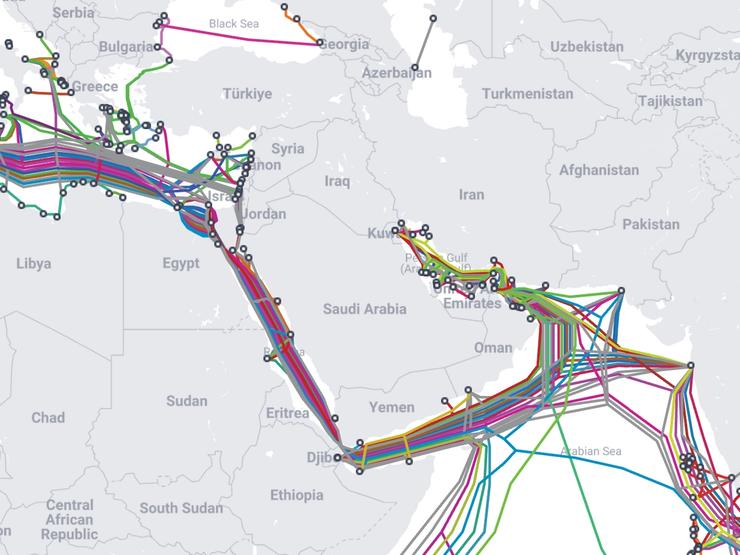
Saudi Arabia and Syria are in talks to build data cables connecting the kingdom to Europe, a move seen as a crucial part of Riyadh’s plan to become a global artificial intelligence hub. Syria plans to award the project this month.

  • Saudi Arabia’s biggest telecommunications firm is one of the short-listed bidders for Syria’s so-called SilkLink project, which would allow data to bypass the Red Sea, currently the main route for internet traffic between the Middle East, Europe, and the US, people familiar with the matter told Semafor.
  • The project would also provide a significant economic boost to the war-ravaged Syrian economy — and outdated domestic internet connectivity — with investments totalling as much as $500 million and recurring revenue from operating the lines, the people said.

“We are in the last stretch before choosing a partner for SilkLink,”  
--- Abdulsalam Haykal, Syria’s minister of telecommunication and information technology, said in an interview. 
  • He added that five companies had submitted proposals including Saudi Telecom Co. (STC), as well as consortiums backed by Jordanian, Kuwaiti, Omani, and UAE firms.
Haykal met his Saudi counterpart in Riyadh earlier this year to discuss the idea, the people said, and state-controlled STC was involved in the talks and could be the firm that builds and owns the data cables.

RELATED