Monday, June 05, 2023

Another Day Another Summit: AIPIC a major force in shaping American policy toward the Middle East

Its critics have stated it acts as an agent of the Israeli government with a "stranglehold" on the United States Congress with its power and influence 

FIRST THIS + THIS 

New
New
CC

But there's an important counterweight to Saudi Arabia's heft in the global energy market: US producers. The rumored death of the American fossil-fuel industry ...
Yahoo Finance · Rick Newman · 3 hours ago 


US committed to Saudi-Israeli normalisation, Blinken tells AIPAC

Antony Blinken tells lobby group that ties between Israel and Saudi Arabia are in ‘national security interest’ of US.
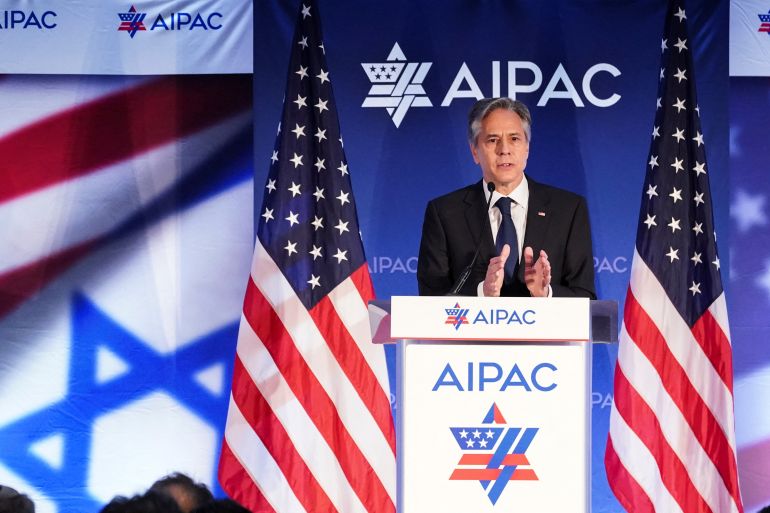
Antony Blinken
US Secretary of State Antony Blinken says 'all options are on the table' to stop Iran from obtaining a nuclear weapon amid stalled diplomacy [Kevin Lamarque/Reuters]

Washington, DC – The United States is committed to brokering formal diplomatic relations between Israel and Saudi Arabia, Secretary of State Antony Blinken has said, as President Joe Biden’s administration continues an Israel “normalisation” push.

Speaking at a conference of the American Israel Public Affairs Committee (AIPAC), an influential pro-Israel lobby group in the US, Blinken said on Monday that Washington “has a real national security interest in promoting normalisation” between the two countries.

“We believe that we can – and indeed we must – play an integral role in advancing it,” he said.

Blinken, who will visit Saudi Arabia this week, acknowledged that a deal may not be finalised easily. “But we remain committed to working toward that outcome, including on the trip I’m about to take this week to Jeddah and Riyadh,” he added.

The top US diplomat’s comments come amid an apparent regional realignment after Iran and Saudi Arabia agreed to re-establish their own diplomatic ties in a move expected to reduce tensions across the Middle East.

Few Arabs states have recognised Israel – a key US ally in the region – since its establishment in 1948, but former US President Donald Trump’s administration helped secure agreements to establish relations between Israel and the United Arab Emirates, Bahrain and Morocco in 2020.

Sudan also agreed to join the normalisation deals, known as the Abraham Accords.

Reporting from the White House on Monday, Al Jazeera’s Kimberly Halkett said that while it has been known that the US was pushing for Saudi Arabia and Israel to establish diplomatic ties, it was significant that Blinken explicitly called the drive a national security interest.

“And so, as a result the US sees itself as being absolutely critical in advancing the integration of Israel in the region,” she said.

Israeli officials have been calling for the normalisation deals, which would help break the country’s regional isolation, independent from its conflict with the Palestinians.

This year, Israeli Prime Minister Benjamin Netanyahu said Israel is seeking formal relations with Saudi Arabia because it could be a “giant leap towards ending the Arab-Israeli conflict”.

For their part, Saudi officials have said Riyadh is sticking by the Arab Peace Initiative, which conditions normalisation with Israel on its withdrawal from Arab territories and the establishment of a Palestinian state, as well as finding a “fair solution” to the plight of Palestinian refugees.

On Iran

On Monday, Blinken heaped praise on Israel, telling the AIPAC crowd that the US commitment to the country’s security is “non-negotiable”. The secretary of state also renewed a promise by the Biden administration to never allow Iran to obtain a nuclear weapon.

“We continue to believe that diplomacy is the best way to verifiably, effectively and sustainably prevent Iran from getting a nuclear weapon; in parallel, economic pressure and deterrence reinforce our diplomacy,” he said.

Indirect talks between Washington and Tehran to revive a 2015 nuclear deal, which saw Iran scale back its nuclear programme in exchange for the lifting of sanctions against its economy, have broken down in recent months.

Israel and AIPAC have been fierce opponents of the agreement, which Trump withdrew from unilaterally in 2018.

Efforts to restore the pact – known as the Joint Comprehensive Plan of Action (JCPOA) – have been further complicated by a crackdown on anti-government protests in Iran and Washington’s allegations that Tehran supplied Russia with drones that Moscow is using against Ukraine.

Iran denies seeking a nuclear weapon, and Israel is widely believed to have an undeclared nuclear arsenal. On Monday, Blinken said if Tehran rejects the path of diplomacy, “all options are on the table” to make sure the country does not obtain such a weapon.

Criticism of Israeli policies

Blinken also reasserted Washington’s support for a two-state solution to end the Israeli-Palestinian conflict, but he admitted that the prospects of that outcome “can feel remote”.

“We are committed to working with partners and with the parties to at least maintain a horizon of hope,” he said.

Blinken appeared to criticise some Israeli policies towards Palestinians. Israel, which prominent rights groups accuse of imposing apartheid on Palestinians, receives $3.8bn in unconditional US aid annually.

Settlement expansion clearly presents an obstacle to the horizon of hope that we see. Likewise, any move toward annexation of the West Bank de facto or de jure; disruption of the historic status quo at the holy sites; the continuing demolitions of homes; and the evictions of families that have lived in those homes for generations damage prospects for two states,” Blinken said.

The Biden administration has been staunchly supportive of Israel, but some cracks have appeared in the relationship after the election of Netanyahu and his far-right government late last year.

On Monday, Blinken weighed in – albeit not explicitly – on the Israeli government’s judicial overhaul plan, which Netanyahu’s critics say would undermine the country’s courts and could lead to authoritarianism. The proposal has been put on hold amid domestic protests and US criticism.

“We’ll continue to express our support for core democratic principles, including a separation of powers, checks and balances, and the equal administration of justice for all citizens of Israel,” said Blinken, calling for “consensus” on any reform.

‘Racist tropes’

Blinken ended his speech on Monday by lauding and expressing gratitude for AIPAC, which spent millions of dollars to defeat progressive Democrats in US elections last year.

The organisation, which progressive activists have accused of being a “hate group”, has also faced criticism for endorsing right-wing American lawmakers who pushed to overturn Biden’s 2020 election victory.

Moreover, AIPAC regularly attacks Muslim-American congresswomen Rashida Tlaib and Ilhan Omar and has compared them to ISIL (ISIS), sparking accusations of Islamophobia.

“AIPAC has been and continues to be one of the major purveyors of Islamophobic and anti-Arab hate in the United States,” Palestinian-American comedian and activist Amer Zahr told Al Jazeera, criticising Blinken for addressing the lobbying group’s conference.

“From its inception, its unwavering support for Israel’s apartheid policies has been served with heaping spoons of racist tropes against Palestinians, Arabs and Muslims,” Zahr said.

“No one who believes in equality and justice should ever be speaking at an AIPAC conference”.

SOURCE: AL JAZEERA
8 hours ago - World

Blinken: Saudi-Israel normalization "should advance wellbeing" of Palestinians

U.S. Secretary of State Tony Blinken said at an AIPAC conference on Monday that any normalization agreement between Israel and Saudi Arabia should also advance the prospects of a two-state solution between Israel and the Palestinians.

Why it matters: Blinken is scheduled to travel to Saudi Arabia later Monday. He is expected to meet with Crown Prince Mohammed bin Salman and discuss the issue of possible Saudi-Israel normalization.

  • The Biden administration wants to try and get a normalization agreement between Israel and Saudi Arabia by the end of the year — before the presidential campaign takes control of Biden’s agenda, as Axios previously reported.
  • The linkage Blinken created between the Saudi-Israeli normalization and the Israeli-Palestinian conflict increases the prospect that any such deal will include a Palestinian component that the Israeli far-right government will have to implement.
  • Israeli Prime Minister Benjamin Netanyahu wants to promote an Israeli-Saudi normalization deal separately from the Palestinian issue. . ."
Go deeper > Axios

Secretary of State Blinken: 'We will discuss normalization during Saudi Arabia trip'

Secretary Blinken told AIPAC: 'The US has a real national security interest in promoting normalization between Israel and Saudi Arabia'
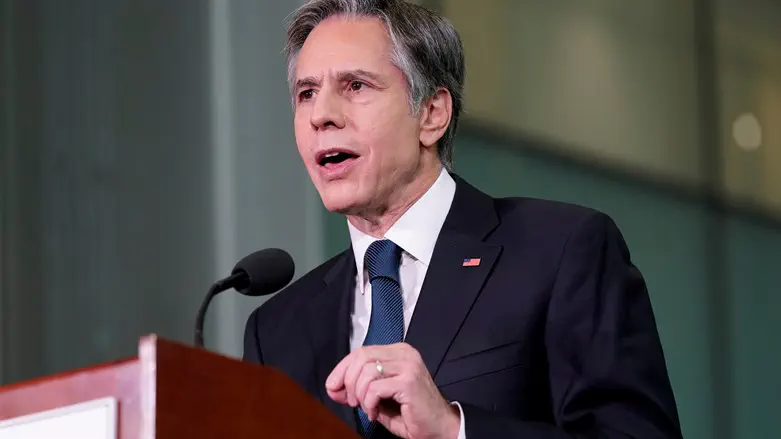
Antony Blinken". . .According to the State Department, during his trip, the Secretary will participate in a US-Gulf Cooperation Council (GCC) Ministerial to discuss the growing cooperation with our GCC partners to promote security, stability, de-escalation, regional integration, and economic opportunities across the Middle East.
He will co-host a Ministerial meeting of the Global Coalition to Defeat ISIS with Saudi Foreign Minister Faisal bin Farhan in Riyadh to highlight the critical role played by the D-ISIS Coalition to address the continuing threat of ISIS and reaffirm our commitment to ensure its enduring defeat. 
Blinken will travel to Saudi Arabia on Tuesday to meet with Saudi officials to discuss U.S.-Saudi strategic cooperation on regional and global issues and a range of bilateral issues, including economic and security cooperation..."
SAUDI STRATEGY 
By Marc Rod June 5, 2023

Blinken: Saudi-Israeli normalization is ‘a real national security interest’ for the U.S.

The secretary of state said he plans to work on the issue during an upcoming trip to Saudi Arabia later this week


"Secretary of State Antony Blinken told AIPAC members that the U.S. has “a real national security interest in promoting normalization between Israel and Saudi Arabia” and pledged to work on the issue on a trip to Saudi Arabia later this week.

“We believe that we can, and indeed we must, play an integral role in advancing [this],” Blinken told an audience of several hundred at an AIPAC Policy Summit in Washington on Monday. “We have no illusions that this can be done quickly or easily. But we remain committed to working toward that outcome, including on the trip that I’m about to take this week to Jeddah and Riyadh for engagements with our Saudi and Gulf counterparts.”

  • Blinken also announced that the Department of State is planning to create a “new position to further our diplomacy and engagement with governments, the private sector and nongovernmental organizations” to advance “a more peaceful and a more connected region.”
  • The comment appears to confirm a recent report that the administration plans to establish a post — potentially to be filled by former U.S. Ambassador to Israel Dan Shapiro — to serve as the administration’s lead official for the Abraham Accords. Lawmakers on Capitol Hill are advancing legislation to create a dedicated ambassador for the Accords.

Blinken described regional normalization as a “cornerstone” of President Joe Biden’s Middle East policy, and pointed to recent Saudi and Omani moves to allow flights to and from Israel to use Saudi and Omani airspace as “concrete progress” for the region.

He also argued that Arab-Israeli normalization should advance the Israeli-Palestinian peace process — a sentiment that may prove more thorny with Israeli Prime Minister Benjamin Netanyahu and far-right members of his government.

“Integration and normalization efforts are not a substitute for progress between Israelis and Palestinians, nor should they come at its expense,” Blinken said. “Israel’s deepening relationships with its partners can and should advance the well-being of the Palestinian people and the prospects for a two-state solution.”

Blinken emphasized in his speech the importance of “maintain[ing] a horizon” for Israeli-Palestinian peace talks, reiterating previous warnings against unilateral actions that increase tensions.

“This work requires both parties to uphold the commitments they make, including at those recent meetings,” Blinken said, referring to recent multilateral talks in Jordan and Egypt. Israeli government officials have claimed subsequently they are not bound by commitments made at those meetings. . ."

Source: Jewish Insider 


RELATED

>

No comments:

We Didn't Start the Fire (Goodbye 2025)