The S&P 500 on Thursday closed above the threshold that marked its exit from the longest bear market since 1948.
Here are some key stats from Dow Jones Market Data:
- The S&P 500 SPX, +0.62% had been in bear-market territory for 248 trading days; the longest bear market since the 484 trading days ending on May 15, 1948.
- Excluding this most recent bear market, the average bear market lasts 142 trading days.
- It took 164 trading days from the bear-market low to exit; the longest period from bear-market low to exiting a bear market since the 191 trading day period ending July 25, 1958.
- Excluding this bear market, the average bear-market low to bear-market exit is 61 trading days.
- The index fell 25.43% from its recent high to its bear-market low, on a closing basis.
- The index is still 10.5% off from its record close of 4796.56, set on Jan. 3, 2022.
Under the criteria used by Dow Jones Market Data and many other market watchers, a 20% rise from a recent low signals the start of a bull market while a 20% fall signals the start of a bear market. That means the market is always in either a bull or bear market. Also, the market doesn’t hop into and out of either a bull or bear each time it crosses the threshold again. It takes another 10% or 20% move in the opposite direction to change the status.
See: S&P 500 exits bear-market territory. Will Big Tech’s rally finally spread to the broader stock market?
So what does history say about what happens next?
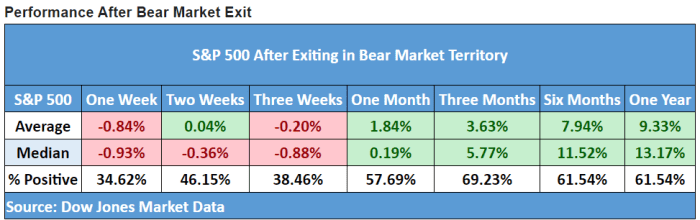
A look by Dow Jones Market Data at median and average performance following past bear-market exits, based on data stretching back to 1929, is largely positive for periods from one month to a year (see table below).
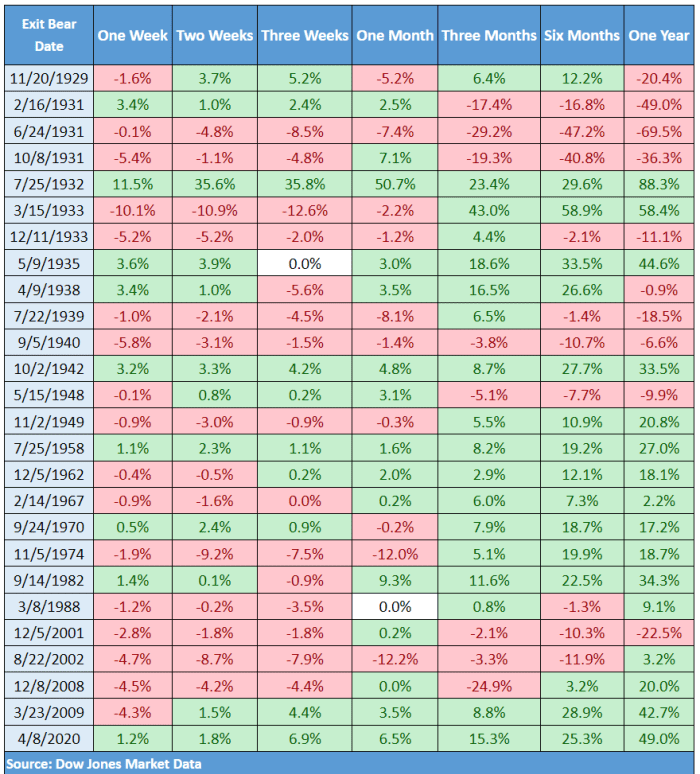
But there’s a lot of variability. Here’s a closer look at what happened after each exit:
The table shows that bear exits usually — but not always — lead to durable bull markets.
In One Chart: Why stock-market bulls must beware of ‘bogus bear-market bottoms’
As noted earlier by Sam Stovall, chief investment strategist at CFRA, of the 14 bear markets since WWII, only two — 2000-’02 and 2007-’09 –– produced exits that saw the S&P 500 quickly slump back into a bear market by declining more than 20%.
See: Big Tech’s added bulk in S&P 500 in 2023 outweighs index’s energy sector, DataTrek says
Stocks were boosted Thursday after a rise in first-time jobless claims appeared to reinforce expectations the Federal Reserve will leave rates unchanged when it meets next week.
The S&P 500 rose 26.41 points, or 0.6%, to close at 4,293.93, its highest close since Aug. 16.
The Nasdaq Composite COMP, +1.02% rose 1% to finish at 13,238.52, while the Dow Jones Industrial Average DJIA, +0.50% gained 168.59 points or 0.5%, to close at 33,833.61, its highest since May 1.
The Nasdaq exited a bear market on May 8, while the Dow exited its bear on Nov. 30.










No comments:
Post a Comment