Carey Davis, a certified public accountant and former mayor of San Bernardino, California, has been speaking out at meetings for months about what he views as overspending by the city, and others have joined in.
A group of self-described concerned citizens said it hopes to pack the hearing to tell the council that $2.56 billion is too big and the city should curb “overspending.”
- They object to the addition of 221 new full-time equivalent employees to city pay rolls,
- the overall level of debt the city carries and
- the transfer of funds from its utility enterprise fund to the city’s general fund.
Tighten your belt, group tells Mesa Council
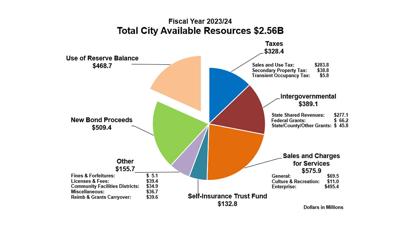
The Mesa City Council has tentatively adopted a $2.56 billion budget for the 2023/24 fiscal year – its largest ever– and the budget goes to a public hearing June 5. (Special to the Tribune)
The proposed budget is $260 million – 11%, higher than last year’s record-setting $2.3 billion budget.
City Manager Chris Brady said he is not surprised this year’s proposed budget is larger than ever, given the growth of the city and its economy, inflation and the continued availability of federal dollars from the American Rescue Plan Act.
Brady said Mesa’s budget total is also bulked up by operations and services that fall under Mesa’s purview that other cities don’t have – including two airports and a gas utility that serves Queen Creek and Pinal County as well as areas inside city limits.
“Those are big and expensive, especially on the capital side, so that’ll show up” in the budget total, Brady said.
Mesa’s proposed budget is higher than that of Chandler ($1.66 billion) and Scottsdale ($2.53 billion). But both have roughly half the population of Mesa.
- The pandemic took Mesa’s budgets to new heights and the city first crossed the $2 billion mark in 2021.
- The 2023-24 proposed budget is 35% higher than Mesa’s 2019-20 spending plan, which was $1.89 billion.
As for the citizens group’s critique of utility fund transfers, city officials have countered that Mesa has been transferring utility funds to the General Fund for nearly 70 years in lieu of charging a primary property tax, which most Valley cities charge.
Mesa’s per capita debt ranks 16th in the state, according to a 2022 report by the Arizona Department of Administration, though it has the second-highest gross debt, behind Phoenix.
Mayor John Giles has touted the city’s AAA credit rating for its general obligation bonds in 2022 from rating agency Fitch.
Budget snapshot. . .City documents show that next fiscal year, Mesa anticipates collecting more revenue in sales taxes, a bigger cut of state shared revenue, more capital from voter-authorized bond sales and increased revenue from services provided by the city.
- There is also $158 million in expenditures rolled over from this year’s budget due to project delays.
The proposed budget includes $87 million of unallocated funds for unforeseen contingencies.
Officially, the theme of the proposed budget is “Innovation and Inclusivity,” but Brady said he believes one of the key takeaways of the new budget is the city’s commitment to public safety.
“Public safety is by far the strongest priority” in the budget, he said.
Funding for police, fire and the municipal court account for 54% of Mesa’s general government expenditures next year, or $352 million.
That’s about a $30 million increase in fire, police and court budgets from this year.
The Mesa Police Department is adding 14 new professional staff positions, including 12 sworn officers. The department is also implementing a “Downtown Ambassador” program and funding the installation of cameras in downtown city parks.
Mesa Fire and Medical is adding 10 full-time firefighters next year, and the construction of a new fire station in Lehi is also on next year’s budget.
- Other new positions coming include an urban forester to help the city implement its “Trees are Cool” initiative to grow its tree canopy, two code compliance officers and four Fleet Services workers.
The payroll includes the equivalent of 4,619 full-time employees, an increase of 221 full-time employees from the current budget year.
Salaries and wages for Mesa employees are growing in the proposed budget.
- In May, the council approved a memorandum of understanding with the Mesa Police Association that increases pay for police officers 7% and sergeants 6%, and gives a 5% step pay increase to all officers with satisfactory job evaluations, in addition to other benefits negotiated with the city.
- For all other city employees, Mesa plans to give a 5% “market adjustment” pay increase starting in July, plus a 3% step pay increase for all eligible employees.
The city has also added a parental leave benefit of 80 hours paid leave. The city will provide up to 80 additional parent leave hours if the employee contributes an equal amount of paid time off.
Next’s year’s budget also includes work on major building projects:
- the new City Hall Council Chambers,
- the Police Evidence Building,
- Southeast Mesa Neighborhood Library,
- the Central Reuse Pipeline and
- the Flare to Fuel project at the city’s northwest water treatment plan.
Brady said that next year’s budget reflects the city’s continued recovery from the pandemic.
The city is seeing people return to city facilities like libraries in large numbers.
In a presentation by the Parks, Recreation and Community Facilities Department before adopting the tentative budget, staff reported that the number of attendees and events held at the Convention Center and Amphitheater are higher than before the pandemic.
One pandemic legacy that continues in next year’s budget is ARPA dollars.
- Deputy City Manager Mike Kennington said the city has earmarked “almost the entire amount” of money allocated to the city under ARPA’s Coronavirus State and Local Fiscal Recovery Funds, but not all the money has been spent.
- City officials have been worrying about the possibility that unspent ARPA funds might be clawed back by the federal government in the future.
Recovery of unspent ARPA funds is part of the deal reached between the White House and U.S. House leaders to raise the national debt ceiling, but Kennington said the city believes Mesa’s allocation is “off the table for any clawback.”
‘Concerned citizens’ weigh in
A resident of Mesa since 2019, Davis took an interest in the city’s finances during last year’s $157 million Public Safety bond election.
- Carey said that given the chance of recession, he doesn’t think it’s prudent for the city to add new recurring personnel costs.
“Have they looked at their departments, and are there ways they could hold costs at the prior year’s budget?” he said. “If you take a look at the state of Arizona, the state of Arizona reduced their budget $300 million over the prior year budget.”
- He also has qualms about the utility fund transfers to the general fund, arguing that Mesa’s utilities generate more surplus revenue than other cities and towns in Arizona, in order, he believes, to cover “overspending” in other parts of the city government.
- “The city, it would seem to me, should be looking at how they could be operating within their resources, the general operating resources, without their utility funds,” he said.
In council meetings, the mayor and city manager have argued that Mesa is the only city in the top 50 largest U.S. cities without a primary property tax and the utility funds transfers comprise a long-standing and legitimate replacement of that revenue.


No comments:
Post a Comment