Saturday, July 10, 2021

Steady as it goes ...for now

Some unease about Crypto. . .

Fed Policy to Provide ‘Powerful Support’ Until Recovery Complete

By , and 
July 9, 2021, 8:08 AM MST Updated on July 9, 2021, 9:40 AM MST
  •  
    Monetary Policy Report says vaccinations aid economic rebound
  •  
    Fed posts report ahead of Powell testimony to Congress

The Federal Reserve said the widening Covid-19 vaccination program has helped the U.S. economy stage a robust rebound, while pledging that monetary policy will continue to provide “powerful support.”

“Progress on vaccinations has led to a reopening of the economy and strong economic growth, supported by accommodative monetary and fiscal policy,” the central bank said Friday in its semiannual Monetary Policy Report to Congress. “However, the effects of the Covid-19 pandemic have continued to weigh on the U.S. economy, and employment has remained well below pre-pandemic levels.”

The Fed report, which provides lawmakers with an update on economic and financial developments and monetary policy, was published on the central bank’s website ahead of Chair Jerome Powell’s testimony before the House Financial Services Committee on Wednesday and the Senate Banking panel a day later.

The Fed's New Dot Plot

Fed officials held interest rates near zero at their meeting last month and released economic projections that show they expect to keep them there until 2023. Policy makers have also pledged to maintain asset purchases at a $120 billion monthly pace until “substantial further progress” had been made on employment and inflation.

A record of the June 15-16 gathering released Wednesday signaled officials expected progress to continue but were not yet ready to lay out a timeline to scale back buying, citing uncertainty over the outlook.

The Monetary Policy Report noted that Fed asset purchases and a pledge not to raise interest rates until it had achieved its inflation and employment goals “will help ensure that monetary policy continues to deliver powerful support to the economy until the recovery is complete.”

In addition to an overview of the economy and monetary policy, the report contained a series of boxes on a variety of subjects, including the pandemic’s effect on the labor market and supply chains, as well as financial stability and the recent pickup in inflation.

Inflation Expectations

The Fed said in its report that if higher inflation doesn’t abate and starts to push expectations about future prices “persistently above” levels consistent with its 2% target, it could “call for a change in the stance of monetary policy.”

Digging into market-based measures of expectations, the Fed said they show investors anticipate inflation settling at around 2.25%, after an upward burst in the near term, which it described as being consistent with the Fed’s goal.

Longer-term inflation expectations of investors, U.S. consumers fairly contained

Expectations taken from surveys show a similar pattern as market-based measures, the Fed said, with higher near-term inflation settling back toward the Fed target.

Despite this benign analysis, Fed officials conceded that there are also signs that forecasters suggest the risk to higher inflation has moved up.

In the Survey of Professional Forecasters, “the average respondent now appears to attach lower probabilities to outcomes of inflation below 2%, and somewhat higher odds of inflation running above 3%, which suggests that respondents’ perceived upside risks to inflation in the near term have shifted up somewhat.”

Financial Stability

On financial stability, the Fed said that that some parts of the financial system had grown more vulnerable to potential instability since its last report in February but that the core of system remained resilient.

It characterized equity and commercial real estate prices as high and said the surge in prices of crypto-assets partly reflected increased risk appetite on the part of investors.

“Asset prices may be vulnerable to significant declines should investor risk appetite fall, interest rates rise unexpectedly, or the recovery stall,” the Fed said.

Labor Market

The Fed said the pandemic may have sped up structural changes that were already taking place in the labor market, such as increased adoption of technology and the pace of retirements, leading to a post-pandemic employment reality that may look different from early 2020, before the onset of the virus.

The labor-force participation rate has recovered somewhat over the past few months, but has done so less consistently than the unemployment rate. Many people remain out of the labor market due to virus fears and to care for children amid a lack of care.

The Fed said the entire decline in mothers’ participation is attributable to care giving reasons, especially so for Black and Hispanic mothers. The impact of expanded employment insurance, which some economists and businesses have argued are incentivizing workers to remain out of the labor force, remains unclear, the Fed said.

Supply Chains

On supply chains, the Fed noted that sudden surges in demand had created logjams that overwhelmed transport nodes like ports and spurred a jump in logistics costs. Supply constraints led to an increase in prices of goods including lumber, motor vehicles and appliances.

“As producers and the distribution network work through these bottlenecks, production is expected to pick up and price pressures to ease -- for example, lumber prices have come down from their late-spring peaks,” the Fed said. “The time frame for the resolution of these bottlenecks is uncertain, as they reflect both the global supply chain and some industry-specific reasons for the tight conditions.”

— With assistance by Augusta Victoria Saraiva, and Vince Golle

SUSPICIOUS OBSERVERS: Earth Rotation Speed, Sunspots, Coronal Hole, X-Rays News July.10.2021

DELAYED DISCLOSURE: Morgan Stanley Report of Incident Last Year

Why so long? Last month, authorities in Ukraine arrested six suspected Cl0p affiliates. A week later, the dark web site used to publish data stolen through Cl0p ransomware posted new tranches, demonstrating that a core group of members remained active.

Morgan Stanley discloses data breach that resulted from Accellion FTA hacks

Financial services firm says data was stolen by exploiting flaws discovered in December.

ransomware — learn more about it — The Hacker News

"Morgan Stanley suffered a data breach that exposed sensitive customer data, and it became the latest known casualty of hackers exploiting a series of now-patched vulnerabilities in Accellion FTA, a widely used third-party file-transfer service.

Three More Ransomware Families Create Sites to Leak Stolen Data

The data obtained included names, addresses, dates of birth, Social Security numbers, and affiliated corporate company names, Morgan Stanley said in a letter first reported by Bleeping Computer. A third-party service called Guidehouse, which provides account maintenance services to the financial services company, was in possession of the data at the time. Unknown hackers obtained the data by exploiting a series of hacks that came to light in December and January.

Accellion FTA Zero-Day Attacks Tied to Clop, FIN11 | Threatpost

What took so long?

Morgan Stanley stated:

According to Guidehouse, the Accellion FTA vulnerability that led to this incident was patched in January 2021, within 5 days of the patch becoming available. Although the data was obtained by the unauthorized individual around that time, the vendor did not discover the attack until March of 2021, and did not discover the impact to Morgan Stanley until May 2021, due to the difficulty in retroactively determining which files were stored in the Accellion FTA appliance when the appliance was vulnerable. Guidehouse has informed Morgan Stanley that it found no evidence that Morgan Stanley’s data had been distributed beyond the threat actor.

=======================================================================
 
INSERT DECEMBER 2020 FROM AN EARLIER POST ON THIS BLOG
What me worry?
It's A HOWDY-DOODY WORLD!
Montana Roué: What me... worry?
What shall we call "the attacker" this time?

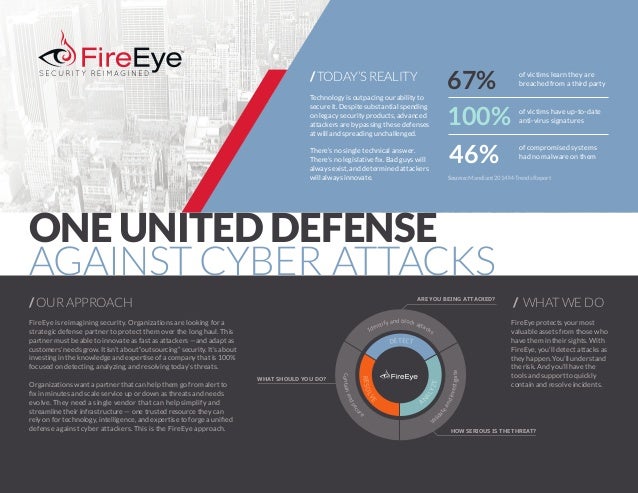
U.S. cybersecurity firm FireEye discloses breach, theft of internal hacking tools

FireEye, one of the largest cybersecurity companies in the United States, said on Tuesday that is has been hacked, possibly by a government, leading to the theft of an arsenal of internal hacking tools typically reserved to privately test the cyber defenses of their own clients.

"FireEye, one of the largest cybersecurity companies in the United States, said on Tuesday that is has been hacked, possibly by a government, leading to the theft of an arsenal of internal hacking tools typically reserved to privately test the cyber defenses of their own . . .Beyond the tool theft, the hackers also appeared to be interested in a subset of FireEye customers.
Over the last several years, FireEye developed a portfolio of cloud and managed services to offset the decline of its legacy hardware businesses. And during the last quarter of 2019, the cybersecurity specialist reached an inflection point . . .
One of the 71 companies that use FireEye is Mandiant
FireEye Corporate Brochure
 
FireEye/Subsidiaries
Mandiant
=======================================================================
". . .Cl1p Cl0p
2021 Accellion Data Breach: What Happened & Who Was Impacted? | PurpleSec

According to research Accellion commissioned from security firm Mandiant, unknown hackers exploited the vulnerabilities to install a web shell that gave them a text-based interface to install malware and issue other commands on compromised networks. Mandiant also said that many of the hacked organizations later received extortion demands that threatened to publish stolen data on a dark web site affiliated with the Cl0p ransomware group unless they paid a ransom.

IT Security firm Qualys extorted by Clop gang after data breach

The earliest detected activity in the hacking campaign came in mid-December when Mandiant identified the hackers exploiting an SQL injection vulnerability in the Accellion FTA. The exploit served as the initial intrusion point. Over time, the attackers exploited additional FTA vulnerabilities to gain enough control to install the web shell.

Mandiant researchers wrote:

In mid-December 2020, Mandiant responded to multiple incidents in which a web shell we call DEWMODE was used to exfiltrate data from Accellion FTA devices. The Accellion FTA device is a purpose-built application designed to allow an enterprise to securely transfer large files. The exfiltration activity has affected entities in a wide range of sectors and countries.

Across these incidents, Mandiant observed common infrastructure usage and TTPs, including exploitation of FTA devices to deploy the DEWMODE web shell. Mandiant determined that a common threat actor we now track as UNC2546 was responsible for this activity. While complete details of the vulnerabilities leveraged to install DEWMODE are still being analyzed, evidence from multiple client investigations has shown multiple commonalities in UNC2546's activities.

Other organizations that researchers suspect were breached through the vulnerabilities include oil company Shell, security firm Qualys, gasoline retailer RaceTrac Petroleum, international law firm Jones Day, the Washington state auditor, US bank Flagstar, US universities Stanford and the University of California, and the Reserve Bank of New Zealand. . .

No advance warning

In-the-wild exploits of the FTA vulnerabilities were first detected in late December. The company initially said that it had notified all affected customers and fixed the zero-day vulnerabilities that enabled the attack within 72 hours of learning of them. Later, Mandiant discovered two additional zero-days. . ."

Sit back and watch hacks around the world in real time | HITBSecNews


Friday, July 09, 2021

James Bond // Daniel Craig >>> NO TIME TO DIE | Trailer 2

The Time to Take Risk Is Now, Says BlackRock's Boivin

Shake-Out at Social Security Admin: Trump Holdover Andrew Saul Gets Fired After Refusing To Resign

After delays in getting out relief payments to millions of Social Security recipients (and other issues), it was just  a matter of time for President Joe Biden to request the resignation followed by a refusal that resulted in dismissal.
Here's a brief rundown : "Saul, a 74-year old former women’s apparel company executive, has run the SSA since 2019, and before that was a top GOP donor and board member of a think tank which advocated for cuts to Social Security benefits. . .
Joe Biden fires Social Security commissioner Andrew Saul

Biden Fires Trump-Appointed Social Security Commissioner

 ". . .Saul, whose term was supposed to run until 2025, dismissed his own dismissal on Friday, telling the Washington Post that he considers himself “term protected,” will challenge the legality of his ouster, and intends to show up to remote work on Monday. He also said he was blindsided and claimed the move had left the SSA in “complete turmoil.” The Social Security Act attempts to insulate SSA commissioners from politics by dictating that they can only be fired by a new president for cause — which the Biden Administration sought to provide plenty of justification on Friday.
SocialSecurityWorks on Twitter: "Social Security Commissioner Andrew Saul &  his deputy David Black have illegally pressured judges to deny disability  claims. Saul & Black are hell-bent on making it harder to qualify

The White House claimed in a statement that Saul had “undermined and politicized Social Security disability benefits, terminated the agency’s telework policy that was utilized by up to 25 percent of the agency’s workforce, not repaired SSA’s relationships with relevant Federal employee unions including in the context of COVID-19 workplace safety planning, reduced due process protections for benefits appeals hearings, and taken other actions that run contrary to the mission of the agency and the President’s policy agenda.”

SocialSecurityWorks on Twitter: "Social Security beneficiaries are waiting  way too long to receive their $1400 COVID relief checks. Trump-appointed  Social Security Commissioner Andrew Saul and Deputy Commissioner David  Black are letting this

The Washington Post adds that:

Saul’s firing came after a tumultuous six-month tenure in the Biden administration during which advocates for the elderly and the disabled, and Democrats on Capitol Hill pressured the White House to dismiss him. He had clashed with labor unions that represent his 60,000 employees, who said he used union-busting tactics. Angry advocates say he dawdled while millions of disabled Americans waited for him to turn over files to the Internal Revenue Service to release their stimulus checks — and accused him of an overzealous campaign to make disabled people reestablish their eligibility for benefits.

Saul’s Trump-appointed deputy, David Black, did resign at the request of the White House on Friday. Biden named the agency’s deputy commissioner for retirement and disability policy, Kilolo Kijakazi, as acting SSA commissioner to replace Saul. She will fill the role until a permanent replacement can be nominated and confirmed...

_____________________________________________________________________________

Approximately 65 million Americans receive a monthly social security benefit, with the majority of payments going to retired workers and their dependents.

Senior citizens and disabled Americans who rely on benefits for the majority of their income are pushing for expansion of social security. Calls for reforms include increasing benefits in line with the cost of living, as employers are providing fewer retirement pensions to workers and the US population at retirement age of 65 is expected to grow from 56 million to 78 million in 2035.

“The nation is really facing a retirement income crisis, where too many people aren’t going to be able to retire and maintain savings to live on,” said Nancy Altman, president of Social Security Works, an advocacy organization for expanding the program. “It’s a very strong system, but its benefits are extremely low by virtually any way you measure them.”

Altman argued an expansion of the program is long overdue, noting that payouts haven’t increased since 1972.

=========================================================================

Fact #10: Relatively modest changes would place Social Security on sound financial footing.

Source: https://www.cbpp.org/

Since the mid-1980s, Social Security has collected more in taxes and other income each year than it pays out in benefits and has amassed combined trust funds of nearly $2.9 trillion, invested in interest-bearing Treasury securities. But Social Security’s costs will grow in coming years as baby boomers retire.

The trustees estimate that, if policymakers took no further action, Social Security’s combined Old-Age and Survivors Insurance (OASI) and Disability Insurance trust funds will be exhausted in 2035. (It is important to understand, however, that the report does not reflect the effects of the COVID-19 pandemic and the resulting recession on the programs’ trust funds, and so doesn’t provide an up-to-date picture of Social Security’s financial status.) After the trust fund reserves are exhausted, even if policymakers took no further action, Social Security could still pay three-fourths of scheduled benefits, relying on Social Security taxes as they are collected. Alarmists who claim that Social Security won’t be around when today’s young workers retire either misunderstand or misrepresent the projections. The long-term gap between Social Security’s projected income and promised benefits is estimated at 1 percent of gross domestic product (GDP) over the next 75 years (and 1.4 percent of GDP in the 75th year).

Policymakers should address Social Security’s long-term shortfall primarily by increasing Social Security’s tax revenues. Social Security will require an increasing share of our nation’s resources in the coming decades as the population ages, and polls show a widespread willingness to support it through higher tax contributions. Recent trends also justify boosting Social Security’s payroll tax revenue: Social Security’s tax base has eroded since the last time policymakers addressed solvency in 1983, largely due to increased inequality and the rising cost of non-taxed fringe benefits, such as health insurance.

=========================================================================

INSERT:

Fact #4: Social Security benefits are modest.

Social Security benefits are much more modest than many people realize; the average Social Security retirement benefit in June 2020 was about $1,514 a month, or about $18,170 a year. (The average disabled worker and aged widow received slightly less.) For someone who worked all of their adult life at average earnings and retires at age 65 in 2020, Social Security benefits replace about 40 percent of past earnings. This “replacement rate” will slip to about 35 percent for a medium earner retiring at 65 in the future, chiefly because the full retirement age, which has already risen to 66, and is gradually climbing to 67 over the 2017-2022 period.

The average Social Security retirement benefit in June 2020 was $1,514 a month, or about $18,170 a year.

Moreover, most retirees enroll in Medicare’s Supplementary Medical Insurance (also known as Medicare Part B) and have Part B premiums deducted from their Social Security checks. As health care costs continue to outpace general inflation, those premiums will take a bigger bite out of their checks.

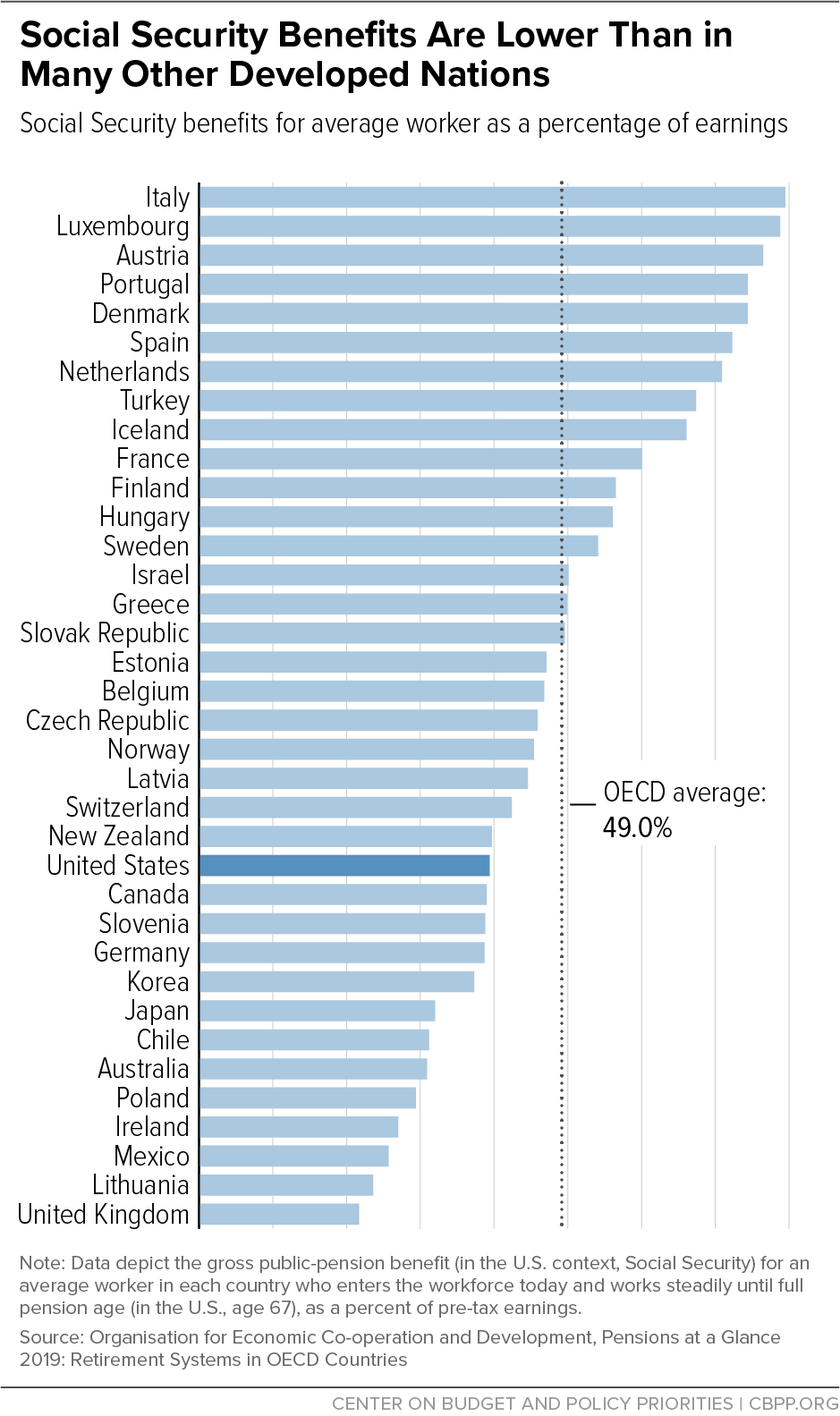
Social Security benefits are modest by international standards, too. The United States ranks just outside the bottom third of developed countries in the percentage of an average worker’s earnings replaced by the public pension system.            

Fact #5: Children have an important stake in Social Security.

Social Security Lifts 1.5 Million Children Out of Poverty

Fact #6: Social Security lifts millions of elderly Americans out of poverty.

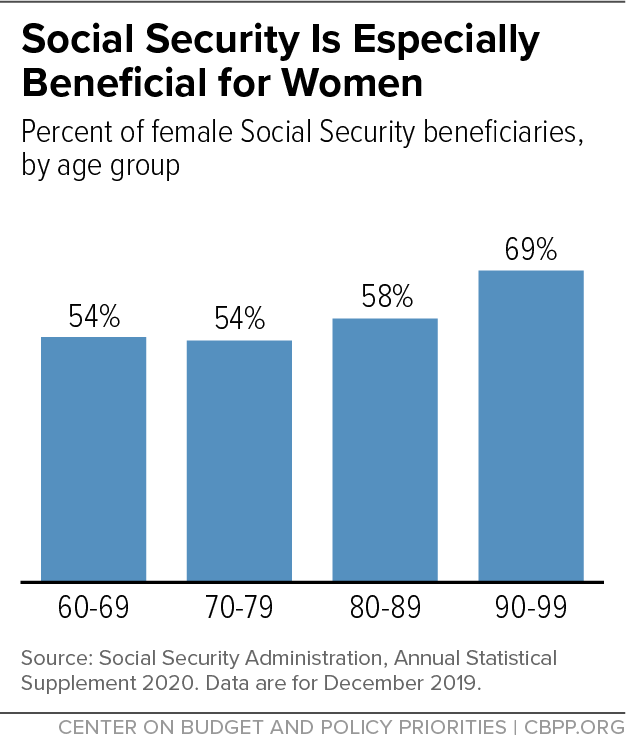
Fact #9: Social Security is especially beneficial for women

Social Security is Especially Beneficial for Women
More

Markets Are Underestimating Inflation Shock, El-Erian Warns