< The purported conflict between Zelensky and Zaluzhny has been rumored for months already, with various sources offering differing explanations for its true nature, ranging from the alleged political ambitions of the top general to differences in approach to handling the ongoing conflict with Russia.
Zelensky jeopardizing Ukraine’s interests – Kiev mayor

Klitschko shared his opinion on the matter in a Telegram post on Monday, stating that Ukrainian society has been “discussing and anxiously waiting for the outcome of the situation” regarding Zaluzhny.
“In many ways, it was thanks to Zaluzhny that Ukrainians truly believed in our Armed Forces, which enjoy the greatest trust today,” Klitschko asserted, warning about the potential consequences of Zaluzhny’s dismissal.
- Klitschko expressed hope that Ukraine’s leadership actually “understands the seriousness of the steps it is taking now and the full extent of its responsibility.”
- Kiev must maintain “combat readiness and coherence of the army” as well as the “unity of society,” the mayor argued, expressing doubts that the potential move would actually contribute to these goals.

“When we talk about this, I mean a replacement of a series of state leaders, not just in a single sector like the military. I’m thinking about this replacement, but you can’t say ‘here we replaced a single person’,” Zelensky explained.
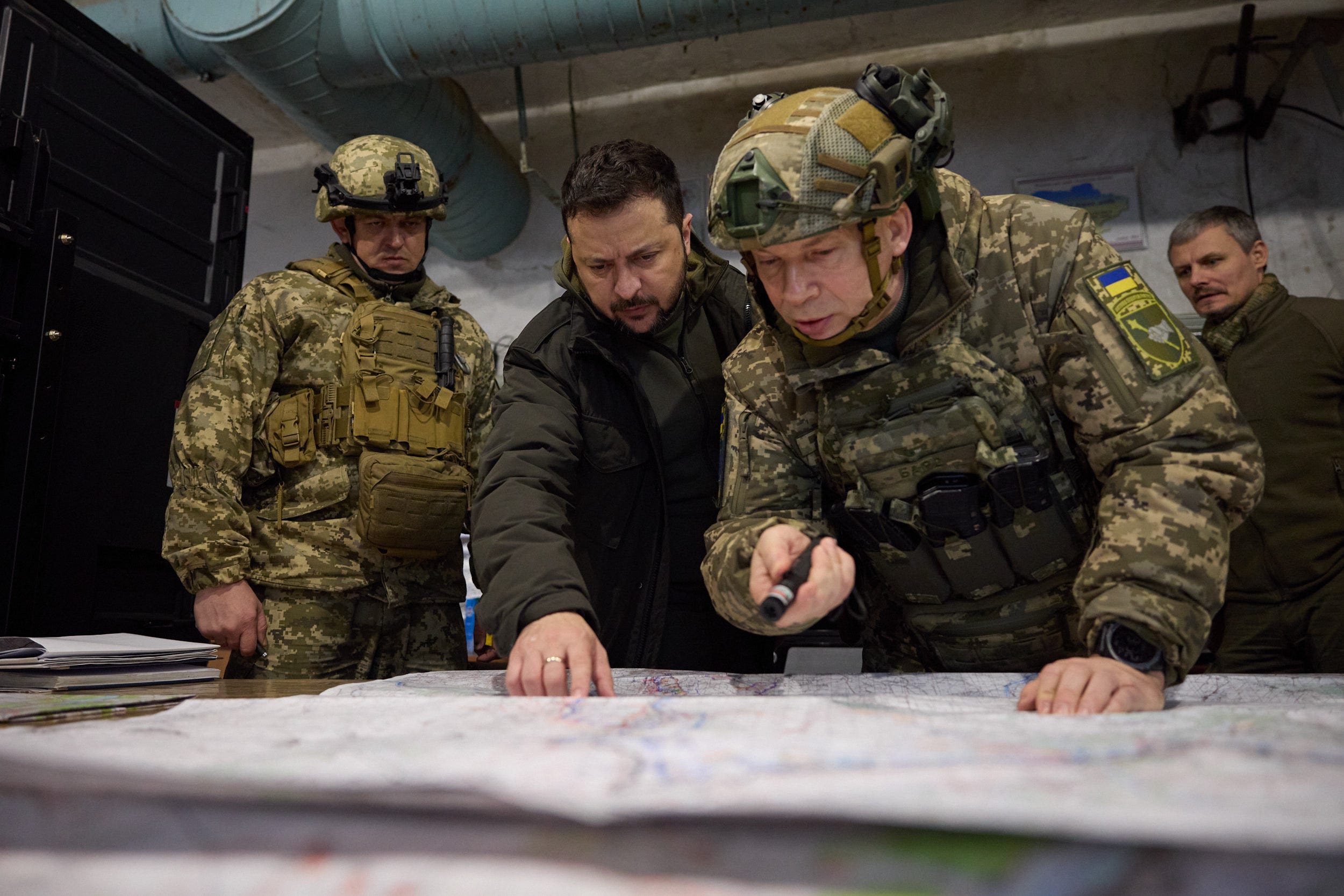
- More importantly, the lack of substantial battlefield progress—which is imperative for continued Western support—could be either the main impetus or the most convenient excuse for Zaluzhny’s dismissal.
- And to the extent that Zaluzhny is a popular figure, it is fair to wonder what effect his removal will have on Ukrainian support for Zelensky and the war effort.
WHAT DOES ALL THIS LOOK LIKE from the point of view of Ukrainian troops? And how should Americans monitoring this story think about it?
I’ve experienced the removal of commanders firsthand, and without knowing why a general is canned, it’s hard to tell if it’s a prudent move. In 2006, my unit was involved in Gen. George Casey’s last gasp, Operation Together Forward II. It failed spectacularly, and as such failures do, it also sapped morale among basically everyone involved. The feeling of futility was apparent in nearly every one of my troops.
It was the lack of tangible battlefield progress that caused President George W. Bush to order a shakeup. Bob Gates replaced Donald Rumsfeld as secretary of defense, and Lt. Gen. David Petraeus replaced Casey.
Petraeus’s “surge” helped give Iraqi Security Forces time and space to reconstitute themselves and provide a semblance of security. Although Iraqi Prime Minister Nouri al-Maliki’s sectarian policies hindered this stability, which I witnessed firsthand in Diyala Province, there was a moment of relative calm for a few years—before ISIS destroyed it.
Zaluzhny is widely considered a respected, competent, and experienced officer, but not every officer is right for every mission.
Or it could be a harbinger of instability.
As a front-row observer of the collapse of the Afghan government, I saw the ill effects of constant battlefield changes. President Ashraf Ghani and his national security adviser, Hamidullah Mohib, spent the year before the fall of Kabul constantly rotating battlefield commanders. Toward the end of my deployment, there were so many new commanders that I couldn’t keep track. They all had visions of grandeur, similar to some of Zaluzhny’s proposed reforms.
Ghani and Mohib were in a death struggle with Minister of Defense Asadullah Khalid and his chief of the general staff, Yasin Zia, over a coherent strategy. It was maddening to watch their feud play out while the Taliban made progress toward provincial capitals.
Their deathmatch underscored one of the Afghan government’s most significant weaknesses: its disunity. In meeting after meeting with senior Afghan officials, I pressed them to put aside their petty differences and unite. Instead, much to my chagrin, Afghan political parties feuded in the open, further worsening the government’s reputation in Washington.
Ukraine’s internal squabbles do not match Afghanistan’s—not even close. And whatever divisions there may be among the senior leadership, Ukrainian society remains basically united, if traumatized.
Zelensky also has a well-earned reputation for being willing to fire incompetent commanders. In November, Zelensky removed his special forces commander, the second major shakeup inside Ukraine’s Special Operations Forces since Russia’s full-scale invasion. Zelensky has fired numerous other commanders throughout the campaign. President Lincoln did the same thing during the Civil War until he finally found, in Ulysses Grant, a general with the ability, temperament, and acumen to prosecute the war the way it needed to be prosecuted.
Of course, sometimes changes in personnel bring no change at all. For all of Gen. William Westmoreland and Secretary of Defense Robert McNamara’s many sins in Vietnam, their replacements—General Creighton Abrams for Westmoreland and three subsequent secretaries of defense for McNamara—fared no better.
(The required word of caution: Historical analogies should be trusted only up to a point. Iraq is not Afghanistan, and they’re not even close to Ukraine or Vietnam.)
Whether Zaluzhny’s removal is the sign of a welcome change, a harbinger of catastrophe, or much ado about nothing—if it even happens at all—it will almost certainly result in cries of a lost war from the usual suspects. Pay them no attention. It’s too soon to know what Zelensky’s reported decision means—except that the future of Western support, and therefore the future of Ukraine, may hang in the balance.
RELEVANT:
HERE'S U.S. CIVIL DEFENSE NEWS ON "X"
In an interview with Italy’s RAI TG1 news channel on Sunday, Zelensky announced that he is planning a “serious” overhaul of the country’s leadership, noting that these changes will not be “about a single person.” He did not, however, list any specific names.
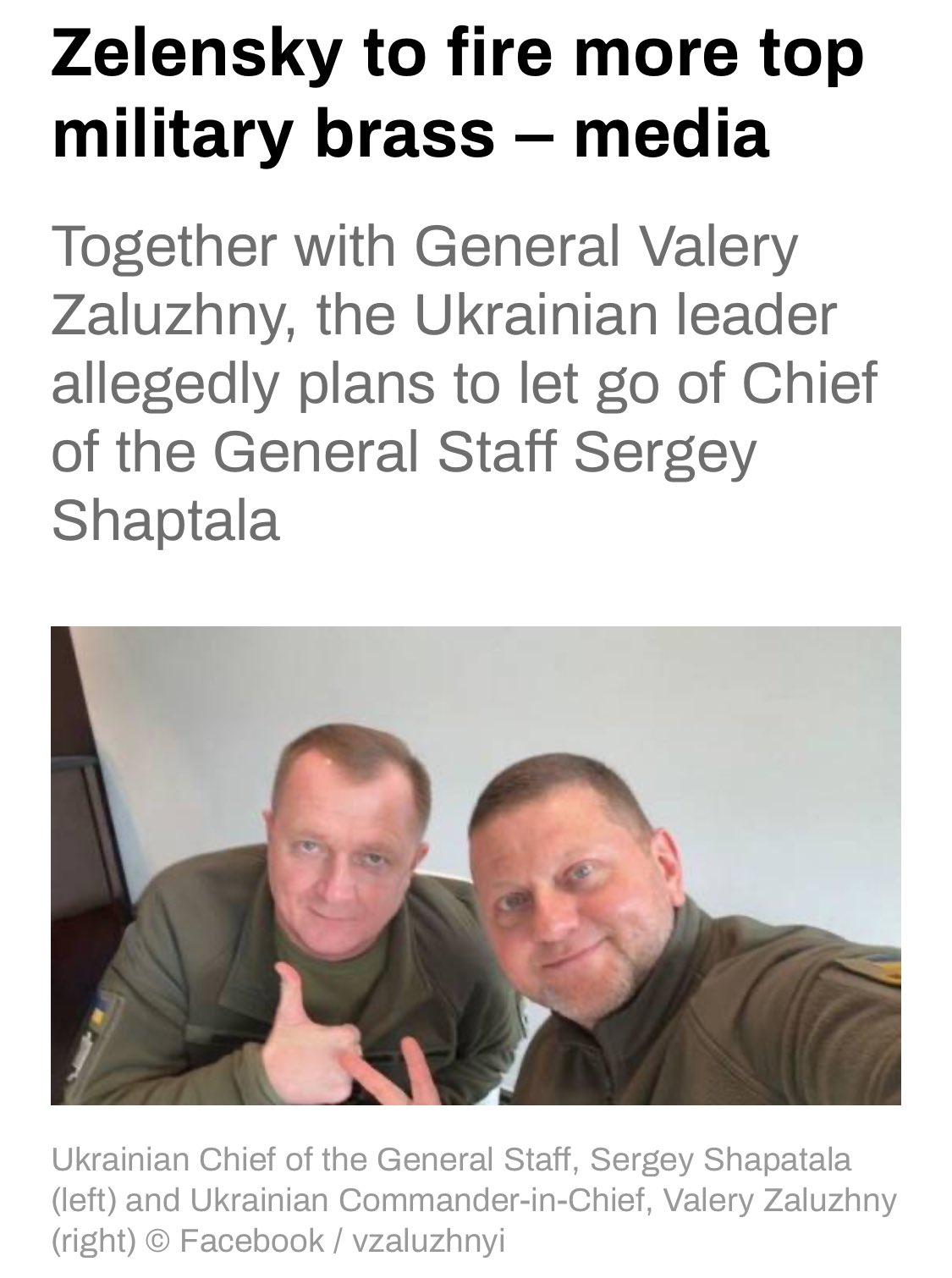
- Citing sources within the Ukrainian government, Ukrainskaya Pravda reported on Monday that Zaluzhny may indeed not be the only one getting canned amid Zelensky’s purge and suggested that Sergey Shaptala, who currently serves as the Chief of the General Staff, will also be leaving his position as early as this week.
“[The fate of] everyone else has not yet been decided,” the source told the outlet.
Rumors of Shapatala’s resignation appear to be partially confirmed by a post from Zaluzhny, who posted a picture with his colleague on Monday, wishing him a happy birthday and writing: “It will still be difficult for us, but we will never be ashamed.”
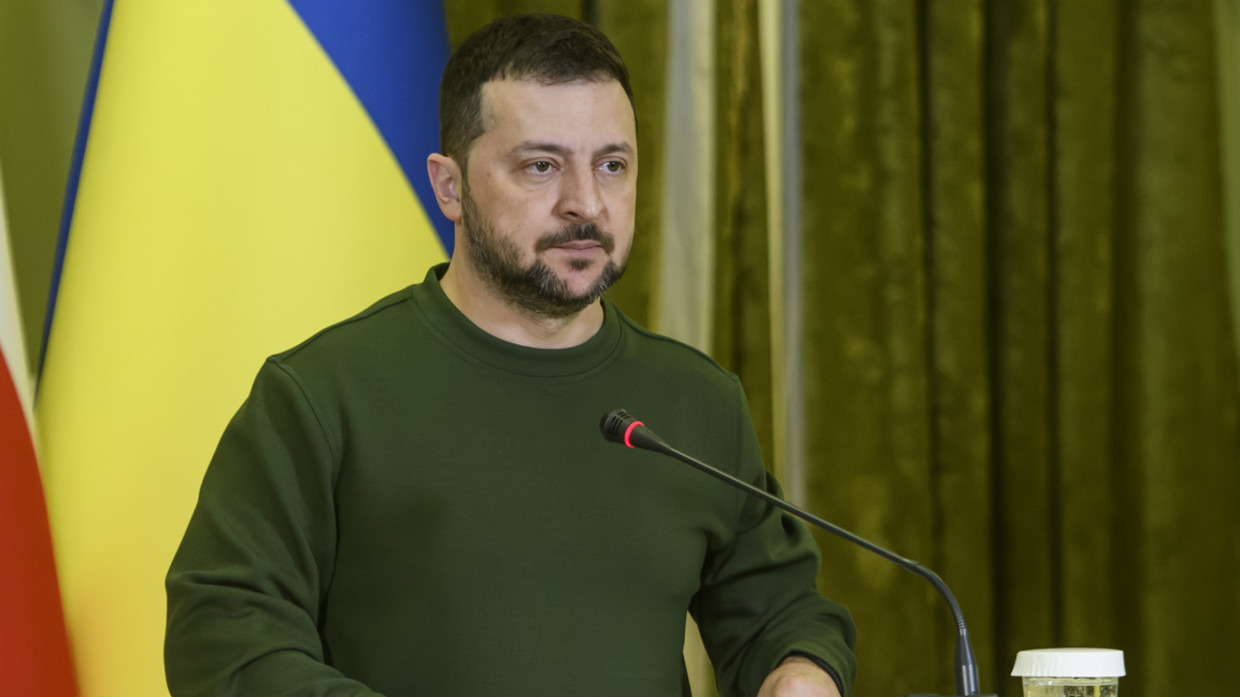
According to Rada MP Evgeny Shevchenko, Zaluzhny could nevertheless potentially vacate his position within the next few days.
- That’s after he reportedly agreed to become the country’s ambassador to the UK.
- Shevchenko noted that such a position is essentially a “political pension.”
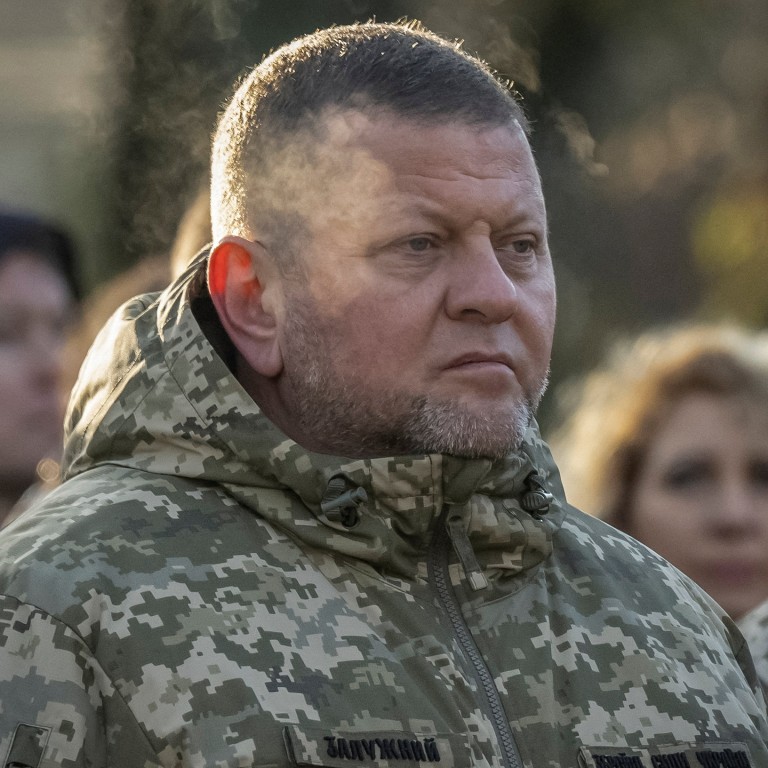
It is unclear who could potentially replace Ukraine’s top military commander, but, according to the Washington Post, Zaluzhny believes no change in leadership would result in any rapid improvements on the battlefield.

>





No comments:
Post a Comment