Sunday, February 11, 2024

Israel-Gaza War: Bond Spree to Pay for War After Downgrade

(Bloomberg) — Israel will have to sell a near-record amount of bonds this year to fund its war against Hamas, according to several finance ministry officials with knowledge of the matter.
The task got more complicated on Friday, when Israel’s credit rating was downgraded for the first time ever. 
Moody’s Investors Service cut the government one level to A2. While Israel’s still well within investment grade territory — and now on a par with the likes of Iceland and Poland — the move underscored the economic toll the conflict’s taking on the nation.
Israel, just downgraded, readies bond spree to pay for war against Hamas -  The Boston Globe

Israel, just downgraded, readies bond spree to pay for war against Hamas

Israel is under increasing pressure, including from the US, to wind down its operations on Gaza and ease the suffering of Palestinian civilians. Yet fighting continues to rage and the Israeli military says it may take until next year to achieve its goals.
> The government is likely to rely heavily on shekel debt markets as it increases its issuance, said the financial officials, who spoke on condition of anonymity so they could discuss sensitive matters. 
  • But it’s also set to sell more foreign-currency bonds, especially via privately negotiated deals.
The war will “materially raise political risk for Israel as well as weaken its executive and legislative institutions and its fiscal strength,” Moody’s said when it announced the downgrade after markets had closed for the week. “Israel’s debt burden will be materially higher than projected before the conflict.”
As the financial costs grow, Israel’s on track to run one of its widest budget deficits this century. The government envisions raising more debt in 2024 than in any other year bar 2020, when it had to spend and borrow heavily to contain the fallout from the coronavirus pandemic and lockdowns, according to the officials.
Analysts in the private sector agree
Total debt issuance will be around 210 billion shekels ($58 billion), an increase of nearly a third from last year, according to Alex Zabezhinsky, chief economist at Meitav DS Investments. In 2020, the figure was 265 billion shekels.

The burden will fall largely on a domestic market that authorities usually tap for about 80% of their financing needs, reducing their reliance on volatile foreign capital flows. . .

Since the conflict began, Israel has not issued foreign-currency bonds in public markets. And it’s in no rush to do so, according to the officials.

The government’s instead sold debt in dollars, euros and yen through private placements, which are typically bought by a few investors at most. 
  • Those have been arranged by banks such as Goldman Sachs Group Inc. and Deutsche Bank AG.

Israel carried out at least four such deals in January, including three top-ups of existing euro-denominated securities and a rare bond in Brazilian real that will be repaid in US dollars. In total, they netted about $1.7 billion in proceeds, as part of foreign borrowing that could exceed $10 billion in 2024.

Domestic issuance in the first two months of this year is projected to total the equivalent of more than $9 billion, a 350% rise from the same period last year.

Zabezhinsky, the economist at Meitav in Tel Aviv, said Israel will need 125 billion shekels to finance the 2024 budget deficit and about 85 billion shekels to refinance maturing debt.

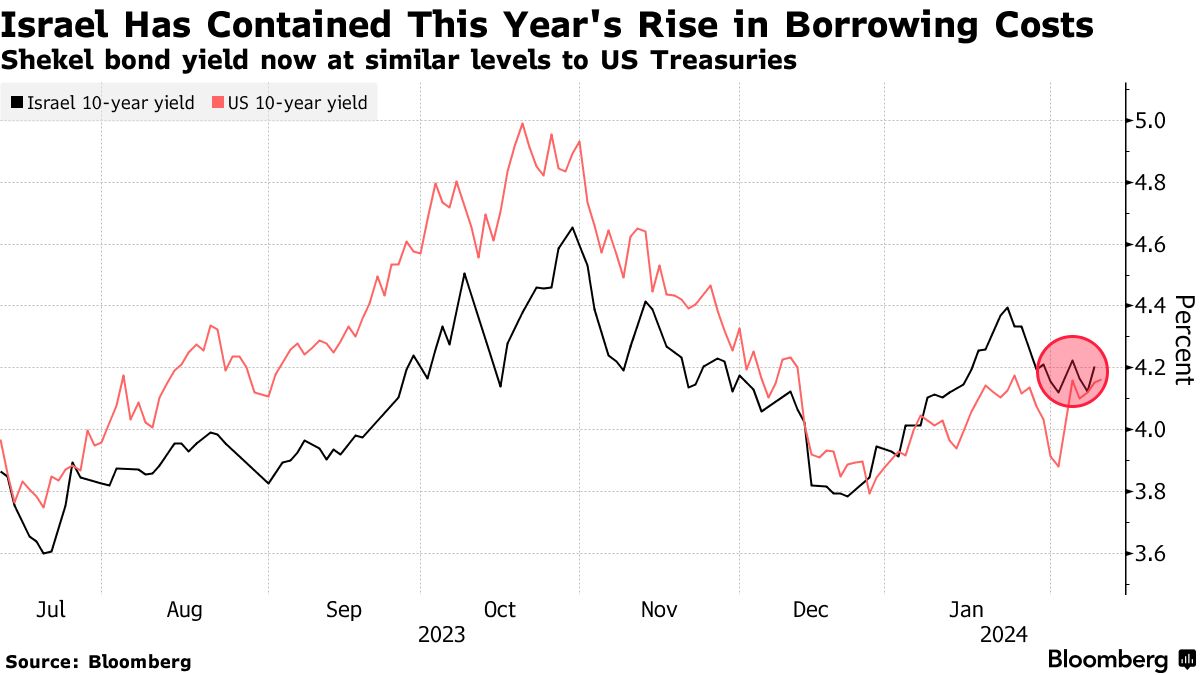
Israeli markets have stabilized after the turmoil unleashed in the first weeks of the conflict and the shekel’s now stronger than its level at the outbreak. Policymakers even cut interest rates last month.

Still, the government has a tall task ahead in paying for a war bill the central bank estimates will come to almost $70 billion — more than 10% of annual GDP — over 2023-2025. . .

Many bond traders already priced in a downgrade, meaning the Moody’s cut may have a muted impact when global markets reopen on Monday.
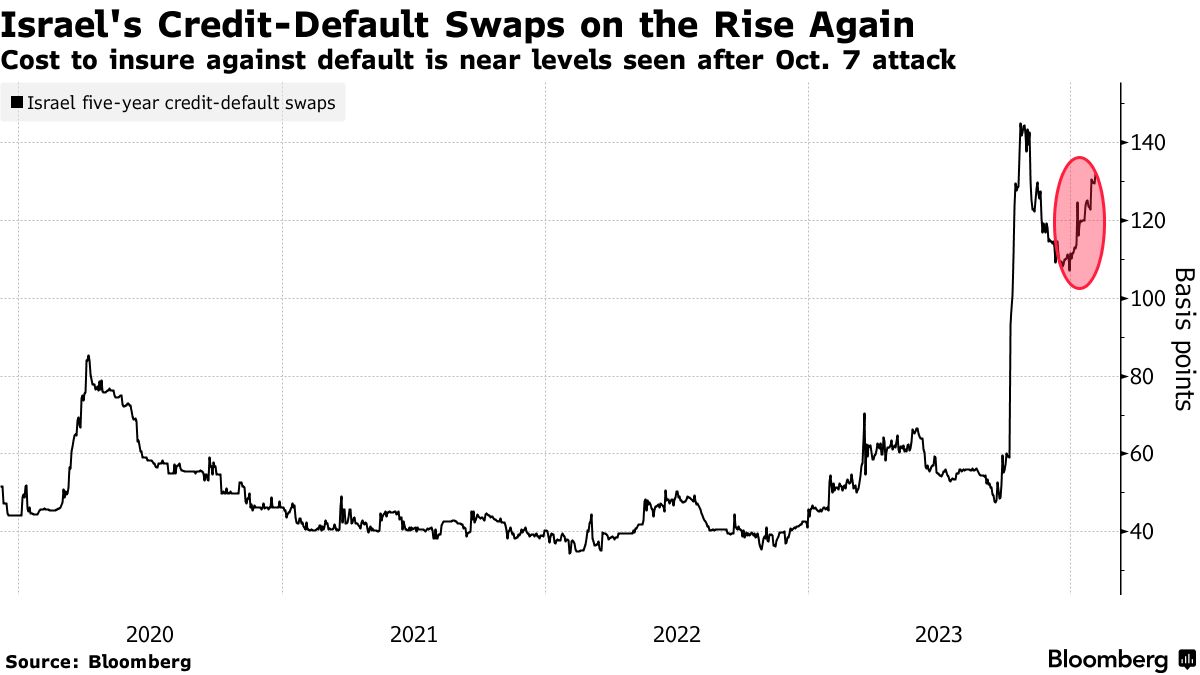
Still, the cost of insuring against an Israeli default — as measured by credit default swaps — is now higher than that for lower-rated sovereigns such as Mexico and Indonesia, indicating some investors are nervous.
Israeli Prime Minister Benjamin Netanyahu insists they shouldn’t be.

“The Israeli economy is strong,” he said in response to Moody’s decision, issuing a rare statement on the Jewish sabbath. “The rating downgrade is not connected to the economy, it is entirely due to the fact that we are in a war. The rating will rise back the moment we win the war.”

> READ-AND-SEE MORE 
Israel-Gaza War: Bond Spree to Pay for War After Downgrade - Bloomberg
1 hour ago — Israel will have to sell a near-record amount of bonds this year to fund its war against Hamas, according to several finance ministry ...
4 hours ago — Israel plans a near-record bond issuance to fund war efforts against Hamas, despite Moody's downgrade from A1 to A2. The government aims to ...
2 hours ago — Updated an hour ago IsraelJust DowngradedReadies Bond Spree to Pay for War Against Hamas Israel will have to sell a near-record amount of bonds this year to ...
Israel, Just Downgraded, Readies Bond Spree to Pay for War Against Hamas

No comments:

‘Wuthering Heights’ To Seduce The World With $70M+ Opening – Box Office Preview

  The first big weekend of the 2026 box office arrives Friday with three major studio movies aimed at three different demos: women, familie...